Email’s Comeback: Why Owned Channels Are Booming Again
Email has been dying for twenty years. In 2005 a Wall Street Journal piece wondered whether it had become “a tool of the past.” In 2009 the paper ran a line declaring its reign over. Sheryl Sandberg told an audience in 2010 that teenagers don’t use email, which was roughly true and completely irrelevant. Then Facebook Messages, then Google Wave, then Slack, then chatbots — each one announced as the thing that would finally put the inbox out of its misery.
None of them did. What they did instead was add a notification layer that ran on top of email.
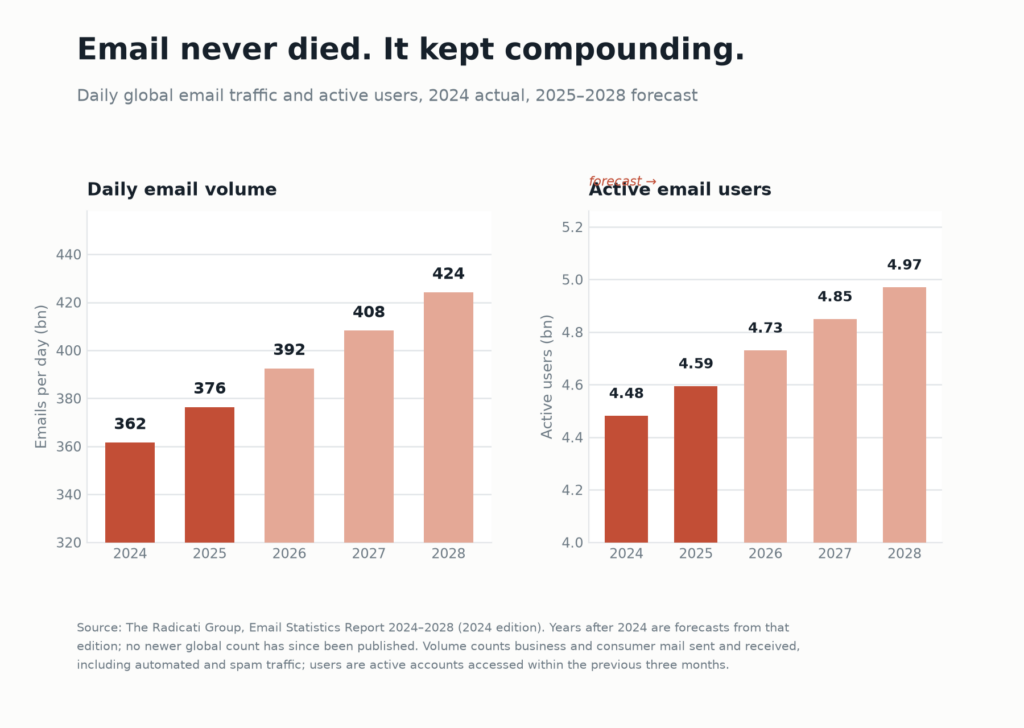
The numbers have never cooperated with the obituary. The Radicati Group’s long-running series has daily global traffic climbing from 361.6 billion messages in 2024 to a forecast 392.5 billion in 2026 and 424 billion by 2028, with active users moving from 4.48 billion to 4.97 billion over the same span. That’s about 3% more users and 4% more volume every year, decade after decade, through every platform shift that was supposed to end it.
So why does 2026 feel different? Because for the first time in a long while, the structural incentives point toward the inbox instead of away from it.
Why email got written off in the first place
The mistake was category confusion. Email was judged as a content channel — how many people see your thing, how much attention it captures, how entertaining it is — and by that standard it looked dowdy next to a video feed engineered by thousands of engineers to hold a thumb in place.
But email was never competing in that arena. It is a relationship channel. It carries receipts, password resets, shipping notices, renewal reminders, and the occasional thing you actually wanted to read. That’s not a concession; it’s the whole point. A channel that people check on purpose, several times a day, for reasons they chose, is a different kind of asset from a feed they scroll past.
The industry also kept quoting the wrong metric. Open rates were treated as the health of the channel, and when Apple’s Mail Privacy Protection began pre-loading tracking pixels in 2021, open rates stopped meaning what people thought they meant. Today roughly half to 60% of opens are estimated to come through Apple’s proxy, where an email can register as “opened” without a human anywhere near it. A channel judged on a corrupted number looks worse than it is.
While everyone was arguing about open rates, the boring metric underneath kept winning. Litmus’s State of Email survey, which polled 692 marketing professionals across the US, UK, Canada, Australia, and Ireland, found that the majority of marketers report returns between 10:1 and 36:1, with 35% at 36:1 or better. Omnisend’s benchmark work puts the industry average at $36 to $42 returned per dollar spent, and $45 for retail and ecommerce. Compare that to roughly $8 for Google Ads and $2 to $5 for social advertising.
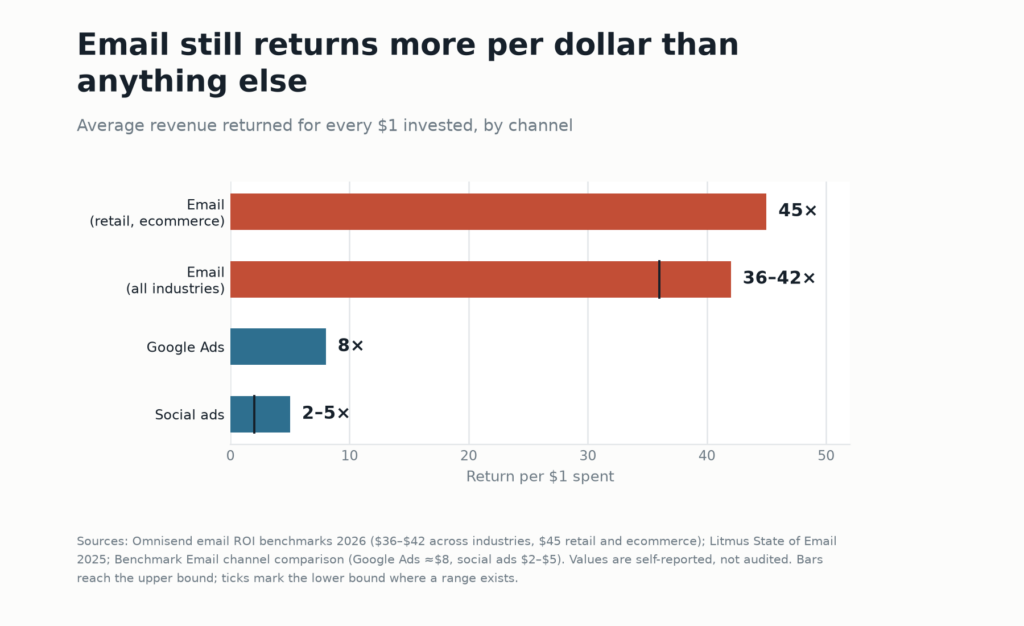
That gap is not a rounding error. It’s a different business model. Paid media rents attention at auction prices that reset every quarter. Email pays a platform fee and a salary, and then the marginal cost of the next send is close to zero.
Which brings us to the actual reason for the comeback.
2026 is not the year cookies died. That is the point.
Here’s where most of the commentary written in 2023 and 2024 needs correcting. The story was supposed to be a clean countdown: Google would kill third-party cookies in Chrome, the tracking economy would collapse, and first-party data would inherit the earth.
That’s not what happened. On April 22, 2025, Google said it would not deprecate third-party cookies in Chrome. Six months later, on October 17, 2025, it retired most of the Privacy Sandbox — Topics, Protected Audience, Attribution Reporting, Shared Storage — citing low adoption and ecosystem feedback. The replacement that a thousand martech decks were built around no longer exists, and the thing it was meant to replace is still there.
Read that as a stay of execution and you’ll misread the market. Three things are true at once, and only the third one matters for planning.
Safari has blocked third-party cookies by default since March 2020. Firefox confines them to the site that set them under Total Cookie Protection. Two of the three major browser engines have been cookieless for years, and no Chrome decision retroactively changes that.
Where the cookie survives, it is optional and uneven. Chrome leaves the choice to users, which means your addressable audience is whatever fraction of Chrome users haven’t turned it off — and that fraction is not something you can forecast with any confidence.
The durable layer underneath is identity you actually hold. Hashed emails, account IDs, transaction records, consented profiles. Everything that still works across browsers next year is built on first-party identity, and email is the primary way most brands collect and maintain it.
The honest 2026 posture isn’t “cookies are back.” It’s “cookies are a fragile partial signal, and the spine of your addressability stack now has to be something you own.” That’s a stronger argument for email than the original countdown ever was, because it doesn’t depend on a deadline that may or may not arrive.
The cost side: when the auction stops being a bargain
The second force is simpler and harder to argue with. Paid acquisition has been getting more expensive in a straight line.
Gartner’s 2026 CMO Spend Survey, fielding 401 marketing leaders across North America, the UK, and Europe in the first quarter of the year, puts paid media at 31.4% of the marketing budget — the largest single category and the only one still growing, funded largely by cutting agency spend. That’s up from 30.6% in 2025 and 25.1% in 2021.
Meanwhile the unit economics inside that spend keep deteriorating. Meta CPMs rose 8% year over year; cost per click across Meta, Google, and TikTok jumped 22% with no lift in click-through rates. Singular’s Q3 2026 mobile benchmark recorded CPM up 13%, with iOS up 21.4% on impressions that actually fell. AdRoll’s quarterly tracking has retargeting CPMs up 18% while prospecting CPMs fell 11%, which is a strange shape for a market to take unless the cheap inventory is cheap because it’s worse.
You can optimize creative forever inside that auction. The floor still rises. Every additional dollar of paid acquisition buys less reach than the dollar before it, and the only channel where that isn’t true is the one where you already have permission to send.
Where email actually sits in the owned hierarchy
“Owned” gets used loosely. Let me be precise about it, because the ranking matters.
Social followers are owned in name only. They live on someone else’s platform, under someone else’s algorithm, subject to someone else’s quarterly revenue targets. The evidence is now hard to dismiss: Socialinsider’s 2025 benchmarks put average Instagram post reach at 3.5% of followers, down 12% year over year, and Facebook page reach at 1.65%. Facebook reach was around 16% in 2012. LinkedIn company pages sit near 1.6%. The pattern is consistent enough across platforms that it reads as a business model rather than a series of accidents: free distribution is the customer acquisition cost of a platform, and it gets clawed back once the audience is captive.
A website or app is owned but passive. Nobody returns to your homepage out of habit. You have to buy the visit, earn the search result, or interrupt someone somewhere else to get them there.
Email, SMS, and push are owned and active. The list is yours. The delivery is direct. There’s no intermediary deciding whether your message is interesting enough to show. And of the three, email is the one with the widest reach, the lowest cost per contact, and the longest history of measurement.
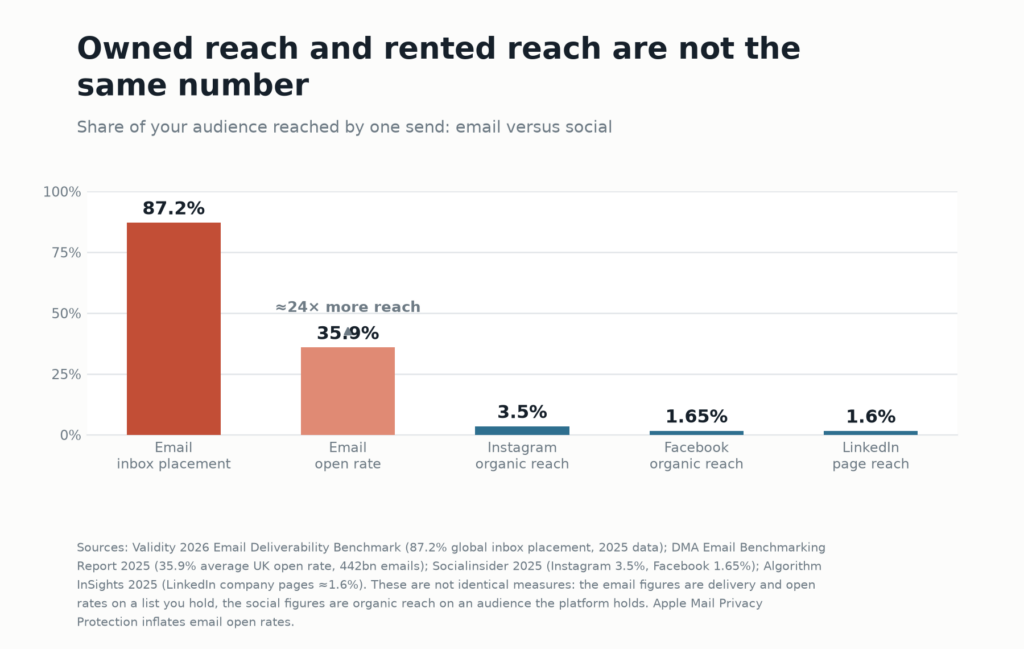
The comparison in that chart isn’t perfectly apples to apples — open rates are inflated by Apple’s proxy, and reach is a different construct from delivery. But the direction of the gap is not subtle. When Validity’s 2026 benchmark puts global inbox placement at 87.2% for 2025, up 3.7 points year over year, it’s describing a channel where a large majority of your list reliably receives what you send. No social platform operates anywhere near that number, and none of them will let you audit it.
The new playbook does not look like the old one
If the comeback were just a return to 2015 practices — buy a list, blast it weekly, count opens — it would fail within a year. The programs actually working in 2026 look quite different.
Consent-first acquisition, enforced by the mailbox providers rather than by lawyers. Since February 2024, Gmail and Yahoo have required bulk senders to authenticate with SPF and DKIM, publish DMARC, and support one-click unsubscribe, honoring requests within two days. Microsoft followed with enforcement in May 2025. This wasn’t a compliance formality; it changed what works. Senders with clean authentication and easy exits got better placement. Senders with purchased lists and buried unsubscribe links started disappearing from inboxes. Validity recorded the first year-over-year decline in global sending volume in the history of its benchmark report — the first time, in other words, that the industry sent less email, with the report attributing it partly to enforcement and partly to AI helping marketers send smaller, more targeted campaigns.
Personalization that doesn’t collapse into sameness. This is where the AI story gets more interesting than the vendor decks suggest. Litmus found 89% of marketers expect up to 75% of their email operations to be AI-driven by the end of 2026, and generative AI use for email image creation rose 340% in a single year. But the same technology that makes personalization cheap makes it generic. Litmus’s own data shows the companies with the best click-through rates — 5% or above — are disproportionately the ones using AI-powered analytics, not the ones generating more content. The distinction matters: AI is useful for deciding who gets what and when, and actively harmful when used to produce the same “Hi [First Name], we thought you’d love this” at a million-person scale.
Lifecycle orchestration instead of campaign calendars. Omnisend’s dataset is blunt about this. Automation made up around 2% of email sends in recent benchmarks and drove roughly 30% of revenue, which works out to about 16 times more revenue per email than a standard campaign send. Triggered messages — browse abandonment, cart recovery, post-purchase, back-in-stock — consistently outperform scheduled broadcasts because they arrive at the moment the interest exists. A brand with mature automation and no clever creative will beat a brand with beautiful creative and no triggers, most of the time.
Measurement that survives scrutiny. Email attribution is deterministic. You know which address received which message at what time, and you can join that to a purchase without modeling anything. In an environment where paid measurement is increasingly probabilistic and 86% of in-house marketers reportedly can’t determine each channel’s contribution to overall performance, that’s not a nice-to-have. It’s the thing that lets you defend the budget line in a room full of people who want to cut it.
The list as an asset that compounds
Here’s the part that doesn’t show up in ROI tables. A subscriber list is one of the few marketing assets that appreciates.
Every opt-in adds a person you can reach without paying again. Every preference center interaction adds a signal. Every purchase adds a data point that improves the next send. Over three years, a list built on consent becomes a first-party dataset with behavioral depth that no data vendor can sell you, because it’s specific to your customers and your catalog.
That’s the moat. Not the software, which everyone can buy, and not the creative, which everyone can generate. The compounding relationship, held in a system you control, addressable without an auction.
The honest caveats
This is where most comeback narratives get lazy, so let me be specific about what can go wrong.
Deliverability got harder while you were away. Validity’s 2026 numbers are uncomfortable reading. Global inbox placement improved to 87.2%, but that average hides a deterioration at the provider that matters most. Gmail’s quarterly inbox placement fell from 90.97% in Q1 2026 to 81.57% in Q3 — a 9.4-point drop in nine months, driven by spam placement rising from 5.4% to 9.5% and missing rates (blocked or rejected) climbing from 3.6% to 8.9%. For B2B senders on Google Workspace, the drop was worse: 88.9% down to 74.3%. Gmail holds 40.4% of global inbox share and 53.9% in the US. If your list is Gmail-heavy, that chart is your chart.
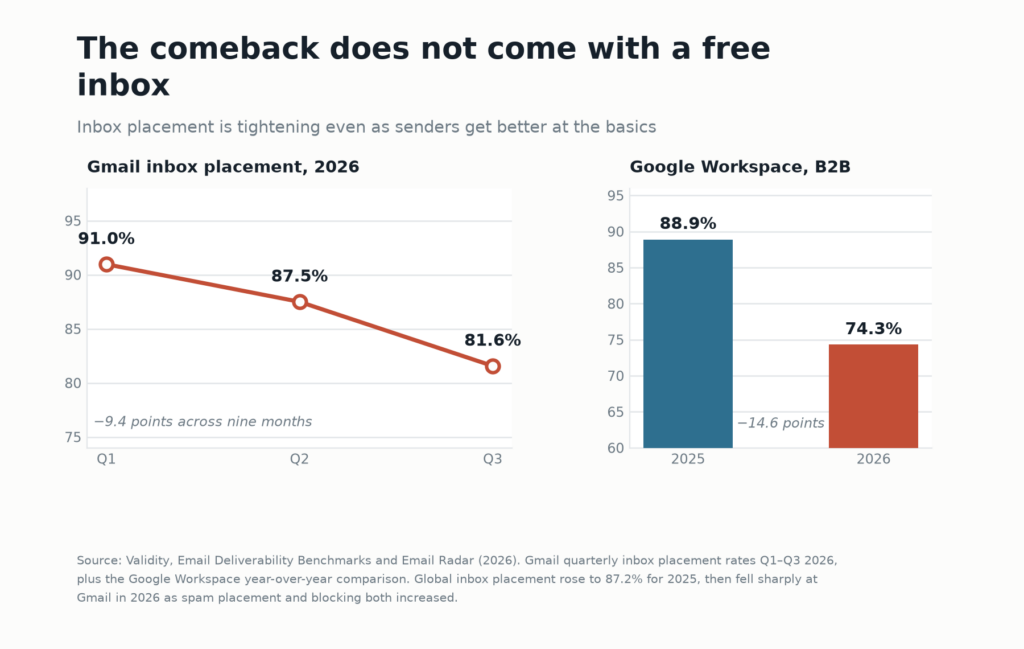
The complaint ceiling moved. The old guidance was to stay under 0.2% to 0.3% spam complaints. That’s now the line you must not cross; the expectation is under 0.1%. Average global complaint rates fell to 0.06% through 2025, which tells you the floor is achievable and that the senders who hit it are being rewarded.
Inbox fatigue is real, and AI is accelerating it. Acoustic’s benchmark work found unsubscribe rates up 22% over five years, alongside a counterintuitive finding: regions with the lowest unsubscribe rates had the lowest engagement. People who can’t easily leave stop reading instead of complaining, and then quietly drag down every metric you report. The comeback invites over-sending. Over-sending is the specific behavior that damaged email’s reputation a decade ago.
Consent is a tripwire, not a checkbox. GDPR enforcement produced about €1.2 billion in fines in 2025 and roughly €7.1 billion cumulatively since 2018, with a record 443 breach notifications per day across Europe. None of that punishes email specifically. But it does tell you something useful: the brands with the strongest email performance in Europe are frequently the ones operating under the tightest privacy regime, because explicit consent produces a list that actually wants the mail. Litmus calls it the GDPR halo effect, and it’s the best available argument that permission-based marketing is a performance strategy rather than a legal tax.
The budget paradox. Gartner’s 2026 survey contains a finding that should sit uncomfortably with anyone reading this: awareness and conversion now absorb 62.6% of media spend, up more than 10 points since 2024, while loyalty and retention spending has fallen 29% to under 15%. The CMO Survey from Duke’s Fuqua School, Deloitte, and the AMA found acquisition budgets running 26% larger than retention budgets, even though respondents say retention performs better. Email’s natural home is the retention half of that ledger, which is precisely the half being cut.
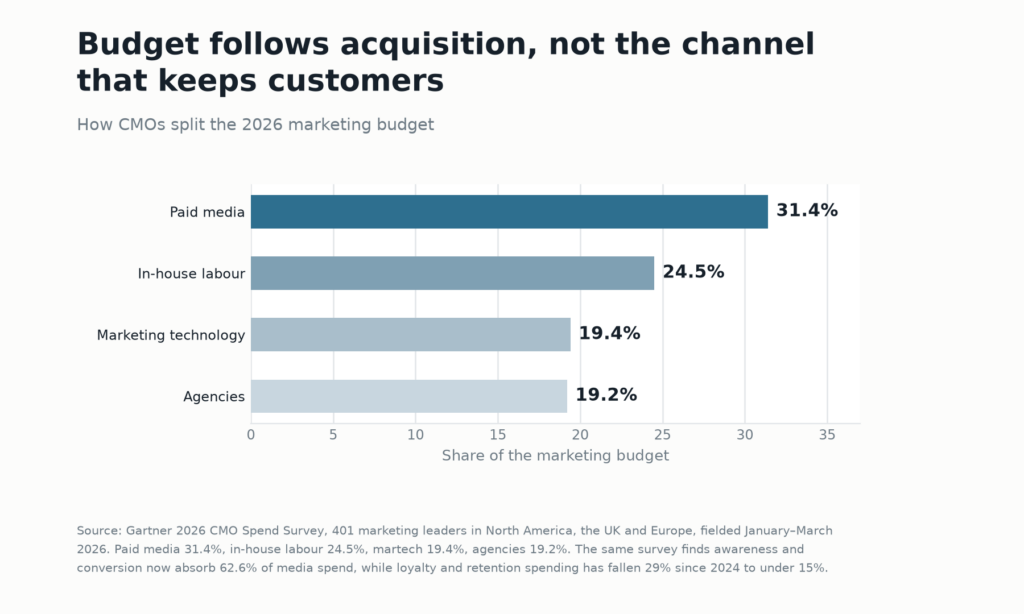
So the channel with the best measured return is being funded out of the smallest and shrinking slice of the budget. That’s not a reason to be pessimistic about email. It’s a reason to be specific in how you make the case for it.
What to actually do in the next ninety days
Audit authentication before anything else. SPF, DKIM, DMARC with aligned domains, separate sending subdomains for marketing and transactional, one-click unsubscribe in the header, and a weekly look at Google Postmaster Tools. This is not optional and it is not a project — it’s a Tuesday.
Kill the dead weight in your list. Sending to subscribers who haven’t engaged in 120 to 180 days roughly doubles your spam placement rate. Suppressing them feels like shrinking your list. It’s actually raising your delivery rate for everyone who remains.
Fix your KPI before you fix your creative. If open rate is your north star, you’re optimizing against Apple’s proxy servers. Move to click rate, conversion rate, revenue per email, and revenue per subscriber. Litmus found 21% of marketing leaders still don’t measure email ROI at all; those teams can’t defend their budget because they can’t produce a number.
Build the triggers you keep postponing. Welcome, browse abandonment, cart recovery, post-purchase, win-back. That’s where the disproportionate revenue sits, and it’s engineering work rather than creative work, which means it actually ships.
Stop buying lists. Not because it’s against the rules, though it is. Because purchased addresses generate complaint rates that damage placement for your entire program, including the people who genuinely wanted to hear from you.
The uncomfortable conclusion
Email’s comeback isn’t nostalgia, and it isn’t a bet against social platforms. It’s a revaluation of a specific kind of asset: a direct, consented, first-party relationship that no intermediary can reprice, throttle, or take away.
The channel that survives every platform shift is the channel nobody can switch off. That’s why the inbox outlasted the death notices, and why the brands rebuilding their lists right now are not being old-fashioned. They’re buying back their independence, at a moment when independence has become the scarce input.