Automate the Grind, Keep the Genius: Where AI Belongs in a Marketing Workflow
Most marketing teams are automating the wrong thing, for a reason that has nothing to do with technology.
The question changed while nobody was watching
Two years ago the argument was whether AI belonged in a marketing team at all. That argument is over. McKinsey’s 2025 survey of 1,993 respondents found 88 percent of organizations using AI in at least one business function and 79 percent using generative AI regularly. Gartner’s CMO research suggests a similar plateau in marketing: 27 percent of marketing organizations still report limited or no adoption of generative AI in campaigns, which means roughly three in four have moved past the starting line. The same firm expects the share of marketing work that is automated to climb from 16 percent in 2026 to 36 percent by 2028.
So the question is no longer should we. It is which parts.
And here is where teams get it wrong, in a specific and predictable way. They automate what is exciting. They automate what got budgeted. They automate what a vendor demoed in a conference room with excellent wifi. Six months later they wonder why the output got faster and the brand got flatter.
The boundary that matters is not between “AI tasks” and “human tasks.” That framing is useless now, because almost every task can technically be handled by a model. The boundary that matters runs between repetition and judgment. Get that line right and automation compounds. Get it wrong and you have paid good money to make your company sound like everyone else.
One number explains the whole mess
Start with the uncomfortable part.
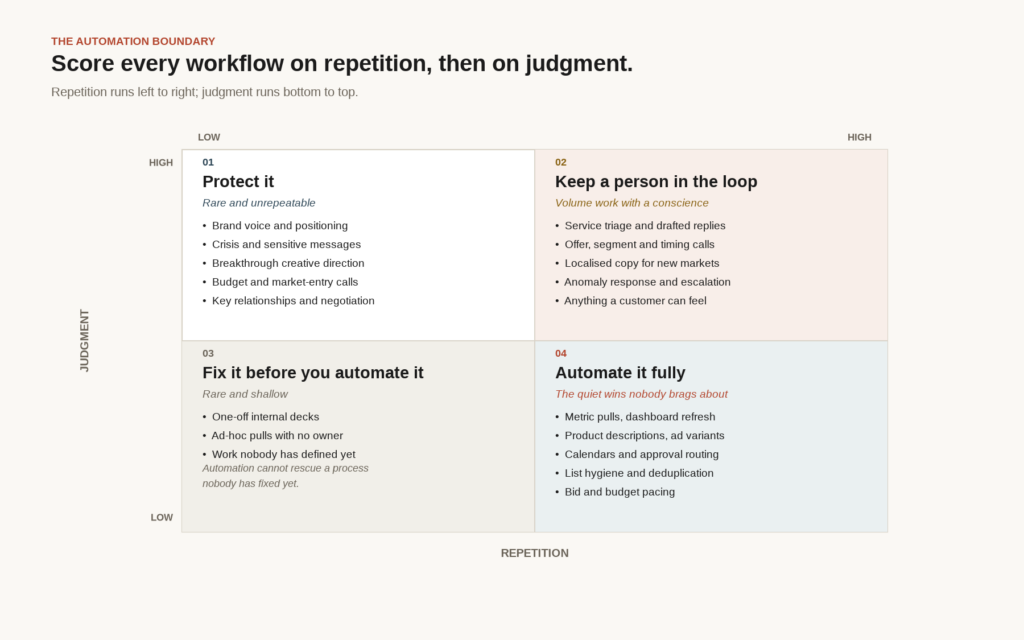
Everybody adopted. Almost nobody can prove it worked. McKinsey found 7 percent of respondents saying AI had been fully scaled across their organization, and about 6 percent meeting the bar for what the firm calls high performers — organizations attributing at least 5 percent of EBIT to AI and reporting significant value. MIT’s Project NANDA went further and blunter: 95 percent of organizations saw no measurable return from generative AI, with only around 5 percent of integrated pilots producing sustained value.
I want to be careful with that MIT figure, because it gets quoted as a headline and then misquoted as a law of nature. It came from 52 structured interviews, 153 executive survey responses and an analysis of more than 300 public deployments. It is a directional snapshot of a young field, not a verdict on the technology. What makes it worth taking seriously is the reason behind it. The failure was not model quality. It was integration. Generic tools work beautifully for one person with one task, then stall inside a workflow they never learned.
Which is exactly what happens when you automate a step without asking what the step was for.
A filter you can actually use
Here is the whole framework, and you can apply it this afternoon.
Score each workflow twice. First on repetition — how often does this task come around, and how little does it vary? Second on judgment — how much taste, empathy, context and accountability does it carry?
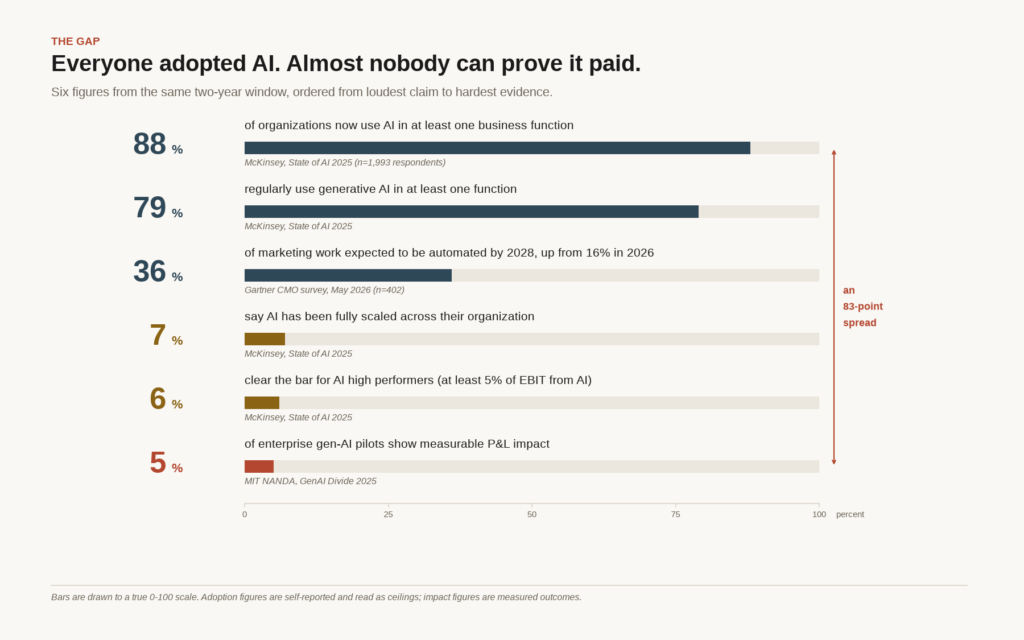
Four quadrants fall out of that, and each one carries a different instruction.
High repetition, low judgment: automate it fully. This is where the quiet money is.
High repetition, high judgment: keep a person in the loop. The machine handles the volume; a human owns the verdict.
Low repetition, high judgment: protect it. These are rare, consequential moments. Automating them buys you nothing and risks everything.
Low repetition, low judgment: fix it first. A one-off task with no owner is not an automation candidate. It is a process nobody has defined, and automating an undefined process just produces undefined output at speed.
Notice what this framework does not ask. It does not ask whether AI can do the task. It almost always can. It asks whether anyone should stop checking.
Automate first: the six jobs nobody brags about
The reporting treadmill
Ask a marketing team where the week went and you will hear the same story. Exporting from four platforms. Pasting into a spreadsheet. Reconciling date ranges and currencies. Reformatting for a slide that gets looked at for ninety seconds.
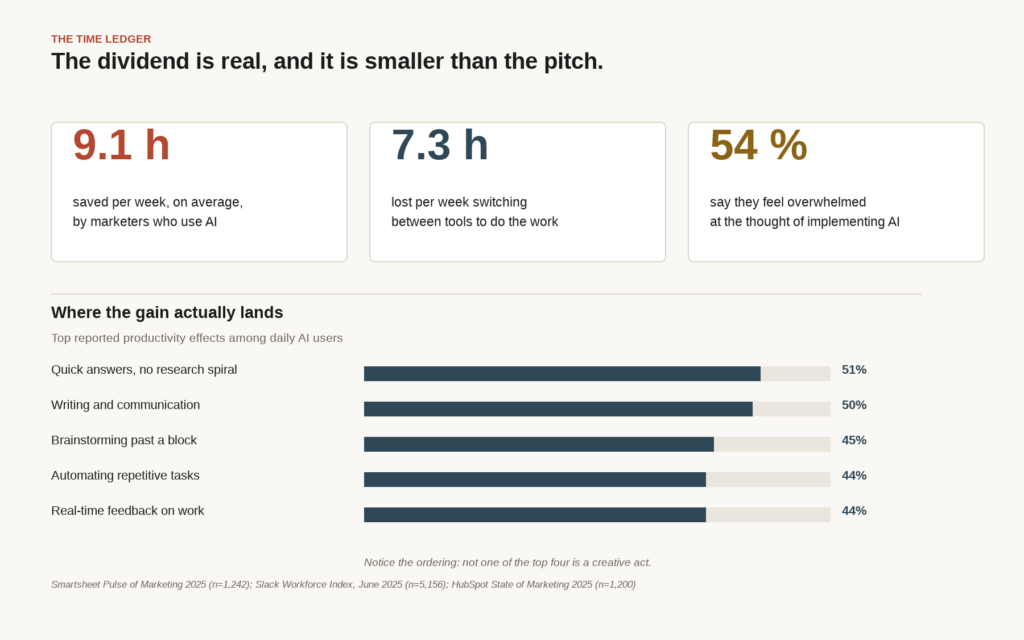
Smartsheet’s 2025 research, drawn from 1,242 marketing and creative professionals, found an average of 7.3 hours a week lost simply switching between tools to get work done. Seven hours. That is nearly a full day spent being a human API between systems that should already be talking to each other.
This is the highest-return automation target in the building, and it is boring enough that nobody puts it in a keynote. Pull the data, build the dashboard, draft the narrative, let a human read it before it ships. The judgment lives in the interpretation, not in the copy-paste.
Copy at volume
Product descriptions for a catalogue of four thousand SKUs. Nine headline permutations for a test. Localised versions of the same landing page for six markets. This is volume work, and volume is precisely what models are good at — provided someone has written down what the brand actually sounds like.
The trap is subtle. Hand over the writing without handing over the voice specification and you get competent prose with no fingerprints. You will not notice for a quarter, because competence reads fine in isolation.
The calendar and the approval chain
Content calendars, routing, reminders, status chasing. Pure process. Nothing here requires a human mind, and everything here currently requires a human’s attention. Move it.
List hygiene
Deduplication, segmentation prep, field cleanup, suppression logic. Nobody enjoys it, nobody is good at it after hour three, and getting it wrong quietly inflates every metric downstream.
Budget pacing and bid decisions
This one is already done, whether you did it or not. Programmatic systems decide who sees what and what it costs in milliseconds, billions of times a day. Madison & Wall estimates that US ad spending flowing through AI-directed or automated campaign products reached roughly 12 percent in 2026, up from 2 percent in 2023, on a path to 27 percent by 2030. The human contribution has shifted from turning dials to writing clearer objectives and better creative inputs.
Service triage
Routing, categorising, drafting a first response. Enormous volume, low variance, immediate relief for the team. With one condition attached, which we will get to in a moment — and which has already cost at least one company a great deal of money.
Never fully automate: the five things that cost you the brand
Voice and positioning
Your voice is not a style guide. It is the accumulated set of decisions that make a stranger recognise you with the logo covered up. Models can execute a voice that has been specified. They cannot decide what it should be — and if you let them decide anyway, you land in what Gartner’s analysts call a sea of sameness: a market where every brand optimises toward the same well-lit middle.
Crisis and sensitive communication
Somebody’s flight was cancelled after a death in the family. Somebody’s payment failed on rent day. Somebody is angry, and the difference between an apology that lands and one that inflames is entirely a matter of judgment under pressure. There is no training set for the specific human in front of you.
Breakthrough creative direction
AI is superb at optimising within a known frame. It is not where the new frame comes from. The campaign idea that makes people stop scrolling usually arrives as an unreasonable human hunch, and then gets refined by machines.
Strategic calls
Budget allocation. Market entry. Positioning against a competitor twice your size. AI can model the scenarios. It cannot carry the consequences. And the moment a decision has a consequence, it needs a name attached to it.
Relationships
The key account. The partnership negotiation. The investor conversation. Trust is built through presence, memory and consistency over time. A model has none of these in the way a person does.
The middle ground is where the money is
Most of the value does not sit at either extreme. It sits in the messy middle, and the middle has three reliable patterns.
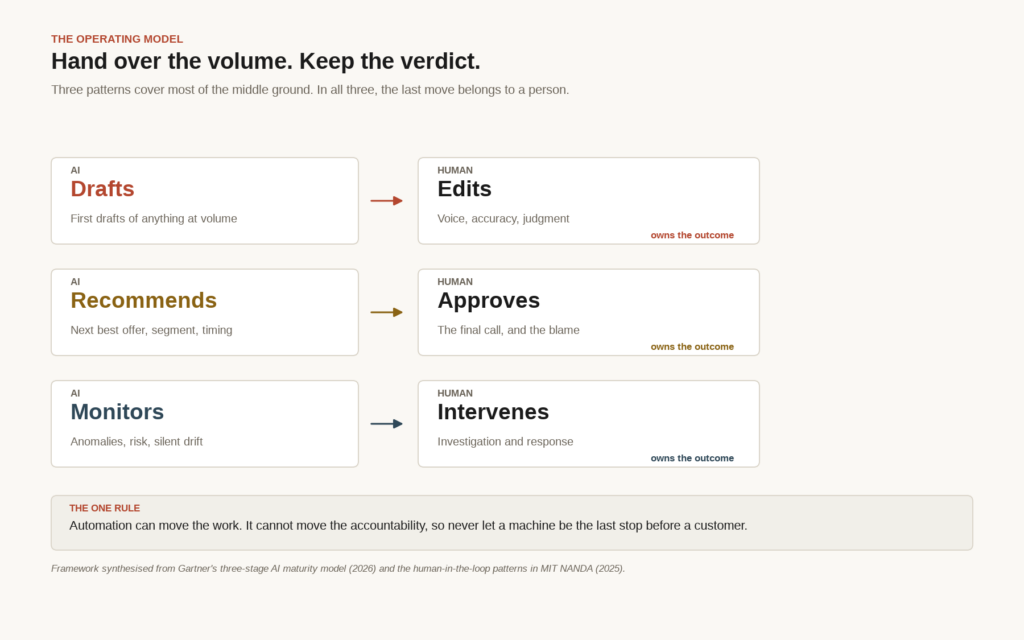
AI drafts, a human edits. For most content this is the correct division of labour, and it always has been. First draft from the machine, voice and accuracy from the person. The failure mode is skipping the edit because the draft looked finished.
AI recommends, a human approves. Next best offer, best segment, best send time. Let the system surface the recommendation and let a person sign it. Accountability does not distribute.
AI monitors, a human intervenes. Anomaly detection is a genuinely good fit: models are tireless, and humans are terrible at noticing slow drift. But detection is not response. Someone still has to decide what to do at two in the morning.
Three walk-backs that should be taped to the wall
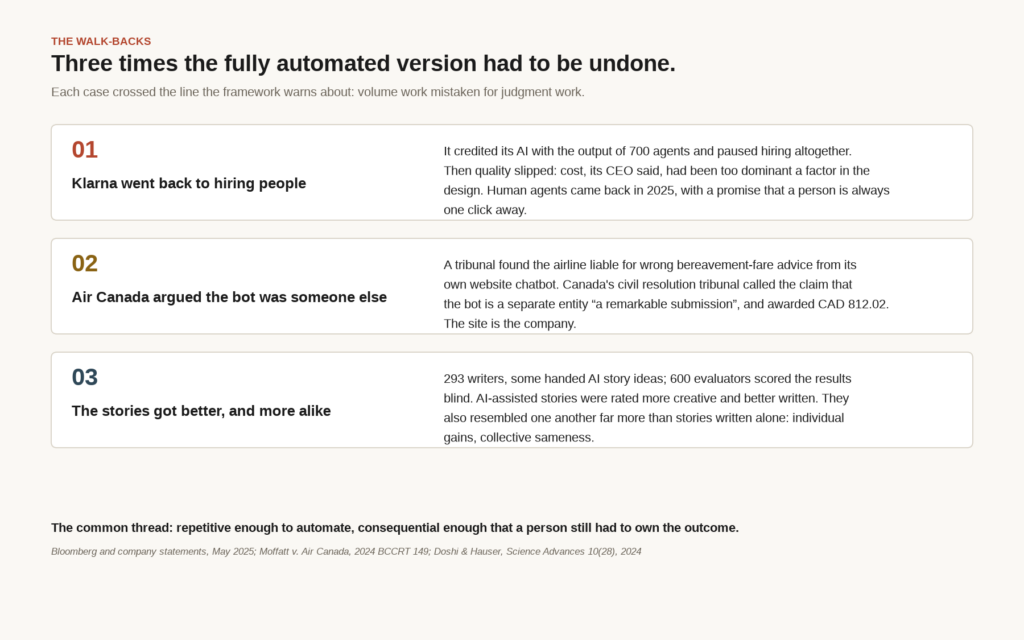
Klarna. The fintech credited its AI assistant with the output of 700 agents and paused hiring. Then quality slipped. Its chief executive later said cost had been too dominant a factor in the design, and that investing properly in human support was the way forward. Human agents came back in 2025, with a public promise that a customer can always reach a person. The AI still handles the majority of enquiries. That is not a retreat from automation; it is a correction of the boundary.
Air Canada. A passenger asked the airline’s website chatbot about bereavement fares after his grandmother died. The bot told him he could apply retroactively. He could not. When he complained, the airline argued it was not responsible for what its own chatbot said — in effect, that the bot was a separate legal entity. The British Columbia Civil Resolution Tribunal called that submission remarkable, found the airline liable for negligent misrepresentation, and awarded CAD 812.02. The reasoning is the part worth remembering: a website is the company, whether the words come from a static page or a model.
The storywriting experiment. Anil Doshi and Oliver Hauser gave some writers AI-generated story ideas, then had 600 evaluators score the results blind. The AI-assisted stories were rated more creative, better written and more enjoyable — especially among writers who were less confident to begin with. They were also significantly more similar to one another than stories written alone. Individual creativity up, collective novelty down. If you run a content operation at scale, that second half is your problem.
The time math, honestly
The productivity story holds up, with caveats. Smartsheet found marketers saving an average of 9.1 hours a week with AI. Slack’s Workforce Index, surveying 5,156 desk workers, found daily AI use up 233 percent in six months, with daily users markedly more likely to rate their own productivity and job satisfaction as very good.
But read the fine print on both. The hours are self-reported. The satisfaction is a self-assessment, not a measured output gain. And the top reported uses — quick answers, help with writing, getting unstuck on a brainstorm — are assistance, not autonomy. Which is fine. Assistance is where the value is. It is simply not the same claim as “we automated the department.”
HubSpot’s 2025 research adds the missing emotional data point: 54 percent of marketers said the prospect of implementing AI in their workflows left them feeling overwhelmed. That is not resistance to technology. That is a team being handed a new operating model with no map.
Why teams resist, and what actually fixes it
Gartner’s 2026 CMO survey found 80 percent of marketing leaders naming staff fear and anxiety as a barrier to AI experimentation. Sit with that number. Not budget. Not data quality. Fear.
The fear is rational, and pretending otherwise insults your team’s intelligence. If someone’s role has been defined by volume — the person who produces the forty assets — and you automate the volume, you have not freed that person. You have erased their job description and called it efficiency.
What works is narrower and less inspiring than a town hall. Name the tasks you are removing, explicitly, and name what replaces them. Publish a skills floor for every role: the minimum judgment, context and accountability each job now requires. Then fund the upskilling instead of announcing it. The World Economic Forum’s 2025 employer survey found 77 percent of companies planning to reskill existing staff for AI collaboration; the same survey found 41 percent expecting to shrink headcount because AI can replicate more of their work. Both things are true at once. Your team knows it, and vagueness reads as a threat.
Audit before you automate
Here is the mistake that outranks all others: automating a broken process.
If your reporting is wrong because three teams use three definitions of a qualified lead, automation will deliver the wrong number faster and with more confidence. If your approval chain has four steps because of a reorg in 2021 that nobody remembers, an automated chain just makes the dead weight move at speed.
Fix first. Document what the process is actually for, kill the steps nobody can justify, then automate what survives. This is dull work, and it is the difference between a 20 percent gain and a 200 percent gain.
Measure something other than hours saved
“Hours saved” is the easiest metric to report and the least useful one to manage by. It rewards automating anything, regardless of whether the output improved.
Four measures that hold up:
Quality at the same volume. Did the error rate in published copy fall? Did the weekly report get more accurate?
Cycle time, end to end. Not the drafting step. The whole path from brief to published.
Share of the team’s week spent on judgment work. If that number is not rising, you moved the work without moving the team.
Rework rate. How often does an automated output come back for correction? A rising rework rate is the earliest and clearest signal that you crossed the boundary.
A 30-day starting sequence
If you want to start Monday, start here.
Week one: audit. List every recurring workflow and score it on the two axes. You will find two or three targets so obvious you will be annoyed nobody did this before.
Week two: pick one, and only one. Highest repetition, lowest judgment, clearest output definition. Reporting is usually the right first move — low risk, and the result is visible to leadership.
Week three: define the human checkpoint before you switch anything on. Who reads the output? What are they authorised to reject? Write it down.
Week four: measure against the baseline you captured in week one. Then tell the team what you removed and what you are asking them to do with the time. If the answer is “more work,” you have misunderstood the exercise.
The boundary is not between AI and people
It is between tasks that repeat and tasks that require someone to be responsible.
Automate the repetition without apology. Calendar routing, list cleanup, dashboard refresh, the forty-first product description. There is no dignity in that work and no strategic value in protecting it.
But guard the judgment with real force, because that is the only part of your marketing a competitor cannot copy by buying the same model. Voice. Crisis. Direction. Decisions with names on them. The relationship that took three years to build.
The teams that win the next two years will not be the ones that automated the most. They will be the ones that drew the line in the right place, and had the discipline to leave it there while everyone else was busy shipping faster versions of the same thing.
Efficiency is easy to buy now. Distinction is not.