One Tool Per Layer: A Practical Framework for De-Redundifying Your AI Marketing Stack
Somewhere in your stack there is a tool nobody has opened since February. It is still billing. You have probably paid for it three times over, because two other tools in the same stack do the same job, and a manager you have never met bought the third one on a card that finance reconciles quarterly.
You are not careless. You are buying into a market that was designed to make this happen.
Marketing technology has spent fifteen years teaching buyers that capability is purchased, one subscription at a time. Then generative AI arrived and every vendor bolted a copilot onto a product that did not need one, and the overlap stopped being a fringe problem. It became the structure of the market.
This article is about building the opposite: a stack where every tool does something no other tool in it does. Not a smaller stack for the sake of minimalism, but a deliberately layered one where each layer has exactly one occupant, and every occupant can defend its invoice.
The catalog has stopped growing. Your stack has not.
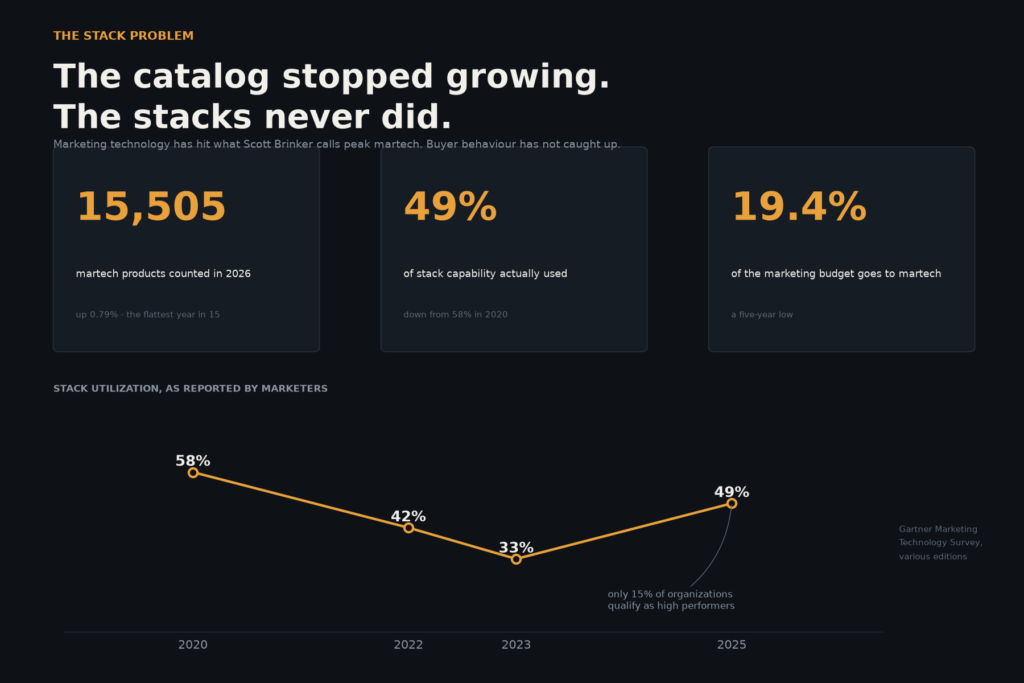
The most useful number in martech right now is one that nobody expected to be small. In 2026 the marketing technology landscape counted 15,505 products, up 0.79% from 15,384 the year before, which is the flattest year in the fifteen years Scott Brinker and Frans Riemersma have been counting. Brinker’s own framing is blunt: we may have finally hit peak martech.
Flat top-line growth hides a violent churn underneath. Additions fell 40% year over year, from 2,489 to 1,488, while removals rose 13% to 1,367, so the flat headline is really additions and removals cancelling out, and the exits skewed toward the cohort that defined the last decade. The largest single cohort of the departures, 51.7%, came from the 2010-2019 SaaS wave, which matters more than the raw count. These were not only tiny AI wrappers from the first ChatGPT gold rush; a meaningful portion of the first great martech SaaS generation is being cycled out. By revenue, 45.5% of removed products sat in the $1M-$10M band, and by headcount 41.2% had between one and ten employees. That profile found traction but not inevitability, squeezed from above by incumbents bundling AI features and from below by AI-native entrants.
So the tool universe is finally contracting. The buyer, meanwhile, is still adding.
MarTech’s 2025 State of Your Stack survey found 62.1% of respondents were using more tools than two years earlier, with only 14.8% using fewer. Zylo’s 2026 SaaS Management Index puts the average organization at 305 SaaS applications, a median of 240, and large enterprises adding roughly 21 net new apps a month. The portfolio count is officially flat, down 0.07%, but spend rose 8% anyway.
That is the shape of the problem. The supply side has stopped expanding and started consolidating. The demand side has not caught up, because nothing in the buying process forces it to.
Redundancy is not an accident. It is the default outcome.
The 80/20 critique is old and mostly true, but it understates what is happening. The more precise diagnosis is that three separate mechanisms push identical capability into your stack, and each one requires a different fix.
Mechanism one: feature convergence
Every category leader now ships the same adjacencies. The content generator adds an SEO audit. The SEO platform adds an AI writer. The CRM drafts the emails. The analytics tool recommends the copy. Gartner’s 2026 CMO Spend Survey found CMOs allocating 15.3% of marketing budget to AI initiatives, and much of that money is landing inside products a team already owned, in the form of features rather than new vendors. The capability arrives without a purchase decision, which means it also arrives without a review.
Mechanism two: shadow buying
Individual seats get bought below the line. BetterCloud’s 2026 State of SaaS report, surveying 525 IT and security professionals, found only 56% of applications in use carry formal IT approval. Roughly 44% run without it, and 21% of organizations discovered previously unknown SaaS and AI tools in use during the past year.
Marketing is where this concentrates, and the ownership question has recently reversed direction. BetterCloud puts the average organization at 118 SaaS apps, of which 27 are AI-powered, and notes that after two years of consolidation the portfolio is expanding again. Gartner’s marketing practice has meanwhile documented CIOs reclaiming authority over martech decisions, with martech falling from 26.6% of the marketing budget in 2021 to 19.4% in 2026. The practical result is split ownership: the team closest to the workflow can still buy, while the function accountable for the portfolio often only sees the purchase after the fact.
Mechanism three: the integration tax
Duplicated tools are annoying. Disconnected ones are expensive. MarTech’s 2025 State of Your Stack survey found 65.7% of organizations name data integration as their single biggest stack-management challenge, which is the polite way of describing teams rebuilding the same report from four exports every month.
The human cost of that is measurable in hours rather than dollars. Smartsheet’s 2025 Pulse of Marketing report found 72% of marketing and creative stakeholders lose five or more hours a week switching between tools, an average of 7.3 hours, and 68% say that switching makes it harder to prove their impact.
Why the waste survives the budget cuts
Here is the part that confuses finance teams. Martech’s share of the marketing budget has been falling hard: 19.4% in 2026, down from 26.6% in 2021, the lowest share in a decade, per Gartner’s 2026 CMO Spend Survey of 401 CMOs, most at companies above $1bn in revenue. Marketing budgets are flat at 7.8% of company revenue. Fifty-six percent of CMOs say they lack the budget to execute their strategy.
Under those conditions you would expect duplicate subscriptions to be the first thing cut. They are not, and the reason is structural: the waste is not concentrated in a line item anyone owns. It is distributed across departmental cards, absorbed into seat counts nobody audits, and invisible until someone builds a map.
Billing models are making it harder still. BetterCloud reports that 22% of the current tech stack is AI-powered and that nearly 40% of AI apps are billed on usage or token consumption rather than per seat. A per-seat duplicate shows up as an obvious line item. A consumption-based duplicate shows up as a variable cost nobody can attribute, which is exactly the kind of cost that survives a budget review.
The utilization number that should end the argument
Gartner’s Marketing Technology Survey has tracked one metric for six years, and it is the closest thing martech has to a verdict. Asked how much of their stack’s capability they actually use, marketers said 58% in 2020. Then 42% in 2022. Then 33% in 2023. The 2025 reading was 49%.
Read that sequence carefully, because two narratives hide inside it. The optimistic one is that utilization has recovered 16 points from its 2023 floor. The pessimistic one is that after six years, a wave of AI investment, and an entire discipline of marketing operations, teams still use less than half of what they buy, and are still nine points below where they started.
Both are accurate. What neither explains is why the recovery happened. Martech’s share of the marketing budget fell to its lowest level in a decade over roughly the same period, which makes it hard to explain the improvement as a spending effect. The likelier reading is that teams stopped adding and started using, consolidating what overlapped and finally adopting what they had already bought. That is the entire thesis of this article, arriving from the data rather than from preference.
The companion finding is worse. Only 15% of organizations qualify as high performers, defined as meeting strategic goals and showing positive ROI on their stack. Half the market is paying for capability it does not use, and roughly six organizations in seven cannot show that the stack, as operated, meets its goals and returns a positive ROI.
The five-layer model
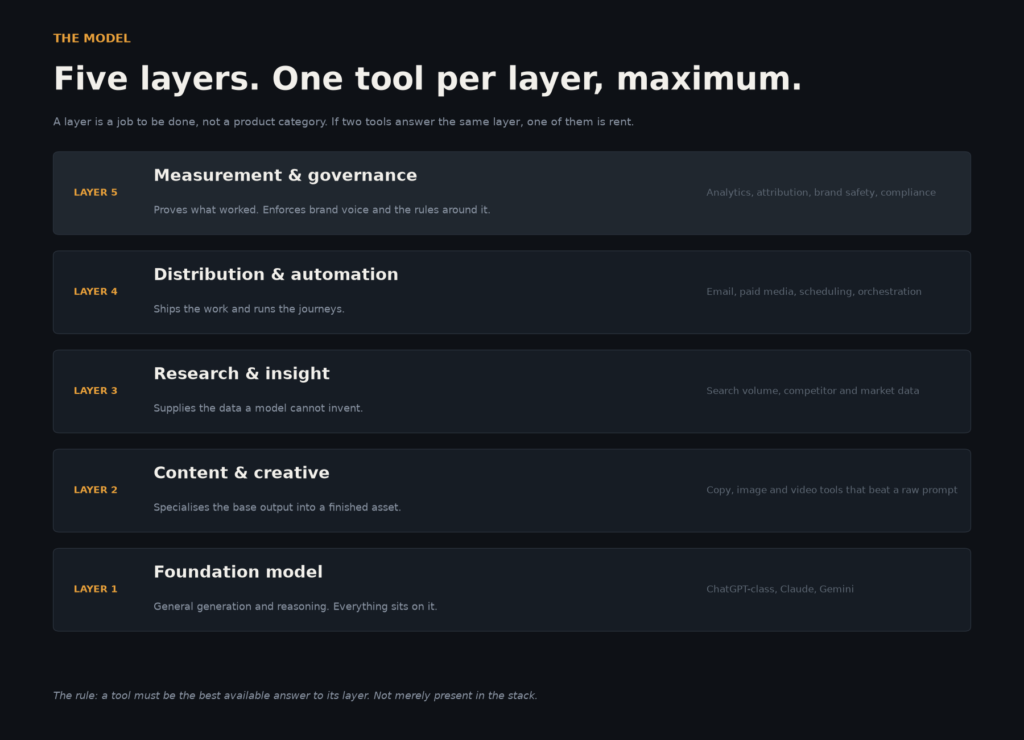
Most stack advice fails because it is organized by product category, and product categories are the vendor’s map, not yours. A stack organized by categories will always have gaps, because the categories keep multiplying. A stack organized by layers is stable, because the underlying jobs do not change.
There are five jobs to be done in a marketing stack, and they stack in a specific order.
Layer 1, the foundation model. General generation, reasoning and synthesis. This is not a tool in the stack so much as the substrate under it. One is enough. If you are paying for three frontier models at full seat price, you are paying for redundancy in its purest form, because the marginal capability difference between them is smaller than the difference in how well your team prompts.
Layer 2, content and creative. Where base-model output becomes a finished asset. This layer is the one that most deserves a specialist, because the value is in the workflow around the model: brand-consistent generation, asset management, versioning, review, and format-specific output. But it is also the layer where the case for a dedicated tool is most often assumed rather than tested. If the tool’s only advantage over your foundation model is a saved prompt, you have bought a prompt.
Layer 3, research and insight. This is the layer where a specialist tool earns its keep almost unconditionally, because it supplies something a model cannot invent: proprietary data. Search volume, competitive ad spend, audience panels, retail movement. A language model can reason about data it is given. It cannot manufacture a first-party dataset it does not have. Pay for data, not for dashboards.
Layer 4, distribution and automation. The execution layer, where work ships and journeys run. Overlap here is usually the most expensive, because distribution tools are priced by contact or by send, so duplicates do not just cost a license, they cost twice on every campaign.
Layer 5, measurement and governance. The layer most stacks skip and most teams need. It proves what worked, enforces brand voice, and holds the rules around consent, claims and disclosure. It is also where AI has created genuinely new obligations, since a governance layer that cannot see which content a model produced cannot govern it.
The governing rule is one occupant per layer, maximum. Not because two tools in one layer is always wrong, but because the burden of proof belongs to the second tool. A layer with two occupants needs a written reason, and that reason should survive next quarter’s renewal.
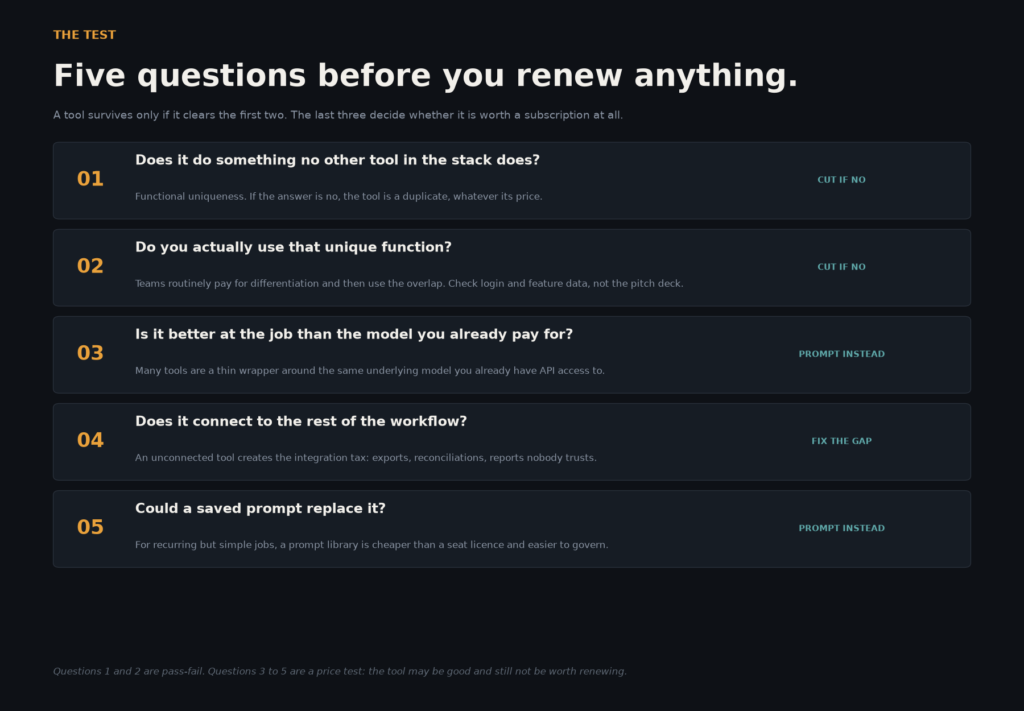
The redundancy test: five questions before any renewal
Every audit framework eventually becomes a scoring exercise nobody completes. This one is designed to be run in a renewal meeting, in about ten minutes per tool, using data you can pull today.
Question one: does it do something no other tool in the stack does? This is functional uniqueness, and it is pass-fail. Map each tool to the job it performs, then group by job. The moment three tools appear in the same group, you have your candidate list without needing a framework at all.
Question two: do you actually use that unique function? This is where most tools fail, and it fails quietly. Teams buy differentiation and then use the overlap, because the overlap is familiar. Pull login data and feature-level usage, not seat counts. A 40-seat contract with four monthly active users is not a tool, it is a subscription to a memory.
Question three: is it better at the job than the model you already pay for? A large share of what markets as an AI tool is a thin wrapper around an underlying model your team already has access to. The wrapper may add workflow, templates, or guardrails, and those can be worth paying for. But you are buying the wrapper, not the intelligence, and the wrapper’s price should reflect that.
Question four: does it connect to the rest of the workflow? An unconnected tool is not neutral. It is a manual step, an export, a reconciliation, and a place where two systems will eventually disagree about the same customer. Given that data integration is the top challenge for 65.7% of organizations, connection quality deserves more weight in the buying decision than feature depth.
Question five: could a saved prompt replace it? For recurring but simple jobs, a maintained prompt library inside your foundation model does the work of a seat license. This question is not an argument against specialist tools. It is an argument against paying a subscription for something your team already knows how to ask for.
Questions one and two are pass-fail. Questions three through five are a price test, and they can fail a tool that is objectively good.
The ranked stack: what earns a permanent place
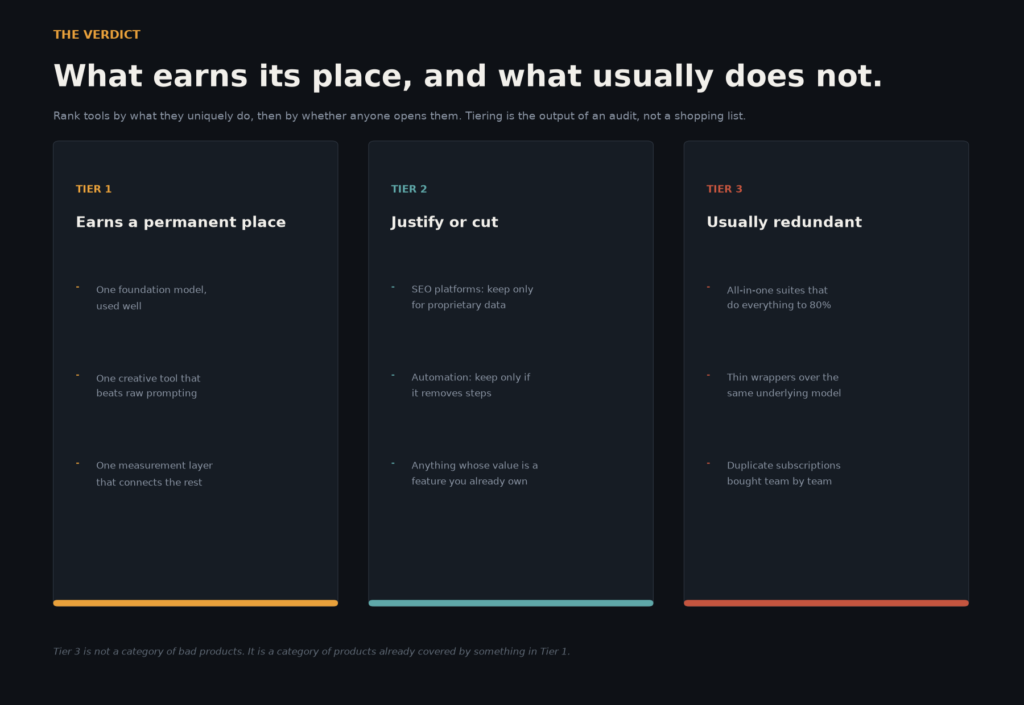
Tiering is the output of the audit, not a shopping list you work down. The point is not that these specific products are right for you. It is that these categories consistently survive contact with the five questions, and the ones below them consistently do not.
Tier 1: earns a permanent place
One foundation model, used well. One creative tool that beats raw prompting on the specific formats your brand actually ships. One measurement layer that connects the rest and produces a number your CFO accepts.
That is roughly three tools, and it is fewer than almost any marketing team currently runs. The reason it works is not frugality. It is that three tools can be governed, audited and integrated by a team of normal size, while thirty cannot.
Tier 2: justify or cut
SEO and content platforms survive only on proprietary data. If you are paying for keyword volumes, competitive intelligence or a link index you cannot get elsewhere, keep it. If you are paying for an AI writing assistant bolted onto a keyword database, you are paying twice.
Automation earns its place only when it removes steps. The test is behavioral: count the manual handoffs before and after. An automation tool that adds a step to the workflow is a net negative, however impressive the demo.
Anything whose value is a feature you already own belongs in this tier by default, and it should be re-tested at every renewal rather than assumed.
Tier 3: usually redundant
The all-in-one suite that does everything to 80% is the single largest source of redundancy in most stacks, precisely because it is the most defensible purchase. It never looks redundant on its own. It looks redundant only when you map it against the specialists it duplicates.
Thin wrappers over the same underlying model are the second source, and the fastest-growing one. Gartner’s data suggests the same thing is happening to the wrappers themselves: by the end of 2025, more than half of generative AI projects had been abandoned after proof of concept, citing weak data quality, inadequate risk controls, rising cost and unclear business value. Note what those reasons are not. Model quality is rarely among them. What fails is everything around the model, which is precisely what a wrapper sells.
Duplicate subscriptions bought team by team are the third, and the easiest to fix. An audit usually surfaces them in the first afternoon, because the finance reconciliation already knows.
The assembly playbook
Audit what you have before you buy anything
Log every subscription, who owns it, what job it performs, and who logged in last month. Do this across departments, not within one, because the duplicates that matter are the ones bought independently. Expect the list to be longer than anyone predicted, and expect at least a quarter of it to be dormant or duplicated.
Start from the foundation and add only what is additive
Resist the urge to fill every layer in one procurement cycle. The foundation model covers more than most teams assume, and every layer you add before testing the one below it is a layer you will eventually remove at higher cost.
Enforce one occupant per layer as a governance rule
This is the mechanism that makes the rest durable. A rule that says a second tool in a layer requires a written justification does two things: it slows the purchase down, and it creates a record you can test at renewal. Governance is not bureaucracy here. It is the only thing that survives contact with a vendor’s quarterly sales motion.
Anchor consolidation on the data layer, not the application layer
When you cut a tool, trace its data first. A platform can look redundant on a capability matrix while quietly serving as the only join between two systems, or the system of record for consent and suppression. Teams that anchor their stack on a shared data layer can remove applications as low-risk swaps. Teams that do not are performing surgery every time they cancel something, which is why they stop cancelling.
Re-audit quarterly
AI tools change fast enough that last quarter’s essential tool can be this quarter’s overlap. Gartner’s utilization recovery did not come from a one-time purge. It came from a standing cadence. Quarterly is frequent enough to catch drift and infrequent enough that people actually do it.
What this means for the next two years
The vendor side is already consolidating, and the numbers are unambiguous. Brinker’s count is flat for the first time, and the fastest-growing categories are not the ones the AI narrative would predict. CMS and web experience management grew 21.4%, ecommerce platforms 19.9%, mobile and web analytics 11.3%, iPaaS and data integration 8.0%, and governance, compliance and privacy 7.1%. Content marketing’s AI boom, by contrast, is the cohort already shaking out.
That pattern is the quiet thesis of this whole article. What buyers are paying for in 2026 is not more generation. It is the surface where AI agents meet your catalog, the plumbing that connects systems, and the rules that govern both. The market is rewarding the connective layers, which are exactly the layers a stack organized by product category tends to leave thin.
Gartner’s CMO research points the same direction from the demand side. AI-ready organizations allocate a larger share of budget to AI, 21.3% versus 15.3%, but they also run larger marketing budgets overall and, more tellingly, pair the spending with operational discipline. The gap between AI leaders and laggards is not turning out to be a tool gap. It is an operating-model gap.
Which means the strategic bet is not on picking the right tools. It is on building the layer structure that makes tool choice reversible. A team with one occupant per layer can swap its creative tool in a week. A team with thirty overlapping subscriptions cannot swap anything without a project plan, which is why it keeps renewing.
The takeaway
The discipline that wins in an abundant tool market is subtraction, and it is harder than buying because it has no demo.
Fifteen years of martech taught buyers that capability is purchased. The utilization data says otherwise: teams use 49% of what they buy, and only 15% can prove the stack pays back. The tools were never the constraint. The architecture was.
Build five layers, put one tool in each, and make the second tool argue for itself. Then do it again next quarter, because the market will keep trying to add a sixth.
Frequently asked questions
What is an AI marketing stack, and how is it different from a martech stack?
A martech stack is the full set of marketing technology a company runs. An AI marketing stack is the subset that generates, reasons, or automates, organized in layers from foundation model up to governance. The difference matters because AI capability now arrives embedded inside existing tools rather than as separate purchases, so the AI stack is increasingly a set of features inside a smaller set of platforms rather than a list of vendors.
How many AI tools should a marketing team actually run?
Fewer than almost any team currently runs, and the exact number matters less than the structure. A defensible stack has roughly one occupant per layer, which puts a marketing team at three to seven tools depending on how much proprietary data and distribution it genuinely needs. Zylo’s 2026 benchmark puts the average organization at 305 SaaS applications overall, with only 54% license utilization, which suggests the constraint is not ambition but governance.
How do I prove a tool is redundant without upsetting the person who bought it?
Use data instead of opinion. Pull login and feature-level usage, then map each tool to the job it performs and group by job. Overlap becomes visible without anyone having to defend a decision, because the finding is about the portfolio rather than the purchase. This is also why the audit has to happen before the renewal date, while the contract is still open and pricing is still negotiable.
Is consolidation always the right answer, or is best-of-breed still valid?
Best-of-breed is still valid where a specialist supplies proprietary data or a workflow a general model cannot replicate. It stops being valid when the specialist’s only advantage is convenience over a foundation model. The practical rule is to be best-of-breed at the layers where differentiation lives and consolidated everywhere else, particularly in distribution and measurement where duplicate costs compound per contact and per send.
What breaks when you cut a tool, and how do you avoid it?
The most common failure is removing something whose visible function was redundant but whose invisible function was load-bearing: the only join between two systems, the system of record for consent and suppression, or the source of an identifier three other tools depend on. Trace the data before you trace the features. Stacks anchored on a shared data layer can absorb removals as swaps; stacks held together by point-to-point integrations cannot.