The Incentives Behind Over-Blocking: Why Nobody Pays for the False Positive
The cost of blocking the wrong article has been measured, published and repeated for seven years. It has not gone away. That is not because the technology is hard. It is because the bill never arrives at the desk of anyone who could refuse it.
The measurement is old, and it changed nothing
In 2019, a study commissioned by the cybersecurity firm CHEQ and conducted by the Merrick School of Business at the University of Baltimore put a number on a suspicion publishers had held for years. American news publishers had lost about $2.8 billion in programmatic revenue that year because brand-safety keyword blocklists had blocked content that was perfectly safe to advertise beside. Roughly one dollar in four.
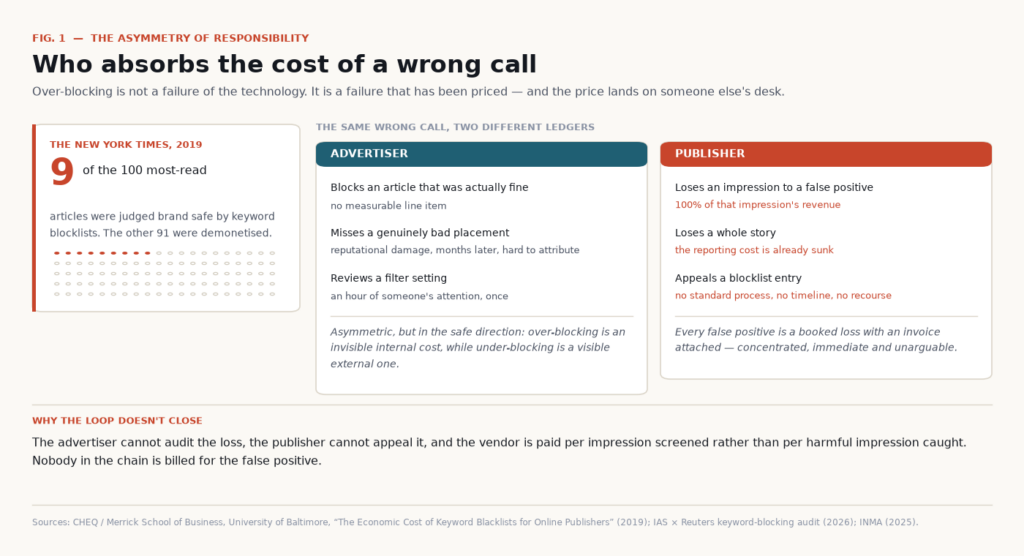
The detail that should stop you is smaller. Of the hundred most-read New York Times articles of 2019, nine were judged brand safe by keyword blocklists. Ninety-one were demonetised — a list that included stories about mobile phones, popular films and science.
That was seven years ago. The technique is still in wide use, the studies keep being published, and the blocklists keep doing roughly what they did then. In 2026 a verification vendor’s audit with Reuters found 54% of news URLs its own semantic system had cleared still tripped a typical keyword list.
So why does a practice with a published, quantified, repeatedly confirmed cost survive?
Because the cost is real but misaddressed
Here is the mechanism, and it is not mysterious. It is accounting.
For a media buyer, a false positive looks like this: a page was excluded, an impression never happened, and the report shows a slightly smaller number in a column nobody scrutinises. There is no line item for it. There is no invoice. The cost is real, but it is paid in foregone attention — the one currency that never appears on a remittance.
For a publisher, the same error appears as a zero. A story is written, edited, fact-checked and published, and then earns nothing, because a word in its URL matched a list that person has never seen. That publisher can feel every single false positive, and cannot appeal any of them.
Now the crucial part: the advertiser and the publisher are not the only two parties, and neither of them writes the list. The verification vendor does, or more precisely the vendor supplies the default configuration that most buyers never overrule. And the vendor is compensated for screening — for volume processed, for coverage claimed — not for the accuracy of the exclusions.
The three-way split that keeps the loop open
Put those positions side by side and the stability becomes obvious.
The party who could turn the filter down, the advertiser, cannot observe the loss. The party who can observe the loss, the publisher, cannot change the setting. And the party who controls the setting is not billed either way.
That is a textbook accountability gap, and no amount of better classification closes it on its own. Semantics help — the vendors who rebuilt their engines around page-level context genuinely recovered enormous amounts of inventory for publishers who adopted them. But the adoption decision belongs to the buyer, and the buyer’s incentive is to leave a setting alone that has never visibly cost them anything.
There is a second asymmetry underneath. Under-blocking is legible: a brand appears beside something dreadful, someone screenshots it, and the story travels. Over-blocking is illegible: an ad that never served leaves no trace, generates no screenshot, and cannot be shown to a board. Between two errors, organisations reliably choose the one that cannot be photographed.
What the money actually says
The programmatic benchmark that has tracked this since 2023 gives the picture a certain grim clarity. For every $1,000 entering a demand-side platform, 43.9% reached consumers in 2024, up from 36% the year before. Less than half, improving slowly.
Read that against the over-blocking estimates and a pattern appears: the industry is capable of fixing what it can measure. When the same benchmark showed MFA spending falling from 15% of budgets to 6.2% in a single year, it proved that a named, quantified waste can be attacked successfully. Over-blocking has not moved in the same way, because the party doing the blocking never books the loss.
The uncomfortable conclusion
The rational move for any individual advertiser is to keep the filter loose and leave it unexamined. Do that across an entire market, and you get a supply of quality journalism that is systematically under-monetised, which is exactly the outcome the industry says it does not want.
So the leverage is not better technology. It is a single question asked in a budget review: what did my filter block last quarter, and what was it worth? Nobody currently has to answer that. Making someone answer it is the entire intervention.