The Incentive Behind the Multicultural Budget Gap
Every explanation for the multicultural budget gap I have read blames a belief. Marketers under-invest because they hold a homogeneity assumption, or a niche framing, or a fear of getting it wrong. All three are true. None of them is the reason the gap survives.
Here is the reason: the people who decide the budget are measured on a horizon that ends before the asset pays back. That is not a belief. It is a term sheet.
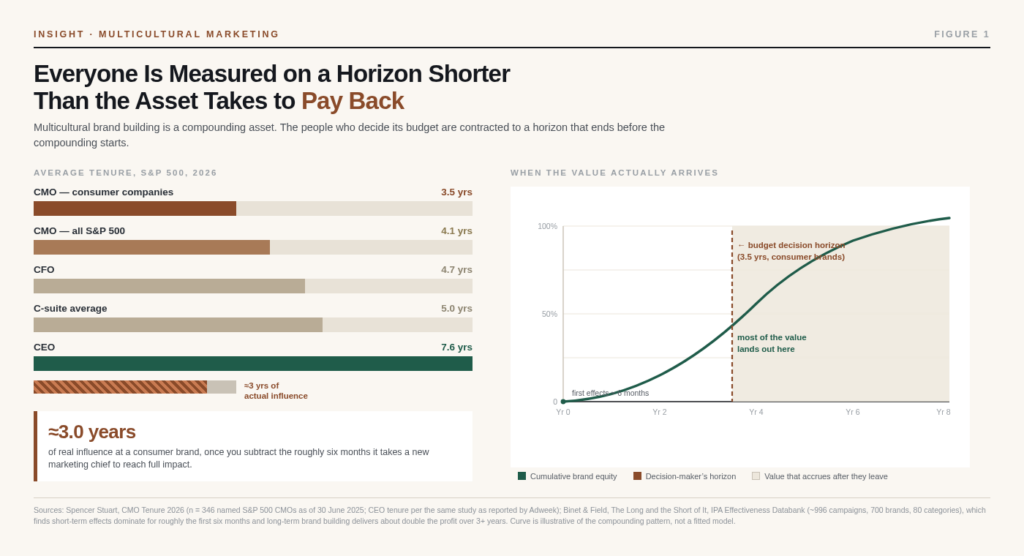
The two calendars do not overlap
Spencer Stuart’s 2026 study of the 346 named CMOs in the S&P 500 puts average tenure at 4.1 years — against 5.0 for the C-suite and 7.6 for CEOs. At consumer companies, the sector where multicultural spend concentrates, it drops to 3.5 years. Strip out the roughly six months a new marketing chief needs to reach full impact and you are left with about three years of actual influence.
Now put that against what the money does. Binet and Field’s analysis of the IPA Effectiveness Databank — roughly 996 campaigns, 700 brands, 80 categories — finds short-term effects dominating for about six months, with long-term brand building delivering roughly double the profit over three years and beyond. They say it plainly: long-term effects are not an accumulation of short-term effects, and short-term metrics are a poor guide to long-term success.
So the asset needs three-plus years to pay. The person funding it has three years of runway, and has already spent half a year learning the job.
The asymmetry that does the damage
Look at the incentives this creates, and notice they are not symmetric.
Cut the multicultural line, and the cost lands on your successor’s results, three years out, in a category that has quietly stopped compounding. Fund it, and the benefit also lands on your successor’s results. Either way, the consequence is someone else’s problem. But only one of those two options shows up as a clean number this quarter.
This is why the gap survived the bull market, survived the 2020–21 diversity commitments, and survived the 2025 retreat. It is not ideological, so ideological argument cannot move it. Binet and Field’s other finding sharpens the point: campaigns targeting the whole market generate three times as many large business effects as those focused on existing customers, while tight targeting helps activation. The “general market” default is not just a cultural habit. It is the short-term-optimized choice, and short-term is what the incumbent is paid on.
What actually changes it
You cannot persuade your way out of a term mismatch. You have to change the accounting period.
Multi-year budget commitments that bind past an individual’s tenure. Brand equity treated as an asset with a measured life. Segment performance tracked on a cohort basis for at least six quarters — committed to before the campaign ships, so the exit review has something to answer to. And part of marketing leadership’s compensation tied to brand metrics with a deliberate lag, so the incentive stops pointing at next quarter.
None of that is a moral argument. It is an argument about who pays for what, and when they find out.
The gap is not there because marketers misread the demographics. It is there because the people who could close it are structurally incentivised not to, and will be gone before the invoice arrives.