Revenue Up, Profit Gone: Why China’s Marketers Moved In-House
Start with two numbers that should not sit comfortably next to each other.
China’s internet advertising market was worth about RMB 725.7 billion in 2025, up 11.5 percent. Fold in internet marketing services and the combined pie reached roughly RMB 1.6 trillion, growing 12.6 percent. By any historical standard, that is a healthy industry.
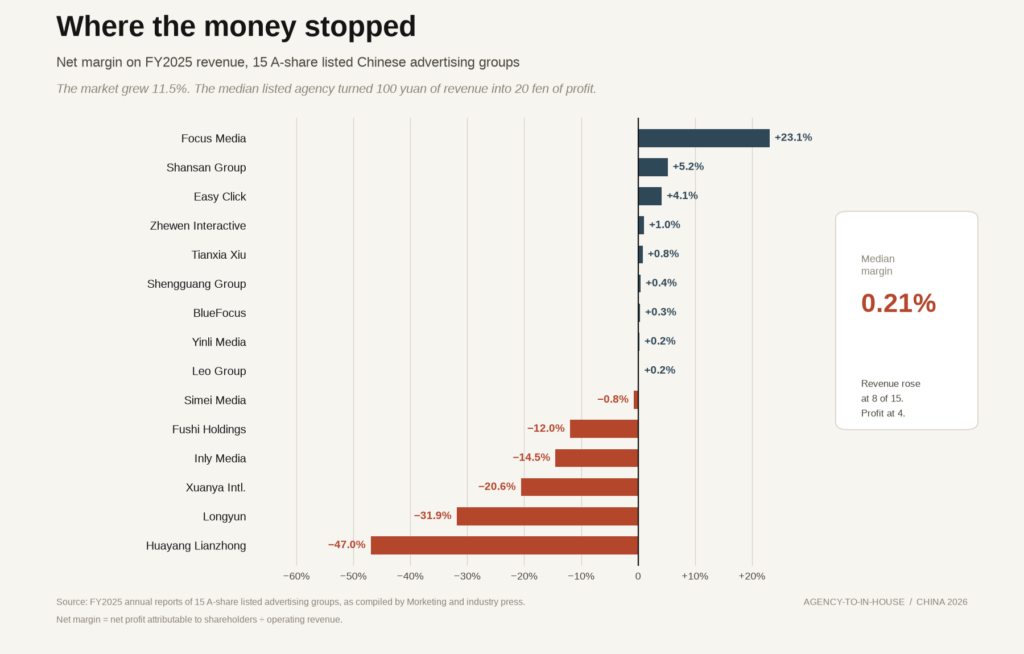
Now look at what the people selling marketing actually kept. Of fifteen A-share listed advertising groups, eight grew revenue and four grew profit. BlueFocus turned RMB 68.69 billion of revenue into RMB 225 million of net profit — a margin of 0.33 percent. Huayang Lianzhong lost RMB 653 million on RMB 1.39 billion. There is a phrase the Chinese trade press has settled on for this: 增收不增利. Revenue up. Profit not.
Where did the money go? Largely to the platforms. Douyin, Alibaba and Tencent took 66.2 percent of the whole market between them; the top ten took 96.6 percent. That is not new information, and it is not the interesting part.
The interesting part is who followed the money out of the room.
The old bargain, and the three assumptions underneath it
For twenty years the agency model ran on a straightforward trade. Brands rented capability they could not justify owning. Agencies pooled scarce talent — platform fluency, creative craft, media relationships — spread its cost across a client roster, and charged a retainer for access.
That bargain was rational for exactly as long as three assumptions held.
The scarce skill stayed scarce. The scarce skill stayed at the agency. The brand could not build it cheaper in-house.
All three were true in 2010. By 2026 none of them were.
China’s version of the bargain had a distinct architecture. A 4A layer owned brand strategy and large-scale production. Local creative shops owned campaign ideas. MCNs and livestream agencies owned creator and commerce execution. Each tier sold a different flavour of scarcity, and each assumed the brand would never want to own the messy middle.
What nobody priced in was that the middle would turn out to be the most valuable real estate in the building.
Force one: the work became too important to rent
Here is the thing most English-language coverage of Chinese marketing gets backwards. The strategic asset in China is not brand equity. It is the owned audience.
Private-domain operation — WeChat, enterprise WeChat, mini-programs, member pools, the whole apparatus of holding the customer relationship instead of borrowing it from a platform — migrated from tactical side-channel to the centre of the business model. You can outsource a channel. You cannot outsource ownership; that is close to a contradiction in terms. The moment a brand decides its customer data and its retention mechanism are the core asset, the team running that asset has to sit inside the building, with access to product, supply chain and pricing decisions no external partner will ever be granted.
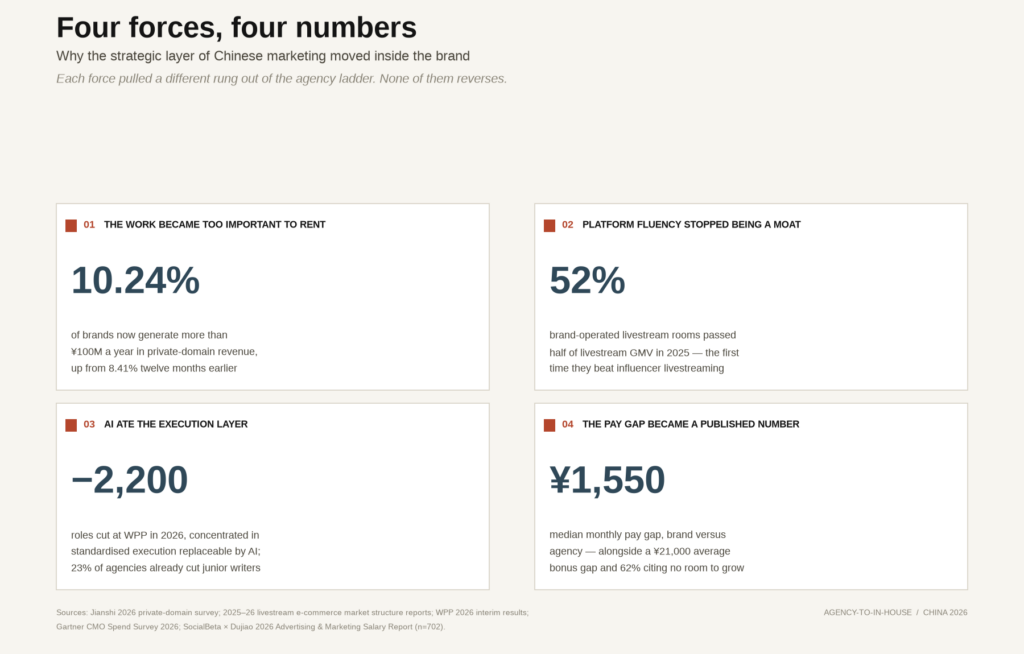
And brands acted on it. In the 2026 edition of an annual private-domain survey run by the consultancy Jianshi, the share of brands generating between RMB 50 million and RMB 100 million a year from private domain rose from 4.13 percent to 7.09 percent in twelve months. The share above RMB 100 million went from 8.41 to 10.24 percent.
Content commerce ran the same play. By 2025, brand-operated livestream rooms passed half of livestream e-commerce GMV for the first time, overtaking influencer livestreaming as the dominant mode, while top-tier influencer GMV share slid to about 10.66 percent.
Every one of those percentage points is a job that used to be billed at a day rate and now sits on a payroll. That is not a metaphor. Somebody had to staff those rooms.
Force two: platform fluency stopped being a moat
Agencies once charged real money for knowing how Douyin’s algorithm rewarded watch time, how Xiaohongshu’s search layer converted intent, how a WeChat funnel actually moved. That knowledge was scarce, and scarcity was the product.
It is now teachable, toolable, and — this is the part agencies underestimated — actively distributed by the platforms themselves. Douyin built staff and creator account systems that onboard brand employees directly. Xiaohongshu rolled out buyer centres and KOS tooling so that a shop assistant with a phone could become a distribution node, with the store’s own inventory behind her.
Ask a blunt question. If the platform’s commercial interest lies in shortening the distance between a brand and a buyer, whose margin is that distance made of?
The practical result: a brand can now hire two sharp people, train them on the platform’s own curriculum, and capture perhaps seventy percent of what an agency’s social team delivered — at a fraction of the retainer, with vastly better access to product truth. The agency did not lose because it got worse. It lost because the thing it was selling became ambient.
Force three: AI ate the execution layer
This is where the economics turn ugly, because the execution layer was never a loss leader. It was the margin.
WPP gives the cleanest public reading. In the first half of 2026 the group cut 1,267 roles, then announced up to a thousand more, explicitly concentrated in what it described as standardised execution roles replaceable by AI tools — media planning and buying, basic content production, routine analysis, process operations. Cumulative cuts for the year exceed 2,200, about 2.3 percent of headcount. WPP’s own measurement puts AI-driven efficiency gains on discrete tasks at 40 to 70 percent, and close to ninety percent of its frontline client-service staff use the WPP Open platform daily. The commercial backdrop is not subtle either: revenue of £13.55 billion in 2025, an exit from the FTSE 100 after nearly thirty years, and a market value down more than eighty percent from its 2016 peak.
WPP is an early indicator, not an outlier. Gartner’s 2026 CMO Spend Survey found that 23 percent of agencies had already cut junior copywriting headcount in 2025, with 31 percent planning further cuts in 2026; junior design roles followed the same curve, down 19 percent with another 24 percent of reductions planned. Forrester tore up its own forecast, moving from 7.5 percent of US agency jobs automated by 2030 to 15 percent eliminated in 2026 alone. A separate Basis survey put the share of organisations already using AI to replace human tasks at 27.9 percent, against 10.4 percent two years earlier.
At the small end the same force appears in miniature. A Nanjing University field study published in August 2026 documented a Nanjing agency that had shrunk from more than sixty staff at its peak to roughly ten, with AI named as a key driver of per-person output. The founder was blunt about what changed: AI did not replace creativity, it replaced the drafting. Her designers now spend the day judging, correcting and integrating instead of producing from zero. The firm also raised its hiring bar — candidates sit a half-day practical test on AI-assisted commercial output.
Hold that detail. It matters more than any of the headline numbers, and I will come back to it.
Force four: the pay gap became a published figure
For years the agency-to-brand drift ran on anecdote. Someone’s old colleague doubled their salary at a platform company. Someone else left after a bad pitch cycle and never came back.
In 2026 it became auditable. The annual salary survey by SocialBeta and the recruitment platform Dujiao — 702 practitioner responses, 63 company responses, collected across April and May — put brand-side median monthly pay at RMB 15,000 against RMB 13,450 agency-side. The averages told the same story. Nearly 77 percent of brand-side marketers cleared RMB 120,000 a year, against 65 percent of agency staff. Bonus coverage ran 58.21 percent versus 32.63 percent, and average bonus size RMB 54,207 versus RMB 33,246.
Raises split identically: 38 percent brand-side against 27 percent agency-side, with 11.8 percent of agency staff reporting a pay cut.
But money is the boring half of the finding. The same survey asked why people wanted to leave, and the top answer, at 62 percent, was not compensation. It was “no visible room to grow.”
Read that again. It is the strategic argument wearing a survey respondent’s clothes. People are not chasing the cheque. They are chasing proximity to the decision — the work that sets direction rather than the work that executes somebody else’s direction at two in the morning.
The strange part: 47 percent want to move, 7 percent did
Here is where the story stops being a simple migration and becomes something more interesting.
The same survey recorded a workforce in suspension. Forty-seven percent of practitioners said they were preparing to move or actively watching the market — the highest reading in four years, up from 42 percent in 2024. Yet only about 7 percent actually moved, and the share listing themselves as unemployed rose to 11.41 percent. Only 27 percent of companies planned to add headcount; nearly half were holding still.
So the direction of desire is unambiguous, and the volume of movement is not. Chinese marketing talent is not fleeing. It is waiting, and the waiting has a shape: it is concentrated among the senior, platform-fluent, strategy-capable people brands most want and agencies most need to keep.
That gap between wanting and going is the real story of 2026. It tells you the pull is structural and the friction is temporary — a frozen hiring market, not a change of heart.
Three destinations, not two
The lazy version of this story says talent moved from agencies to brands. The accurate version says the agency pipeline forked, and brands captured the fork that mattered.
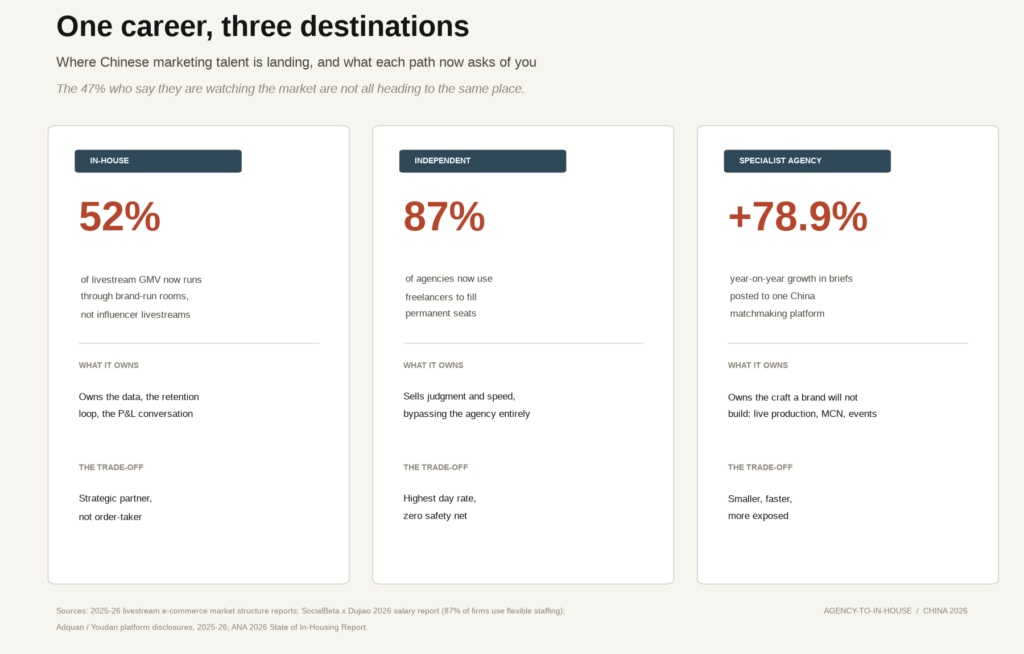
In-house. The brand-side team now owns the data, the retention loop, the P&L conversation. It is where private-domain, content commerce and AI orchestration live. This is the fork everyone talks about, and it is real.
Independent. Separate from both, a third path matured. According to the same salary survey, 87 percent of agencies now use freelancers to fill what used to be permanent seats; on one Chinese matchmaking platform, demand for freelancers overtook demand for agencies for the first time in the first half of 2025, at 50.75 percent against 49.25 percent, with freelancer requests up 106.9 percent year on year. Senior people who left agencies did not all go to brands. Plenty hung out a shingle and now sell judgment by the day.
Specialist agency. What survived on the agency side moved down the value chain and got more specific: live-commerce production, MCN and creator management, event execution, the craft a brand genuinely does not want to staff. Briefs posted on the same platform grew 78.9 percent year on year in 2025 — the demand did not vanish, it fragmented into smaller, faster, more executional jobs.
The full-service agency is what got squeezed. Not the category. The middle.
What brands won, and what they now owe
In-housing looks like a straightforward win, and it usually starts as one. You get people who know your product, sit twenty metres from the supply chain team, and can answer a pricing question without a change request.
Then the bill arrives, in three instalments.
The first is integration. An in-house strategist who cannot get access to the CRM, the product roadmap or the sales team’s calendar is an expensive content producer with a better title. The organisational plumbing has to be built, and nobody warns you that the plumber is you.
The second is retention. The ANA’s 2026 State of In-Housing Report, drawing on 404 jurors of its in-house awards, named the biggest threat to in-house success as creative stagnation — being too close to the brand, losing fresh perspective — followed immediately by talent burnout, the inability to hold on to staff through volume and repetitive work. Read those two together and you get the trap: you hire a senior strategist to do strategic work, then bury them in production because production is what the calendar demands, and then wonder why they leave in eighteen months.
The third is measurement. As one respondent in that research put it, in-house teams get trapped seeking validation from the C-suite instead of building frameworks the C-suite cannot ignore. Own a metric that matters. Connect the work to commercial outcomes and report on it relentlessly. Executive teams do not respect marketing sophistication; they respect maths that makes their lives easier.
What agencies become
The hardest sentence to write honestly is this: the agency’s old value proposition is gone, and no amount of repositioning rhetoric brings it back. “We own the scarce expertise” stopped being true when the expertise became teachable and the tools became cheap.
What survives is narrower and, in some ways, better. Two viable shapes.
One is a specialist execution partner — the live-production shop, the MCN, the event machine, the studio that can turn around forty variants of a product film in a week. Brands will pay for this precisely because they do not want it on payroll. It is high-craft, high-throughput, low-glamour work, and it is defensible because the operational complexity is real.
The other is a judgment business. Not a bigger deck. Not a rebranded consultancy. A firm that is paid for knowing which of the eleven plausible strategies is the right one, and for saying so plainly enough that the client can act on it. That is a smaller business than the retainer model, with fewer people and better margins, and almost nothing in the traditional agency P&L prepares a leadership team to run it.
What the data does not say
Three caveats, because the tidy version of this argument is wrong in three specific ways.
The agency is not dying. It is re-segmenting. Revenue in the category is not collapsing; margins are. Fifteen listed firms still booked around RMB 1.6 trillion of combined revenue. What hollowed out is the generalist middle, and the fact that the middle was where most agency careers were built does not make the whole category extinct.
In-housing is not universally winning. The US experience is instructive precisely because it is messier than the narrative. The ANA recorded high-profile in-house closures and downsizings in 2025 — Keurig Dr Pepper and Expedia among them — and dismissed them as individual business decisions rather than a reversal. The topline still leans one way: 35 percent of respondents said brands are in-housing more than ever, against 7 percent saying they are pulling back; and the share citing cost-saving as the primary rationale collapsed from 30 percent in 2023 to 9 percent, with 53 percent now describing in-house teams as strategic partners. But 34 percent saw scope expanding while 7 percent saw it contracting. That is a strong trend with real exceptions, not a law of physics.
This is a senior-layer story. The migration is most visible among senior, strategic people at large brands in tier-one cities. Smaller brands still lean heavily on agencies and freelancers, because a ten-person marketing department cannot staff a private-domain team, a livestream room and an AI workflow simultaneously. Anyone telling you “everyone went in-house” is describing their WeChat feed, not the market.
The bit nobody wants to talk about
Back to that Nanjing agency, and the detail I asked you to hold.
The junior role was the apprenticeship. Three years of volume production, bad briefs, endless revisions — that was where a young person acquired craft, and where the industry acquired its next generation of people with judgment. AI absorbed exactly that role. Gartner’s trajectory implies more than half of junior copywriter positions at large agencies disappearing over two years. The work did not disappear. The seat between the work and the senior reviewer did.
So ask the uncomfortable question. If nobody serves the apprenticeship, where do the senior strategists of 2035 come from?
The industry is currently answering that question by accident, which is to say it is not answering it. Gartner’s own analyst has warned against mistaking the automation of entry-level tasks for the elimination of the need for entry-level talent. She is right, and nobody has a working model yet.
This is, quietly, the largest risk in the whole shuffle — larger than any single agency’s P&L. Brands are hiring judgment they cannot yet grow. Agencies are shedding the training ground they will eventually need. Both sides are drawing down an account neither is paying into.
What to actually do
If you run a brand. Treat the hire as the start of the project, not the end. Build the plumbing before the headcount: data access, decision rights, a metric your new hire can own outright. And ring-fence strategic time from production demand, or the person you poached for their judgment will spend their first year making social assets.
If you run an agency. Pick a shape and stop hedging. The generalist full-service position is the most exposed position in the market. Either become operationally excellent at something specific and hard, or become a small, senior judgment business with a genuinely different economic model. The hybrid — big team, broad scope, retainer pricing — is where the margin went to die.
If you are the marketer. Three paths is more leverage than one. The scarce combination in 2026 is not platform fluency alone, nor AI tooling alone, but the ability to sit in a room with a P&L owner, translate a commercial problem into a marketing system, and then operate that system. That combination is portable across all three destinations, which is precisely why it is worth building.
If you are a global brand entering China. The interesting consequence of this shuffle is that China’s best marketing talent is now inside brand organisations, not inside agencies. That changes your build-or-buy maths. Poach for the strategic layer and buy specialists for execution — live production, MCN, events. The full-service middle option, the one procurement departments find easiest to justify, is the option that has been hollowed out.
The short version
The Chinese marketing market grew double digits and its agencies made almost nothing, because the value migrated to platforms and the strategic work migrated inside brands. Private-domain ownership could not be outsourced. Platform fluency stopped being scarce. AI flattened the execution layer where the margin lived. And the pay data finally made the direction legible, with a 62 percent plurality naming growth, not money, as the reason to leave.
The talent followed the strategy. It usually does. The open question is not whether the shuffle was right — the evidence suggests it was — but whether the industry can rebuild the apprenticeship it just automated away.