KOL, KOC, KOS: China’s Influencer Tiers and Who to Pay When
Every quarter, a brand team somewhere in London or Chicago gets handed a deck that reads: “China influencer activation — 3 KOLs, 40 KOCs, ¥1.2m.” The slide looks professional. The trouble is that the three numbers were agreed before anyone asked what each of them is meant to buy.
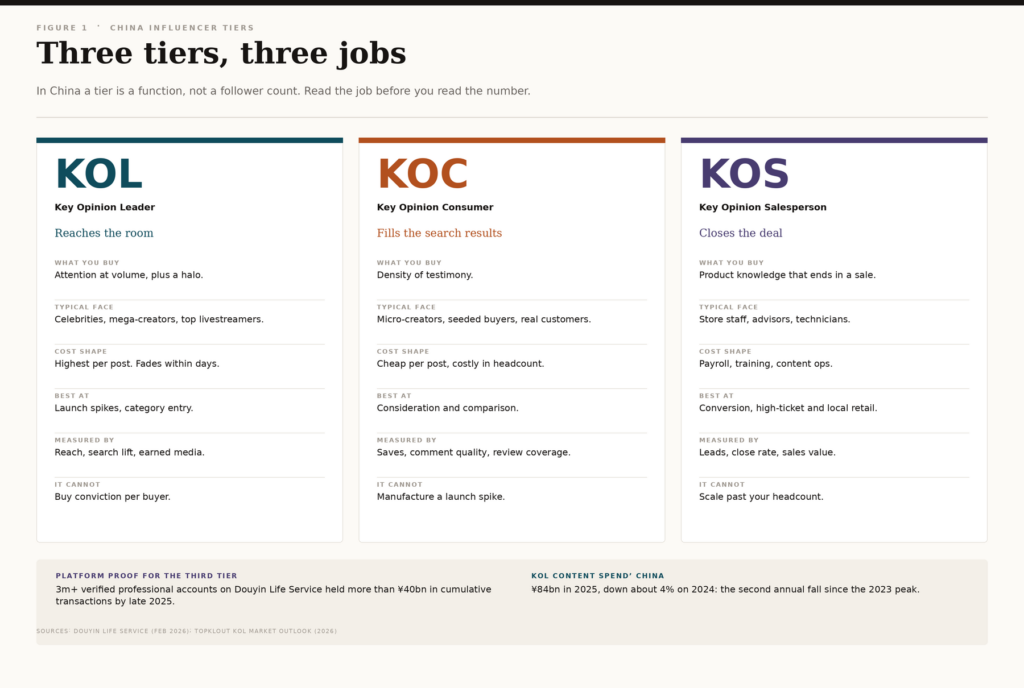
That is the problem in one line. China’s creator economy is not a single market with one rate card. It is three labour markets that happen to share the same apps, and they are priced, staffed and measured in completely different ways. KOL rents you attention. KOC manufactures proof. KOS closes the sale. Pay the wrong one at the wrong moment and you do not get a mediocre campaign. You get an expensive one that hits every target except the one that mattered.
Here is how the tiers split the work, where the money actually moved this year, and why most of the trust statistics you have read are answering a question nobody asked.
The short version
- A tier in China is a job description, not a follower count. Reach, proof and closing are three separate purchases.
- KOL content spend shrank to about ¥84 billion in 2025, the second annual decline in a row. The head of the market is losing share inside a market that is no longer growing.
- Nearly 87% of KOL bookings now go to mid- and long-tail accounts, which is where search results get filled and where doubt gets removed.
- The third tier, KOS, is usually your own sales staff. It is the only tier that produces transactions by default, and the only one most foreign briefs never fund.
- Trust numbers disagree with each other because they measure different questions. Treat “KOC equals trust” as a hypothesis to test, not a law to build on.
1. A tier is a job description, not a follower count
Western influencer marketing runs on a size ladder: nano, micro, mid, macro, mega. The rung is decided by audience volume, and the implicit promise is that a bigger rung does more of everything — more reach, more credibility, more sales.
China does not organise it that way. The three letters describe three functions, and the third one is usually performed by someone who is not a creator at all.
- A KOL is a media buy with a face attached.
- A KOC is a review shelf, assembled from ordinary-looking accounts.
- A KOS is your own sales floor, moved onto the internet.
Which means a top-tier KOL who cannot close and a store advisor with 3,000 followers and a healthy close rate are not on the same ladder. They are in different departments. Once that lands, budget meetings get shorter, because you stop arguing about creator size and start arguing about which stage of the purchase you are willing to fund.
2. KOL: you are renting attention, and the rent is falling
Start with the money. China’s KOL content spend came in at roughly ¥84 billion in 2025, down about 4% from ¥87.3 billion in 2024 and the second consecutive fall from a 2023 peak of ¥90 billion. On the wider measure that includes traffic boosting and integrated campaigns, Ebiquity puts the social KOL market at ¥93 billion: 58% of global KOL investment and about 17% of everything Chinese brands spend on brand advertising. Forecast growth for 2026 is around 1%.
That is a maturing market, not a collapsing one. But look at where the bookings went. Head-tier creators took 13.1% of them and 20.5% of the money. Mid- and long-tail accounts took 86.8% of bookings and close to 80% of spend.
What a KOL buys is salience: the spike, the halo, the sense that a brand is real because someone famous touched it. What it does not buy is conviction, per person, at scale. BCG’s reading of China is blunt — here, creators are expected to carry the transaction, unlike most Western practice where they mainly build awareness. So a KOL moment with nothing to hand off to is not a launch. It is a firework.
3. KOC: you are buying density, because the decision ends in a search box
Why would 86.8% of bookings go to smaller accounts? Because Chinese purchase decisions tend to finish in a search bar rather than in an ad impression. On Xiaohongshu, a platform that behaves like a search engine wearing a lifestyle magazine’s clothes, the company reported around 200 million users a month coming to it specifically for purchase advice in late 2025. When that buyer arrives, one glossy feature is not an answer. Forty notes from people who look like them is an answer.
Cost is not on your side here either. BCG measured China’s creator-seeding costs rising 15–25% in 2025, with some brands putting 65% of their marketing budget into seeding, and up to 40% of skincare purchases in China traceable to creator content against 25–30% globally. Cheap reach is over. What you are buying now is volume of testimony, which means headcount, operations and patience.
The part agencies leave out
A good deal of that testimony is manufactured to feel spontaneous, and pretending otherwise is how brands get burned. A nine-month ethnographic study of Xiaohongshu KOCs, published in 2024, followed creators negotiating with marketers, brands and the platform — and found the commercial labour deliberately obscured so posts read like ordinary life, while the work itself is routinely underpriced in corporate paperwork. None of that makes KOC content fake. It makes it a performance, and the useful skill is learning to judge one.
4. KOS: the tier most briefs never budget for
Now the one that surprises people outside China. KOS usually stands for Key Opinion Sales, sometimes expanded as Key Opinion Salesperson, and the concept arrived with a specific moment: on 26 March 2021, Douyin and MAC ran a talent search called KOS101 for counter staff, drawing 500 million impressions, more than 10,000 entrants, 101 shortlisted and 11 finalists, plus close to ¥6 million in sales on finals night. The idea was simple. The best person to sell a product online is often the person who sells it offline.
Five years later it is infrastructure. Douyin Life Service’s verified professional accounts — store managers, staff, trainers, technicians — passed 3 million by the end of 2025 and had produced more than ¥40 billion in cumulative transactions, with sales from those accounts up 2.6x year on year, livestream sales up 331%, and coverage across 17 categories. Xiaohongshu has more than 130,000 beauty-advisor and sales-associate accounts of its own.
Brands have built the rest. TCL went from 500 senior advisors to more than 3,100 KOS, and its Douyin local-services work produced ¥370 million of incremental offline retail between June and November 2025; notably, 20.6% of those conversions came from customers who visited a store more than eight hours after buying a voucher, which is the signature of content creating demand rather than intercepting it. Wuling turned 10,000 dealer accounts into a matrix generating roughly 200,000 leads a month. NIO’s advisor accounts sold more than 1,000 cars through Xiaohongshu notes, and Loewe’s KOS grid lifted daily enquiries by 522%. Those are company-reported figures and should be read as claims rather than audits, but the direction is consistent across categories.
The budget implication is the part nobody plans for. KOS cost sits in payroll, training and content operations, not in a media plan. It looks like headcount, so it is the first line cut in a downturn, and it is the only tier that produces transactions without being asked.
5. The stage-matching rule
If you keep one table from this piece, keep this one.
| Stage you are funding | Hire | What the money buys | What happens if you hire the wrong tier |
|---|---|---|---|
| Launch and awareness | KOL | A spike, a halo, a search term with volume | KOCs deliver forty quiet posts and no spike |
| Consideration and comparison | KOC | Volume of testimony where buyers look | Reach with no proof; the sale stalls at the search bar |
| Conversion and close | KOS | Product knowledge, an answer, a transaction | Demand peaks with nobody to transact with |
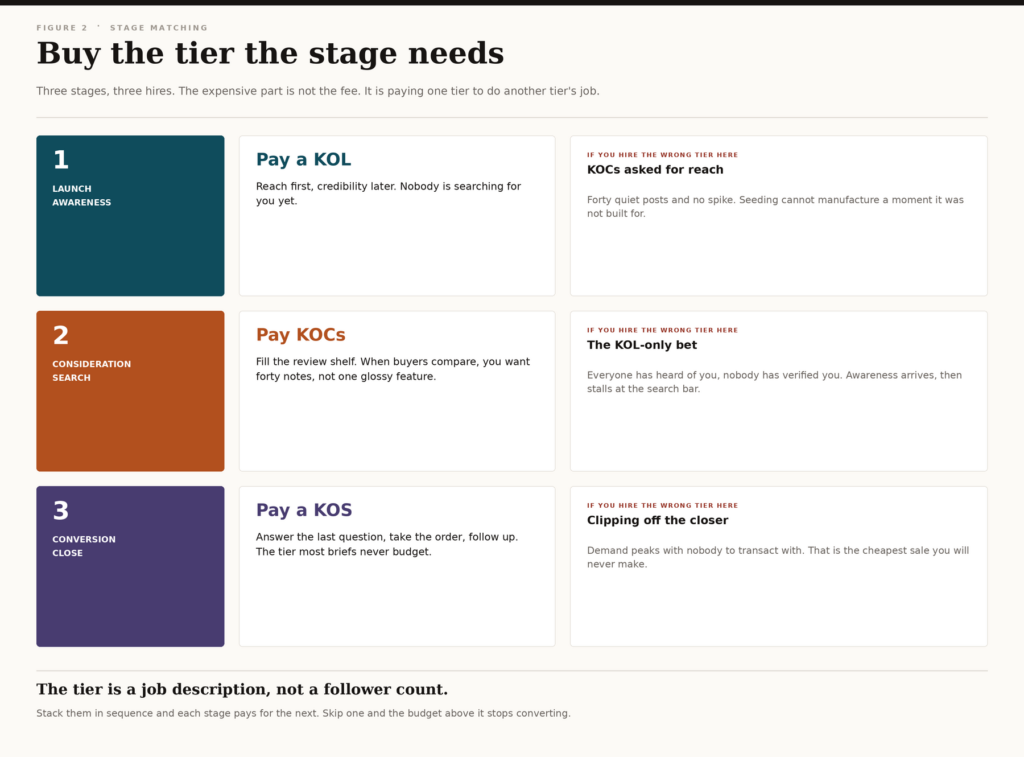
The order matters more than the split. A KOL moment that hands off to a search term, a KOC cluster that fills that term, and a KOS team that answers the last question is a system. Any one of them alone is a purchase, not a campaign.
6. Four ways the budget goes sideways
The KOL-only bet. You buy the famous name, publish once, and wait. Everyone has heard of you, nobody has verified you. In a market where buyers cross-check before they spend, reach without proof converts badly. The China-British Business Council’s observation of UK brands entering China is that many allocate 70–80% of an influencer budget to a single top-tier creator and publish once, then wonder why nothing stuck.
KOC asked for reach. Forty micro-posts cannot manufacture a launch spike, and briefing them to try wastes the one thing they are good at.
The missing closer. Reach and proof get built, then the campaign stops one step short of a transaction. This is the most common structural gap in foreign-owned China campaigns, and the cheapest one to fix.
The inverted budget. The glamorous tier is over-funded and the unglamorous ones live on leftovers, which inverts the logic of the funnel: the stage that decides revenue gets the smallest cheque.
7. Trust is not a tier. It is a question.
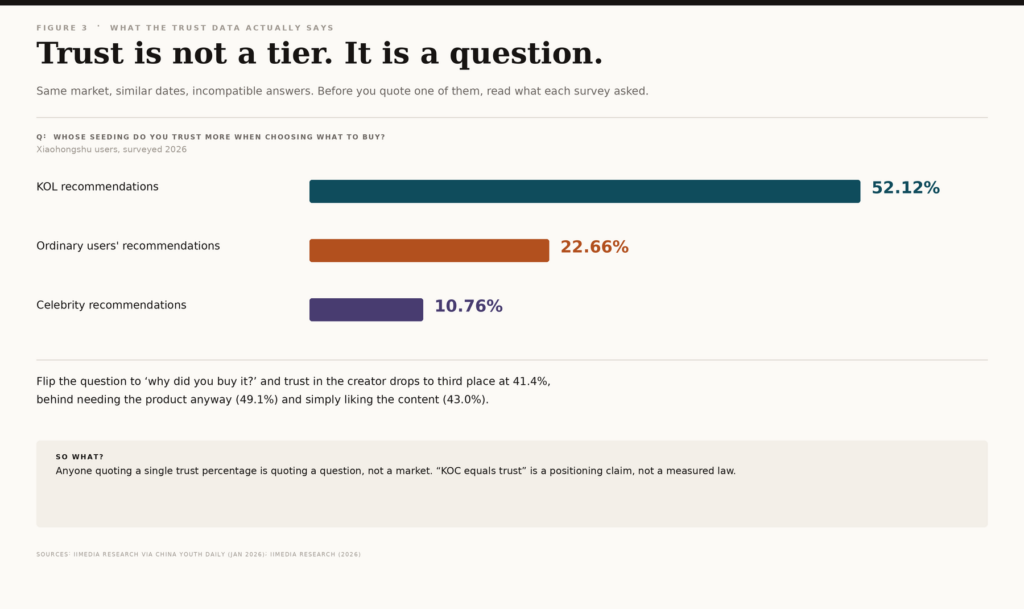
Here is where the industry’s favourite sentence falls apart. “KOCs own trust in China” gets repeated in every deck, and the survey data underneath it is far messier than the claim.
Ask Xiaohongshu users whose seeding they trust more, and the answer is not the little guy. KOL recommendations lead at 52.12%, ordinary users sit at 22.66%, celebrities at 10.76%. Ask a different question — why did you buy what a creator recommended — and trust in the creator drops to third place at 41.4%, behind needing the product anyway (49.1%) and simply liking the content (43.0%). Ask young consumers about celebrity endorsement and the number collapses into single digits. Same market, similar dates, three incompatible answers, because each survey measured a different decision.
And then there is the measurement problem underneath all of it. Studies cited by the China-British Business Council suggest up to 45% of influencer metrics may be fabricated, and roughly 45% invalid followers were detected across major Chinese platforms in 2023. Reach is not a fact you receive. It is a claim you audit.
The practical conclusion: test trust in your own category instead of importing someone else’s percentage. Twenty KOCs, one SKU, two weeks, then read the comments rather than the dashboard. Comments ask questions when the audience is real. They leave emojis when it is not.
8. Compliance follows the tier, not the invoice
One more reason the tier matters: it determines your liability.
The Advertising Law is the base layer. Endorsers may not recommend goods they have not used, they carry joint liability where false advertising concerns consumers’ life or health, and knowingly false endorsements can bring confiscation plus a fine of one to two times the fee.
The Internet Advertising Measures, in force since 1 May 2023, added two provisions that matter here. Article 9 requires knowledge-sharing, experience-sharing and review content that carries a purchase link to be clearly marked as advertising. Article 19 states that a livestream host who recommends goods in their own name or image takes on the duties of an advertising endorser. That second sentence is essentially the KOS tier written into law.
Then came a bigger change. On 7 January 2026, the market regulator and the cyberspace administration jointly issued the Livestream E-commerce Supervision and Administration Measures, the country’s first dedicated regulation for the sector, effective 1 February 2026. It builds a full-chain duty system across platforms, studio operators, hosts and MCN agencies; it requires identity verification and annual training for hosts; and it requires AI digital-human hosts to be persistently and conspicuously labelled as AI-generated, with the operator carrying legal responsibility. If your China plan involves synthetic presenters standing in for KOS staff, that clause is now your problem.
Enforcement has teeth. Xiaohongshu’s governance team had handled more than 3.2 million violating accounts by February 2025; in December 2025 it penalised 621 brands for irregular marketing and permanently banned 88; by November 2026 it was explicitly policing coordinated comment-section marketing.
Translate that into tier risk. KOLs carry classic endorsement exposure with the highest visibility. KOCs sit on the disclosure battlefield, because the “experience sharing plus shopping link” rule was written for exactly that format. KOS carries the most practical risk of the three, because an employee makes specific, comparable, checkable claims on a brand-owned account, and “I use it every day” has to be true.
9. Score each tier against its own job
The fastest way to waste a good campaign is to measure one tier with another tier’s scorecard.
- KOL: reach, search lift, earned media value, share of category conversation.
- KOC: saves and shares relative to likes, comment quality, how many of your target queries now return your product.
- KOS: qualified leads, close rate, sales value, response time on enquiries.
Two traps worth naming. Measure KOCs by CPM and you will conclude they are inefficient, then cut the only tier producing proof. Measure KOS by impressions and you will conclude they are small, then cut the only tier producing revenue.
10. A ninety-day sequence
- Write one sentence per tier describing the job. If you cannot, you do not have a strategy yet.
- Book one KOL moment, and build the handoff before you sign: a searchable brand term, a stocked landing page, KOS staff on shift.
- Cluster 20–40 KOCs around the exact queries buyers type, not around the hashtag your agency likes.
- Convert 20–50 frontline staff into KOS: one account each, two posts a week, a template bank, a lead-routing rule, and an incentive tied to closed sales rather than follower counts.
- Assemble the compliance file first: disclosure line, claim list per SKU, evidence, approval trail. Cheap now, expensive later.
- Review by stage, not by post.
Bottom line
The market is flattening at around ¥84 billion, with something close to ¥83.5 billion expected in 2026. Flat markets are unforgiving, because growth stops covering for bad allocation. Rent attention once, buy proof at volume, and own the close. The brands that win here are not the ones with the biggest name on the poster. They are the ones who knew which tier was supposed to do what — and paid for the stage the buyer was actually standing in.