The forty-point gap: why Chinese marketers want to leave and don’t
Every story about China’s marketing talent has the same shape. Agency people are going in-house. The pay is better, the work is closer to the business, and the smartest people have already left. The narrative is tidy, and it is largely true.
It is also, on the evidence, mostly not yet happening.
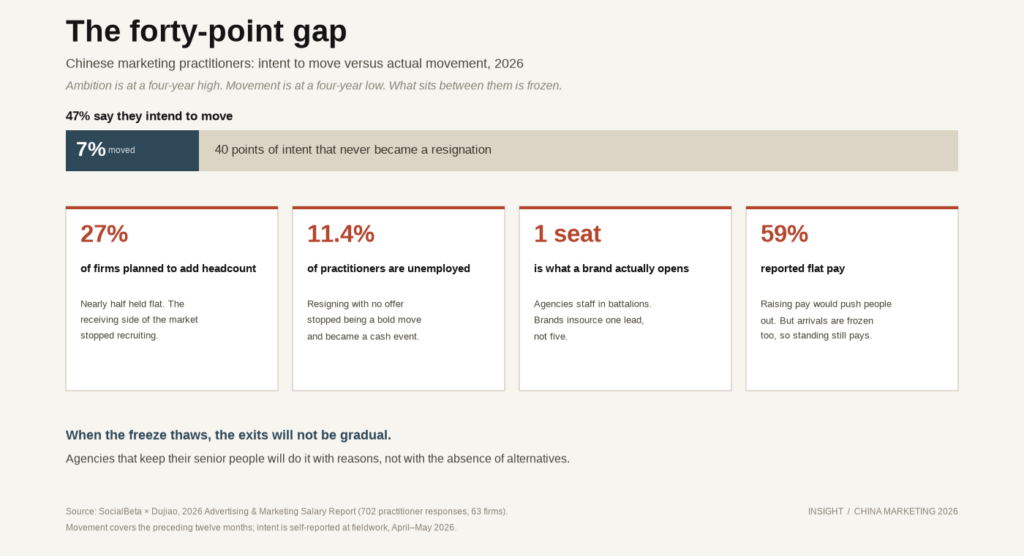
Here is the pair of numbers that should stop you. In the latest annual survey by SocialBeta and the recruitment platform Dujiao — 702 practitioners, 63 firms, fieldwork in April and May — 47 percent of respondents said they were preparing to move or actively watching the market. That is the highest reading in four years, up from 42 percent in 2024. In the same survey, roughly 7 percent had actually moved in the preceding twelve months.
Forty percentage points of ambition that never became a resignation.
The instinct is to read the gap as inertia. It is not. A forty-point gap that opens in the same year senior salaries diverge by RMB 1,550 a month is not people failing to act on their preferences. It is people acting rationally inside a market that will not let them.
Four things stand in the way, and none of them is a personality trait.
The receiving side stopped recruiting. Only 27 percent of companies said they planned to add headcount this year; nearly half were holding flat. The in-house migration the survey measures is real, but it is happening at the top of the org chart and nowhere else. Brands are not building marketing departments. They are surgically inserting one or two senior people into a team that already exists.
The downside changed. The share of practitioners listing themselves as unemployed rose to 11.41 percent. In a market where more than one in ten peers has no job, resigning without an offer stops being a courageous career move and becomes a cash-flow event. Agency people have always had the option of leaving badly. This year, they notice the price.
The seat count is smaller than the ambition. An agency team of thirty might need three people replaced in a year. A brand insourcing its strategic layer opens exactly one seat, often a new one, often for someone already known to the hiring manager. The volume of in-house work is growing much faster than the number of in-house positions. Every brand that brings strategy inside competes for the same small pool of people who can hold that job.
Standing still pays again. Fifty-nine percent of practitioners reported flat pay, and 11.8 percent took a cut. Ordinarily, frozen wages push people out the door. But when the destination market is also frozen, the value of not moving goes up. A modest raise and an unchanged title beat a leap into a vacancy that might close before you land.
Put those four together and the gap stops looking like a puzzle. It is a queue. A long one, formed at a door that opens a few inches at a time.
Which is why the second-order question matters more than the headline. A queue of this length does not dissolve when conditions improve — it discharges. The moment hiring thaws, the forty points of accumulated intent become forty points of actual movement, compacted into a single cycle, and the agencies that spent this year quietly congratulating themselves on stable headcount will discover they were stable for the wrong reason.
Stability built on the absence of alternatives is not retention. It is a deferred resignation.
The practical reading for anyone running a team in China: use the freeze. The people who wanted to leave but couldn’t are still sitting in your building, still under contract, and — unlike the ones who already went — still reachable. That window does not reopen. When the market thaws, the conversation you could have had this quarter becomes a counter-offer you lose.