32.6% More Revenue, 1.9% More People: The AI Math of China’s Ad Industry
In 2025, China’s advertising industry booked RMB 2.05 trillion in business revenue — up 32.6% in a single year, the first time the sector crossed the two-trillion mark. Over the same twelve months, the number of people working in it grew by 1.9%.
Read those two numbers side by side and you have the entire argument of this article. The work didn’t disappear. The money didn’t disappear. What disappeared was the assumption that output and headcount move together.
That is not a rounding error. It is a repricing.
And if you want to watch the AI-labour question get settled in real time — not theorised, not modelled, but measured — China’s marketing industry is the least ambiguous test case on earth. Here’s why, and here’s what it means for your own salary.
Why China Is the Cleanest Test Case Anywhere
Most labour-market debates about AI drown in confounds. Economies are messy; hiring slows for a dozen reasons at once; nobody can isolate the machine from the interest rate.
China’s marketing sector happens to sit in an unusually clean pocket of that mess. It is enormous — the world’s second-largest ad market, roughly a fifth of global spend. It is unusually measurable, because the State Administration for Market Regulation and the China Economic Information Society publish an annual index with headcount, pay, revenue-per-head and job-mix breakdowns. And it was, before 2022, structurally routine-heavy: a thick middle layer of copywriters, junior designers, media buyers and community managers whose job was to produce volume.
That is exactly the layer generative AI is best at eating. So the experiment almost designed itself.
The Pre-AI Baseline: What You Were Actually Paid For
Here’s the thing people forget when they mourn the old marketing career path. Most of that path was not paid for insight. It was paid for throughput.
A junior copywriter in 2019 was not compensated for having rare taste. They were compensated for being able to produce forty product descriptions before Friday, in a brand voice that was approximately right. A junior designer was paid to produce twelve banner variants at four different aspect ratios. A media buyer was paid to move budget between placements and report back.
Platform fluency — knowing how Douyin’s algorithm punishes a slow first second, how Xiaohongshu rewards a certain kind of caption, how WeChat private-domain funnels actually convert — commanded a genuine premium. That premium was real and it predates AI. But underneath it sat an enormous volume of repeatable execution, and the career ladder was built as a staircase of that execution: do the boring volume for three years, absorb the craft by osmosis, become someone who makes judgements.
Every rung of that staircase was load-bearing. That matters later.
The Output Side: 32.6% More Revenue, 1.9% More People
Let’s start with the least arguable data in this entire piece — the official numbers.
According to the China Advertising Industry Development Index Report (2026), released jointly by the State Administration for Market Regulation and the China Economic Information Society in June 2026, the industry’s composite index reached 143.3 points, up 11.6%. Business revenue hit RMB 2,050.21 billion. Internet advertising alone contributed RMB 1,357.43 billion, up 34.6%, now 66.2% of all ad business revenue.
And the employment line? Practitioners grew 1.9%.
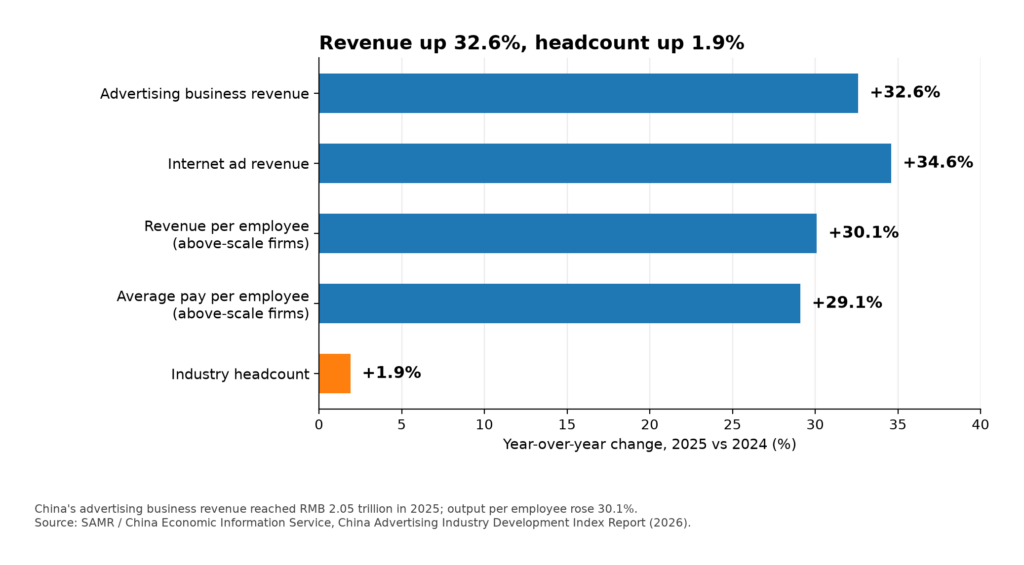
Revenue per employee at above-scale firms rose 30.1%. Average pay per employee at those firms rose 29.1%. Read that again: pay per head grew almost exactly as fast as output per head, in an industry that added almost no heads.
That is not a story about mass redundancy. It is a story about a productivity step-change being captured by the people who were already inside — and a door that stopped opening for the people who weren’t.
The industry’s own report says it plainly, in language that would be startling if it appeared in a Western trade body’s PDF: growth has shifted from relying on headcount expansion to relying on technology-enabled productivity; traditional basic roles are being replaced by AI and related technologies; the model is moving from labour-intensive to human-machine collaborative. And, crucially, the short-term pressure falls on base-level roles while the long-term adjustment is structural.
The Wage Fork: One Skill, RMB 78,000
Now the part that should make you check your own CV.
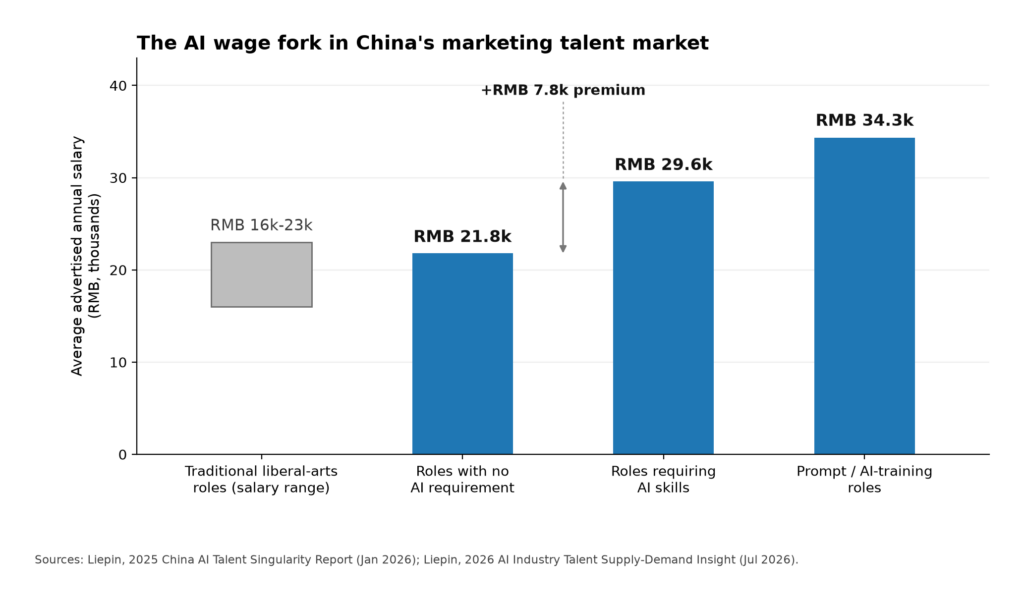
Liepin’s 2025 China AI Talent Singularity Report, published in January 2026, compared advertised salaries for roles that require AI skills against roles that don’t. The gap came out at RMB 78,000 a year — RMB 296,000 versus RMB 218,000. Same labour market, same city, often the same job title with one extra line in the description.
The demand side moved faster than the supply side. Postings requiring AI capability grew 215.61% year on year, while résumés explicitly claiming AI-tool proficiency grew 139.67%. When demand outruns supply that sharply, the price signal isn’t subtle.
Globally, the pattern is even blunter. PwC’s 2025 Global AI Jobs Barometer, built on close to a billion job ads across six continents, found the average wage premium for AI skills hit 56% in 2024 — more than double the 25% recorded the year before — while postings requiring AI skills grew 7.5% even as total postings fell 11.3%.
So the first half of the thesis holds up cleanly: the premium moved from execution to orchestration. Not because machines are clever, but because a marketer who can direct a model, specify a brand voice precisely enough to survive generation, and then judge the output — that person now produces what a small team used to produce. And they’re paid for the leverage, not the volume.
The Rung That Vanished
Here’s where it gets uncomfortable, and where most cheerful AI-and-jobs commentary quietly looks away.
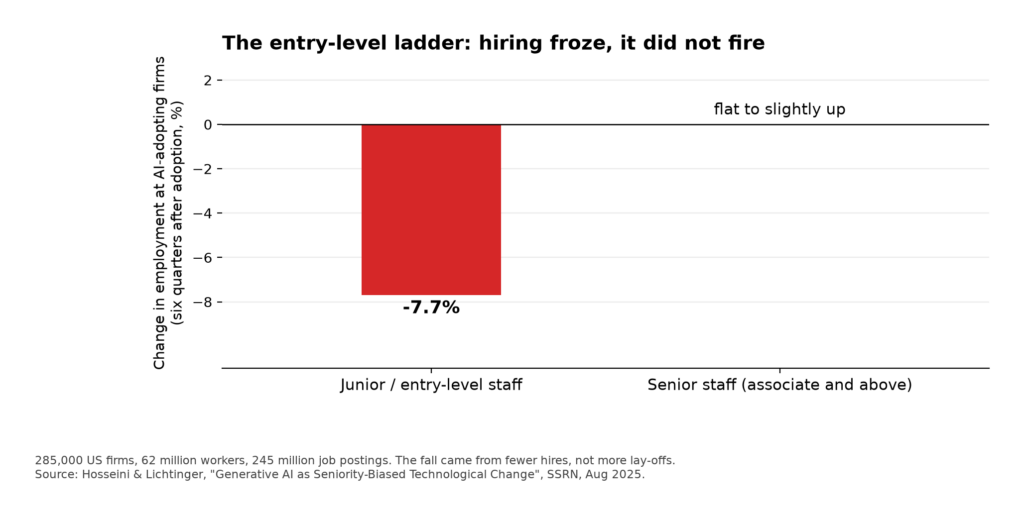
The Harvard research on this is the most rigorous thing we have. Hosseini and Lichtinger’s paper, Generative AI as Seniority-Biased Technological Change, posted to SSRN in August 2025, tracked 285,000 US firms, 62 million workers and 245 million job postings. At firms that adopted generative AI, junior employment fell 7.7% within six quarters. Senior employment didn’t.
And the mechanism matters enormously: the decline came from hiring, not firing. Firms didn’t march junior staff out of the building. They simply stopped replacing them. In the six quarters after adoption, AI-adopting firms hired roughly a fifth fewer junior people than comparable non-adopters.
Stanford’s HAI index work found the same shape in the occupations most exposed to AI: employment for 22-to-25-year-olds fell sharply relative to older colleagues, with software developers in that bracket down close to 20% from their 2022 peak by September 2025.
Now translate that to marketing. The junior copywriter role was never just a job. It was the apprenticeship. It was where you learned what a bad brief looks like, where you developed the instinct that tells you a headline is technically compliant and completely dead. If AI absorbs the volume work and firms stop hiring juniors to do it, you don’t just lose a salary band. You sever the supply line of future senior marketers.
Which creates a delicious, ugly irony: the industry is now inflating the price of judgement while quietly dismantling the institution that produced judgement.
Two Honest Objections — and Why They Don’t Rescue Anyone
Objection one: it’s the economy, not the machine. Fair. The entry-level hiring slowdown in many markets began before ChatGPT shipped, and China’s marketing sector has spent three years in a low-growth, high-caution cycle. Michael Page’s China Mainland Salary Report 2026 describes a market where employers are “cautious”, hiring focuses on roles that directly support profitability, and opportunities for generalists are shrinking. Not everything is AI’s fault.
But “not everything” isn’t “nothing”. The divergence between AI-required and AI-indifferent postings happened inside a cooling market — that’s the whole point of a structural shift. When total postings fall and AI-required postings rise, you’re not watching a tide. You’re watching a reallocation.
Objection two: everyone becomes a strategist. No they don’t. Most marketing work retains a routine component, and the realistic future is AI-assisted, not AI-replaced. The honest framing isn’t “stop doing execution and start doing strategy”. It’s “your execution now takes a tenth of the time, so the question becomes whether you can turn the reclaimed nine-tenths into judgement — or into more execution”.
That’s a personal choice, and a lot of people will make the wrong one, because more execution feels like productivity.
What China’s Platform Layer Did While Everyone Was Arguing
There’s a piece of this story that Western coverage routinely misses, and it explains why the wage gap opened so fast here.
China’s ad platforms didn’t wait for marketers to adopt AI. They shipped it as infrastructure.
CICC’s research on AI in Chinese advertising documented that Kuaishou’s AIGC marketing materials were already consuming more than RMB 30 million per day in the fourth quarter of 2024 — estimated at a low-double-digit share of total material spend. ByteDance’s Jichuang platform, Tencent’s Miaosi, Bilibili’s Bida: every major platform now ships a creative-production engine as a free or near-free layer inside the buying console. CTR’s 2025 China Advertiser Marketing Trends Survey found 53.1% of advertisers already use AIGC in creative generation.
Think about what that does to a headcount plan. When the platform will generate thirty compliant video variants, swap the digital-human presenter, test them, and kill the losers automatically — the marginal value of the fourth junior creative hire approaches zero. Not because they’re bad at their job. Because the job got absorbed into the ad buy.
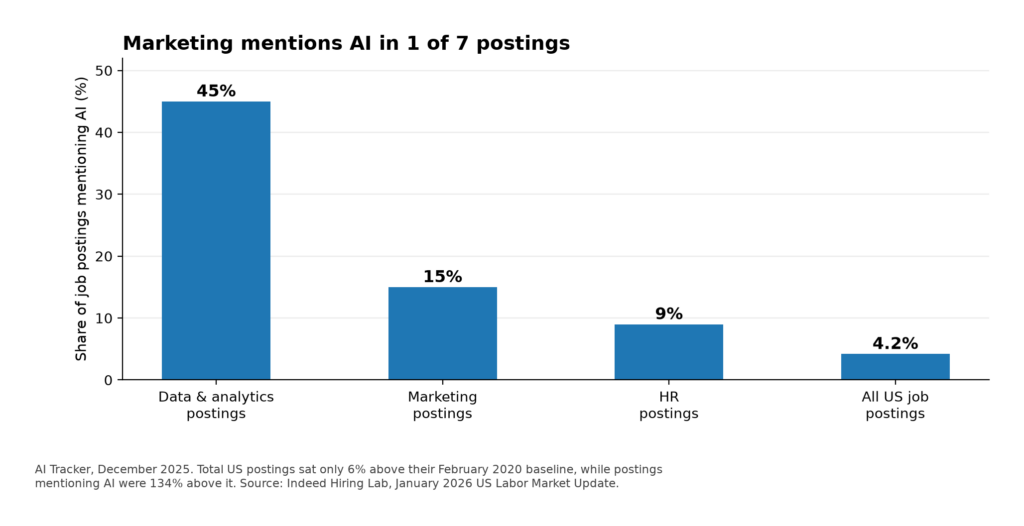
Meanwhile the demand signal kept climbing. Indeed Hiring Lab’s January 2026 update found marketing job postings mention AI in about 15% of cases — mid-table behind data and analytics at nearly 45%, but far ahead of human resources at 9%, and rising fast.
The Skills That Got Repriced
Let’s do the ledger properly, because vague talk about “upskilling” helps nobody.
Devalued:
- Volume copywriting — product descriptions, ad variants, SEO filler, templated social captions.
- Template design — banner resizing, layout variants, standard e-commerce imagery.
- Routine media buying and reporting.
- Generic community management — scripted replies, moderation at scale.
Revalued:
- Brand-voice specification precise enough that a model can execute it without drifting.
- Creative direction rather than creative production.
- Data and attribution judgement — deciding what a metric actually means.
- AI workflow orchestration: which model, which step, what guardrails, who signs off.
- Taste. Genuinely, taste — the ability to look at ten plausible outputs and know which one is right, and why.
The new meta-skill is leverage. One marketer who can write a voice spec, a prompt template and an evaluation rubric now produces what five people used to. And the market is paying for that compression — RMB 78,000 a year more, according to Liepin’s numbers, and far more at the top end.
Here’s the part that surprised me. Remember the assumption that AI would gut the humanities? Liepin’s 2026 AI Industry Talent Supply-Demand Insight, released at the World AI Conference in July 2026, found prompt-engineering roles up 486.84% year on year at an average annual salary of RMB 343,100 — and AI human-machine training roles at the same level. AI creative-narrative roles up 84.21%. AI ethics and social-science roles up 78.26%.
Traditional liberal-arts-friendly roles cluster at RMB 160,000 to 230,000. The new AI-adjacent ones sit at RMB 230,000 to 340,000.
So the machine didn’t eliminate the language graduate. It repriced her — provided she learned to speak to it in structured, evaluable, repeatable terms. What got destroyed was not humanistic skill. It was low-judgement, high-repetition work that happened to be done by humanists.
The Job Titles Are Already Being Formalised
If you want a leading indicator of where the org chart is going, watch what governments officially recognise.
China’s Ministry of Human Resources and Social Security added “generative AI system application specialist” to the national occupational classification in July 2024, alongside eighteen other new professions. A year later, the seventh batch added seventeen more professions and forty-two new work types — including “generative AI system tester” and “generative AI animation producer”.
That’s not a press release. That’s the state building training standards, evaluation criteria and salary benchmarks around a role that didn’t have a name in 2022. When a competency gets a job code, it gets a pay band. When it gets a pay band, it gets a budget line.
Expect “AI marketing operator” to follow the same path: not a side-competency you list in the skills section, but a defined role with a defined ladder.
The Data’s Shadow: What These Numbers Cannot Tell You
I’d be doing you a disservice if I pretended this was settled. Three caveats, stated plainly.
Chinese job-market data is directional, not precise. Platform salary pages are self-selected samples; recruitment reports measure advertised pay, not paid pay; the official index covers above-scale firms and public institutions, which is a particular slice of a very fragmented industry.
The Harvard study is American. The seniority-bias mechanism is probably universal, but the magnitude isn’t. China’s apprenticeship structure, its platform-native skill premium, its super-app ecosystem — all of that shapes how the repricing lands.
Correlation, not causation, on the aggregate numbers. The 32.6% revenue jump in 2025 partly reflects a statistical reclassification: from October 2025, platform ad-spend fees were brought into the advertising-expense category, which mechanically inflates the measured base. The productivity story is real, but don’t read 32.6% as pure organic growth.
What To Actually Do About It
Four moves, in order of leverage.
1. Audit your week for routineness. Not your job title — your actual tasks. List them, then mark each one: could a competent model do 80% of this with a good spec? The proportion you mark tells you your exposure. Job security now runs inversely to how routine your work is.
2. Move from producer to director. The identity shift is “I make the content” → “I specify, direct and sign off on the content”. The uncomfortable part: directing requires you to be able to articulate why something works. Many execution-level marketers have never had to. That articulation is now the job.
3. Stack platform fluency with AI fluency. China’s top of market is the intersection: you know how Xiaohongshu’s discovery layer actually behaves and you can build the workflow that feeds it. Either skill alone is commoditising. The pair is not.
4. Build the portfolio that proves judgement, not volume. Ten mediocre deliverables say nothing. One documented case — here’s the brief, here’s the AI workflow I designed, here’s the evaluation rubric, here’s the lift — says everything. Michael Page’s 2026 guide notes that candidates with scarce skills can command 30% jumps while generalists compress. That’s the whole game.
The Forward Look
Three things I expect to be true by 2028.
The entry-level marketing job will be redesigned rather than restored — less “produce volume”, more “operate and audit a system”, with a higher bar to entry and fewer seats. The apprenticeship problem will get worse before anyone fixes it, and the firms that solve it deliberately will have an unfair talent advantage in five years.
The AI-native marketer will formalise into a named role with its own salary band, roughly where the “growth hacker” title sat in 2016: slightly inflated, genuinely scarce, and eventually normalised.
And the premium will keep migrating. Not to “people who use AI” — that’s already table stakes, and BOSS Zhipin’s data shows the AI salary multiple cooling from 3.3x in 2022 to 2.6x in 2025 as adoption spreads. The premium migrates to people who can be accountable for what the AI produced. Accountability cannot be automated, because accountability requires someone to blame.
The Point, Stated Once
China’s marketing labour market isn’t proof that AI kills jobs. Total revenue is up, headcount is flat-to-up, and the industry is hiring — just differently.
What the data shows is a repricing along the judgement axis. Volume execution compressed because a machine now does it at near-zero marginal cost. Judgement, direction and orchestration inflated because the supply of people who can do them didn’t grow — and the pipeline that used to produce them is being dismantled.
Which leaves every marketer with the same fork, in Shanghai or in Chicago. The work that made you employable in 2019 is now the work that makes you replaceable. Not because it was worthless — because it was learnable by a machine. The part that isn’t learnable by a machine is the part you have to start doing on purpose.
AI didn’t take the marketing job. It took the routine half, and handed you the other half with a higher price tag attached.
Whether that’s a promotion or a warning depends entirely on which half you’ve been practising.