Why the fine everyone fears almost never shows up in the statistics
Here is a puzzle worth sitting with.
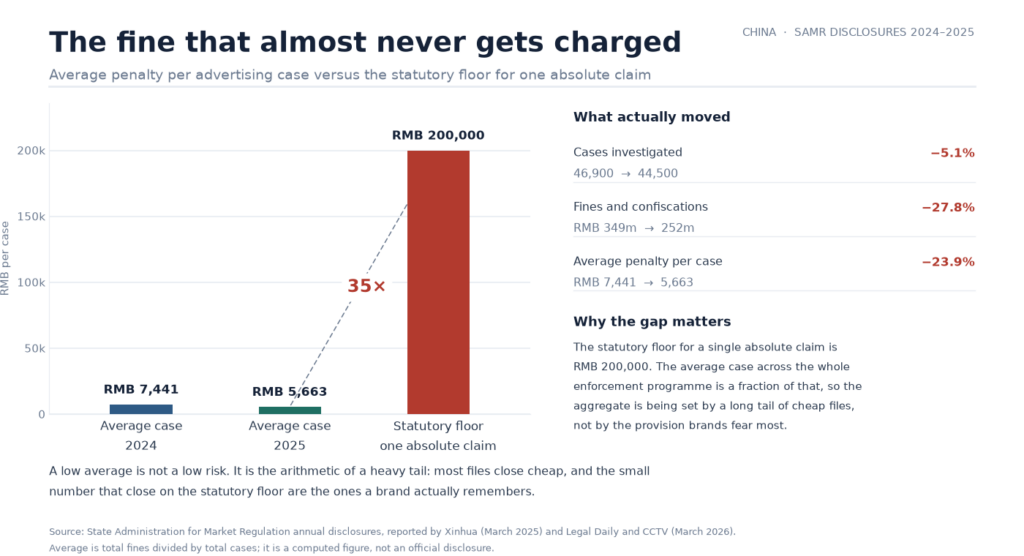
The statutory fine for using one banned superlative in a Chinese ad — a single word, on a claim that might even be true — starts at RMB 200,000. Yet the average advertising penalty across the entire national enforcement programme in 2025 was RMB 5,663.
That is a gap of about thirty-five times. Both numbers are real, both come from the same regulator, and if you build a risk model out of the second one, you are modelling the wrong population.
The average is a portfolio, not a penalty
Regulators do not run one kind of case. They run tens of thousands, and most are small: a shop that failed to mark an advertorial, where the ceiling is RMB 100,000 and the outcome is often a correction; a minor claim by a vendor with no compliance function. In 2024, of 46,900 cases, more than 30,000 were internet advertising and 19,100 fell in six priority sectors. Those two buckets are most of the file.
Average across that and you get a number in the low thousands. It describes the typical file, not the typical breach a brand like yours would commit.
The tail is where the risk actually lives
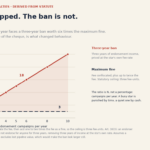
The distribution is not a bell curve. It is a heavy tail: a dense cluster of cheap closures, and a thin, expensive edge.
The 2025 figures move unexpectedly. Cases fell 5.1 per cent, penalty value 27.8 per cent — but average penalty per case fell too, from RMB 7,441 to RMB 5,663, a 23.9 per cent drop. The portfolio got cheaper, not bigger. Whatever 2025 represented, it was not a pivot toward fewer, larger flagship cases.
The cases brands remember all sit on the edge. The Tinghua liquor matter, run across three provinces and the full chain — outlets, organisers, planners — closed at RMB 4.3 million. The Xihan Yangsheng series, across six provinces, at RMB 3.08 million. Neither is visible in an average of 5,663 — averages are not built to make outliers legible.
The gap that is quietly widening
There is a second signal, and it is the more interesting one.
China Consumers Association figures show 2,016,448 complaints in 2025, up 14.45 per cent. Of those, 158,902 were classed as false or misleading advertising — 7.88 per cent of the total, up from 6.60 per cent in 2024, one of the few categories whose share rose. Demand-side pressure on claims is increasing. Penalty capacity per case is decreasing.
Put those together and you get triage. A regulator facing more complaints and collecting less per file necessarily becomes more selective about which files get expensive. That is the mechanism behind the falling average — not leniency, concentration. Fewer claims pursued to the statutory floor, and those that are pursued, pursued properly.
What this means if you are planning a budget
The implication is uncomfortable for anyone who likes point estimates. Falling averages do not mean falling risk. They mean rising variance. Exposure is becoming bimodal: most campaigns land in the cheap cluster and never learn the regime exists, and a small number land on the edge — where the penalty is a multiple of the floor rather than a fraction of it, and where the investigation walks backward through your agency, your KOL and your media buyer.
Provision for the variance, not the mean — and read the average as a description of everyone else’s files, not a forecast of yours.
The fine you are afraid of was never in the average. It is in the tail, and the tail is getting thinner and sharper at once.