The Fine Was Never the Point: Why China’s Endorsement Ban Does the Real Work
In 2022, Jing Tian paid RMB 7.22 million for a single food commercial. That number made the headlines. The clause that actually changed behaviour is the one nobody bothered to total up.
In late May 2022, Guangzhou’s market regulator closed its case against Jing Tian. The breakdown is the interesting part: RMB 2.579 million of endorsement fees confiscated, plus a fine of RMB 4.642 million. Total RMB 7.2212 million — 2.8 times what she had been paid.
Now run the arithmetic nobody ran at the time. Article 61 of the Advertising Law caps the whole package at three times the fee: one part confiscation, up to two parts fine. Which means the penalty is not scaled to the harm done. It is scaled to the invoice. A star earning eight figures per campaign can absorb a three-times multiplier and take the next meeting.
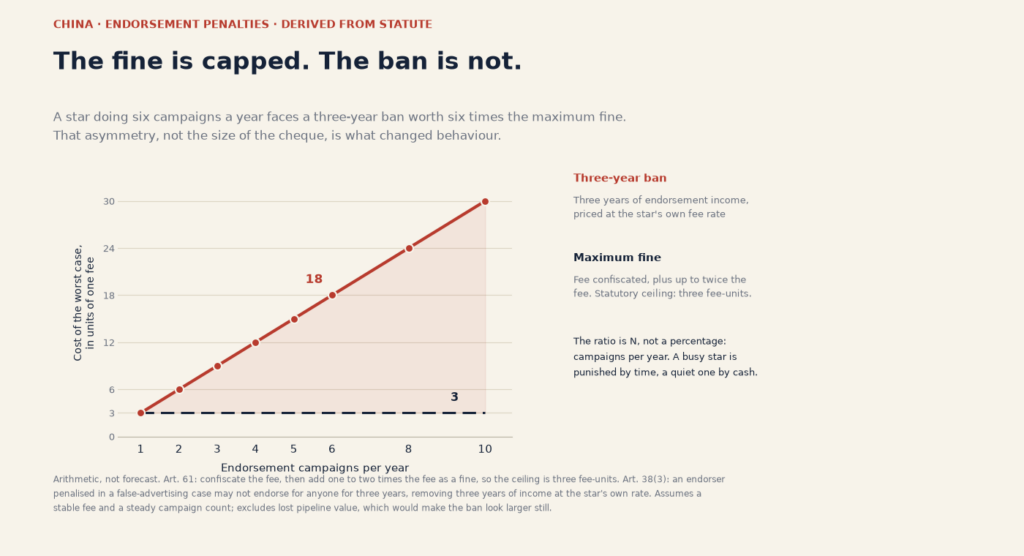
Here is what actually bites. Article 38(3) says an endorser penalised in a false-advertising case may not endorse anything, for anyone, for three years. That is not a percentage of a fee. It is the deletion of a revenue line, and its size is not fixed by statute: it is three years times however many campaigns the star would otherwise have signed. The ratio between the two penalties is therefore N — campaigns per year — not a constant. A star who books six endorsements annually faces a ban worth six times the maximum fine.
And yet the ban was never really aimed at the talent’s wallet. Read Article 58 next to it. A brand that uses a disqualified endorser is itself in violation, with penalties calculated on its advertising spend: one to three times the spend, a flat fine where the spend cannot be calculated, three to five times in serious cases, and licence revocation on the table. So the star’s disqualification does not stay with the star. It converts into an advertiser-side penalty proportional to the campaign rather than to the fee. That is the mechanism sitting behind the morality clauses, eligibility warranties and clawbacks that now appear in every serious endorsement contract.
Which raises the question worth asking. If the clause has existed since 2015, why did it take a decade to matter?
Because enforcement needs evidence, and evidence needs a format. Proving that an endorser “knew or should have known” is straightforward when the claim was scripted, pre-approved and filmed in a studio with a compliance file attached. It is close to impossible against a shoot where the star read a line somebody else wrote. For most of the law’s life the three-year bar was, as a 2021 editorial in The Paper put it, a scarecrow: no star had yet been administratively penalised for endorsing a false ad.
Then the format changed. A livestream is four hours of unscripted speech, recorded, archived, timestamped and re-cut into ads. It manufactures exactly the evidentiary record a television shoot never produced. The 2025 totals — 44,500 advertising cases, 9,487 of them in food, with influencer livestream endorsement singled out as a priority — are not the product of a new statute. They are the product of a new paper trail.
That is the finding. China did not tighten its endorsement rules in 2026 so much as it finally acquired the evidence to apply rules written in 2015. And that leaves brands with an uncomfortable question to underwrite: the risk is no longer whether the star can stay out of trouble. It is whether you can document what they said, and when.