China’s Ad Law in Practice: The Compliance Crash Course
There is a specific moment that catches foreign marketers in China, and it is rarely the one they prepare for.
It is not the legal review meeting. It is the Tuesday afternoon when someone in Shanghai says, very politely, that the hero line — the line, the one the global CMO personally approved — cannot run. Not because it is false. Because it is absolute.
That distinction is the whole game, and it is the thing almost nobody arriving from a Western market is told at the start.
The thing your global playbook never had to teach you
In most Western markets, “best” is a posture. It reads as puffery — a flourish, a tone of voice — and regulators largely leave it alone, because no reasonable consumer treats “the best coffee in the world” as a measured factual claim. You can say it, everyone understands the move, and the market prices it accordingly.
China does not price it that way.
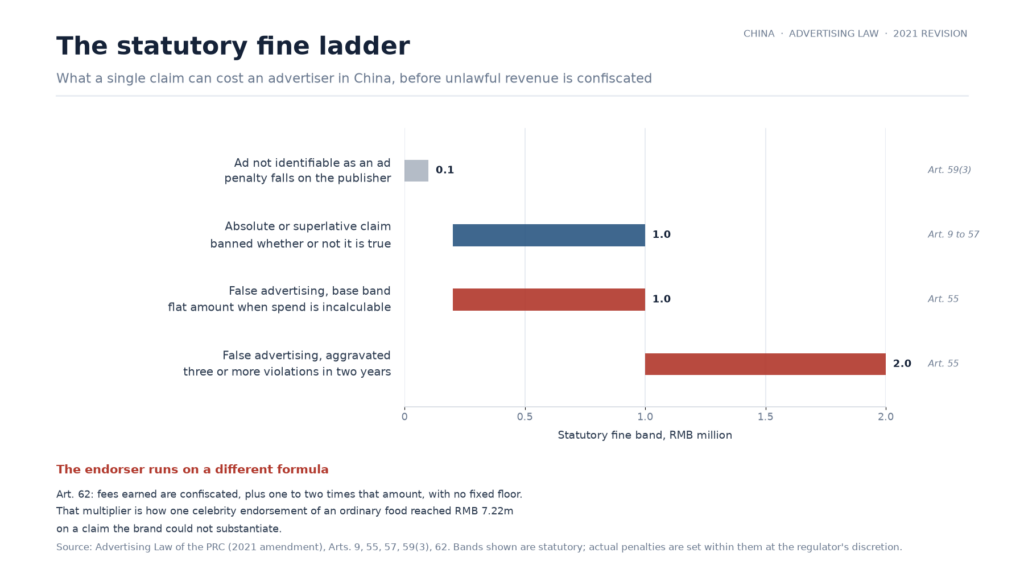
Article 9(3) of the Advertising Law prohibits advertising from using terms such as national-level, highest-level and best, along with any other wording of the same or similar meaning. The statute is short. What makes it consequential is what sits behind it: Article 57 sets the penalty for breaching Article 9 at a fine of RMB 200,000 to RMB 1,000,000 for the advertiser, with licence revocation available where circumstances are serious, and with the advertising review authority empowered to withdraw approval documents and refuse new applications for a year.
Read those two provisions together and the strategic picture changes. The floor is not zero. The floor is RMB 200,000 — and it applies whether or not the claim is true.
That clause is what breaks the imported mental model. In a Western compliance review, the question is “can we prove it?” In China, for an absolute claim, the question is “did we say it?” Truth is not the defence you were expecting.
What the regulator actually published, and why it cuts both ways
Here the story gets more interesting than the standard “China bans superlatives” warning — and this is where a lot of foreign commentary gets it wrong in the opposite direction.
On 25 February 2023, the State Administration for Market Regulation issued its Enforcement Guideline on Absolute Terms in Advertising (Announcement No. 6 of 2023). It is a genuine attempt to stop mechanical, one-size-fits-all enforcement, and it defines the space you can actually operate in.
The Guideline sets out situations that fall outside Article 9(3). Two categories matter most.
First, terms that do not point at the product being sold. If the wording only expresses the advertiser’s service attitude, operating philosophy, corporate culture or subjective aspiration, or only states a target the company is pursuing, the absolute-terms rule does not apply. Nor does it apply where the term is not directly connected to the performance or quality of the goods and would not mislead consumers.
Second, terms that do point at the product but carry no objective consequence of misleading consumers or disparaging competitors. That covers self-comparison within the same brand or company; consumer notices on how long to use a product, when to use it, or how long it keeps; product grading terminology recognised under national, industry or local standards where the basis is stated; absolute terms inside a product name, model number, registered trademark or patent, used to identify the product and distinguish it from others; awards and titles assessed under state rules that contain such terms; and — the most commercially useful — statements of chronological order or of factual information such as sales volume, sales value or market share, where the specific time and geographic conditions are stated.
That last provision is the escape hatch, and it is a real one. “Ranked first by X in a Y survey of Z buyers in 2025” is not the same claim as “the best.” The first is a fact with a boundary drawn around it. The second is an assertion whose boundary you cannot draw.
The Guideline also handles penalty discretion, and the drafting there is precise in a way that matters operationally. Article 9 provides that, outside the exempted categories, a first use of an absolute term where the harmful consequence is minor and corrected in time may be exempt from administrative penalty. Article 10 goes further for advertising on the operator’s own premises, own website or another medium it lawfully controls: where the term was displayed briefly or seen by few people, caused no harmful consequence and was corrected in time, the authority shall not impose a penalty; where the consequence was minor, it may impose a lighter or reduced one.
Note the modal verbs. May versus shall. Those two words separate a discretionary pass from a legal entitlement, and they govern only that narrow self-published scenario. They are not a general amnesty. Treating them as one is how brands end up in the aggravated band.
The 2026 addition that turns substantiation into paperwork
If the absolute-terms rule is the front door, citation is the back door — and until recently it was the one nobody locked.
Article 11 requires that data, statistical material, survey results, abstracts and quotations used in advertising be true, accurate and attributed to a source, with any applicable scope and validity period clearly stated. On 3 June 2026, SAMR published its Enforcement Guideline on Cited Content in Advertising (Announcement No. 20 of 2026), which converts that principle into something close to an audit standard.
The Guideline requires cited content to be true, accurate and lawful, and expressly forbids citing fabricated, forged or unverifiable material. Statistics and survey results must come from scientific method, with a scope that is broad and reasonable; where sampling is used, the sample must be scientific and representative and the deviation within a reasonable range. The cited content must be consistent with the meaning of the underlying experiment, measurement, test data, research finding, statistics, survey result or literature. That is a subtle but significant bar: it is not enough that your number appears in the source, because your use of it must not travel further than the source’s own meaning.
Source disclosure is specified in detail — the name of the institution that ran the experiment, measurement, test, research, statistics or survey; for journal citations, the journal name, issue number and edition; for internet sources, the access path, and if the online content or path changes, the advertising must be adjusted or withdrawn. Where cited content has a scope or validity period, it must be stated: laboratory-only or condition-specific reproducibility, test data valid only for the submitted sample, and geographic, industry or temporal limits on findings, statistics and surveys.
Two drafting details catch people who believe they are compliant. First, data the advertiser commissions from a third party and then uses counts as cited content — outsourcing the study does not outsource the obligation. Second, breach of the disclosure and scope provisions is treated as a breach of Article 11 and pursued under Article 59. So the fix is not rhetorical. It is a file: the study, the institution, the sample, the date, the boundary.
Why the aggregate numbers are the wrong thing to look at
This is where most analysis of Chinese ad enforcement goes astray, and it is worth being blunt.
The headline figures look like a softening. In 2025, market regulators nationwide investigated 44,500 advertising violations and imposed RMB 252 million in fines and confiscations, per SAMR disclosures reported by Xinhua, CCTV and Legal Daily. In 2024 those figures were 46,900 cases and RMB 349 million.
Cases fell about five per cent; penalty value fell nearly twenty-eight per cent. Read at face value, that is a regulator easing off. It is not. What it shows is a shift in where the money comes from — fewer, larger, more carefully built cases, with average value per case falling from roughly RMB 740,000 to RMB 570,000.
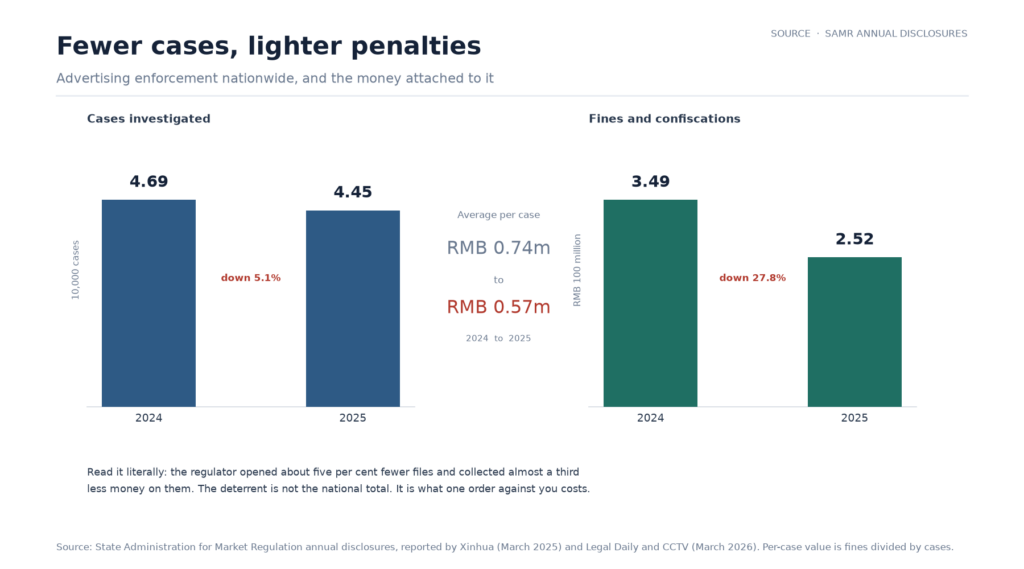
None of that is reassurance at the level of a single brand. The number that matters for your campaign is not the national total. It is the statutory band attached to the article you are about to breach, and those bands did not move.
The composition of enforcement tells you where attention sits. The 2024 disclosure broke the numbers out usefully: of the total, 19,100 cases fell in the priority sectors — medical, pharmaceutical, medical devices, health food, financial services and education — carrying RMB 158 million in penalties, while more than 30,000 cases were internet advertising, carrying RMB 187 million. Roughly two-thirds of cases sat on the internet, and roughly half the money sat in six sectors the regulator has publicly named.
Two co-ordinated crackdowns from that year show how a file gets built when the regulator decides to make an example. On the Tinghua liquor matter, SAMR directed authorities in Sichuan, Qinghai and Tibet to pursue the leads through the full chain — the outlets that ran the advertising and the organisers and planners behind them — for combined penalties and confiscations of RMB 4.3 million. On the Xihan Yangsheng oral liquid series it directed six provinces — Jilin, Heilongjiang, Henan, Hubei, Sichuan and Shaanxi — for combined penalties of RMB 3.08 million.
The lesson is structural rather than financial. When a claim crosses a line the regulator cares about, the investigation does not stop at the media buyer. It walks backward through the chain.
The endorsement trap, and why the maths is different
If absolute claims are the most common failure, endorsements are the most expensive, because the penalty is not a fine band at all.
Article 38(1) requires that an endorser’s recommendation be based on fact and prohibits endorsing goods the endorser has not used or services they have not received. Article 38(2) bars anyone under ten from acting as an endorser. Article 38(3) bars anyone who recommended or certified in false advertising and was penalised for it within the previous three years.
The penalty sits in Article 62, and it is a multiplier rather than a range: the authority confiscates the unlawful gains and imposes a fine of one to two times that amount. No floor, no absolute ceiling — exposure scales with what the endorser was paid.
Which is precisely how one case became the industry’s reference point. In 2022, the Tianhe District Market Supervision Administration in Guangzhou handled the endorsement by actor Jing Tian of an ordinary fruit-and-vegetable food sold by Guangzhou Wuxianchang Health Technology. The product was ordinary food. The company had no valid evidence that it blocked the absorption of fat and sugar. Jing Tian, who could reasonably be expected to know that ordinary food may not be advertised with therapeutic or health effects, and who had not verified the efficacy claim through any valid channel, nonetheless recommended the product in her own name and image as having that effect.
The outcome: unlawful gains of RMB 2.579 million confiscated, a fine of RMB 4.6422 million, total RMB 7.2212 million. The company was dealt with separately and later listed as a seriously dishonest enterprise.
Note what the number is not. It is not a fine calibrated to the size of the campaign. It is a multiple of what one person was paid to say one sentence.
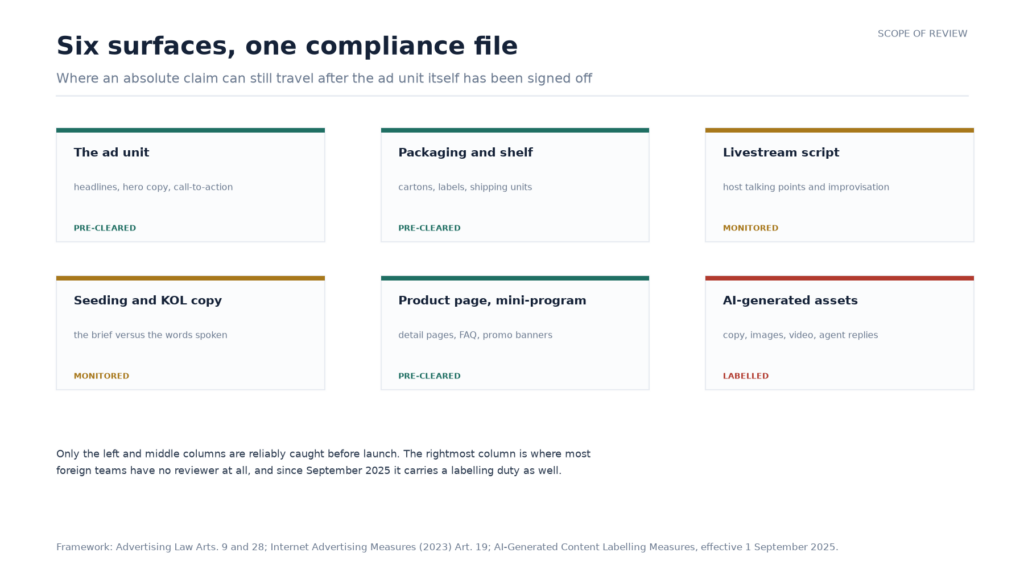
The surfaces your review process does not cover
This is the part of the crash course most global teams have not internalised, because the failure mode is not a bad claim. It is a good claim in an ungoverned channel.
Start with the definitional move that ended the “it isn’t really an ad” defence. Article 19 of the Internet Advertising Measures, effective 1 May 2023, provides that where a merchant or service provider promotes goods or services by internet livestream and that constitutes commercial advertising, it bears the advertiser’s responsibilities. Where a livestream room operator, or a livestream marketer, accepts a commission to design, produce, place or publish advertising, it bears the operator’s and publisher’s responsibilities. And where a livestream marketer recommends or certifies goods in their own name or image in a way that constitutes endorsement, it bears the endorser’s responsibilities.
Read that last sentence twice. The host reading a script is not a channel. The host is a potential endorser with a multiplier-based penalty attached.
Then there is identifiability. Article 9 of the same Measures requires internet advertising to be identifiable as advertising, and specifically requires that where goods or services are promoted through knowledge sharing, experience sharing or consumption reviews with an attached purchase link or similar buying mechanism, the publisher must prominently mark it as advertising. Article 14 of the Advertising Law requires identifiability generally, and Article 59(3) sets the penalty for breach at correction plus a fine of up to RMB 100,000, imposed on the publisher.
The regulator then filled the practical gap. SAMR’s Enforcement Guideline on the Identifiability of Internet Advertising, published 22 August 2024, confirms that identification turns on substance rather than the presence of a link — whether something is marked as advertising is not the test for whether it is advertising. It expressly permits voice prompts as a means of identification, so a livestream host can discharge the marking duty verbally with a clear spoken statement. And it allocates responsibility: a platform user publishing advertising through the platform’s services is the publisher, and where the platform operator intervenes in natural ranking by human or algorithmic means, influences display, or attaches a purchase link in a way that constitutes advertising, the platform operator is the publisher.
Then the newest layer, and the one with the shortest implementation runway. The Measures on the Labelling of AI-Generated Synthetic Content, issued jointly by the Cyberspace Administration of China, the Ministry of Industry and Information Technology, the Ministry of Public Security and the National Radio and Television Administration, took effect on 1 September 2025, alongside mandatory national standard GB 45438-2025. The regime requires both explicit labels — text, sound or graphic notices perceptible to users — and implicit labels embedded in file metadata. Where a service offers download, copy or export, the file must carry a compliant explicit label. Distribution platforms must verify metadata and label content that is declared, detected or identified as generated.
Now place those three instruments side by side. A brand runs an AI-generated presenter, in a livestream, reading a script containing an absolute claim, with a purchase link in the description. Four obligations attach at once: the endorser duty under Articles 38 and 62; the identifiability duty under Articles 14 and 59(3); the labelling duty under the 2025 Measures and GB 45438-2025; and the underlying claim duty under Articles 9 and 57. The pre-publication review most global teams run catches, at best, the last one.
The workflow that survives contact
What follows is not a compliance philosophy. It is the operating sequence the enforcement pattern implies.
Build the claim register before you build the campaign
Every claim that will appear anywhere gets logged with three fields: what is asserted, what evidence supports it, and which provision governs it. That register is what turns legal review from an opinion into a check. A claim with no evidence line and no article number does not get made.
Rewrite absolutes as bounded facts
This is where most of the creative work now lives, and it is a craft skill rather than a restriction. “The best-selling serum in our category” becomes “the top-selling serum in the mass-market facial category on Tmall in the twelve months to December 2025, per [named data provider].” The second sentence is longer, less elegant, far more defensible — and, usefully, the 2023 Guideline expressly contemplates exactly this construction when time and geography are stated.
Treat substantiation as an artefact, not a position
Under the 2026 citation Guideline, “we know it’s true” is not a defence; “here is the study, the institution, the sample, the date and the boundary” is. Build the file when the claim is created, not when it is challenged. And respect the consistency requirement: your headline must not claim more than the underlying finding actually says.
Collapse the review surface into one queue
The ad unit, the packaging, the product detail page, the mini-program, the KOL brief and the AI-generated asset should pass a single reviewer against a single register. The reason brands get caught on the sixth surface is that surfaces one through five were approved by five people against five standards.
Pre-cleared vocabulary beats post-hoc correction
Give writers, hosts and prompt templates a library of constructions that are already safe: quantified comparisons with a named source and a stated window; mechanism language rather than outcome promises; ingredient and process descriptions rather than efficacy claims. This is cheaper than review and it reaches surfaces review cannot.
Monitor, because the unscripted channel is the exposure
The livestream and the seeding post are where the compliance file and the actual words diverge. The 2024 identifiability Guideline hands you a workable tool here — voice prompts — but only if someone is listening. Build a loop that samples live output, not one that audits the brief.
Know where the pre-publication gate is absolute
Article 46 requires advertising for medical services, pharmaceuticals, medical devices, pesticides, veterinary drugs and health food to be reviewed by the advertising review authority before publication, and prohibits publication without that review. Article 58 sets the penalty for publishing without it at one to three times the advertising expense, or RMB 100,000 to RMB 200,000 where expense cannot be calculated or is manifestly low, rising to three to five times, or RMB 200,000 to RMB 1,000,000, where circumstances are serious. In those categories, no amount of claim-craft substitutes for the approval document.
The cost you are actually optimising against
It is tempting to model this as a fines problem and size a provision accordingly. That is the wrong model, and the enforcement data hints at why.
Fines are the visible cost. They are also the smallest. Under Article 57, serious circumstances permit licence revocation and, for the advertiser, withdrawal of approval documents with no new applications accepted for a year. Under Article 55 the same is available for aggravated false advertising. For a brand whose China revenue depends on continued certification and continued platform access, those are not penalties. They are an exit.
Then there is reputational asymmetry, which is specific to this market and rarely modelled explicitly. A regulatory finding that a brand overstated a product claim does not read to a Chinese consumer as an isolated marketing error. It reads as evidence about what kind of company this is. The Edelman Trust Barometer China report, published with Tsinghua University’s National Image Communication Research Centre, put China’s composite trust index at 80 in 2026 against a 28-market average of 57 — a genuinely high-trust market. That is the asset a public enforcement notice draws against.
The demand-side data says the same thing from the other direction. China Consumers Association figures for 2025 record 2,016,448 complaints received nationwide, up 14.45 per cent, of which 158,902 were classed as false or misleading advertising — 7.88 per cent of the total, up from 6.60 per cent in 2024, and one of the few categories whose share rose rather than fell.
Consumers are not passively absorbing claims. They are filing on them.
What compliance gets you that care does not
There is a version of this article that ends on a warning, and that would be a disservice, because the strategic read is more interesting than the risk read.
Brands that operate well in this regime do not produce weaker marketing. They produce marketing with a different centre of gravity. Where a Western brief reaches for a superlative as a shortcut to confidence, the China-competent brief reaches for a number, a source and a window — and that construction is commercially the stronger object, because it gives the reader something to check. In a market where consumers file two million complaints a year and trust is the scarce input, giving the reader something to check is not a constraint on persuasion. It is the mechanism of it.
The crash course, in the end, is not a list of forbidden words. It is a discipline that forces every claim to have a spine: an assertion, an article, an artefact. Brands that build that spine once — in the register, the vocabulary library, the review queue — stop rediscovering it campaign by campaign.
And they stop getting the Tuesday afternoon call.
The short version
Absolute claims are banned in China whether or not they are true, and the floor is RMB 200,000. The 2023 Guideline carves out real room — self-comparison, standards-based grading, awards, and bounded factual statements of sales or share with time and place stated — and that room is where good China copy now lives. Citation is a separate obligation with its own 2026 audit standard, and it demands a file rather than an assertion. Enforcement volume fell in 2025 while the statutory bands stayed exactly where they were, so the aggregate is not your risk model. Endorsements run on a multiplier, livestream hosts can be endorsers, seeding content with a link must be marked, and AI-generated assets have carried a labelling duty since September 2025. Build the register, bound the claim, file the evidence, unify the review surface, and watch the live channel. The reward is not only avoiding the fine. It is a claim architecture a sceptical market can verify — which is the only kind that converts.