Less Than One Percent: What a Celebrity Endorsement Is Worth to China’s Gen Z
Ask a Chinese brand manager what happens when they put money behind a display ad aimed at people born after 1997, and you will usually get a shrug. Ask the same manager what happens when a 400-follower account posts a photo of a cracked phone case with the caption “third one this year, the hinge is the weak point,” and you will get a different answer: the search page fills up, the product page traffic spikes, and the customer service inbox starts moving.
Both things are advertising. One gets skipped before it renders. The other gets saved, forwarded, screenshotted and argued about in the comments.
That gap is the whole story. China’s Gen Z is not hostile to being sold to. It is hostile to being sold to in the format of an advertisement. And once you accept that distinction, most of the received wisdom about “reaching young Chinese consumers” stops working.
The trait, stated plainly
China’s Gen Z trusts content. Not “content marketing” in the agency-deck sense — actual content: the review, the comparison, the unboxing, the tutorial, the ordinary person’s photo of a product they paid for with their own money, and increasingly the answer an AI hands back when they type a question at eleven at night.
What it does not trust is the pitch. The banner, the pre-roll, the celebrity holding a bottle, the brand film with a symphony score — these are read as commercial speech, and commercial speech is discounted automatically. Not angrily. Automatically. The way you discount a pop-up.
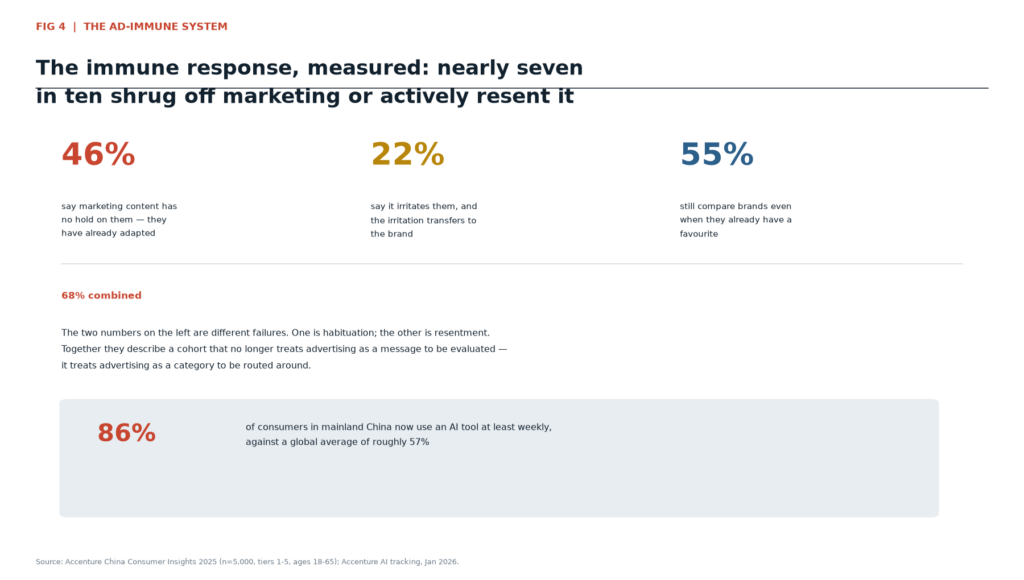
This is not a soft, self-reported attitude. Accenture’s 2025 survey of 5,000 Chinese consumers found that 46 percent say marketing content has essentially no hold on them, and another 22 percent say it actively irritates them and the irritation transfers to the brand. That is 68 percent of the market either immune or resentful. In the same study, the influence of celebrity endorsement on trying a new brand fell by four percentage points against 2021, and streamer recommendations fell by three.
And yet the very same cohort will sit through a twenty-minute teardown of a mechanical keyboard.
The attention is enormous. It is just allocated to content-shaped things rather than ad-shaped things. That single sentence explains more about Chinese youth marketing than any channel deck you will read this year.
Why this cohort, specifically
Four mechanics produced this, and they compound.
1. Exposure built the reflex
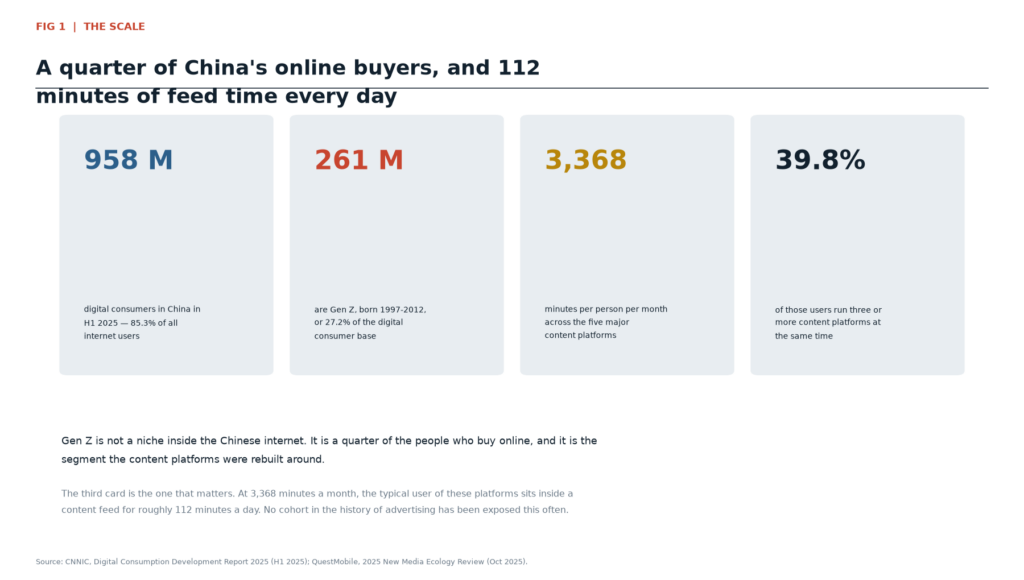
China’s advertising industry booked 2.05 trillion yuan in revenue in 2025, crossing the two-trillion mark for the first time, with internet advertising now carrying 66.2 percent of the total. That is the supply side. On the demand side, QuestMobile counted 1.149 billion de-duplicated monthly users across the five major content platforms in October 2025, spending an average of 3,368 minutes each per month.
Do the arithmetic: roughly 112 minutes a day inside a feed.
No previous cohort of consumers has spent anything close to that much time inside a surface engineered to serve them commercial messages. And the predictable result of over-exposure is not persuasion. It is tolerance, then resistance. Ad-blindness in this cohort is a learned adaptation, not a personality trait — which matters, because learned adaptations can be unlearned by changing the format, and cannot be unlearned by shouting louder.
2. The medium trained the preference
For this generation, discovery does not start with an advertisement and continue into content. It starts with content and ends with a purchase. Search is where the decision actually happens: Xiaohongshu disclosed more than 400 million monthly users and roughly 800 million searches a day in May 2026, with about seventy percent of its monthly users searching on the platform.
That is the structural point. When your entire information environment is user-written notes, video essays and comment threads, an advertisement is not the default surface. It is an intrusion into a flow you chose. The medium taught the preference before any marketer had an opinion about it.
3. The verification reflex got tools
Chinese consumer culture already carried a strong verify-before-trust instinct. What changed is the cost of verifying. A shopper who wants to know whether a serum is worth 600 yuan can now check the ingredient list against a competitor’s, read forty reviews, watch a dermatologist’s video, and cross-examine an AI assistant — in under ten minutes, on a phone, in a queue.
Accenture’s Gen Z work captures this cleanly: compared with older cohorts, Gen Z relies far more on multi-source validation, and prefers information vetted through livestream and video platforms, content communities and AI tools over standardised product descriptions. The brand’s own description is the source they trust least. That is a remarkable inversion, and it is the direct consequence of verification becoming cheap.
4. Being hard to fool became an identity
This is the part that Western brand teams consistently under-read. In China, not being fooled is not a consumer skill. It is a social identity.
You can see it in the pingti (平替) phenomenon — the practice of hunting the factory that makes the premium product and buying the same item without the logo. One 2025 survey of the 16-to-34 cohort found 79 percent had used second-hand platforms and 40 percent deliberately chose a cheaper equivalent over a premium brand. Shanghai’s Youth Research Centre puts habitual pingti behaviour at 21.8 percent, with 71.2 percent having done it at least once in the previous six months.
Bain and Worldpanel’s China Shopper Report makes the macro version of the same point: in 2025, urban fast-moving consumer goods spending rose just 0.9 percent while volume rose 3.6 percent and average selling price fell 2.6 percent. People bought more units and paid less per unit. The consultants call it value-seeking. The shoppers call it not being an idiot.
Once that is your identity, trusting an advertisement is not merely inefficient. It is a small loss of face.
What this breaks
Let us be blunt about the casualty list.
The interruption model is the first casualty. If attention is bought by inserting a message into a flow, and the audience has trained itself to skip insertions, then every marginal yuan of reach buys a smaller increment of attention. China’s total ad market grew 5.4 percent in 2025 and 7 percent in the first seven months of 2026, while the audience’s defensive reflex held steady. More spend, less traction.
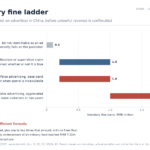
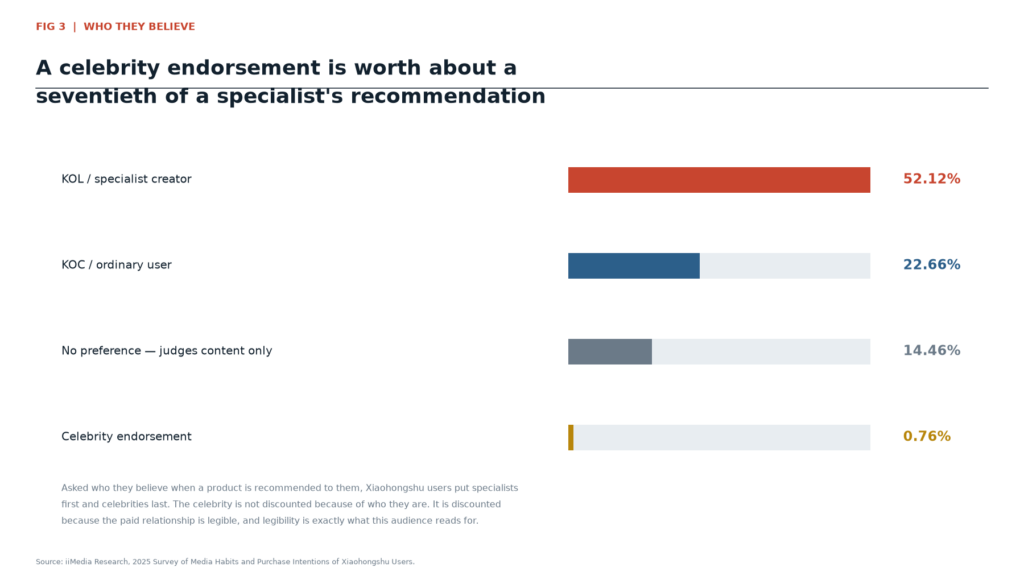
The celebrity endorsement is the second. Here the numbers are unusually brutal. iiMedia’s 2025 survey of Xiaohongshu users asked a simple question: when a product is recommended to you, who do you believe? Specialist creators took 52.12 percent. Ordinary users took 22.66 percent. Fourteen percent said they ignore the source and judge the content. Celebrity endorsement took 0.76 percent.
Less than one percent. A celebrity endorsement, in this environment, is worth roughly one-seventieth of a specialist’s recommendation.
That is the figure worth pinning above your desk, because it survives cross-examination. Dentsu’s 2025 Asia-Pacific influencer study found 50 percent of consumers rate specialist influencers as more credible than celebrities, against 23 percent for celebrities, and among Chinese Gen Z specifically, 61 percent say specialist influencers are the more credible voice. Two independent research houses, two different methodologies, same direction.
What it builds
If the ad-shaped yuan is losing yield, where is the content-shaped yuan going?
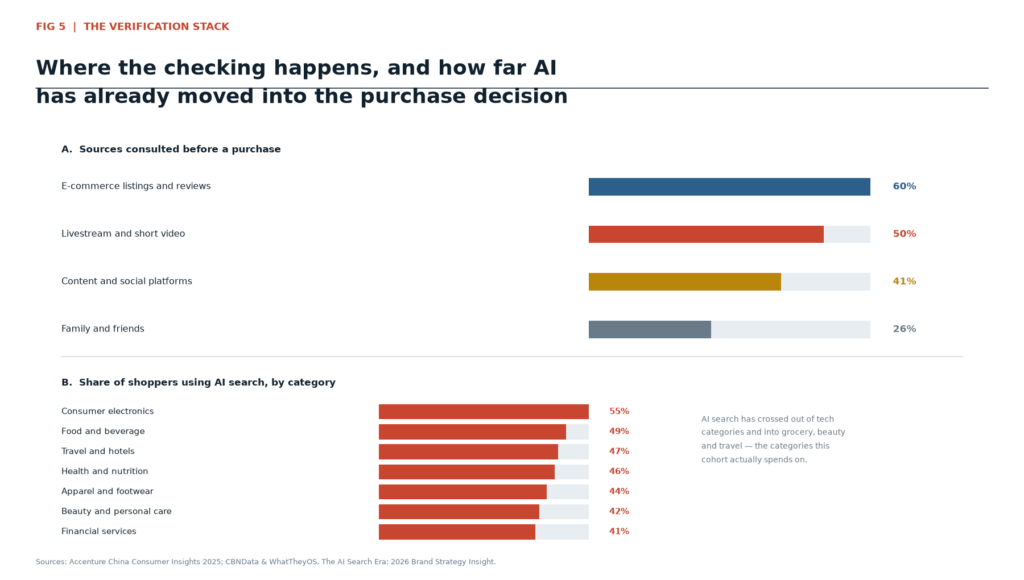
Into service. The buyer’s guide, the honest comparison, the “how to choose” explainer, the sizing chart that actually answers the question. Accenture’s data shows where information consumption has migrated: e-commerce listings and reviews remain the largest single source at 60 percent, but livestream and short video jumped 28 percentage points since 2021 to 50 percent, and content-sharing platforms rose nine points to 41 percent. Meanwhile family and friends fell 13 points to 26 percent. The advice network didn’t shrink. It moved online, into content, where it could be checked.
Into the peer layer. Micro-creators and ordinary users are not a cheaper substitute for celebrity. They are a different product. A specialist creator earns credibility by being right repeatedly in one narrow domain; an ordinary user earns it by having no obvious reason to lie. Both beat the celebrity, who has an obvious reason.
Into verifiable proof. This is the least glamorous and most reliable lever. Ingredient lists, test data, tear-downs, warranty terms, return costs. The cohort wants to verify. Supply the verification and you earn the trust the hiding brand forfeits.
Into community. Trust here is often trust by association — the brand that hosts the place where peers compare notes inherits some of the credibility of the conversation.
The uncomfortable middle: when content is an ad in disguise
Here is where most Western brands get caught, and where I would push back on the cheerleading.
Gen Z’s immune system is not tuned to “ads.” It is tuned to commercial intent. The sponsored post that reads organic, the “unpaid review” that was in fact paid, the influencer who has never met a product they did not love — these fail harder than an honest advertisement, because they combine the sin of selling with the sin of pretending not to.
The regulatory environment has also tightened. Paid partnerships on Chinese platforms must be labelled, and enforcement has become more consistent since 2024. So the disguise is not merely ineffective. It is increasingly risky.
There is a second, subtler problem: content saturation. When every brand pivots to “content over ads,” content becomes the new clutter. The cohort’s next immune response will not be “reject content-shaped things.” It will be “reject content that is merely content-shaped” — generic, unoriginal, obviously produced to hit a format. The premium shifts from format to distinctiveness, which is a much harder thing to buy.
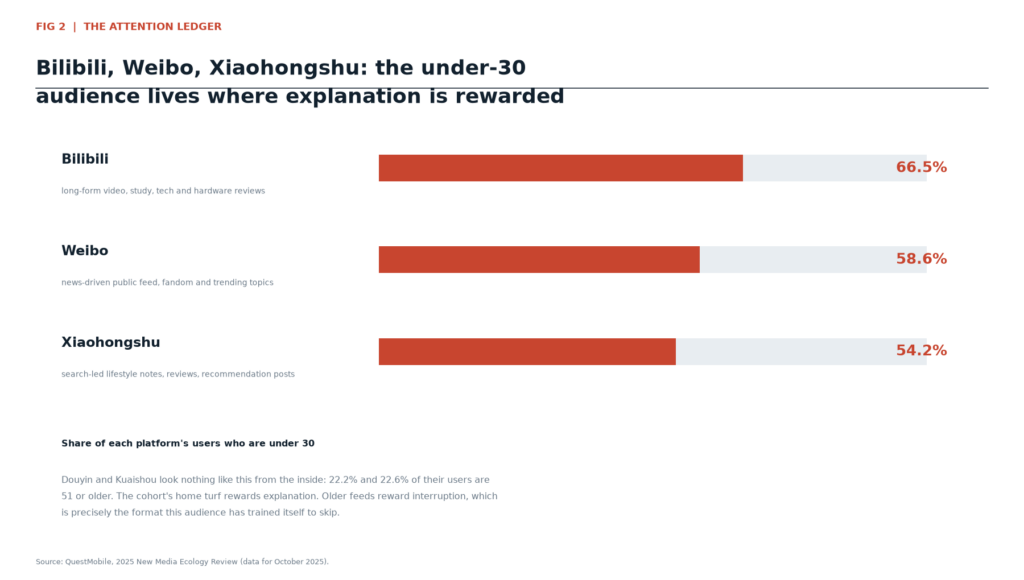
And a third caution: Gen Z in China is not one audience. The under-30 share of users is 66.5 percent on Bilibili, 58.6 percent on Weibo, 54.2 percent on Xiaohongshu, and 39.8 percent of users are spread across three or more platforms at once — which means the “content over ads” trait is broad but not uniform. A tier-one beauty buyer and a tier-four shopper hunting a factory-identical dupe are not running the same decision process.
The machine joins the audience
Now the complication that makes this moment different from every previous “young people hate ads” cycle.
The verification reflex has been outsourced, partly, to an assistant.
In mainland China, 86 percent of consumers now use an AI tool at least weekly, against a global average of roughly 57 percent, and generative AI users grew from about 249 million in December 2024 to 602 million by December 2025. Morgan Stanley’s survey puts weekly use at 80 percent in China versus 54 percent in the United States. A separate Q2 2026 survey by the China Association of Small and Medium Commercial Enterprises with Lixin Data found 79.4 percent of shoppers consult an AI tool before buying — and, for the first time, the share who say AI consultation meaningfully shapes their decision (43.7 percent) edged past those who say the same of traditional media advertising (42.6 percent).
Read that last number again. The AI answer has overtaken the advertisement as a decision input. Not by a landslide. By a nose. But it has crossed.
This matters because the AI answer is not neutral plumbing. It cites what it can find and trusts what is structured for it. When CBNData and WhatTheyOS mapped AI search penetration by category in 2026, consumer electronics led at 55 percent, then food and beverage at 49, travel at 47, health at 46, apparel at 44, beauty at 42 and financial services at 41. These are no longer tech-only categories. They are the categories this cohort actually spends money in.
So the two disciplines that used to be separate — being the content a young shopper trusts, and being the source an AI cites — have collapsed into one job. If your product facts live only in a campaign film and a paid post, neither the shopper nor the assistant can verify anything, and both will route around you.
What to actually do
Four moves, in descending order of how much they cost.
Stop buying reach, start buying usefulness. Reallocate from formats the cohort skips into assets that answer a question someone actually typed. A comparison table beats a hero video. A sizing guide beats a brand film. This is not a creative preference; it is a response to where the 60 percent and the 50 percent in Accenture’s channel data went.
Build the specialist tier, not the celebrity tier. The evidence is now overwhelming and consistent across two research houses. Budget that once went to one household name can fund a hundred credible specialists and a thousand real users. The catch, which most brands discover late, is that this requires operational capacity — briefing, compliance, measurement — that a single celebrity contract never demanded.
Make verification the product. Publish the test data. Name the factory. Show the failure case. In a market where 68 percent of consumers have gone numb or hostile, the brand that hands over checkable evidence is doing something no advertisement can do: it is letting the customer win the argument.
Treat AI findability as a content discipline, not a media buy. Structured facts, consistent naming, sourced claims, pages that survive being quoted out of context. The assistant is a reader with no patience and perfect recall.
The forward view
Three things I would watch.
The first is whether content saturation produces a second-order immune response. It will. The window in which “we made content instead of ads” reads as virtuous is already closing.
The second is whether AI trust holds. It is not guaranteed. Shanghai’s consumer council found 44.5 percent of respondents worry that AI recommendations are captured by commercial interests. The assistant currently enjoys the benefit of the doubt that the advertisement lost. It will not keep it indefinitely, and the brands that treat AI visibility as a loophole rather than a service will accelerate the loss.
The third is the quiet one: measurement. Trust earned through content compounds slowly and resists attribution. Reach bought through media reports cleanly and converts poorly. Most organisations will keep funding the thing they can measure. That is the real obstacle — not the cohort’s taste, but the finance department’s spreadsheet.
The short version
China’s Gen Z did not reject advertising. It outgrew the format. Raised inside one of the most ad-dense media environments ever assembled — 112 minutes of feed time a day, 2.05 trillion yuan of annual ad revenue behind it — it built a reflex that skips the pitch and reads the review, the teardown, the peer’s photograph, the specialist’s verdict, and now the machine’s summary.
Marketing to this cohort is therefore not a creative problem. It is a decision about what you are willing to be: a thing that interrupts, or a thing that is useful. The brands that keep buying interruption will keep being filtered out, and they will explain the shortfall with audience fatigue, platform costs or macro headwinds. The brands that become useful will discover that the most educated, most price-literate, most thoroughly un-foolable consumer cohort on earth is also the most loyal — precisely because it decided, on the evidence, to trust them.