The Line Is the Ad: The Scarcity Mechanics Behind Launch-Day Demand
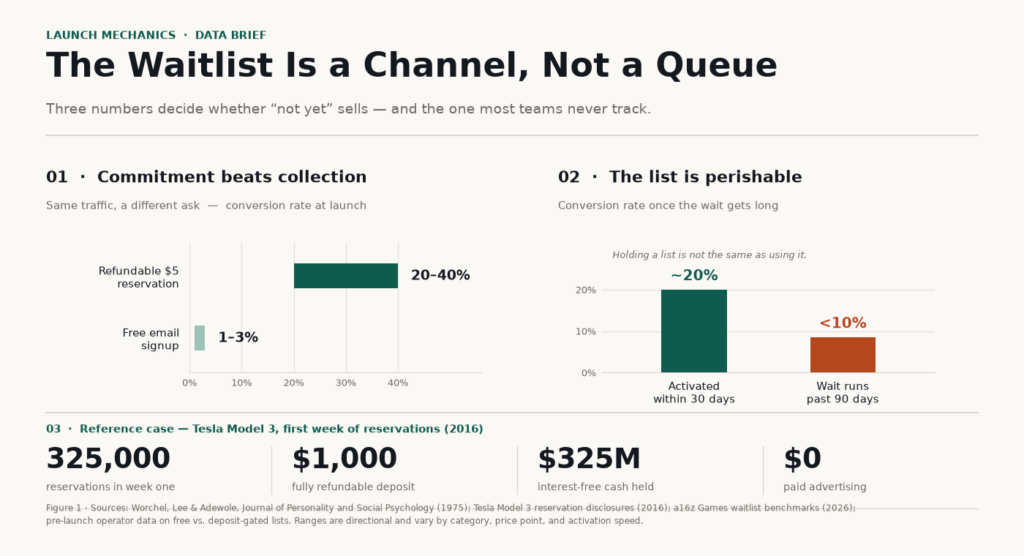
Tesla took 325,000 reservations for the Model 3 in the first week of April 2016, and made a point of noting it had bought no advertising to get them. Most coverage read that as a demand story. The stranger number is the one that sat on the balance sheet: at $1,000 a reservation, fully refundable, that queue held roughly $325 million of interest-free cash for a car that wouldn’t reach driveways until late 2017.
That isn’t a backlog. That’s a channel doing its job — and the mechanism is less mysterious than the hype suggests. Three forces are doing the work, and only one of them is about scarcity.
The queue rewrites the reason you can’t have it
In 1975, a study in the Journal of Personality and Social Psychology handed students cookies from a full jar or a nearly empty one. The scarce cookies were rated more desirable and more valuable. But the detail marketers keep skipping is this: cookies that turned scarce because of high demand were rated higher than cookies that turned scarce because of an accident. Same cookie. Different explanation for the shortage.
A waitlist is a machine for making that swap. Nothing about the product changes; what changes is the story attached to its unavailability — from “we underestimated demand” to “everyone wants this and you’re late.”
Money changes what a name is worth
Now the economics get lopsided. A free email signup converts at roughly 1–3% on launch day. Send the same audience a small refundable reservation — $5, say — and operator benchmarks put conversion at 20–40%. Nothing was invented. The ask got more expensive, and the conversion rate went up.
The reason isn’t sunk cost, because nobody is sunk. A refundable deposit is a filter and a public commitment at once. It separates people who like the idea from people who want the thing, then hands the second group a decision they’ll defend out loud.
The list is perishable
This is the number almost nobody puts in the launch deck. Reported benchmarks put waitlist conversion near 20% when people are activated within a month, and below 10% once the wait runs past three months. The queue doesn’t accrue value while you leave it alone. It decays.
Xiaomi ran the opposite play in March 2014: 419,000 people confirmed reservations for the 300,000 units on offer in a single Tencent Qzone drop, then closed the window and reopened it later. Note the shape — short, dated, repeated. The scarcity was staged, but it was real, and it expired on schedule.
The test that separates staging from faking
Refundability is the tell. Tesla’s deposits came back on request, the dates slipped anyway, and the queue held — because the wait was explained and the position was honored. Break either and the same machinery runs backwards. Waiting-line research has known for decades that an unexplained wait feels longer than an explained one, and an unfair wait longer than an equitable one.
What to do with it
Treat the join moment as the sale, not the paperwork. Ask for something that costs the customer a decision. Put a date on the promise and keep it. Show the queue where people can see it, because a visible line is the one piece of social proof you cannot buy.
Make them wait honestly, and “not yet” outsells “available now.”