China’s Retention Obsession Is Really a Traffic-Cost Hedge
Every Western teardown of Chinese marketing lands on the same word eventually: culture. Chinese shoppers prize relationships, so brands build communities. Private domain, WeChat groups, loyalty ecosystems — all filed under relationship-first. It is a tidy explanation, and I think it is mostly wrong. Read the same behaviour with a CFO’s pencil and the word changes. Not culture. Hedge.
The number that gives the game away
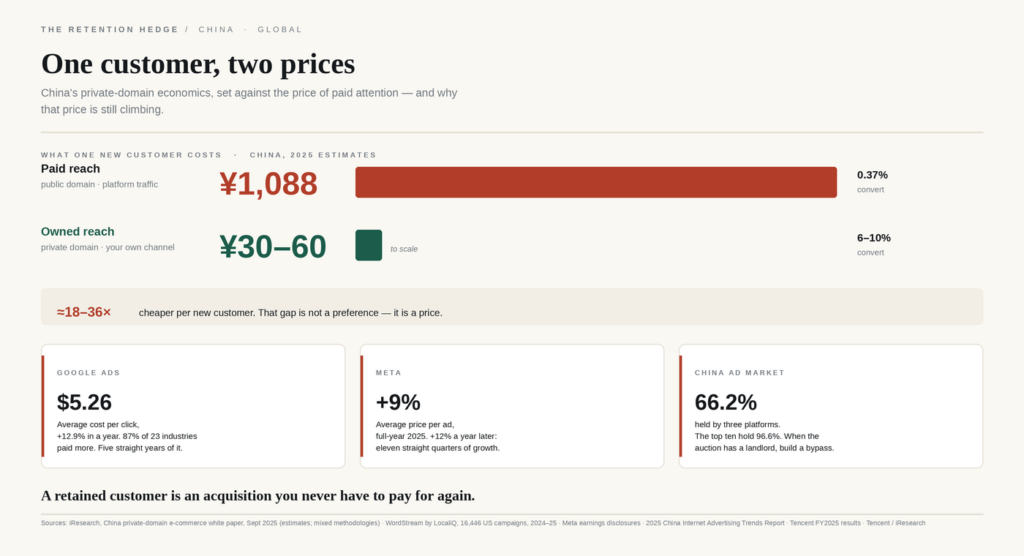
The arithmetic is stark. In its September 2025 white paper on China’s private-domain commerce, iResearch puts the cost of one new customer bought through public-domain traffic at about ¥1,088. That figure is modelled, not metered — the firm derives it from marketing spend divided by new users — and the conversion rates it sets beside it come from different channel types, so treat the set as indicative rather than precise. Even so: private-domain acquisition lands at ¥30 to ¥60 per customer, at 6–10% conversion against 0.37% on platform traffic. Eighteen to thirty-six times cheaper to own than to rent.
The trend doing the pushing
None of that would matter if attention were getting cheaper. It isn’t. WordStream’s benchmark of 16,446 US Google Ads campaigns put the 2025 average cost per click at $5.26, up 12.9% in a year, with 87% of 23 industries paying more — the fifth consecutive year of increases. Meta’s own numbers confirm the pattern from the seller’s side: average price per ad rose 9% across 2025, then 12% year on year into 2026, eleven quarters running in positive territory. This is repricing, not a bad quarter.
Why China read the invoice first
Because the auction had a landlord. Douyin, Alibaba and Tencent together take roughly 66.2% of China’s internet ad market; the top ten take 96.6%. When that few companies control the supply of attention, media-buying skill doesn’t buy you a discount. You either rent reach forever or build a pipe that bypasses the meter. WeChat was that pipe — 1.418 billion monthly users, a place where reaching someone who already bought from you costs approximately nothing.
The stat you should stop quoting
Here is where I break with most retention decks. The claim that keeping a customer costs five times less than winning one is not a measurement. It traces to a 1990 Harvard Business Review piece, where it came from a thought experiment about a credit-card company’s defection rate, not from anyone’s books; Byron Sharp has since called the whole family of multipliers “pure fantasy.” Hedges don’t need folklore. They need one defensible line item — the reach you no longer have to buy. In China that line item is about ¥1,000 a head.
What the copiers get wrong
Which is why the Western version usually fails. A brand builds a community, runs it for two quarters, and finds a newsletter nobody opens. The form was copied; the purpose wasn’t. The plumbing is local — email, Discord, a membership tier. The mechanism is universal: push the marginal cost of reaching an existing customer towards zero while the price of reaching strangers keeps climbing. You cannot pour a retaining wall mid-flood.
Retention isn’t affection. It’s insurance against a cost curve that only bends one way, and the premium is cheapest while the weather is fine. China didn’t buy the policy out of sentimentality. It bought it because it read the invoice first. Everyone else is holding the same envelope now.