Why Loyalty Changed Hands the Year Your Customer Stopped Choosing
Something odd happened in 2026: AI taught people to start shopping somewhere other than Amazon, then taught them nothing else. About 58 million Americans now begin product research with an AI tool; roughly 54 million still hand their money to Amazon anyway, even when the agent found it somewhere else.
That gap is the whole story. Not the traffic. The handoff.
The ledger that stopped reconciling
Every brand runs two sets of books. One is visible: the loyalty program, the email list, the points. The other is quieter: the assumption nobody audits, that someone who loves you will come back and type your name.
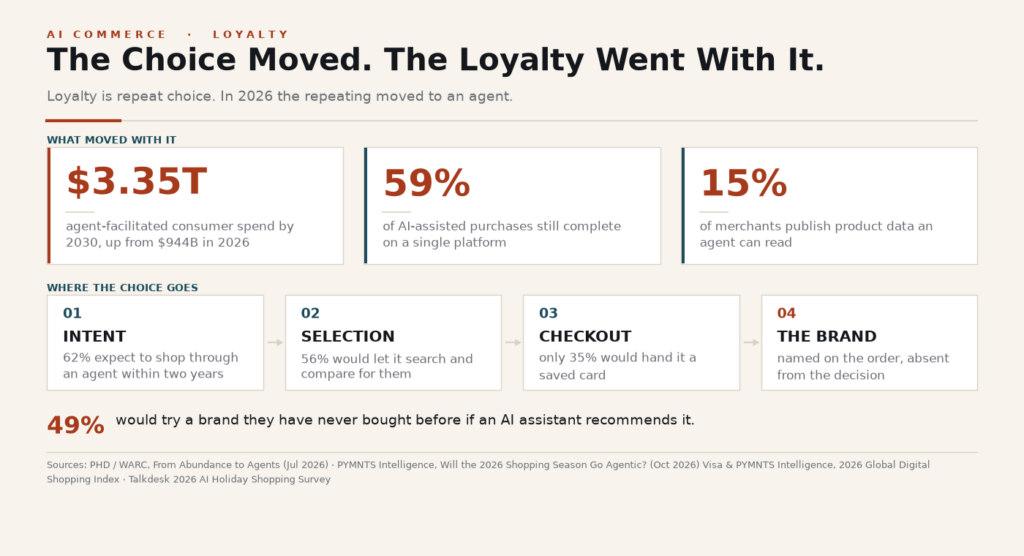
Agentic commerce barely touches the first. It stops the second from balancing. Sixty-two percent of US shoppers expect to use an AI shopping agent within two years; nearly half of online shoppers used AI to research their last purchase. Those sales arrive with revenue attached and almost no identity.
Loyalty was never a feeling. It was a repeat.
Here is the mechanism that never makes it onto a slide. Loyalty is not affection stored in a customer’s heart; it is the same choice, made again, at cost. Brands built it by being easy to recall at the moment of choosing — mental availability, as the trade calls it.
Move the choosing and you move the asset. When an agent researches, filters and shortlists, the person who stood at the shelf is gone. What is left is a selection function. And a selection function does not love you.
Which raises the question nobody asks out loud: if a preference never reaches checkout, does it exist? Not economically, no.
What the agent optimizes for
Not desire. Eligibility. Whether your catalog is machine-readable, whether your price survives systematic comparison, whether your brand appears in the material an answer is drawn from. Only 15% of merchants have product data an agent can read. Fifteen. The ones who fixed that moved the needle: Mondelēz lifted Oreo’s share of cookie-related AI answers from 10% to roughly 70% by making its content legible to machines.
The tell is in the filings
You can measure an industry’s fear by what it puts in writing. Walmart now names agentic platforms among its competitive risks. Kroger goes further, disclosing potential disintermediation from the customer relationship in its filing. Not a marketing worry — a board-level admission that the front door may no longer belong to the house.
The numbers split the same way. AI-referred traffic to US retail sites grew 393% in a year and now converts 42% better than any other channel, while one platform still captures 59% of AI-assisted purchases. Discovery is fragmenting. Checkout is consolidating. The brand sits between them, paying for neither.
The uncomfortable arithmetic
Willingness to hand an agent the card fell, from 32% to 24% in a year. This is not full delegation yet. But delegation is a ladder, not a switch, and every rung climbs the same way: search, compare, decide, pay. Each step moves one more decision — and one more loyalty — out of the customer’s hands.
So the question is not whether people will still love brands. It is whether anyone will be in a position to act on that love. Brands that treat AI visibility as a PR metric will keep buying affection they cannot convert. Those that treat it as distribution — structured data, machine-legible pricing, citation share by category — will own the answer the agent gives.
Loyalty did not die this year. It changed hands, quietly, at the exact moment nobody was watching the choosing.