Why Making Your Community Bigger Makes It Worth Less
Member count is the most reported number in community marketing and the least useful. The participation and trust data point the other way.
There is a number every community team reports, and it is the wrong one. Member count tells you how many people walked into the room. It tells you nothing about how many will speak, and less about how many will buy. Those are different questions with different answers, and the gap between them is where most community budgets quietly die.
The evidence is unusually consistent. A study in IEEE Transactions on Computational Social Systems (2026) tracked conversation on six platforms over 33 years and found that smaller platforms host richer, more sustained exchanges, while larger ones produce broader but shorter participation — and that a member’s likelihood of returning to a thread falls as the community grows. The authors flag one exception: niche environments, where participation stays robust even at size. Hold that thought, because it is the whole trick.
Operational data says the same in plainer numbers. An enterprise benchmark covering 3.5 million Viva Engage users found that about 10% of members contributed in organisations under 2,500 people, against 2.4% in organisations of 25,000 to 50,000. A 2014 peer-reviewed study of four health communities found that fewer than a quarter of members had ever posted at all, while a sliver of roughly 1% produced three-quarters of the content. Scale does not multiply participation. It dilutes it.
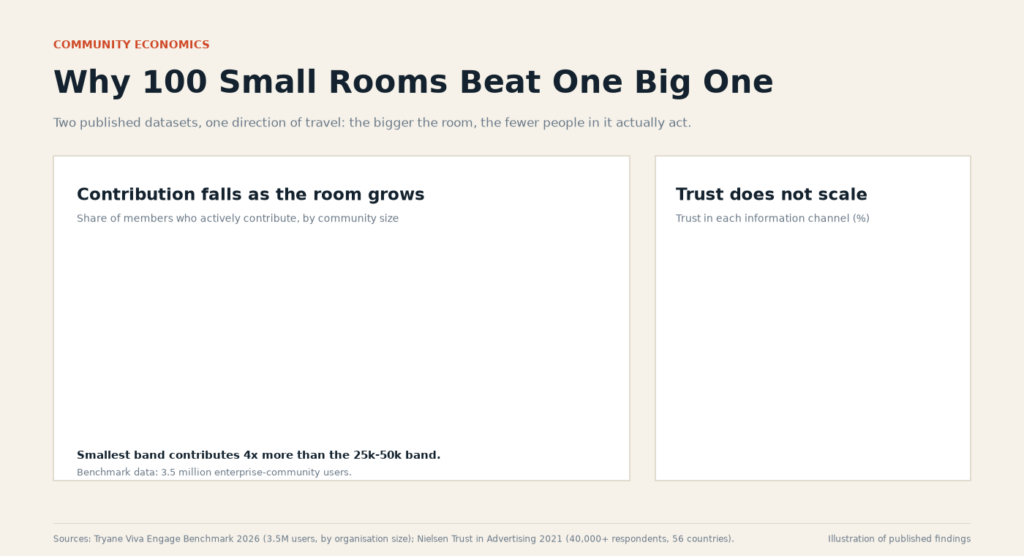
Why? Because conversion is a trust event, and trust is a relationship, not a broadcast. Dunbar’s circles place real familiarity at layers of about 5, 15, 50 and 150 people, then 500 and 1,500 for faces you merely recognise. Below the 150 line, a recommendation comes from someone whose judgement you can weigh. Above it, the same words are just content. Nielsen’s 2021 Trust in Advertising study found that about 89% of people trust recommendations from people they know, against 23% who trust ads delivered by influencers. That is a 66-point gap, and no amount of reach closes it.
Here is the honest part. The 150 figure is contested: Lindenfors and colleagues argued in Biology Letters in 2021 that no single cognitive limit can be derived from primate brain data. Fair enough. But the mechanism never depended on the number. Attention is finite, and a real relationship costs time every week. Whether the ceiling sits at 150 or 250 barely matters. What matters is that a ceiling exists, and that every member you add past it buys audience while spending intimacy.
That reframes the arithmetic. One group of 10,000 and a hundred groups of 100 contain the same people and produce wildly different results, because relationship density, not headcount, sets conversion. This is why China’s private-domain commerce — sales closed inside owned chat groups — reached an estimated RMB 5 trillion in 2024, up 8.7% in a year when paid traffic kept getting more expensive.
So stop asking how big the community is and start asking how many people inside it know each other. Build fleets, not stadiums: many small groups bound by a real shared identity; split them deliberately once they pass their comfort ceiling; measure contribution and revenue per group instead of membership. Keep the mega-channel for reach if you must. Just stop expecting it to sell.
Scale buys attention. Intimacy buys action. They were never the same budget line.