Why the Harder You Push, the Worse the Data Gets
Every CRM cleanup starts the same way. A dashboard goes red, someone calls a meeting, and the remedy announced is always more discipline — mandatory fields, weekly audits, a compliance scorecard. Six months later the dashboard is red again, and nobody asks why the same remedy keeps failing.
The answer is not that salespeople are lazy. It is that the CRM has always been a tax levied on one person and collected by another, and no amount of enforcement changes who pays.
The asymmetry nobody budgeted for
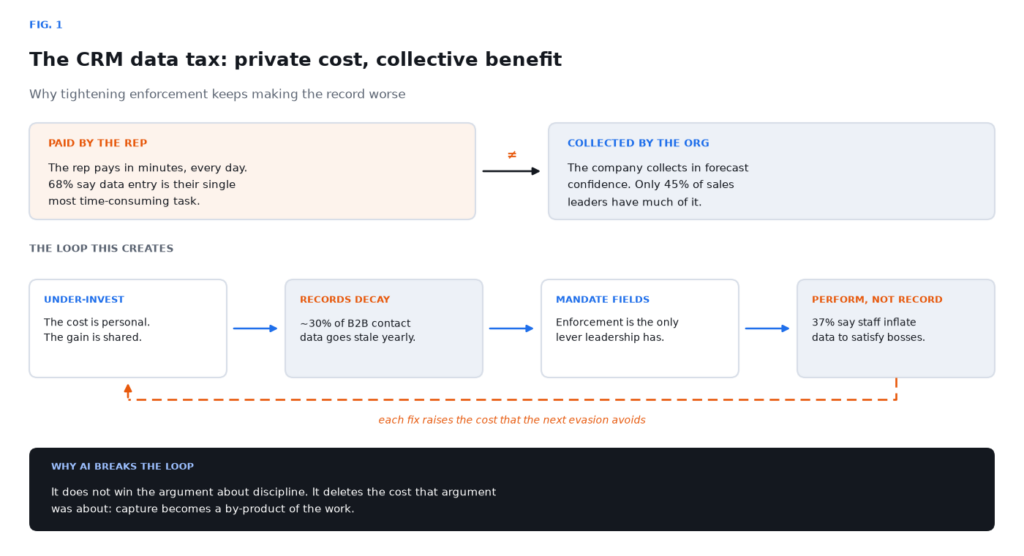
Data entry is a cost one role bears and a different role benefits from. The rep pays in minutes — 68% call it their single most time-consuming task, and 43% give it ten to twenty hours a week. The organization collects in forecast confidence, which only 45% of sales leaders claim to have.
When the payer and the beneficiary are different people, investment is rational only up to the point where the payer captures some of the gain. Reps can’t. So they under-invest — not out of indifference, but out of arithmetic.
What enforcement actually does
Enforcement doesn’t change that arithmetic. It raises the price of not paying. Now the rep faces a choice: spend the minutes, or satisfy the check. Given a thirty-minute call and four dropdowns that don’t fit it, satisfying the check is the cheaper option. Thirty-seven percent of CRM users say staff inflate records to satisfy decision-makers. That isn’t corruption. It is the predictable output of a system that measures the field rather than the customer.
Which produces the counterintuitive result: the harder you push, the worse the record gets. Each escalation makes the data look more complete while making it worth less, because the record has quietly become a report about compliance instead of a description of a buyer.
Why this is structural, not cultural
The numbers line up too neatly to be a culture problem. Seventy-six percent of CRM users say less than half their data is accurate and complete. Thirty-seven percent have lost revenue directly because of it. Only one in five has formal data governance, and roughly a third cannot name who owns data quality at all. Meanwhile the tax keeps compounding: about 30% of B2B contact records go stale every year.
Huge private cost, diffuse collective benefit, no named owner. That is not a discipline failure. It is a commons with nobody assigned to it.
Why a smarter nag wouldn’t have helped
The instinct now is that AI will make compliance effortless — auto-fill, smart defaults, gentler nudges. That misreads the problem. If capture still costs the rep minutes, every AI reminder is merely a smaller tax, and smaller taxes are still avoided at the margin by anyone who is paid on quota.
What breaks the loop is that capture stops being a separate act. The call is transcribed because it happened. The field is populated because the transcript contains it. The rep’s marginal cost falls toward zero, and a zero-cost activity has nothing to evade. AI doesn’t win the argument about discipline. It deletes the thing the argument was about.
The uncomfortable part
Removing the human’s incentive does not install one in the machine. A model that fills fields has no stake in whether they are right. That is why the teams adopting capture fastest are also meeting a new failure mode: records that are confident, complete, and wrong. A blank field advertises its uncertainty; a fabricated one doesn’t.
So the governance question moves rather than disappears. It stops being how do we get reps to fill the record, and becomes who checks the record when nobody wrote it.
One diagnostic worth running
Ask a rep to find something in the record that is true, useful, and that they did not put there themselves. If they can, the tax is gone. If they can’t, you have automated the filing, not the thinking.