From Data Entry to Automatic Insight: How AI Rewrote the Customer Record
Sales has spent thirty years being told to update the CRM. It has spent thirty years not doing it. The reasons were never mysterious — nobody was hired to be a database administrator, and the database never paid commission. What is new in 2026 is that the argument is finally over, because the record no longer depends on someone remembering to fill it in.
This is not a story about a smarter piece of software. It is a story about the cost of an accurate customer record collapsing toward zero — and what that does to forecasting, to adoption, and to the shape of the sales job itself.
The CRM’s Original Sin
The CRM was sold as the single source of customer truth. What it actually became was a compliance artifact: a system valued for what got logged rather than what got known. That distinction matters more than it sounds, because a system optimized for logging will always lose to a system optimized for selling whenever the two compete for the same hour.
And they compete constantly.
What the selling week actually looks like
Salesforce’s seventh State of Sales report, published in February 2026 and drawing on 4,050 sales professionals across 22 countries, puts active selling at 40% of a rep’s week. The other 60% goes to admin, internal meetings, and the upkeep of records.
That 40% figure is worth pausing on, because it is better than it used to be and still indefensible. Earlier editions of the same research landed closer to 28% selling time, and the drift between editions is itself instructive — the definition of selling has quietly widened to include activities that once counted as admin. Read the number as a ceiling, not a floor.
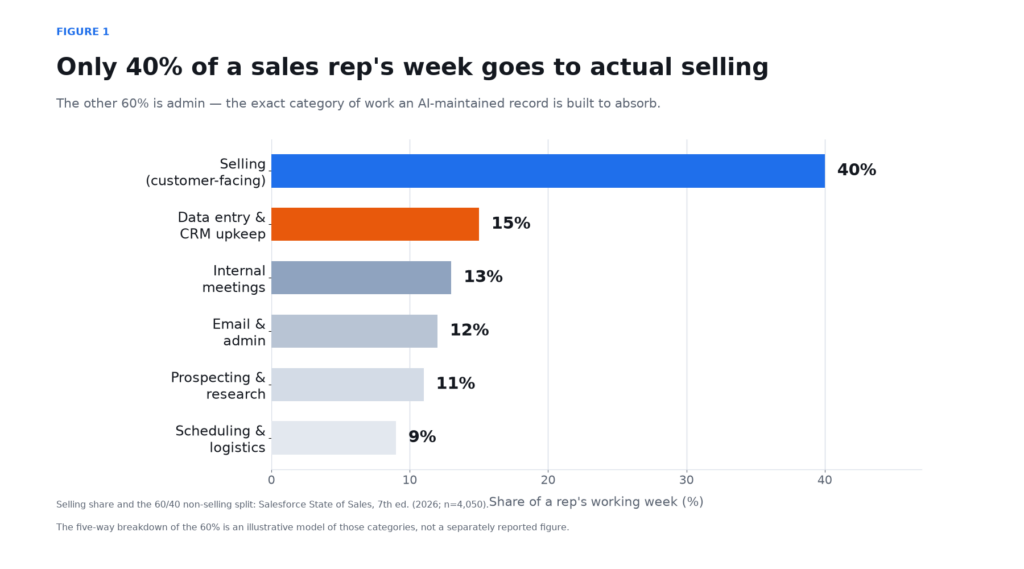
Now add the second-order cost. Salesforce’s sixth edition, surveying 5,500 professionals, found 68% naming note-taking and data input as their single most time-consuming task, with 43% spending ten to twenty hours a week on administration. The work is not merely large. It is the work reps resent most, which is why it is the work they do worst.
Data rot is not a discipline problem
Here is where most commentary gets it wrong. The instinct is to blame lazy reps and prescribe tougher enforcement, mandatory fields, and audit reports. Every one of those remedies has been tried for two decades and none of them worked, because the diagnosis was wrong.
The data is bad for structural reasons. Fields are designed around what a manager needs for a quarterly report, not what a seller needs to close a deal. A thirty-minute discovery call contains dozens of signals — competitor mentions, timeline shifts, a champion losing authority — and almost none of them map cleanly onto the dropdowns available. So the rep translates a rich conversation into four impoverished fields three days later, from memory.
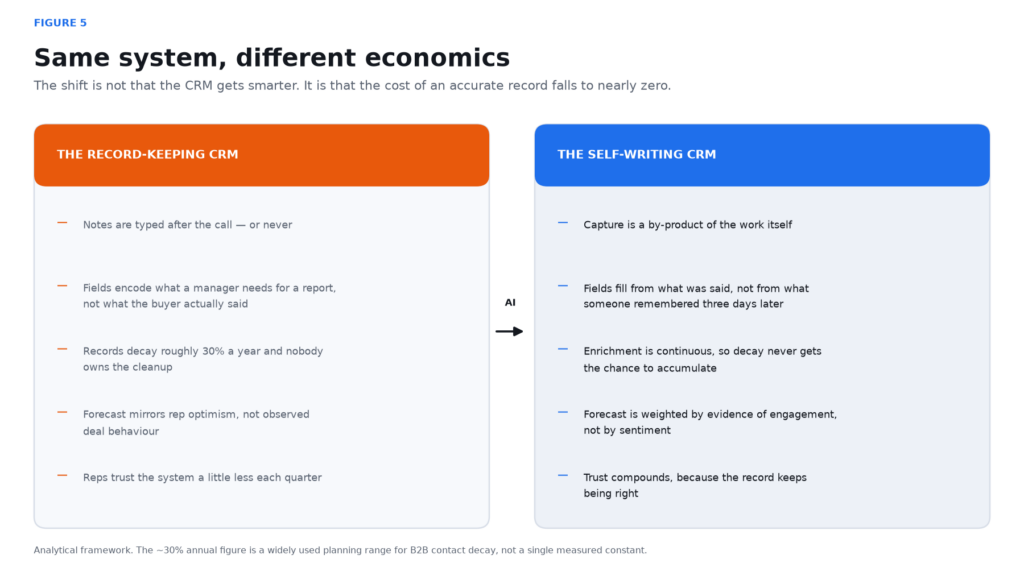
Then entropy does the rest. B2B contact records decay at roughly 30% a year as people change jobs, get promoted, and companies get acquired. Lusha measured 12.25% of US sales leaders changing roles within a single twelve-month window. Nobody made a mistake; the world simply moved.
Validity’s 2025 study of 602 CRM users and administrators puts a number on the accumulated result: 76% say less than half their CRM data is accurate and complete, and 37% report losing revenue directly as a consequence. More than a third say staff inflate records to satisfy decision-makers. Only one in five organizations has a formal data-governance policy, and roughly a third cannot name who owns data quality at all.
The trust loop nobody escapes
Put those findings beside the confidence data and a pattern emerges that explains why the problem is so durable.
Gartner’s State of Sales Operations research found only 45% of sales leaders and sellers had high confidence in their forecast accuracy, and only 47% believed their organization held high-quality data. Salesforce’s own measurement is blunter: 35% of sales professionals completely trust their data.
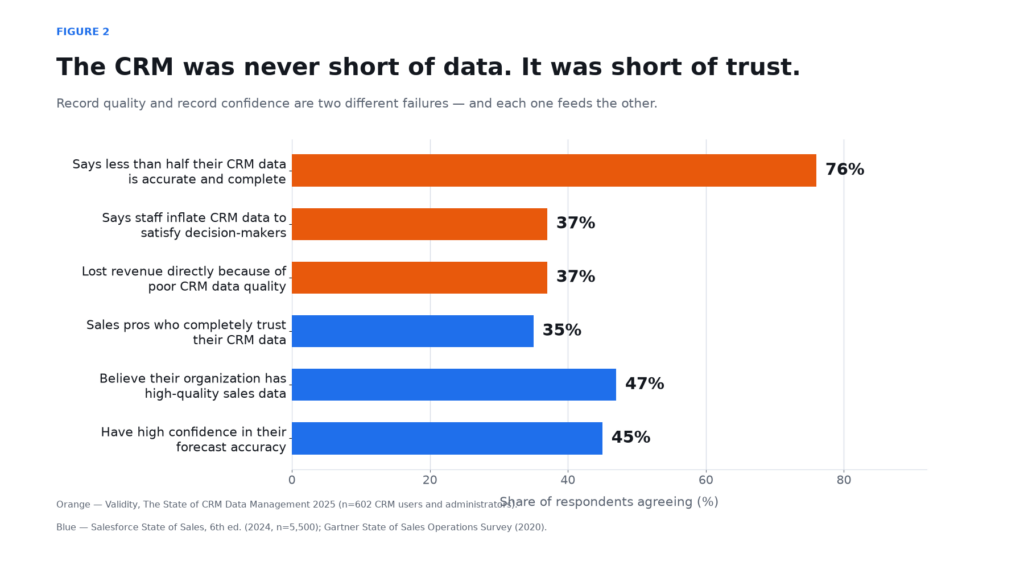
The loop runs like this. Reps distrust the record, so they keep their real working knowledge in spreadsheets, inboxes, and their own heads. Because the real knowledge lives elsewhere, the record stays incomplete. Because the record is incomplete, forecasts built on it are wrong. Because forecasts are wrong, leadership demands more fields and more discipline. Because there are more fields, fewer get filled. Trust erodes a little each quarter, and the system that was supposed to create visibility becomes the reason nobody has any.
What AI Actually Changes
The useful way to think about AI in CRM is not as a feature but as a change in where the data comes from. Historically, the record was a secondary artifact — reconstructed after the fact by a human with limited time and imperfect recall. AI makes the record a by-product of the work itself.
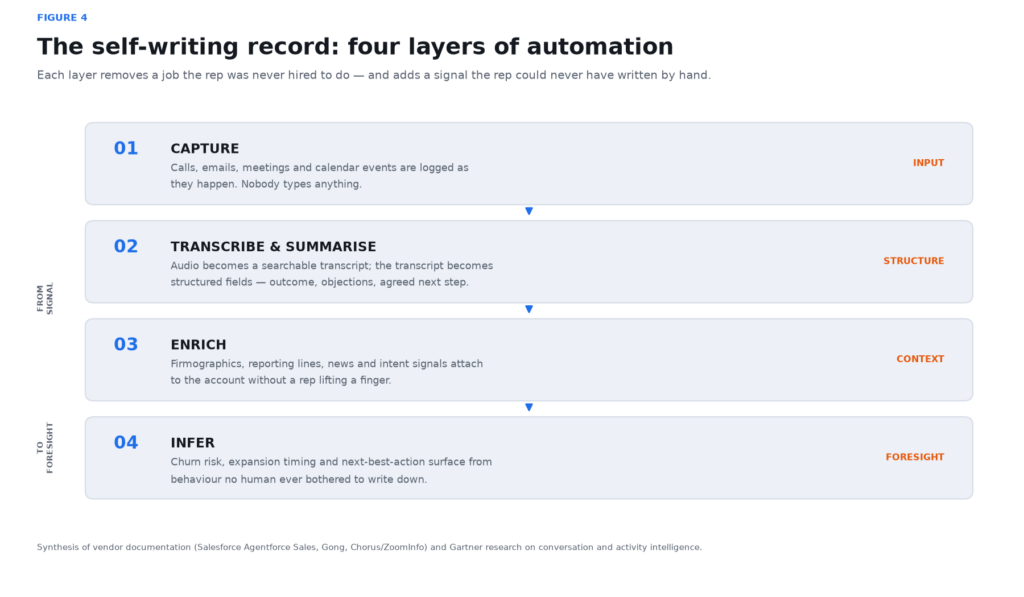
That happens in four layers, each removing a different failure mode.
Layer one: capture without compliance
Calls, emails, meetings, and calendar events get logged as they occur. Nobody types anything, which means nothing depends on the rep’s memory, mood, or available minutes at 6pm on a Friday.
This is the layer that quietly fixes adoption, because it removes the tradeoff that made adoption impossible. Previous CRM initiatives asked reps to sacrifice selling time for record quality. Capture-at-source asks for no sacrifice at all — the record improves as a side effect of doing the job.
Adoption of the underlying technology is already past the experimental stage. Laxis puts AI note-taker use at 75% of professionals in 2026, with 67% of Fortune 500 companies having deployed it somewhere, and conversation intelligence running in 27.7% of field sales teams. The category is no longer a bet. It is infrastructure with a procurement cycle.
Layer two: transcription into structure
Audio becomes a searchable transcript. The transcript, more importantly, becomes structured fields — outcome, objections raised, agreed next step, named stakeholders.
The distinction between transcript and structure is where most implementations stumble. A searchable transcript is a convenience. Structured fields are an asset, because they are queryable, aggregatable, and capable of feeding a forecast. Vendors that stop at transcription have built a very good notebook. Vendors that complete the mapping have rebuilt the database.
Layer three: enrichment as a continuous process
Firmographics, reporting lines, funding events, hiring signals, and intent data attach to the account automatically. This attacks decay at its root rather than treating it as a seasonal cleanup project.
It also changes what enrichment is for. Traditional enrichment filled gaps so that marketing could segment. Continuous enrichment keeps records current so that prediction has something true to predict from — a materially more demanding job, and the one that determines whether the downstream layers work at all.
Layer four: inference from behaviour
Churn risk, expansion timing, and next-best-action surface from behavioural evidence no human ever wrote down. Not because reps were lazy, but because the evidence was never legible as a field: call frequency dropping, a champion going quiet, a competitor appearing in three consecutive transcripts.
This is the first layer that produces something genuinely new. Layers one through three restore the record to what it should always have been. Layer four turns it into something it was never able to be — a forward-looking instrument.
What a Self-Writing CRM Unlocks
Forecasting stops being a negotiation
A forecast built on rep-entered stages is a forecast built on optimism, sandbagging, and the social cost of marking a deal lost. A forecast weighted by observed engagement is a different kind of object.
The market context makes this urgent. Gartner sized CRM software at $128 billion in 2024, growing 13.4%, with the sales-specific segment at $25.7 billion and projected to reach $28.7 billion in 2025 at a 12.8% CAGR through 2029. GenAI and AI sales agents are named as the incremental value drivers. In other words, the growth thesis for the entire category now rests on the record being trustworthy enough for agents to act on.
Gartner’s 2024 survey of 1,026 B2B sellers found that those who effectively partner with AI tools are 3.7 times more likely to meet quota. That is an association, not a causal guarantee, and it deserves to be read skeptically — sellers who are good at their job are also more likely to adopt good tools. But the mechanism is plausible: the same survey found 50% of sellers overwhelmed by the amount of technology in their job, and overwhelmed sellers are 45% less likely to hit quota. Tool sprawl is not neutral. Salesforce’s finding that teams average eight separate solutions, with 84% of non-platform teams intending to consolidate, reads as the market correcting its own mess.
The single source of truth finally behaves like one
Every touchpoint captured automatically means sales, marketing, and support read the same record. Not a reconciled approximation assembled by an integration project, but the same underlying evidence.
Consider what this does to a handoff. PenFed Credit Union’s contact-center deployment is a small but revealing case: an agent listens to calls in real time, transcribes them, and updates the full record after human approval, with reported results of 10% lower handle time, 50% less after-call work, and 40% fewer held calls. The point is not the percentages. The point is that whoever picks up the next call, on any channel, already knows what happened on the last one.
Rep time, and the adoption problem that dissolves
Freed from data entry, reps do the job they were hired for. The arithmetic is straightforward: moving from 40% to 50% selling time is a 25% increase in selling capacity across the same headcount.
But the more interesting consequence is cultural. The CRM’s eternal problem was that using it well made you worse at your job, and every rep knew it. When the system starts handing back time instead of consuming it, adoption stops being a change-management campaign and becomes a preference.
Personalization that is not guesswork
Richer, current records make personalization real rather than theatrical. A message informed by an accurate transcript of last week’s objection is a different artifact from a message informed by a first-name merge field and a guess about industry pain.
McKinsey’s work on agentic AI in frontline sales suggests roughly a fifth of current sales-team functions could be automated, and that redesigning a commercial journey around agents can release about 10% of additional seller time. Microsoft’s own internal measurement is more specific still: heavy users of Copilot within its sales organization saw a 9.4% increase in revenue per seller and a 20% increase in close rates. Vendor-reported figures warrant caution, but the direction is consistent across independent research.
The Strategic Shift: From Tool to Intelligence Layer
Here is the part most teams underrate. The interesting change is not that the CRM stores better data. It is that the CRM stops being a place where data rests and becomes a place where inference happens continuously.
The rep becomes an editor, not a clerk
If capture is automatic, the human contribution shifts from transcription to judgement. The rep reviews what the system heard, corrects what it misread, and adds the interpretive layer that no model can supply: why the buyer hesitated, what the room felt like, which stakeholder actually decides.
That is a better use of a skilled person, and it has a governance implication. If nobody reviews the machine’s output, the machine’s errors become the official record. Organizations that treat review as optional are not saving time; they are deferring a correction they will eventually pay for.
Integration is the moat, not the model
A self-writing record only works if the intelligence spans the full stack — telephony, email, calendar, CRM, external data, and the systems of record downstream.
This is why the strategic question is not which model to use. Foundation models are broadly available and rapidly commoditizing. What is not commoditized is a unified data layer with permissioned access to everything a customer has ever done. Gartner’s observation that customer data platforms grew 21.9% — well ahead of the CRM market itself — is the tell. Buyers have understood that the prerequisite for AI is a data foundation, and they are funding it before they fund the agents.
A compounding data asset, not a depreciating one
Most enterprise software depreciates: it ages, accumulates workarounds, and eventually gets replaced. A clean, continuously maintained customer record appreciates, because every additional interaction makes prediction better and every improved prediction makes the next interaction more relevant.
That is a genuinely unusual property, and it argues for patience. The value does not arrive in the quarter the system is switched on. It arrives in the third year, when the record contains context no competitor can buy.
The Honest Caveats
None of this is free, and three failure modes deserve to be named plainly.
Consent is not a checkbox
An AI system listening to calls and reading emails sits directly on top of surveillance law, and the law is fragmented in ways that punish carelessness. Federal US law requires one-party consent; roughly a dozen states — California, Florida, Illinois, Pennsylvania, and Washington among them — require all parties to agree. Because a single remote call routinely crosses jurisdictions, the only safe operating assumption is the strictest applicable standard.
The exposure is not theoretical. Otter.ai faced a class action filed in August 2025 alleging it recorded private conversations surreptitiously and used them to train its transcription service. Separately, Illinois’ biometric privacy law reaches voiceprints that notetakers may generate to distinguish speakers.
Europe adds a second layer. The EU AI Act becomes fully applicable in August 2026, with penalties reaching €35 million or 7% of global turnover. Emotion recognition in the workplace is prohibited outright, and AI-driven employee monitoring is classified high-risk, carrying documentation, transparency, human-oversight, and registration obligations. Any organization treating consent as a line in a privacy policy is exposed.
A confidently wrong record is worse than a blank one
A missing field is an honest gap. A field populated by a hallucination is a lie wearing a suit — and it propagates. Transcripts misattribute statements between participants; summaries drop qualifiers; systems trained on certain accents perform unevenly, raising bias exposure in any downstream employment decision.
The asymmetry matters. Blank fields signal uncertainty, so humans verify. Confident wrong fields signal completeness, so humans proceed. The second failure is more expensive precisely because it is invisible.
Gartner’s projection that organizations will abandon 60% of AI projects unsupported by AI-ready data is not a warning about model quality. It is a warning about exactly this: agents acting decisively on a foundation nobody audited.
The adoption paradox
Reps who distrust AI-captured records may fight the change — and they have earned the right to be skeptical, having been promised productivity by four generations of sales technology.
Trust in the system has to be earned through visible accuracy, not asserted through a rollout email. The practical test is whether a rep can find, in the record, something true and useful that they did not put there themselves. Until that happens, adoption is compliance in costume.
Governance is the product
If accuracy governance is treated as an afterthought, the self-writing CRM introduces errors at machine speed and thereby destroys the trust that made it valuable. The uncomfortable conclusion is that data governance — ownership, standards, review cadence, retention — is not overhead attached to the AI project. It is the AI project.
What to Do First
A short sequence, ordered by what actually gates the outcome.
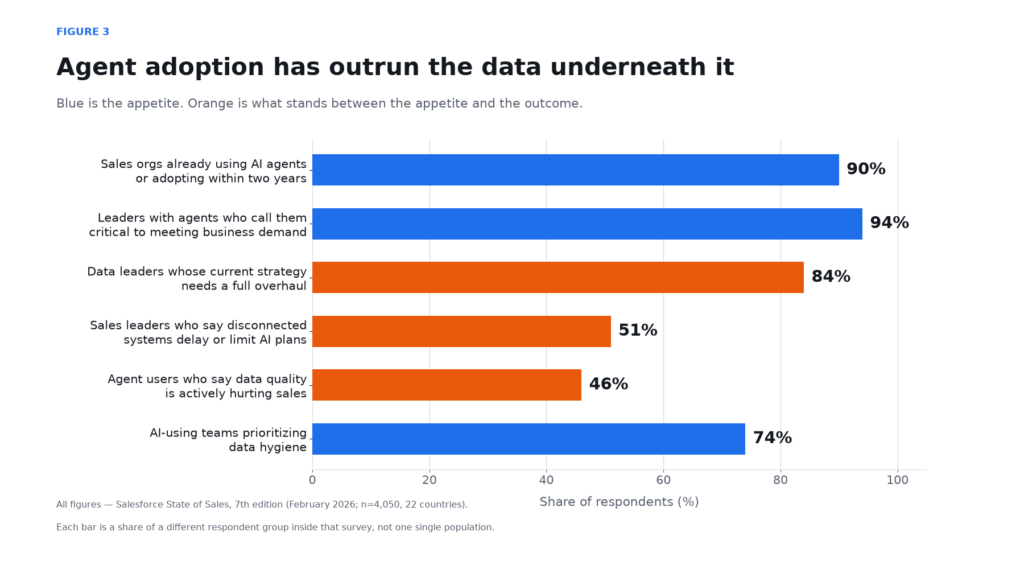
- Fix the data strategy before buying agents. 84% of data and analytics leaders say their current strategy needs a full overhaul. Believe them. An agent built on fragmented records automates the wrong answer faster.
- Consolidate the stack. Eight tools per team, 42% of reps overwhelmed, 51% of leaders saying silos limit AI. Integration is prerequisite work, not a later optimization.
- Start with capture, not inference. The four layers are sequential. Predictive insight built on un-captured activity is numerology.
- Design consent into the workflow. Disclosure before recording, jurisdiction mapping, automatic suppression for privileged or sensitive conversations, and a retention policy that survives an audit.
- Make review cheap and visible. A one-click correction path, plus a monthly sample audit. If corrections cost more than they save, nobody makes them.
- Measure the record, not just the revenue. Track field completeness, correction rate, and forecast error — not because dashboards are virtuous, but because decay is invisible until you instrument it.
The Takeaway
The CRM’s original sin was demanding manual data entry from people whose job is not data entry. For three decades the industry responded by demanding harder. AI finally removes the demand rather than enforcing it — the record writes itself, from capture through enrichment to inference.
What emerges is not a better-liked CRM. It is a different kind of system: an always-current intelligence layer that does what the CRM always promised and never delivered.
And the strategic consequence runs further than the sales department. When the customer record is accurate by default, the constraint on personalization, forecasting, and agent autonomy stops being data quality and starts being judgement about what to do with it. That is a far more interesting problem to have.