AI Didn’t Make Marketers Care About Accessibility. It Made Caring Affordable.
For twenty years, accessibility was the line item everyone agreed with and nobody funded. AI didn’t make marketers care about it. It made caring affordable. That is a very different kind of change.
The checkbox that never got checked
Every marketing organisation has one. A document in a shared drive, last opened during a rebrand, titled something like “Accessibility Requirements — Phase 2.” Phase 2 never arrives. The site ships. The campaign runs. Somebody adds an alt-text ticket to a sprint backlog, and it dies there, quietly, between a banner-resize request and a cookie-banner tweak.
We have spent two decades treating accessibility as a moral obligation dressed up as a compliance task. Laudable. Also, mostly unfunded. The people who cared were usually the people without budget authority, and the people with budget authority were usually looking at a spreadsheet where “described images” competed against “paid social” and lost by a mile.
Then two things happened at almost the same time, and together they broke the old arithmetic. Regulation got teeth. And the labour that made accessibility expensive stopped being human labour.
Why accessibility stayed expensive for twenty years
Three forces kept accessibility permanently deferred. None of them were about indifference.
The work was manual and specialised. Writing a useful image description is not typing. It is deciding what a blind reader needs to know about a photograph and what they can safely ignore. Captioning a forty-minute webinar at broadcast quality takes hours. Tagging a PDF so a screen reader can traverse it takes an afternoon you did not have. Multiply that by every asset your team publishes in a quarter, and the number stops fitting in any sprint.
It was framed as legal defence, not audience growth. Accessibility programmes were justified by the cost of being sued, which means they were funded like insurance: as little as possible, as late as possible, and only when the risk department got loud. Nobody ever got promoted for a remediation roadmap.
The audience was invisible in the media plan. If your targeting excludes a segment by default, that segment never appears in a report, and a segment you cannot see is a segment you cannot justify spending on. Disability sits outside most audience taxonomies entirely.
The baseline is worse than the anecdote suggests
If you suspect the web is not getting more accessible despite fifteen years of advocacy, the data agrees with you, and then some.
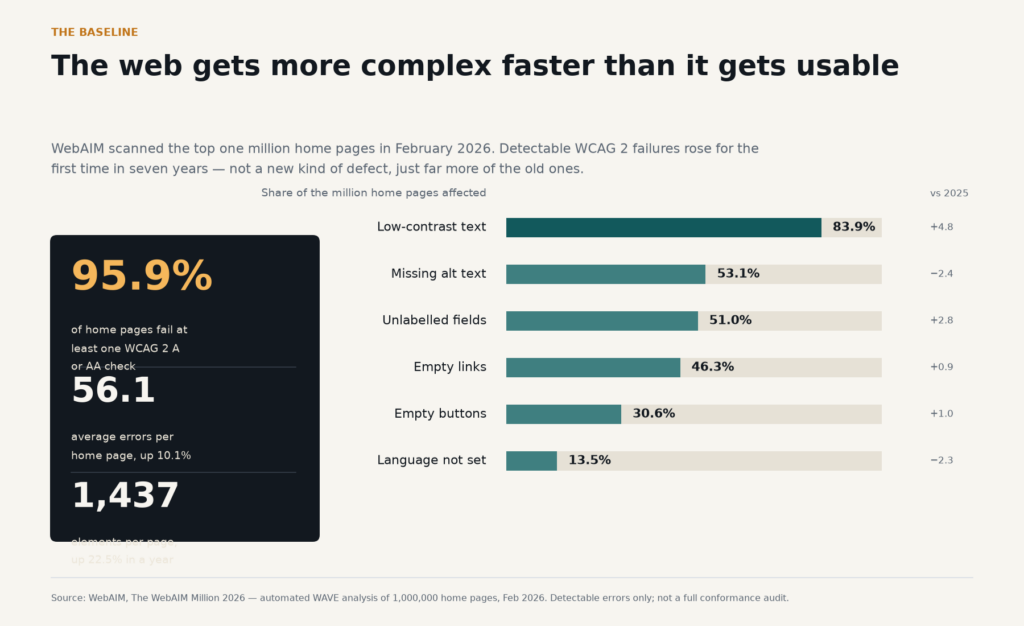
WebAIM’s annual analysis of the top one million home pages found that 95.9 percent still fail at least one detectable WCAG 2 A or AA check. That figure went up from 94.8 percent the year before — the first reversal after six years of slow improvement. Average detectable errors per home page climbed 10.1 percent, to 56.1. And the reason is not a new class of mistake. It is the same six mistakes, repeated more often, because the average home page now carries 1,437 elements, a 22.5 percent jump in a single year.
Low-contrast text appears on 83.9 percent of home pages. Missing alt text on 53.1 percent. Unlabelled form inputs on 51 percent. Empty links on 46.3 percent, nameless buttons on 30.6 percent, undeclared page language on 13.5 percent.
Read that list again and notice what is missing from it: nothing exotic. These are the fundamentals. We are not failing at the hard parts of accessibility. We are failing at the parts a competent junior developer could fix in an afternoon, at a scale that suggests the problem was never technical difficulty.
One more detail in that report deserves a paragraph of its own. Pages that use ARIA — the accessibility attributes designed to make custom interfaces understandable — averaged 59.1 errors. Pages that avoid ARIA averaged 42. A tool built to help, deployed by people who did not fully understand it, producing the opposite of its intended effect. Hold that thought, because it is the same failure mode as the widget industry we will get to shortly.
One in six is not a niche
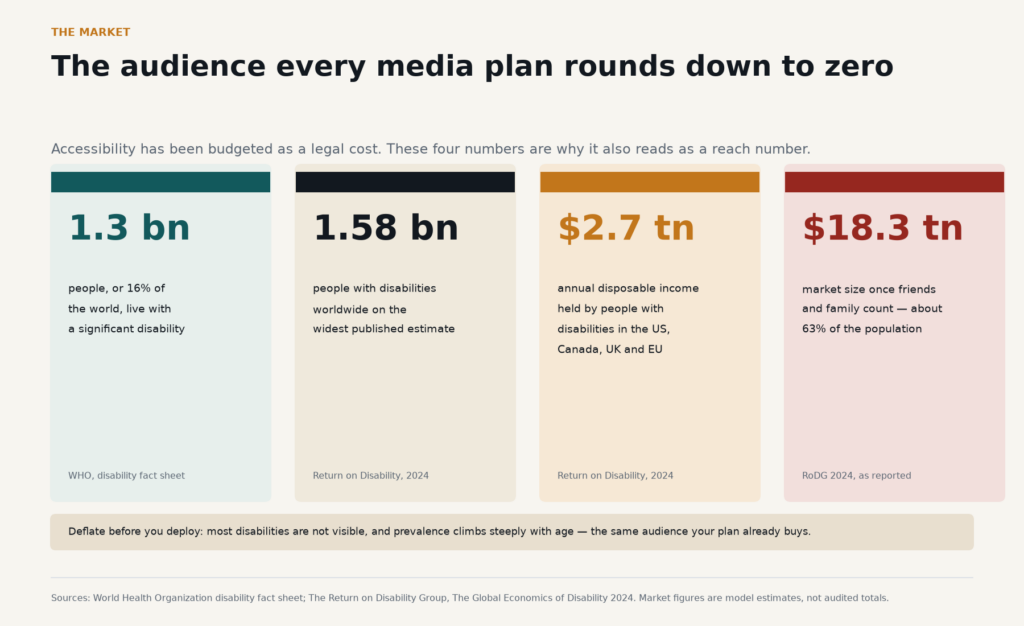
The World Health Organization puts the number of people living with a significant disability at roughly 1.3 billion, or 16 percent of the global population. One in six humans. In the United States, the Centers for Disease Control and Prevention reports that 28.7 percent of adults have some form of disability — a much higher share, though it comes from a different survey instrument with a different question set, which is exactly why you should quote the source and the method rather than the headline alone.
Here is the part media planners consistently underestimate: disability is not a stable minority that lives somewhere else. It is the one demographic everybody joins eventually, if they are lucky enough to age. Vision declines, hearing declines, motor control declines, and cognitive load tolerance declines. The accessible experience you build for a blind customer in 2026 is the experience you will personally depend on in 2046.
What actually changed in the last eighteen months
Two curves crossed. The regulatory curve steepened, and the automation curve got cheap enough that the first one became survivable.
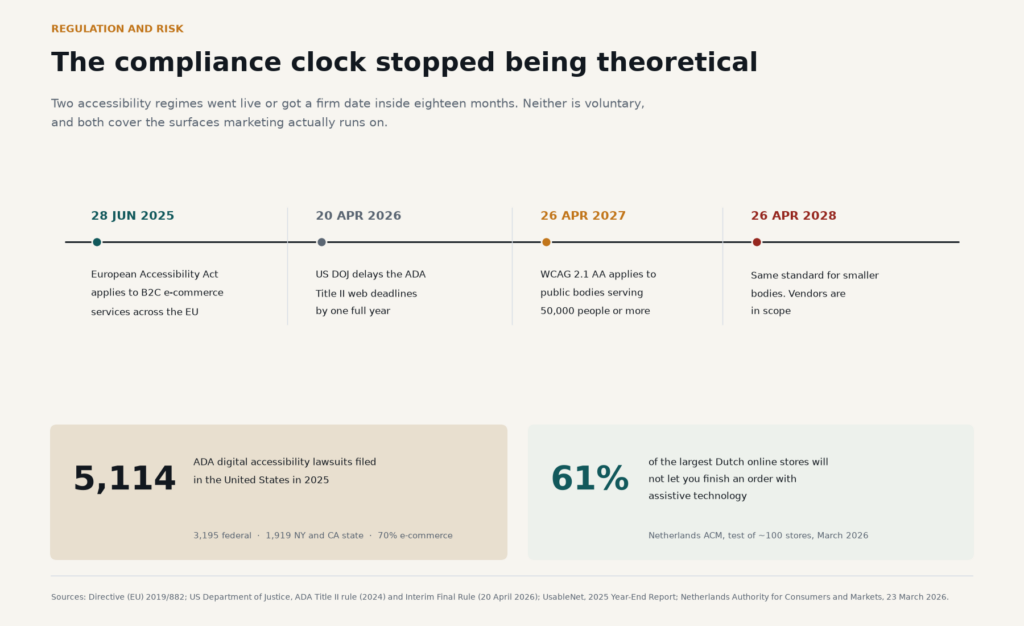
On the regulatory side, the European Accessibility Act became applicable on 28 June 2025, and it covers consumer e-commerce services — the online shop, not just the brochure site. In the United States, the Department of Justice’s 2024 rule under ADA Title II adopted WCAG 2.1 Level AA as the technical standard for state and local government web content, with an interim final rule in April 2026 pushing the compliance dates back a year: April 2027 for public bodies serving 50,000 people or more, April 2028 for smaller ones. The extension changed the calendar, not the obligation, and the rule reaches content “provided or made available” through contractors and vendors — which is to say, through agencies.
The more instructive signal came from a courtroom rather than a regulator. In June 2026, the judicial court in Caen, France, ordered Carrefour to make its grocery site and app fully accessible within six months, with a €500 daily penalty for slippage. Carrefour’s defence was that it was already 71.21 percent conformant. The court was unmoved, and its reasoning is the sentence every marketer should tape to a monitor: an e-commerce site cannot be somewhat accessible; it must be accessible. Partial conformance is not a defence, because accessibility is an obligation of result, not of effort.
Meanwhile the market surveillance data shows how far the average retailer is from that bar. In March 2026, the Netherlands Authority for Consumers and Markets tested roughly one hundred of the country’s largest online stores and telecom and energy providers. At 61 percent of them, a person using assistive technology could not complete an order at all. Another 33 percent could complete it, but only with significantly more effort. Six percent passed cleanly.
That is not a compliance statistic. That is a checkout abandonment statistic wearing a legal costume.
The four jobs AI now genuinely does well
Strip away the vendor language and the capability story is narrower, and more useful, than the pitch.
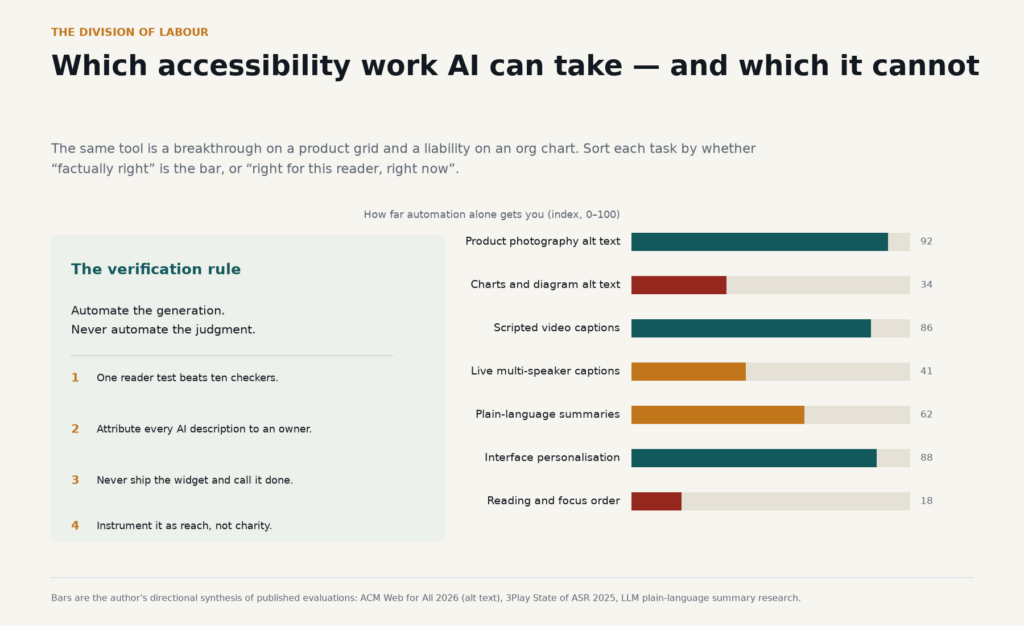
Image descriptions at catalogue scale. For standard product photography — a jacket on a white background, a chair in three-quarter view — a multimodal model will reliably tell you what the object is, what colour it is, and what is visible. For a brand publishing ten thousand SKU images a month, that is the difference between a described catalogue and an undescribed one.
Captions and transcripts. Automatic speech recognition has reached the point where scripted, single-speaker video can be captioned with error rates low enough to be genuinely useful, and where the transcript doubles as indexable text on the page.
Reading the page aloud. Text-to-speech is now good enough that “listen to this article” is a real feature rather than an accessibility checkbox nobody uses.
Plain-language rewriting. Density is a barrier, not a virtue. Summarising a twelve-hundred-word policy page into four clear sentences is exactly the kind of task a language model performs competently — and cognitive accessibility is the largest single disability category in the United States, at 13.9 percent of adults.
Personalisation. Contrast, type size, spacing, motion reduction: preferences that used to be a settings menu nobody found can now be detected or requested and applied per session.
Where the automation hits a ceiling
Now the uncomfortable half, because this is where most “AI plus accessibility” content quietly stops.
Peer-reviewed evaluation of model-generated alt text for complex figures is not flattering. A 2026 study presented at the ACM Web for All conference compared expert human descriptions of automata diagrams against outputs from leading multimodal models. The models produced fluent, confident text that frequently missed the structural semantics that made the diagram meaningful — and in batch mode, produced outright hallucinations, occasionally describing diagrams that were not there. The authors’ conclusion was pointed: automated similarity metrics do not capture accessibility-critical errors, and a description can read beautifully while being useless.
The same pattern shows up in speech. 3Play Media’s 2025 benchmark, covering 205 hours of audio across eight ASR engines plus a multimodal model, found accuracy improvements flattening for English pre-recorded content, and error rates across every engine still short of what accessibility work requires. Human review remains part of the pipeline, not an optional extra.
And in plain language. A large crowdsourced evaluation of AI-generated plain language summaries of medical research found something subtle and important: readers rated the AI summaries as indistinguishable from human-written ones, but comprehension was significantly better with the human versions. The text felt clear. It did not make people understand.
So the honest division of labour looks like this: AI compresses the cost of generation, and does nothing to compress the cost of judgment. Generation is now nearly free. Judgment is the scarce input, and it is still human.
The market number that should end the argument
Here is where the conversation usually turns defensive, so let us put numbers on it instead.
The Return on Disability Group’s 2024 Global Economics of Disability report estimates 1.58 billion people with disabilities worldwide — 22 percent of the population aged five and above — and puts the annual disposable income controlled by people with disabilities in the United States at roughly $1.3 trillion, with a further $1.4 trillion across Canada, the UK and the EU. Add friends and family, who make consumption decisions shaped by the person they love, and the firm’s publicised figure for the total disability market reaches $18.3 trillion, touching around 63 percent of the global population. Treat those aggregate figures as modelled estimates rather than audited totals, and they are still enormous.
On the operating side, Accenture’s multi-year analysis of companies participating in the Disability Equality Index found that the 45 firms it identified as inclusion leaders averaged 28 percent higher revenue, double the net income and 30 percent higher economic profit margins than their peers. That is correlation among already-high-performing large US companies, not a causal guarantee. But it is the opposite direction from “accessibility is a cost centre.”
Accessibility is a funnel problem, not a virtue problem
The frame that finally gets budget is not ethical. It is arithmetic.
You already paid to acquire the traffic. Some percentage of that traffic hits a form field with no label, a date picker that will not take keyboard input, or a CAPTCHA that a screen reader cannot solve. They leave. You never see them in the funnel report, because they never entered the funnel — they are the invisible denominator.
The Dutch regulator’s finding — 61 percent of major stores blocking order completion for assistive-technology users — is the clearest available measurement of that invisible loss. Those are not marginal users with unusual setups. They are customers using keyboards, screen readers and switch access, which is how a substantial share of people with motor, visual and cognitive disabilities shop.
And the spillover is the part that finally silences the sceptics: the fixes that make a checkout usable with a screen reader also make it usable one-handed on a train, at 200 percent zoom, in bright sunlight, with a toddler on your arm. Accessible design is not a special-case branch. It is the main path, built more carefully.
The trap: buying a widget and calling it strategy
You have seen the pitch. One line of code, full compliance, forty-eight hours. It is a seductive offer to anybody who has just been handed a deadline and no headcount.
In April 2025, the US Federal Trade Commission closed a case that should end the sales conversation permanently. A vendor of an AI-powered accessibility overlay paid $1 million to settle allegations that it misrepresented its tool as capable of making any website compliant with WCAG, and that it dressed up paid reviews as independent opinion. The resulting order bars the company from making compliance claims it cannot substantiate, and it remains in force for twenty years.
Meanwhile, UsableNet’s tracking of US litigation counted more than 1,400 lawsuits in 2025 naming companies that already had an accessibility widget installed on their site — roughly 95 to 155 new cases every month of the year. Across the full year, 5,114 digital accessibility lawsuits were filed, 70 percent of them against e-commerce sites, and 1,427 of the federal cases targeted companies that had already been sued once. A widget does not stop litigation; it just changes which paragraph of the complaint you appear in.
The structural reason is simple, and it is the same reason misused ARIA correlates with more errors rather than fewer. An overlay changes what a visitor sees. It does not change what the underlying document is. Assistive technology reads the document.
The inclusive-marketing playbook: five moves
1. Automate the floor, not the ceiling. Push model-generated alt text, captions and transcripts across the entire content estate. Accept that this establishes a floor. The floor is vastly better than the current average of 53 percent of pages missing alt text.
2. Route complexity to humans on purpose. Standardise the rule rather than debating it case by case: product photography and simple charts go through automation with spot checks; org charts, data visualisations, diagrams and anything carrying meaning in its structure get a human description. Ambiguity here is how quality quietly collapses.
3. Build accessibility into the design system, not the backlog. A component library with keyboard behaviour, focus states and accessible names baked in fixes the problem once instead of eleven times. Every audit you have ever read is a list of the same defects reintroduced by the same templates.
4. Test with assistive technology, not just with a scanner. Automated tools catch perhaps a third of real barriers, and they cannot tell you whether a description is useful. Fifteen minutes with a screen reader user will surface things no dashboard reports. Recruit two or three; pay them properly.
5. Publish the accessibility statement and keep it honest. Under the European regime, the statement is a legal artefact, and in several enforcement regimes it is the first thing an inspector reads. A candid statement with a dated conformance level and a remediation plan is worth more than a perfect score you cannot document.
Measure it like a channel, not like a project
If accessibility stays a project, it will be finished once and rot. If it becomes a channel, it gets managed.
Instrument completion rates on the four journeys where abandonment is most expensive: search, product detail, checkout, and returns or support. Segment by assistive-technology usage where you are permitted to detect it, and by the proxies you can observe — keyboard-only navigation, zoom level, reduced-motion preference. Watch error rates on form validation. Watch support contacts about “the button doesn’t work.”
Then report it in the same slide as paid social. Not because the numbers are comparable, but because that is the only way the audience stops being invisible.
The honest caveats
Three things this article is not claiming.
It is not claiming AI makes accessibility free. It makes generation cheap and shifts cost to review, governance and testing. Total spend usually falls, but it does not vanish, and teams that budget for generation alone end up with a large library of confident, unusable descriptions.
It is not claiming automation replaces inclusive design. Automated remediations sit on top of structure. Bad structure plus automation equals bad structure with better marketing.
And it is not claiming compliance equals inclusion. You can pass an audit and still be exhausting to use. The brands that get real return from this work treat the audit as a starting line, not a finish line.
A 90-day sequence that survives contact with reality
Weeks 1 to 2: run a scan of your top fifty templates, then read the results next to a manual keyboard pass. Do not fix anything yet. Establish what is actually broken and how much of it is template-driven.
Weeks 3 to 6: fix the four defects that appear on nearly every page — contrast, alt text, form labels, empty links. These are cheap, and they clear the majority of detectable failures.
Weeks 5 to 8: deploy automated alt text and captions across your content pipeline with a review queue, not a straight-to-live path. Define the complexity threshold in writing.
Weeks 8 to 12: publish or republish your accessibility statement, and instrument the four journeys. Book a test session with two assistive-technology users. Then put the findings in front of whoever owns the revenue number, not whoever owns the risk register.
The unlock is not the technology
Here is the thing worth taking away. AI did not solve accessibility. What it did was remove the excuse.
When the work was slow, specialised and unbudgeted, “we’ll get to it” was a defensible position. When description, transcription and plain-language rewriting can be produced at near-zero marginal cost, and when a French court will tell a retailer that 71 percent is a failing grade, that position stops being defensible and starts being a choice.
The brands that move now will pick up something their competitors have been systematically declining to serve: a large, loyal, remarkably under-targeted audience, reached through experiences that happen to be faster, clearer and easier for everybody else too. That is not a compliance story. That is a distribution advantage, disguised as a footnote.
Accessibility, powered by AI, stopped being the thing marketing should do. It became the thing marketing can finally afford to do well.