Why Cheap AI Made Marketing More Expensive, Not Less
Nine out of ten people reading a token-price chart reach the same conclusion: if intelligence got 208 times cheaper in twenty-three months, every function that consumes intelligence should now be spending far more on it. Coding did — 7.7 times, to $34 billion. Marketing grew 1.8 times, to $1.2 billion, the slowest multiple Menlo Ventures recorded for any function.
The usual explanation is that marketing lacks technical buyers. That doesn’t hold up. Marketing budgets are large enough to buy software without a procurement committee, and CMOs have been signing AI contracts since 2023. The real reason is structural, and it explains far more than one budget line.
AI only compresses the half of a job you can check
Every knowledge job has two layers: producing the artifact, and judging whether the artifact is right. AI is extraordinary at the first and indifferent to the second — unless the judgment is mechanical. Code compiles or it doesn’t. A test passes or it fails.
Coding, then, was the perfect target. AI could compress production and automate verification, so the loop closed without a human in it, and agents could run unsupervised through the night. Marketing got the compression without the closure. Five hundred ad variants now cost what five used to, and a person still has to decide which one is any good — because “good” depends on brand memory, category context and a legal team.
That’s the asymmetry nobody priced in: the 208-fold cut landed almost entirely on the cheap half of the work.
Free generation raises the review bill
Here is the part missing from every cost-savings deck. When production becomes free, the number of candidates explodes, and someone still has to look at them. The savings from cheap tokens don’t accumulate into a larger software line item — they accumulate into a larger review burden, paid in salaries and invisible on any invoice.
Which produces the counterintuitive result: marketing’s AI spend stayed small precisely because cheap inference worked. The savings were real; they were just absorbed by headcount marketing already had.
The budget is a slice of a slice
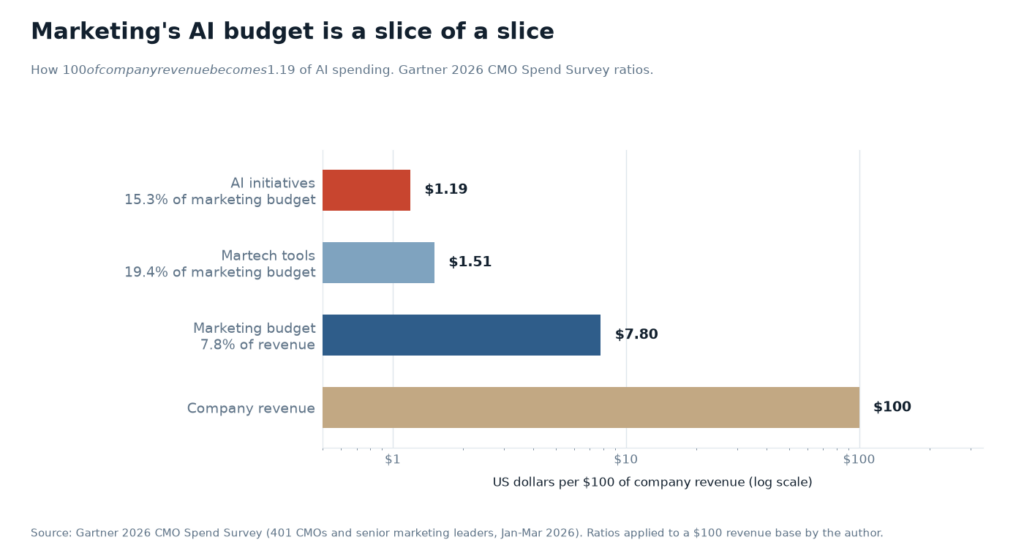
Gartner’s 2026 survey puts marketing budgets flat at 7.8% of company revenue, with martech taking 19.4% of that and AI initiatives 15.3%. On a $100 revenue base, that is $1.19 of AI money — inside a budget pegged to a percentage that isn’t growing. Every AI dollar is therefore a dollar taken from something else, and something else has an owner who objects.
Coding’s money came from a different place entirely. Menlo found 55% of incremental enterprise AI spend came from net-new budgets. Net-new money doesn’t require a fight.
So name the tax
The verifiability tax is the cost of proving an outcome in a form a machine can check. Functions that pay it cheaply — coding, support, IT operations — scale effortlessly. Functions that can’t pay it in software end up paying it in human review and stalled expansion.
The fix isn’t a better model. It’s a narrower claim. Define one checkable unit — a resolved conversation, a qualified lead, a variant that beat control at 95% confidence — and price against it. HubSpot did exactly this in April 2026, moving its Customer Agent to $0.50 per resolved conversation at a 65% resolution rate.
That isn’t a pricing tactic. It’s a function finally writing down what “done” means — the precondition for ever being automated at all.
Cheap inference didn’t fail marketing. It audited it.