The Consideration Channel Nobody Budgeted For: Visual Search and the Multimodal Shift
Every marketing discipline you have was built on a single premise: the machine reads text. Keywords went into a box. Copy went on a page. Alt text was a courtesy for screen readers and a checkbox for auditors. Images were decoration, and video was a channel you bought media in, not a surface you were indexed on.
That premise is gone. Ask Google Lens about a blender on a friend’s kitchen counter and it will identify the model, show you the price at four retailers, and pull up reviews. Point your phone at a coat on a stranger’s back and the search begins from the photo, not the word.
Here is the part most decks get wrong. The interesting question is not whether AI can see your product. It is whether seeing your product leads anywhere. And the evidence on that second question is much less flattering than the vendor blogs suggest.
What “multimodal” actually means in practice
Strip the jargon and multimodal just means one model handling several kinds of input at once: text, image, audio, video, and increasingly the sensor data and screen state of the device itself. The old stack bolted these together. A vision model found shapes, a text model found words, and a rules engine guessed at the relationship. The current generation does the relationship as part of the same forward pass. It reads the scene.
That distinction sounds academic until you watch it work. Google’s own engineers describe a “fan-out” behaviour: give AI Mode a photo of a styled living room and it does not hunt for one object. It identifies the lamp, the rug, the side table, and the chair, runs separate searches for each, then stitches the results into one answer. Ask about a garden you admire and it works out what care each plant in the frame needs. Ask it to explain a museum wall and it will talk you through every painting hanging there.
Three things follow from that, and they matter more than the feature list:
The unit of search stopped being the item. It is the scene.
The unit of understanding stopped being the caption. It is the pixels.
And the unit of competition stopped being the keyword. It is whether your visual identity survives being described by something that has never touched your product.
The scale is real, and the caveats are real too
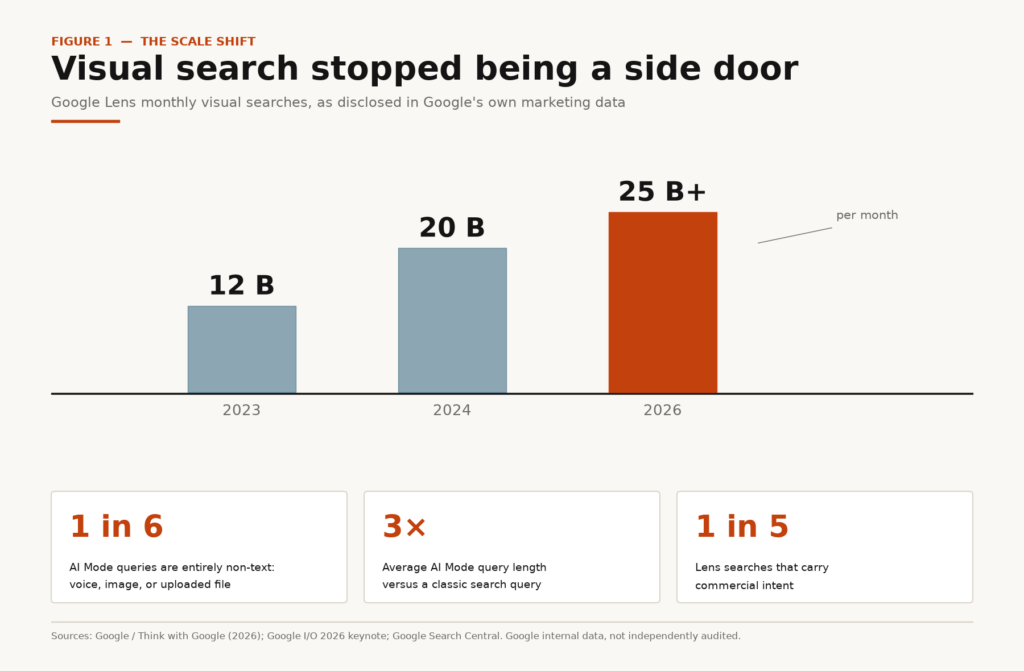
Google now says Lens handles more than 25 billion visual searches a month, and that roughly one in five carries commercial intent. For context, Google reported about 12 billion in 2023 and over 20 billion in late 2024. Meanwhile AI Mode passed a billion monthly users within a year of launch, AI Overviews sits above 2.5 billion, and average AI Mode queries run three times longer than a classic search.
Then there is the number that reframes the whole channel: more than one in six AI Mode queries is now entirely non-text. No words at all. Voice, an image, an uploaded file. Image-led searches are growing faster than 40% month over month on Google’s own accounting.
Treat all of it as directional rather than audited. These are Google’s internal figures, published by Google’s marketing arm, with no disclosed methodology and no regional breakdown. And there is a small inconsistency worth noticing: in 2024 Google said one in four Lens searches had commercial intent, and in 2026 it says one in five. Either commercial intent genuinely fell as casual usage scaled, or the definition moved. Nobody outside Google can tell you which.
That does not make the numbers useless. It makes them a ceiling on what you should claim internally.
Four ways discovery actually breaks open
1. The visual query becomes a first-class citizen
When the query is an image, the words you spent a decade optimising become secondary evidence. What leads is whether the product in frame is unambiguous, correctly identified, and attached to a page that answers “is this the right variant?” rather than “what is this thing?”
2. Voice and camera merge into one gesture
Search Live now runs in more than 200 countries and territories, on voice and camera at once, in whatever language you speak. You can hold a phone at a shelf and ask a question out loud. That is not a chatbot with a microphone; it is a query that has an object in it. For brands, the practical consequence is that your copy has to survive being spoken, and your product has to survive being framed badly by a person in a hurry.
3. Products become quotable without their copy
An assistant answering “what is a good running shoe for wide feet” can now reason from a product image and a video testimonial, not only from the description you wrote. Your visual identity becomes a ranking input, which cuts both ways: a clean, consistent, recognisable product architecture helps a model resolve a match to your brand. A generic silhouette resolves to a category.
4. Video becomes searchable at the frame level
Models can now index what happens inside a clip: the demo, the tutorial, the moment the product does the thing. Chapters, transcripts and scene descriptions are no longer accessibility features. They are the index that lets a machine cite your video instead of a competitor’s blog post.
The number nobody quotes
Now the uncomfortable part, and the reason this piece exists.
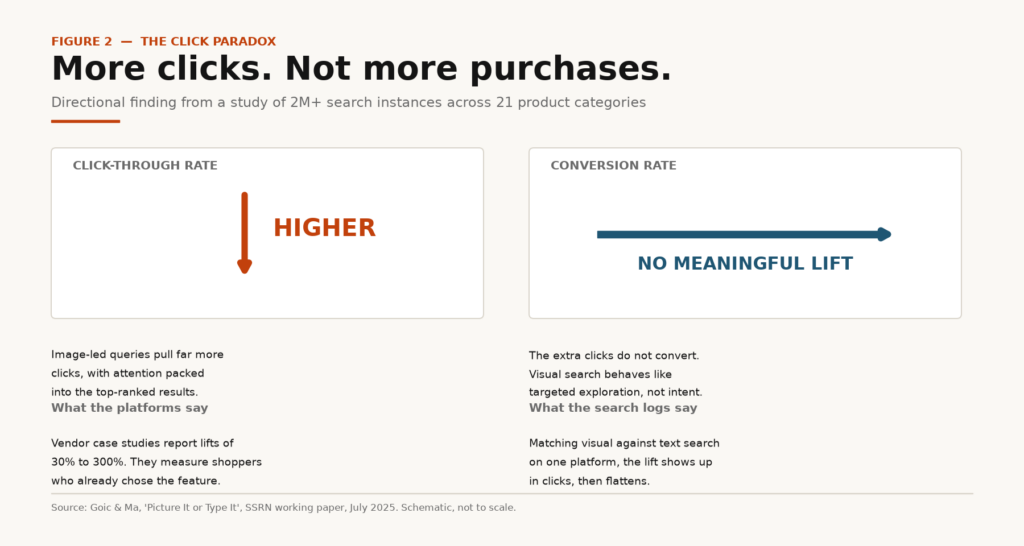
The cheerful version of this story comes from vendors. Visual search converts 30% better. Conversational search converts three times better. Return rates fall 78%. Those figures exist, and they are not fabricated — but every one of them measures shoppers who voluntarily chose the new feature inside a store that just built it. That is a selection effect presented as an average.
A cleaner test exists. A working paper by Marcel Goic and Liye Ma examined more than two million real search instances across 21 product categories on a single platform, comparing image-led search against text search head to head, same catalogue, same shoppers, same session context.
Image search produced significantly higher click-through rates. Attention concentrated harder on the top results. And conversion did not rise. Not marginally, not in aggregate. The extra clicks simply did not travel to the cart.
The authors’ explanation is the useful part: visual search behaves like targeted exploration. The shopper has a clear picture of what they want and is not yet ready to buy. They are calibrating. A text query like “black leather crossbody bag” arrives late in the journey, carrying vocabulary the shopper already assembled. A photo arrives at the beginning, carrying a desire the shopper has not yet priced.
Read those two datasets together and the strategy writes itself. Visual search is a discovery and consideration surface, not a bottom-funnel one. If you staff it like a conversion channel, you will report a disappointment. If you staff it like a consideration channel — make the variant obvious, make the price honest, make the next step cheap — you are meeting a shopper exactly where the photo caught them.
There is supporting evidence that this is worth doing properly. A 2026 experimental study of 321 participants, using wine and a visual search app, found that visual search raised product valuations relative to text search, through perceived ease of use, novelty and enjoyment. The effect even survived into the tasting itself. Perception set expectations, and expectations shaped experience.
Five things a machine sees wrong
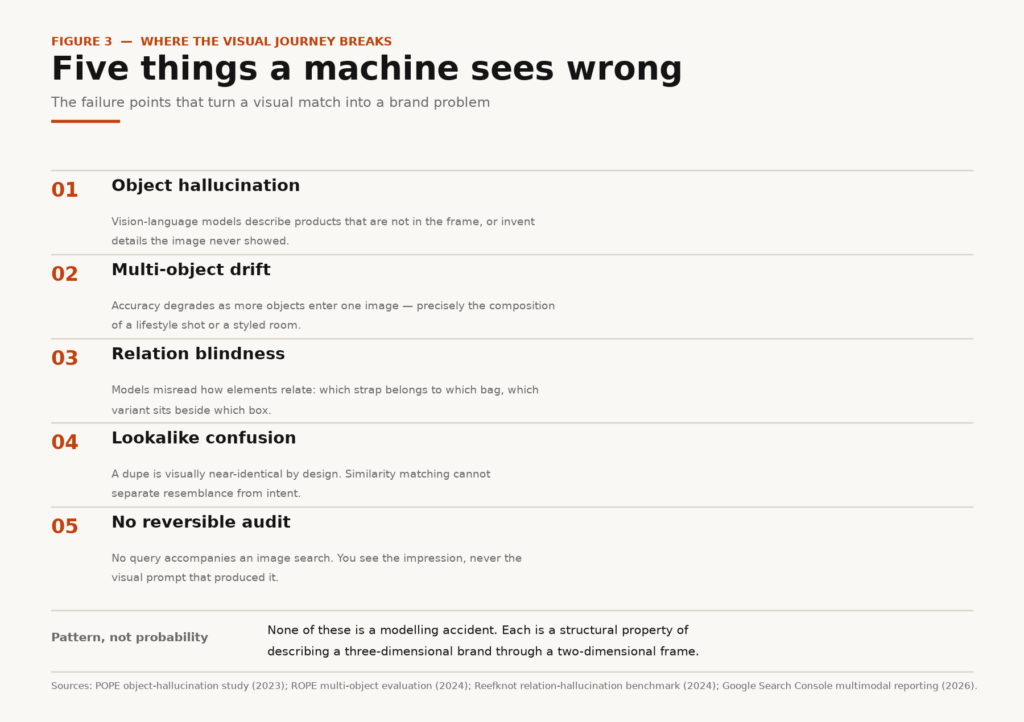
Every brand-safety conversation about generative AI focuses on text. The visual failures are worse, because they are harder to spot and harder to appeal.
Object hallucination. Vision-language models describe things that are not in the frame. This is not a bug in one model; it is a documented, systematic property. The POPE evaluation established the pattern, and later work showed it worsens with multi-object scenes — which is precisely what a lifestyle photograph is. The richer your styling, the more chances the model has to invent.
Relation blindness. Models misread how elements relate to each other. Which strap belongs to which bag. Which variant sits beside which box. Relation-level hallucination has its own benchmark now, built from over twenty thousand real samples, and the mitigation techniques published so far buy single-digit percentage improvements. That is progress, not a fix.
Lookalike confusion. Here the technology collides with culture. Circana reports that 58% of shoppers bought a dupe in 2026, with apparel leading at 54% of dupe buyers and beauty at 51%. Among beauty buyers, 70% would choose the dupe even if they could afford the original. A near-identical copy is, by design, a near-identical image. Similarity matching has no way to distinguish resemblance from intent, so the counterfeit or the dupe can be retrieved alongside you — or instead of you.
The scale of that adjacent market is not small. The OECD and EUIPO put global counterfeit trade at USD 467 billion in 2021, about 2.3% of world imports, with clothing, footwear and leather goods accounting for 62% of seizures and roughly 65% of seizures involving small parcels and mail. The distribution channel is the post.
And the audit problem. Since September 2026, Google Search Console has a web multimodal filter covering Lens, Circle to Search, image uploads and Chrome’s image search. It is genuinely useful and it is genuinely limited: there is no query dimension. You can see which pages earned impressions from image-led searches. You cannot see which image, or what the person was looking for. Meanwhile Google confirmed this data was not previously counted in your web numbers at all, which means your historical baselines are quietly incomplete.
The asset layer, in the order it matters
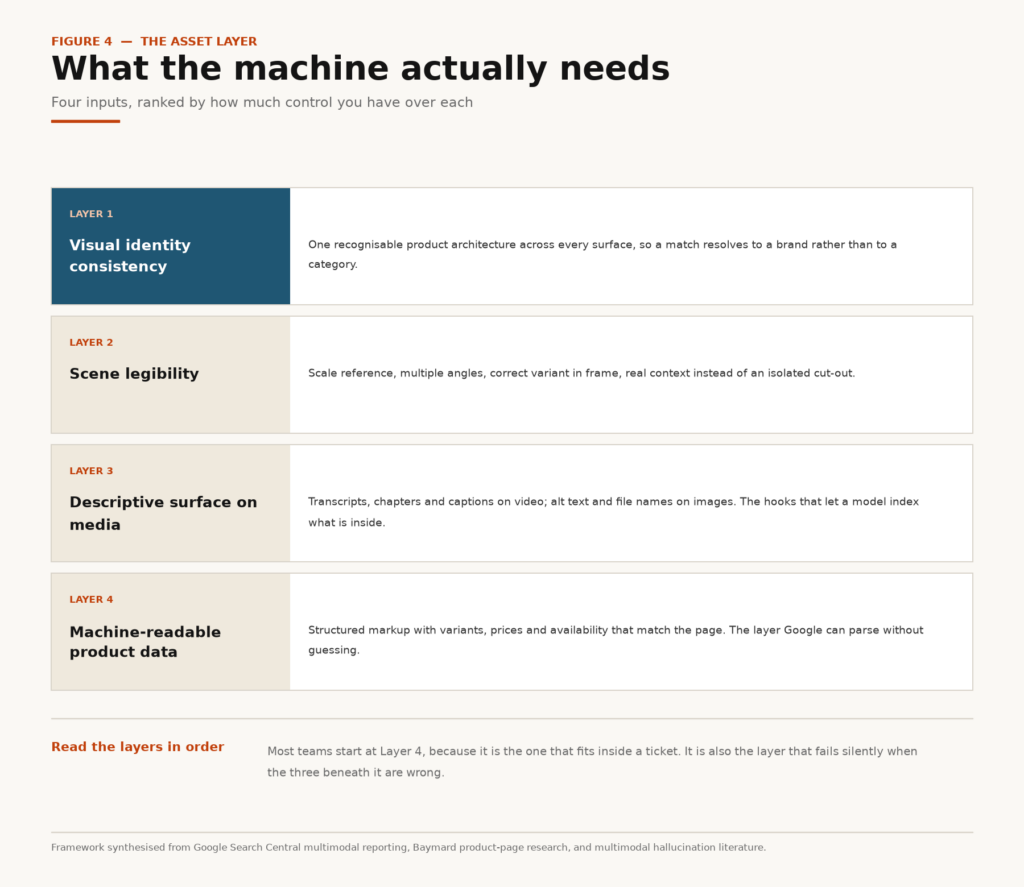
Most visual-optimisation advice starts at the bottom of this stack, because structured data is the part that fits inside an engineering ticket. It is also the layer that fails silently when the three beneath it are wrong.
Layer 1 — visual identity consistency. Can a model resolve a match to you rather than to your category? This is a design decision, made years before anyone thought about retrieval, and it is the hardest to retrofit. A recognisable silhouette, a consistent proportion, a signature detail. The visual brand used to be a nice-to-have for recall. It is now an identifier.
Layer 2 — scene legibility. Baymard’s product-page research is the most useful evidence here. Fifty-six percent of shoppers open the image gallery before reading anything else. Forty-two percent try to judge size from the photograph, and 37% of sites still ship no image with a scale reference. Twenty-three percent show no human model for wearable products. These are the same gaps that make a machine’s read unreliable, because a model and a human are solving the same problem: what am I looking at, and how big is it?
Layer 3 — descriptive surface on media. Transcripts, chapters and captions on video; filenames and alt text on images. Unsexy, and the difference between a model indexing your demo and ignoring it.
Layer 4 — machine-readable product data. Structured markup with variants, prices and availability that match the visible page. Google has been explicit that this is not a ranking formula, only that conflicting information is an avoidable problem. Believe them. Consistency is the deliverable; the ranking is a hoped-for consequence.
The playbook
Audit for machine readability, not beauty. Take your ten best-selling products. Show the primary image to a multimodal model with no context and ask what it is, what variant, and what it costs. Then compare that to your product page. The gap is your worklist.
Shoot for disambiguation. Every SKU in a family needs a visual tell that survives a 400-pixel thumbnail: a colourway, a hardware finish, a proportion. If your variants differ only by name, the machine will guess, and it will guess wrong.
Instrument the multimodal channel. Pull the Search Console multimodal filter and separate it from text-based search for the same pages. Then read it as an upper-funnel number. Impressions and clicks, not revenue.
Give video an index. Chapters, transcripts, and a described demo. A model cannot cite a video it cannot parse.
Monitor the description, not just the mention. The new reputational risk is being described inaccurately, at scale, in a surface that leaves no query trail. Sample what assistants say about your products monthly, using photographs rather than prompts.
What to actually take away
Multimodal AI does not make your images into advertising. It makes them into evidence. Evidence that a model weighs when someone asks a question you never anticipated, in a form you cannot audit, on a surface where the query leaves no record.
The brands that handle this well will not be the ones with the most beautiful photography. They will be the ones whose products are unmistakable in a bad photo, whose pages agree with their own pictures, and who stopped measuring a consideration channel by its conversion rate.
Your product photo is now part of your answer. It is worth asking what it says when nobody is writing the caption.