45% of New Phones Can Think Locally. Your Marketing Stack Still Assumes They Can’t.
For about a decade, “AI in your app” meant a round-trip. Your request left the handset, crossed a network, landed in a data centre, got processed, and came back — usually fast enough that nobody thought about it. On-device AI deletes that sentence. The model runs on the phone. The data it reasons over never leaves the hand.
That sounds like an engineering detail. It is not. It changes what a marketer is allowed to know, how fast an experience can respond, and — most importantly — which personalisation model survives the next five years of privacy tightening. The interesting part is not that phones got faster. It is that the industry spent a decade building personalisation on a data flow that is now being structurally closed, and the edge is the only place left where the signal still exists.
The phone stopped being a terminal
Ten years ago the smartphone was a glass rectangle that displayed decisions made elsewhere. Today it makes them.
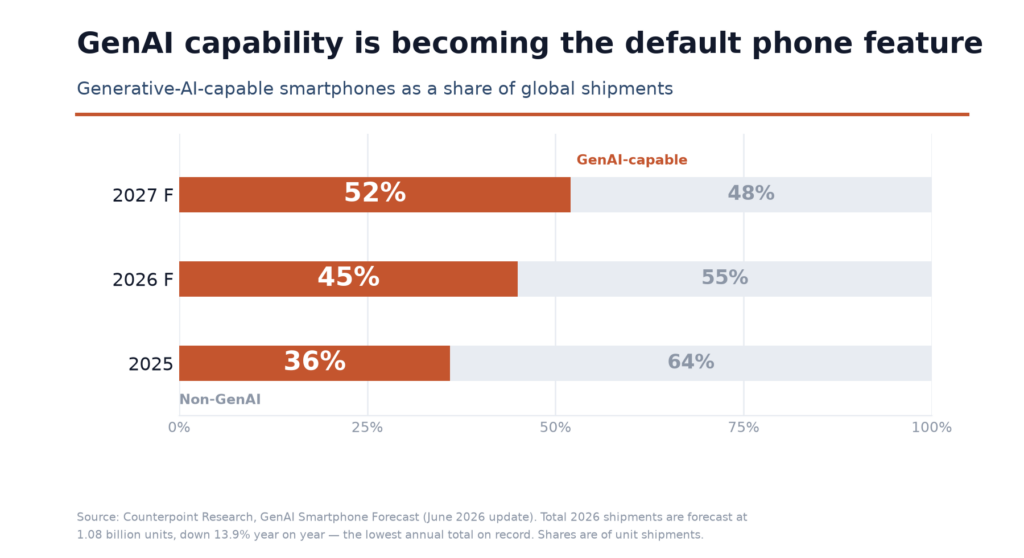
The hardware shift is the visible part. Counterpoint Research’s June 2026 forecast projected that generative-AI-capable smartphones would account for 45% of global shipments in 2026, up from 36% in 2025, and reach 52% in 2027 — at which point the capability stops being a differentiator and becomes table stakes. That forecast landed alongside a less cheerful number: total smartphone shipments were projected to fall 13.9% to 1.08 billion units, the lowest annual total in the firm’s series, as a memory supply crisis squeezed the entry-level segment hardest. GenAI capability is becoming standard precisely in the part of the market that can still afford to buy.
The software shift matters more. At its 2026 developer conference, Apple turned the Foundation Models framework into a single native Swift interface spanning supported on-device models, server models, image input and custom skills, and introduced Core AI as the path for running a developer’s own model locally on Apple silicon. Google’s Android team spent the same cycle making the identical move from the other direction: Gemini Nano 4 went into preview on the Gemma 4 family, ML Kit added structured output and prompt prefix caching, and Firebase AI Logic introduced explicit routing modes — prefer on-device, prefer cloud, only on-device, only cloud — as an experimental feature that turns where-to-run into a configurable parameter rather than an implementation accident.
Read those two sentences again, because they contain the whole story. Both platform owners have stopped asking whether AI should run locally. They are now shipping the plumbing that decides, per request, where it runs.
There is a second, subtler finding buried in the same Counterpoint release, and it is the one marketers should pin to the wall: GenAI capability has become standard in handsets above roughly $400 wholesale, yet a clear gap remains between devices that are capable of it and devices on which people regularly use AI features. Capability shipped. Habit did not. That gap — not the silicon — is the commercial opportunity.
What on-device AI actually is, and what it is not
Three things changed at once, and campaigns usually only account for one of them.
Models got small enough. Distillation and quantisation compressed capability that once needed a rack into something that fits in a few gigabytes of memory. Chips got specialised: neural processing units stopped being a line on a spec sheet and became the part of the system-on-chip that actually matters for inference. And the frameworks got boring — which is the real milestone. When routing between local and remote inference is a parameter you set, the technology has stopped being research.
What it is not: a replacement for cloud AI. An on-device model is smaller, and smaller means less capable on hard reasoning. Anyone telling you the edge wins outright is selling something. The assistant your customers just got pushed in a system update is not a frontier model, and pretending otherwise is how teams ship a worse experience and call it private.
What it is: a different economic and legal position. Cloud inference centralises cost, capability and liability in one auditable place. Edge inference spreads all three across millions of devices you will never see. That trade is the whole subject.
Counterpoint’s analysts make a related point that rarely survives into marketing decks: the competitive layer is shifting from the device to the model underneath it. Google’s Gemini has become the shared foundation for Apple’s rebuilt Siri, Samsung’s Galaxy AI and the overseas devices of major Chinese brands — while Apple, Samsung and Chinese vendors at home keep proprietary on-device capability. The model layer is consolidating. The experience layer, where you compete, is not.
The trust data says the shift is already priced in
Here is the number that should make you uncomfortable. In Deloitte’s August 2026 survey of nearly 2,600 US banking customers, 79% trusted their bank’s own website when researching products. Traditional search engines drew 67%. Generative AI tools drew 49%. Social media and forums drew 28%.
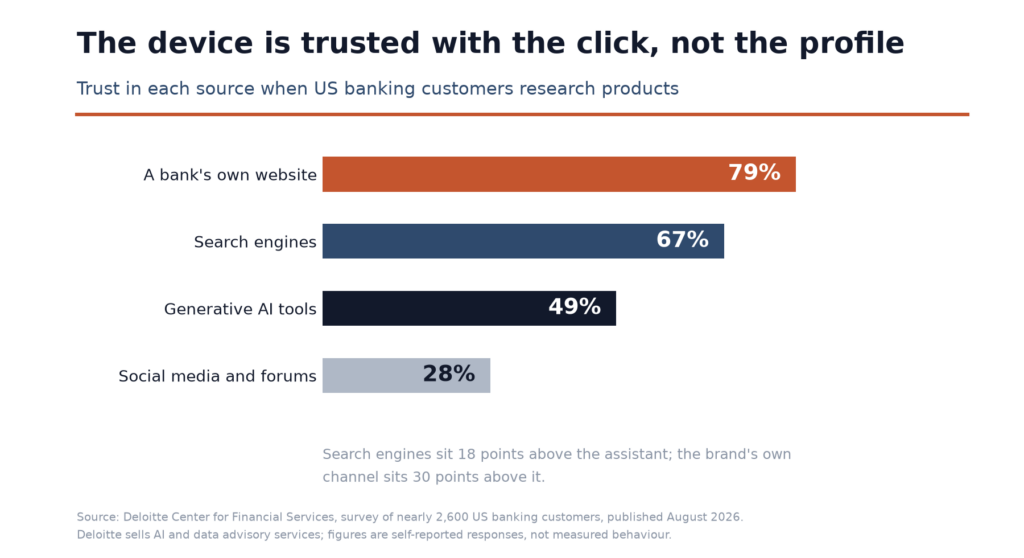
The gap between 67% and 49% is the interesting one. People will hand a search engine a question. They hesitate to hand an assistant their financial situation — and 72% of the same respondents said they were worried about sharing financial information with generative AI at all. Even more telling: 83% said they would feel anxious about an AI agent acting on their finances without approval. Deloitte sells AI and data advisory work, so apply the usual discount to the framing; the pattern is consistent enough across other surveys to survive it.
Now hold that next to what consumer research says about personalisation itself. Usercentrics’ State of Digital Trust 2026, fielded by Sapio Research across 11,000 consumers in seven markets in March 2026, found 71% consider AI-driven personalisation intrusive — 75% in the US. Almost half, 47%, reported taking at least one action with a direct revenue consequence in the previous six months over how a brand used their data in AI systems.
That reads like a verdict against personalisation. It is not. Among consumers who actively engage with privacy choices, 53% are comfortable with brands personalising their experience. Among those who do not understand what is collected, that falls to 19%. Same technology, same offer, 34 points apart.
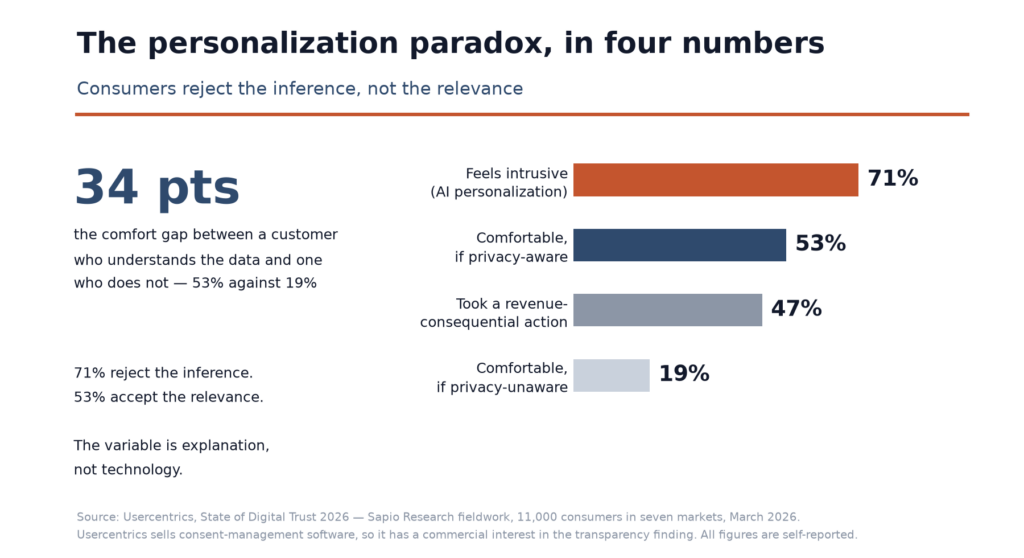
The variable is explanation. Not model architecture. Not data volume. Explanation.
That distinction is the entire commercial case for the edge, and most content about on-device AI misses it. A brand that says “we compute this on your phone, nothing leaves it” is making a claim a customer can verify by turning off Wi-Fi and watching the feature still work. A brand that says “we handle your data responsibly” is making a claim the customer has heard eleven times this week and has no way to check.
Why the edge matters: privacy, latency, and the third one nobody names
Privacy is the one everyone leads with, and it is the weakest argument on its own. Privacy is a compliance posture; customers do not switch brands to reward it. Usercentrics did find that 52% say they would pay more for a brand transparent about its AI data practices, at a reported average premium around 7% — but stated willingness to pay is the softest number in any survey. Do not build a business case on it alone.
Latency is the harder one. The canonical benchmark is old and it still stings. Google reported that 53% of visits in an opted-in sample of 3,700 mobile sites were abandoned when a page took longer than three seconds to load. A separate Google modelling exercise estimated the probability of bouncing rose 32% moving from one second to three, and 113% moving from one to seven. Those are modelled estimates from 2017, not a controlled experiment — but nothing since has made people more patient. A cloud round-trip is a latency tax you pay on every personalisation decision, and you pay it in the exact moment the customer’s attention is available.
The third one nobody names is the interesting one. Cloud tracking built profiles by following people across sites and apps. That mechanism is in structural retreat. Google’s Anthony Chavez announced in October 2025 that the company would retire a list of Privacy Sandbox technologies through Chrome and Android deprecation processes — including Attribution Reporting, Topics, Protected Audience, Protected App Signals and, notably, On-Device Personalization — while keeping CHIPS, FedCM and Private State Tokens. Apple’s App Tracking Transparency did the same thing from the other side: Adjust’s Mobile App Trends 2026 put global ATT opt-in at 38% in the first quarter of 2026 among users actually shown the prompt, up from 35% a year earlier. That is a decent number until you remember the other 62%.
Cross-site identity is thinning. But behaviour on a person’s own device has not gone anywhere. It is sitting right there, on hardware that is now capable of reading it locally.
One clarification worth making loudly, because the coverage gets it wrong: the On-Device Personalization that Google retired was a Sandbox API for interest-based ad targeting computed inside the browser. It is not the same thing as on-device inference for app experiences. Same words, different mechanism, opposite trajectory.
Where the inference runs changes the craft
Put the two loops side by side and the strategic asymmetry becomes obvious.
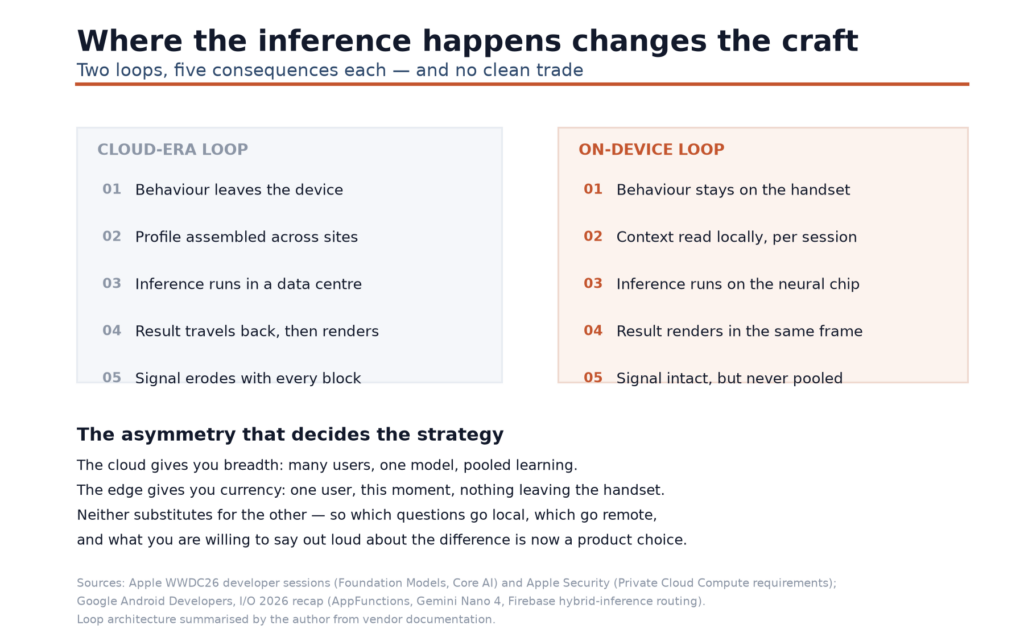
The cloud loop gives you breadth: many users, one model, pooled learning, and the ability to improve the system for everyone when one person’s behaviour teaches you something. It also gives you a signal that erodes every time a browser blocks a script, a user declines a prompt, or a regulator retires an API.
The edge loop gives you currency: one person, this moment, nothing leaving the handset. It cannot pool. A model that learns only from your device learns slowly, and a model that learns only from my device cannot help you.
Neither substitutes for the other. That is why the routing decision — the one both platform owners just made configurable — is now a marketing decision, not an engineering one. Which questions go local, which go remote, and what you are willing to say out loud about the difference.
Five things the edge unlocks that the cloud could not
Personalisation computed where the behaviour happens. Recommendations built from what a person is doing in this session, on this device, without a cross-site profile. McKinsey’s 2021 Next in Personalization research put the typical revenue lift from personalisation at 10–15%, with company-specific results spanning 5% to 25% depending on sector and execution — a range wide enough that it is really a statement about capability, not about the technology. The edge does not raise that ceiling. It changes whether you are still allowed to reach for it.
Real-time experiences that survive a bad network. GSMA’s State of Mobile Internet Connectivity 2026 estimated that 3.1 billion people — 38% of the global population — live inside mobile broadband coverage but do not use mobile internet, and more than 90% of people not using it are already covered. Most of that usage gap is about device affordability and skills rather than signal. But the practical consequence for product teams is blunt: an experience that assumes a stable connection excludes a large share of the planet by design. A feature that degrades gracefully offline is not a niche play.
On-device generation. Apple’s Core AI framework is aimed at running models locally on unified memory and the Neural Engine, and the Foundation Models interface now accepts image input. Personalised creative assembled on the handset — a filter, a layout, a variant — is a different product from a template fetched from a server.
Context the device already owns. Language, location, time, what the user just did. The phone knows all of this. A cloud profile infers it badly from proxies. Local inference reads it directly, which is both more accurate and less intrusive, because the inference happens in the same place as the evidence.
A verifiable privacy claim. This is the underrated one. Apple’s Private Cloud Compute requirements — stateless computation, enforceable guarantees, no privileged runtime access, non-targetability, verifiable transparency — were extended in June 2026 to Google Cloud infrastructure using NVIDIA Confidential Computing, Intel TDX and Google’s Titan chip, with the deployment explicitly in preview while protections were phased in. You do not have to believe the marketing to notice the shape of the argument: the claim is designed to be checkable. That is a different category of promise from a privacy policy.
The hybrid reality nobody markets honestly
Both platforms now ship routing. Firebase AI Logic exposes prefer-on-device, prefer-cloud, only-on-device and only-cloud. Apple splits work between on-device models and Private Cloud Compute. Google frames Android as an intelligence system, with AppFunctions — in experimental preview — letting an app act as an on-device Model Context Protocol server so that system agents can call its tools.
So the honest description of 2026 is not “the edge replaces the cloud.” It is: the boundary moved, and it moved into the product.
Which means the marketing question is no longer “do we have AI?” It is “which parts of this experience happen on the handset, and can we say so in a sentence a customer understands?” That sentence is worth more than most personalisation roadmaps, because it is the thing that turns a privacy cost into a trust asset.
Where the argument breaks
Four honest caveats, because a piece that only lists upside is a brochure.
Cold start. Local personalisation depends on accumulated local signal. A new device knows nothing. The first session is worse on the edge than in the cloud, and no amount of architecture fixes it — you can seed it with declared preferences or accept a mediocre first mile.
Fragmentation. Counterpoint notes that the additional DRAM required for model weights keeps GenAI devices above roughly $400 wholesale, and that memory supply is the binding constraint on how fast the capability spreads down-market. Apple and Google can mandate floors; a brand shipping across a thousand Android variants cannot. Feature parity across your install base is a fantasy you plan around rather than chase.
The capability ceiling. On-device models are smaller. For complex reasoning the cloud still wins, and pretending a local model handles everything is how you ship a demo that dies in production.
Privacy theatre. This is the one that will actually hurt. If your on-device feature still phones home with the inputs, you have not built privacy — you have built a claim. And the audience for that claim is the 47% who already took a revenue-consequential action over exactly this.
What to build, in order
Audit the routing you already have. Take your five most important personalisation surfaces and write down, for each, what data crosses the network and when. Most teams cannot answer this without asking an engineer. That is the finding.
Pick one latency-critical moment and move it local. Not the whole journey. One moment where a round-trip demonstrably costs you — a recommendation that must appear before the scroll, a search suggestion, a form completion. Ship it, then measure the delta. Cloud and edge are comparable only when you have a controlled comparison.
Design the explanation before the feature. “This runs on your phone” is a sentence with a testable claim behind it. Write it, then verify the architecture actually supports it. If it does not, you have found the gap between your roadmap and your marketing.
Stop treating offline as a fallback. GSMA’s 3.1 billion usage-gap figure is not your addressable market tomorrow, but the design principle holds: experiences that assume connectivity exclude people by default. Graceful degradation is positioning.
Build the first mile deliberately. Cold start is real, so the earliest sessions need declared signal — preferences, a short quiz, a stated goal. That is zero-party data doing the job behavioural inference used to do badly.
How you will know it worked
Three metrics, and none of them are impressions.
Time-to-first-relevant-content, measured on-device rather than server-side, because server-side timing excludes the part of the journey you just fixed. Network payload per session on the surfaces you moved, which should fall — and is the cleanest proof that the claim is true. And consent-adjacent behaviour: opt-in rates, disclosure reading, feature usage after a privacy explanation. The entire thesis rests on the idea that explained personalisation converts better than inferred personalisation.
If the third metric does not move, the argument collapses and you are just running a faster server.
The uncomfortable conclusion
The industry has spent fifteen years getting very good at a personalisation model whose fuel is being rationed. On-device AI does not replace that model. It offers a different one: less breadth, more currency, a claim you can verify instead of a promise you have to trust.
The brands that win here will not be the ones with the most sophisticated local model. They will be the ones who closed the gap Counterpoint identified — between a device that can run AI and a customer who actually uses it — by redesigning an experience around a sentence: this happens on your phone, not on our servers. Then they made the sentence true.
That is a slower project than shipping a chatbot. It is also the only version of personalisation that does not require the customer to keep losing something.