Why Visual Search Wins the Click and Loses the Cart
Google will tell you that Lens handles over 25 billion visual searches a month, and that roughly one in five of them carries commercial intent. Every vendor deck built on that figure reaches the same conclusion: optimize your images, and the revenue follows.
Now look at what happens when somebody actually counts.
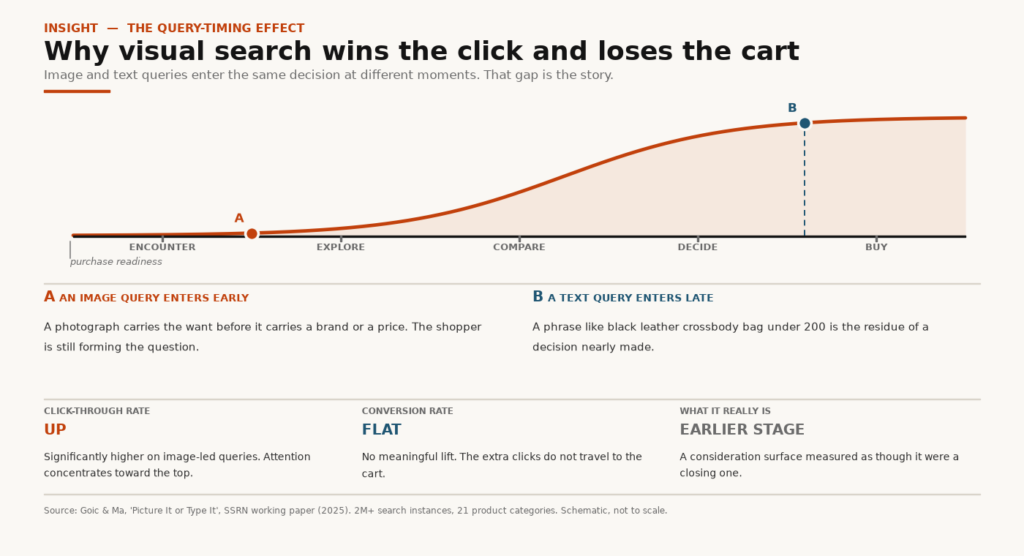
A working paper by Marcel Goic and Liye Ma tracked more than two million real search instances across 21 product categories on a single platform. Same catalogue, same shoppers, same session context. Image-led searches against text searches, head to head. Image search produced significantly higher click-through rates, with attention packed hard into the top results. Conversion, the number every commercial team actually gets paid on, did not move.
Not up a little. Not up in aggregate. The extra clicks simply never arrived at the cart.
Two facts that cannot both be true under the standard story. Hence the puzzle, and hence this piece.
The mechanism is timing, not technology
Here is the explanation the paper offers, and it is more useful than any conversion benchmark.
Think about what a photograph actually is, informationally. It is a want with no vocabulary attached. Someone sees a coat on a stranger in a café and takes a photo. They cannot yet say the brand, the fabric, the price band, or the category name. They have an image and an appetite. That is the entire query.
A text query is the opposite residue. “Black leather crossbody bag under 200” is not a want being formed; it is a want that has already been through a filter. The shopper has compiled the adjective list. They know what they are looking for, roughly what it costs, and what they will accept instead. They are not exploring. They are confirming.
So the two query types are not competing methods of asking the same question. They are two different moments in one decision, and they arrive at the funnel at different depths.
An image query lands at the top, where the shopper is still deciding what the thing even is. A text query lands near the bottom, where the shopper has already decided and needs a supplier.
Now the disappointing conversion number stops being disappointing and starts being obvious. Selling to someone who is calibrating is a different job from selling to someone who is checking out. The click is easy at the top of the funnel, because curiosity is cheap. The purchase is hard there, because commitment is not.
The metric was never wrong. It was measuring the wrong stage.
What this looks like on the other side of the counter
This is where theory gets tested, because the people running image search programs describe the same phenomenon without using the word “funnel.”
They will tell you the traffic is real and the intent is soft. Sessions arrive, scroll, and leave without a cart event. The dashboards look like a channel that is underperforming, so somebody proposes pulling the budget, and the only person who objects is the brand manager who has watched the same traffic quietly searching the brand name three days later.
That delayed search is the whole return, and it almost never gets attributed. A photograph starts a consideration that finishes on a different device, in a different session, sometimes in a different week. Your image search program gets the click and your brand search gets the conversion, and the reporting splits them into an underperformer and a winner that had nothing to do with each other.
There is supporting evidence that the early stage is worth owning properly. A 2026 experimental study of 321 participants, using a wine-label scanning app, found visual search raised product valuations relative to text search, working through perceived ease of use and enjoyment. Notably, the effect held through the tasting itself. What the shopper expected shaped what the shopper tasted.
That is not a conversion effect. It is a prior effect, and priors are exactly what you are buying at the top of the funnel.
The uncomfortable implication
If image search is a consideration surface, then treating it as a performance channel will keep producing two failures at once: you will under-invest in it because the return on ad spend looks poor, and you will mis-brief it because conversion-optimized creative is the wrong creative for someone who has not yet decided what they are looking at.
The brands getting this right are doing something quieter than “visual SEO.” They are removing friction from the moment of calibration. Making the variant unmistakable in a bad photo. Making the price honest on the first click. Making the next step cost the shopper almost nothing, because the shopper is not ready to pay yet and will not be pushed.
None of that shows up as a lift in the channel report. All of it shows up three days later in brand search, where nobody will credit it.
The takeaway
Visual search is not a worse version of text search. It is an earlier version of it, wearing a different interface. Judge it by the job it does, which is helping someone work out what they want, and it starts looking less like a broken channel and more like the cheapest attention you can buy.
Measure it by last-click, and you will conclude the opposite, cancel the program, and hand the top of your funnel to whichever competitor is willing to be patient.