Insight: The Accounting Trick That Makes Marketing the First Thing Cut
Here is a strange asymmetry, and once you see it you cannot unsee it.
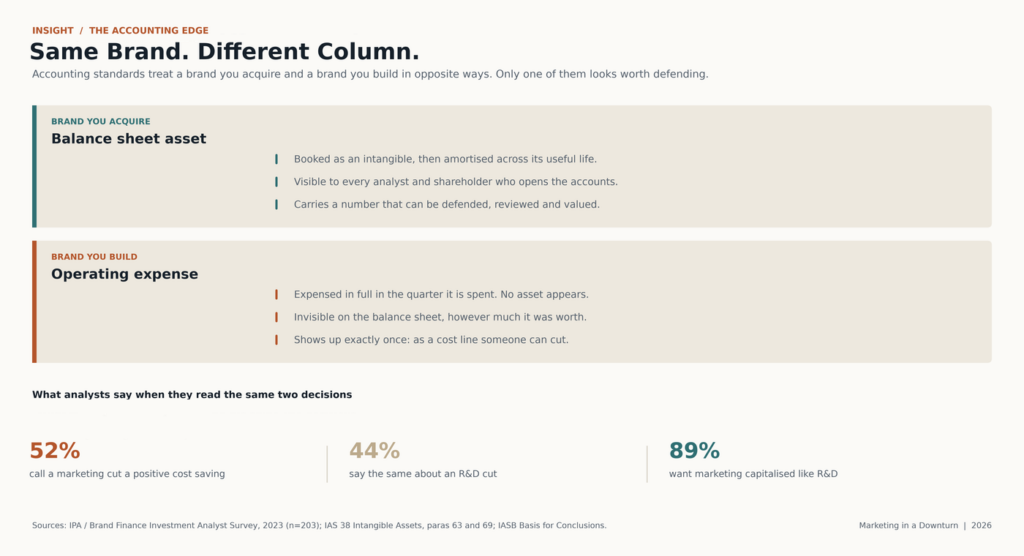
Imagine two companies buy the same brand. One acquires it — writes a cheque, books it as an intangible asset, amortises it gently across a decade. The other builds it — spends the same money on advertising, and watches all of it hit the income statement in the quarter it was spent.
Same asset. Same economic reality. Two completely different columns.
IAS 38 is explicit about this. Internally generated brands cannot be recognised as intangible assets at all. The standard’s own reasoning is disarmingly honest: expenditure on a brand cannot be distinguished from the cost of developing the business as a whole. And advertising and promotional expenditure, per paragraph 69, is expensed the moment it is incurred.
The IASB has even documented the logic in its own words. Advertising enhances or creates brands and customer relationships, which generate revenue. But because a brand built internally is not recognised as an asset, it would be inconsistent to recognise the advertisement that builds it. So the advertisement becomes an expense — matching a prohibition.
That is not a neutral bookkeeping choice. It is a decision about which investments look defensible when a company gets nervous.
The Numbers Get Worse the Closer You Look
The IPA and Brand Finance put this to 203 UK and US investment analysts. The findings are unusually self-contradictory, in a way that shows exactly where the fault line sits.
Seventy-nine percent cite strength of brand and marketing as a factor in how they appraise a company — ahead of leadership quality at 76% and technological innovation at 72%. Thirty-seven percent see advertising as an investment; only 24% see it as a cost. And nearly 90% want marketing spend capitalised like R&D, either always (56%) or some of the time (33%).
So by their own stated preferences, financial analysts believe marketing is an investment, know brand strength is what they evaluate, and want the accounting fixed.
Then ask them what they would do if a company announced a marketing cut. Fifty-two percent call it a positive cost saving. Only 36% call it a short-term fix with long-term damage.
Run the same question on R&D: 44% positive cost saving, 47% short-term fix with long-term damage. The numbers flip. Analyst instinct — the same analysts — distinguishes between two identically long-horizon investments, and it distinguishes them in exactly the direction accounting taught it to.
That is the whole insight. The preference is real. The behaviour contradicts it. And the gap is not cynicism; it is a learned response to a reporting convention.
Why This Is Worse in 2026 Than It Was in 2009
In a normal downturn the accounting bias is a nuisance. In this one it is a loaded gun.
Global ad spend is up 11.9% to $1.34 trillion, but marketing budgets sit at 7.8% of revenue, 18% below 2022, flat for four years. Forrester found 21% of B2B marketing leaders had budgets cut below their January plans, against 10% who saw increases. When a company needs a number that lands this quarter, marketing is the only large line item that produces one cleanly — no severance, no lease, no depreciation schedule.
And AI has sharpened the temptation. Thirty-five to 50% of mid-tier agency production work is at risk of moving in-house or being disintermediated over the next 12 to 24 months, as brands absorb execution into systems that cost less per asset. Those savings are genuine. But because they arrive as a budget reduction rather than a balance-sheet change, they read to the market as discipline — the same way a brand cut does.
Meanwhile the cost of the cut stays invisible. BCG’s estimate: $1.92 of future investment to regain every $1 saved. Not a cost on any statement, at any point, ever.
The Practical Consequence
If you are arguing to protect budget, stop arguing about marketing and start arguing about the reporting line.
Three moves, in order of leverage.
Reframe the language. Not “marketing spend” — intangible capital expenditure. Ian Whittaker’s formulation, and it is the right one. The moment the phrase changes, the comparison set changes with it.
Stop defending with ROI. ROI is a ratio, and a ratio can be improved by shrinking the denominator. Cutting budget flatters ROI. That is not a bug in your argument; it is the argument your competitor is quietly winning. Use discounted cash flow and NPV instead — the tools a CFO already respects for a factory.
Disclose what you can. Analysts who examine marketing expenditure are significantly more likely to treat it as an investment. Eighty percent now do, up from 6% in 2005. The engagement itself moves the perception. That is the only lever here that costs nothing.
The Uncomfortable Part
The accounting standard is not wrong on its own terms. It is internally coherent, and the IASB has defended it carefully.
But coherence and consequence are different things. A rule that makes one kind of brand-building visible and another invisible will, over enough quarters, produce a systematic bias in how capital gets allocated — and no individual decision in that chain will look irrational.
That is what makes this a mechanism rather than a mistake. Nobody in the room is being stupid. Everyone is reading the same column, and the column is telling them something the business cannot afford to believe.