Translation Made Your Copy Fluent. It Left Your Brand on the Other Side of the Border
In November 2018, Dolce & Gabbana pulled a Shanghai runway show hours before it opened. The trigger wasn’t the clothes. It was a set of promotional films in which a Chinese model tried to eat pizza and spaghetti with chopsticks while a narrator smirked. The campaign had been made for China. Chinese talent, Chinese settings, Chinese catering. What it did not have was a Chinese point of view. Celebrities withdrew. Retailers pulled product. The founders apologised on camera, in Italian, with subtitles — the sequence is documented in contemporaneous Reuters reporting.
That is the shape of the problem we keep misnaming. It wasn’t a language error. It was a perspective error — and perspective does not store well in a translation memory.
Translation Solves the Wrong Problem
Translation answers one question: do these words mean the same thing? For most marketing content, that question was settled years ago. Machine translation is fast, cheap and, on plain prose, often indistinguishable from competent human work. Which is precisely why the interesting question has moved somewhere else.
Here’s the uncomfortable part. A campaign can be grammatically flawless and still fail, and the failure won’t announce itself. It looks like a 1.2% conversion rate where you forecast 3%. It looks like respectable click-through and a dead checkout. It looks like silence — no shares, no argument in the comments, nobody screenshotting your ad for a group chat.
CSA Research surveyed 8,709 consumers across 29 countries in their own languages, working with Kantar on the Can’t Read, Won’t Buy series. Seventy-six percent prefer product information in their own language. Forty percent say they will not buy from sites in another language. Those numbers are load-bearing, and they are also a floor rather than a ceiling: they measure whether people can read you. Being readable buys you consideration. It does not buy you conviction.
Three Gaps Translation Cannot Close
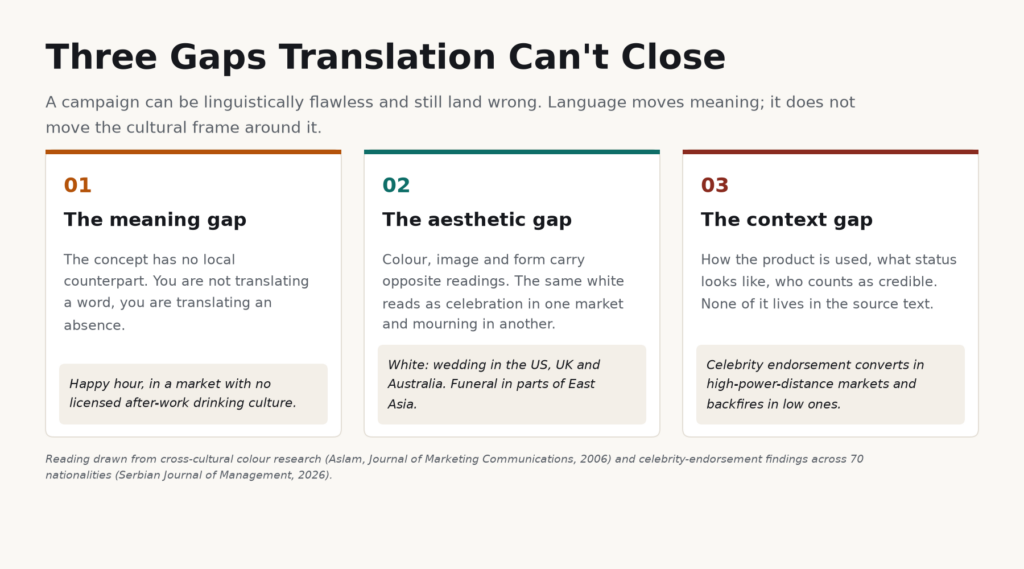
The meaning gap: translating an absence
Some concepts have no local shelf to sit on. Happy hour, in a market without a licensed after-work drinking culture. Tailgating, outside North America. The German Feierabend — the deliberate, almost ceremonial start of one’s own time — has no tidy English equivalent, which is why English copy about work-life balance so often reads like a policy document.
When the concept is missing, translation produces a sentence that is correct and empty. It reads fine. It means nothing.
The aesthetic gap: when white means the opposite
Colour is not decoration; it is vocabulary. White is bridal in the United States, Britain and Australia, and it is the colour of funerals across parts of East Asia. Aslam’s review in the Journal of Marketing Communications traces how colour associations shift across cultures and warns explicitly against treating any palette as pan-cultural. Red carries luck and celebration in Chinese-speaking markets and warning or deficit in many Western financial contexts. In Mandarin-speaking markets, four is avoided in floors, addresses and price points because it sounds like the word for death, while eight is prized for sounding like prosperity. None of that is in your source file.
The context gap: status, credibility, and who you trust
Hofstede’s power distance index puts China at 80 and the United States at 40 — one society expects hierarchy to be visible, the other expects it to be flattened. That single difference changes who should hold your product in a photograph. A celebrity endorsement reads as borrowed authority in a high power-distance market and as rented credibility in a low one, where “someone like me” outperforms “someone famous”. It also changes what the product is: a coffee machine is a 15-minute ritual in one market and a 90-second stimulant in another.
The Evidence That Should End the Argument
Liferay’s 2026 Website Localization Report surveyed 800 U.S. adults who had used a non-English website, app or digital service in the previous twelve months. The findings are blunt.
Fifty-six percent had decided not to buy from a company because the site or app felt poorly adapted to their language. Ninety percent had noticed at least one localization problem. Only twenty-three percent said non-English sites usually feel like they were written for them. Forty-eight percent had chosen a competitor because its experience felt better adapted. And eighty-two percent were confident they can tell machine-translated content from human-reviewed content.
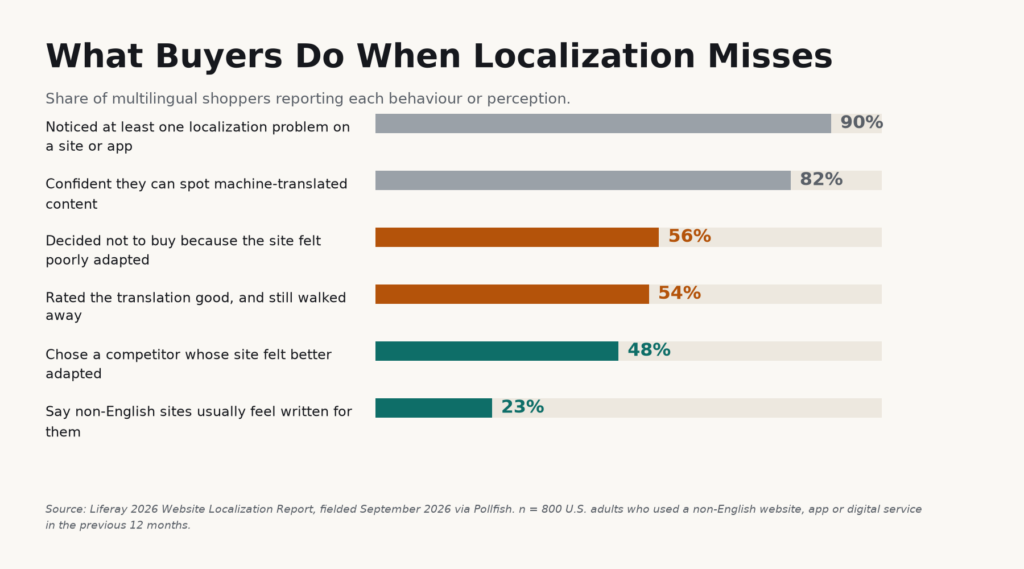
Then comes the number that matters most for anyone who thinks they’ve already solved this. Among consumers who rated a brand’s translations good or excellent, fifty-four percent had still walked away from a purchase over poor localization.
Sit with that. You can score well on translation quality and still lose the sale. Translation quality and localization quality are two different variables, and the second one is where the money lives.
Liferay is a digital experience platform vendor, so treat its framing with the usual discount — but the directional finding is corroborated. Phrase’s 2025 global expansion study reports 55% of business leaders saying their company has lost business to the absence of a proper localization strategy. Also vendor research. Also pointing the same way.
The Machine Got Fluent. It Did Not Get Cultural.
Here is the most useful piece of academic evidence I found, and it is uncommonly clear-headed about its own limits.
Van Doren and colleagues built a human evaluation benchmark for cultural nuance in machine translation, presented at the ACL 2026 GEM workshop. Seven multilingual large language models, fifteen target languages, five native-speaker raters per language, scored on a 0–3 ordinal scale. Full-text quality averaged 1.68 out of 3. The strongest tier: GPT-5 at 2.10, Claude Sonnet 4 at 1.97, Mistral Medium 3.1 at 1.84. At the segment level the category effects are stark — holidays 2.20 and cultural concepts 2.19, against idioms at 1.65 and puns at 1.45, with idioms the most likely to be left untranslated altogether.
Read that plainly. On a scale where 3 means a native writer would produce this, the best model in the world lands around 2.1 on ordinary prose and collapses to roughly 1.45 on jokes. Puns and idioms are the hardest material in any language — and they are also what brand voice is mostly made of. The authors’ own conclusion is blunt: a persistent gap between grammatical adequacy and cultural resonance.
Meanwhile the volume keeps shifting. Smartling’s production data shows fully human translation falling from 72% of corporate volume in 2021 to 40% in 2024, with 40% now fully machine and 25% hybrid. That is supplier data from a translation management vendor, so weight it accordingly. The direction is not in serious dispute: Nimdzi’s 2025 industry report puts the language services market at 71.7 billion dollars in 2024, tracking toward 92.3 billion by 2029, with growth increasingly coming from AI-adjacent services rather than classic translation.
Where Marketers Hand the Work Over, and Where They Refuse
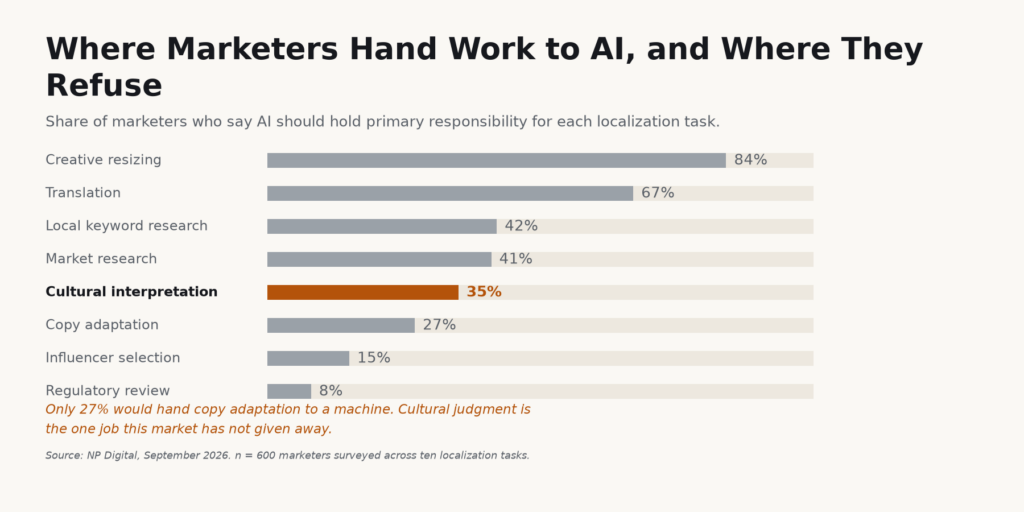
NP Digital asked 600 marketers which localization tasks should have AI in the primary seat. Eighty-four percent said creative resizing. Sixty-seven percent said translation. But only 35% said cultural interpretation, and only 27% said copy adaptation.
That gap is the whole story. The industry has quietly drawn a line and mostly agreed where it sits: the machine owns the production layer, humans keep judgment. It’s the same line that separates translation from localization, except nobody put it on a slide.
Why Nuance Converts: The Mechanism, Not the Metaphor
Four steps, and each one is testable.
Recognition. When a brand reflects a consumer’s cultural frame — the imagery, the rhythm of the copy, the things it chooses not to say — the message lands as “this was made for people like me”. That is not a soft feeling. It is a filter that content either passes or fails before any argument gets made.
The insider effect. Foreign brands are guests. Insiders get the benefit of the doubt, the second look, the assumption of good intent when something goes wrong. Cultural fluency is how a brand stops being a guest.
Fluency. Reber, Schwarz and Winkielman’s review in Personality and Social Psychology Review establishes that material processed easily is experienced as more pleasant, and that this pleasantness gets misattributed to the thing being evaluated. Culturally aligned design is easier to process. Easy feels good. Good gets clicked.
Shareability. People share what confirms their identity. Culturally resonant content becomes a small piece of evidence about who the sharer is. Translate-only content rarely earns that.
The Cultural Localization Playbook
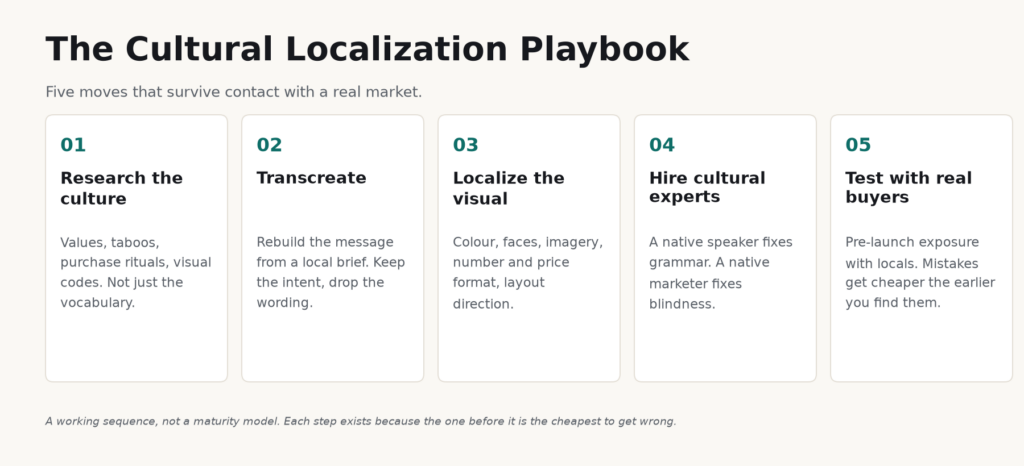
Research the culture, not the language
Values, taboos, purchase rituals, visual codes, the shape of a household’s decision. Not vocabulary lists. This is the foundation nobody budgets for, which is exactly why it shows up as a mystery later.
Transcreate, don’t translate
Give the writer a brief, not a source document. The brief says: here is what this campaign must make a person feel, and here is what we know about how that feeling is produced in your market. Then let them build it. You keep the intent. You surrender the wording.
One caution, and I want to be direct about it: there is no credible published head-to-head benchmark proving transcreation outperforms translation by X percent. The figures circulating in vendor blog posts generally arrive without a methodology attached. Anyone quoting a clean transcreation ROI number is selling you something. Treat the absence of that benchmark as a finding in itself.
Localize the visual, not the copy alone
Colour, faces, body language, room scale, price format, date format, number convention, reading direction. In Liferay’s data, imagery that feels culturally out of place was named by 16% of respondents as the single most damaging kind of localization error — behind nonsense phrasing and wrong tone, but ahead of untranslated buttons and currency mistakes. Visual localization is not cosmetics. It is conversion infrastructure.
Hire cultural experts, not just native speakers
A native speaker fixes your grammar. A native marketer fixes your blindness. These are different jobs and they are rarely the same person. If your review gate is a freelancer checking sentences, you have a proofreading function, not a localization function.
Test with real buyers before launch
Five conversations with people who actually shop in that market will surface more than a month of internal debate. Show them the creative, not the strategy deck. Ask what they think the brand is trying to say about them. If the answer makes you wince, you have found something cheap.
Four Caveats That Keep This Honest
It does not scale like translation does. Cultural adaptation is human-hours work. You cannot post-edit your way to resonance, and any workflow that pretends otherwise is optimising the wrong variable.
Stereotyping is the failure mode. Localizing to a culture badly produces caricature — the dragon, the family dinner, the flag. The line between resonant and reductive is thin, and it moves. In practice: adapt the meaning, not the tropes.
Over-localization erases the brand. In 2009, HSBC retired its “Assume Nothing” private bank line after it read as “Do Nothing” in some markets, and rebuilt the identity for a reported 10 million dollars. That is a meaning gap with a price tag attached. Localize the expression, protect the idea.
The measurement is messier than the argument. Resonance converts, but it doesn’t show up as a clean line item. You will end up defending it with pre/post tests, holdout cells and sales-lift reads — not with a dashboard that says cultural nuance, 4.2% attribution. Budget for the argument, not just the work.
And one methodological caution on the frameworks themselves: Hofstede’s dimensions are a lens for generating hypotheses, not a map of individuals. Within-country variation swamps between-country averages in most categories. Use the index to ask better questions, never to skip asking them.
What to Do Monday Morning
Audit your twenty highest-revenue pages in your two biggest non-English markets. Count how many use local price and date formats, local faces, local social proof, local units, local spelling conventions. You will find more gaps than you expect, and they will be cheap to close.
Then run a tone read: five native buyers, one question — what does this brand seem to think of people like you? Score the answers. That single exercise will tell you more about your localization debt than any dashboard.
Finally, put a human gate on anything containing humour, price, health claims, or a famous face. Those four categories account for most of the damage, and they are exactly where the models score worst.
The Bottom Line
Translation earns you comprehension. Cultural nuance earns you conviction. The brands that globalise well are not the ones speaking the most languages — they are the ones who understand the most worlds, and who localise the meaning, the emotion and the visual code rather than only the words. In a crowded market, the conversion battle is not won by being understood. It is won by being felt.