The Budget Is Shrinking. The Market Isn’t.
Every downturn opens with the same move. Somewhere in a building with good coffee and bad news, a spreadsheet gets opened, and marketing is the first line anyone feels brave enough to touch.
Not headcount. Not the office lease. Marketing. Because marketing is the line item nobody in the room can defend with a number that arrives before the quarter closes.
You already know how this ends. What you may not know is that in 2026 the move is being made in a market that is, by every aggregate measure, still growing. Global ad spend is forecast to rise 11.9% this year to $1.34 trillion. Next year, 8.4%. The year after, 7.9%. Those are WARC’s October numbers, and they were revised upward from June.
So we have a puzzle worth sitting with: the category is expanding, and your budget is shrinking. Both things are true at once, and the gap between them is where this whole playbook lives.
The Reflex, and Why It Feels So Reasonable
Cutting marketing in a squeeze is not stupidity. It is rational behaviour inside a broken frame.
Marketing sits on the P&L as an operating expense. It gets fully expensed in the period it is spent, unlike a factory or a fleet, which can be capitalised and depreciated across years. So a marketing cut shows up in this quarter’s profit, immediately, cleanly, in a way a CFO can point at. The damage shows up eighteen months later, in a different reporting period, under a different leader’s watch, attributed to something else.
That asymmetry is the whole game. The IPA has documented it directly: when analysts were asked how they read a marketing cut, 52% called it a positive cost saving. Only 36% saw it as a short-term fix with a long-term cost. For R&D cuts, the numbers flipped — 47% recognised the long-term damage. Marketing is the one investment where the smart money misses the point.
And the room is not full of marketers. In the FT/IPA boardroom research, more than half of C-suite executives rated their own board’s knowledge of brand building as fair to very poor. Only 8% called it excellent. So the case for protecting brand spend is being argued by people who believe it, to people who were never taught to.
The 2026 Twist: This Is Not the Downturn You Think
Here is where the standard playbook needs an edit.
If we were in a genuine advertising recession, the advice would be straightforward: hold your nerve, wait for the recovery, harvest share when competitors blink. That advice was written for 2008 and 2020, when the category itself contracted.
That is not what is happening.
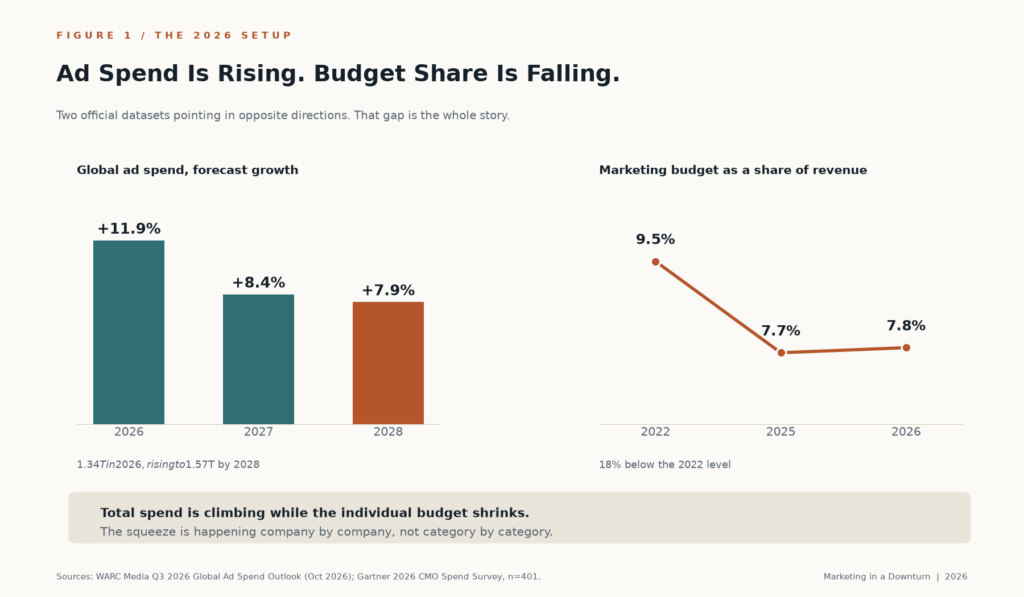
The category is growing because a small number of very large spenders are growing. WARC attributes much of the resilience to structural AI investment and to tentpole events and elections — money that does not behave like a normal marketing budget. Underneath that aggregate, the median marketing organisation is being squeezed.
Gartner’s 2026 survey puts budgets at 7.8% of revenue. Up 1.3% on last year, which sounds like growth until you see it is still 18% below where budgets sat in 2022, and has been flat for four years. Half of CMOs report budgets of 6% of revenue or less.
Forrester’s October 2026 poll of B2B marketing leaders is blunter. Twenty-one percent said their budgets had been cut below the levels set at the start of the year. Only 10% had seen an increase. A third said headcount fell in the second quarter, and 16% described the cuts as major layoffs. Full-year growth expectations slipped from 5% to 3%.
Meanwhile the mood outside the building is worse than the mood inside it. The University of Michigan consumer sentiment index hit 48.0 in October, the second-lowest reading on record. The Nasdaq fell 5.5% on a single day in early November.
So: the pie is bigger, your slice is thinner, and the people you sell to are frightened. That combination is not a recession playbook. It is a share-shift playbook. The growth in the category is being captured by whoever is still spending, and the brands pulling back are donating their share of voice to competitors in real time — not after some future recovery.
That is a much better opportunity than a downturn. And a much worse moment to be timid.
What the Evidence Actually Says About Cutting
The intuition that cutting protects you is old, popular, and wrong. It has been tested repeatedly, and it keeps producing the same answer.
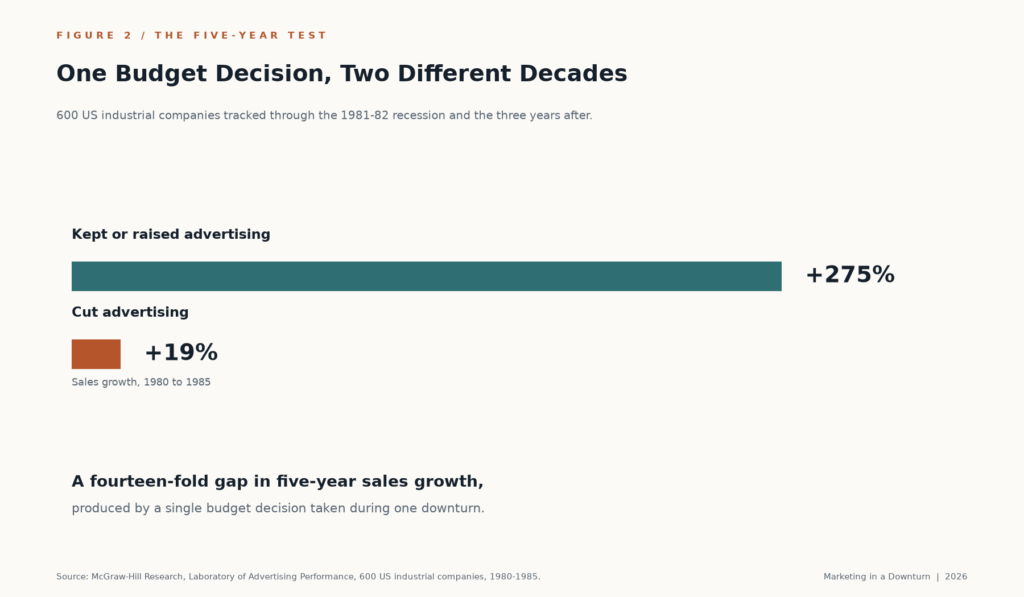
The 1981 figure is famous enough that people have stopped checking it, so let me be precise: an index of 375 against a base of 100 means sales grew about 275%. The cutters’ index of 119 means about 19%. The ratio between them is roughly fourteen to one.
That is a single study from a single recession, and you should treat single studies carefully. So look at the replication.
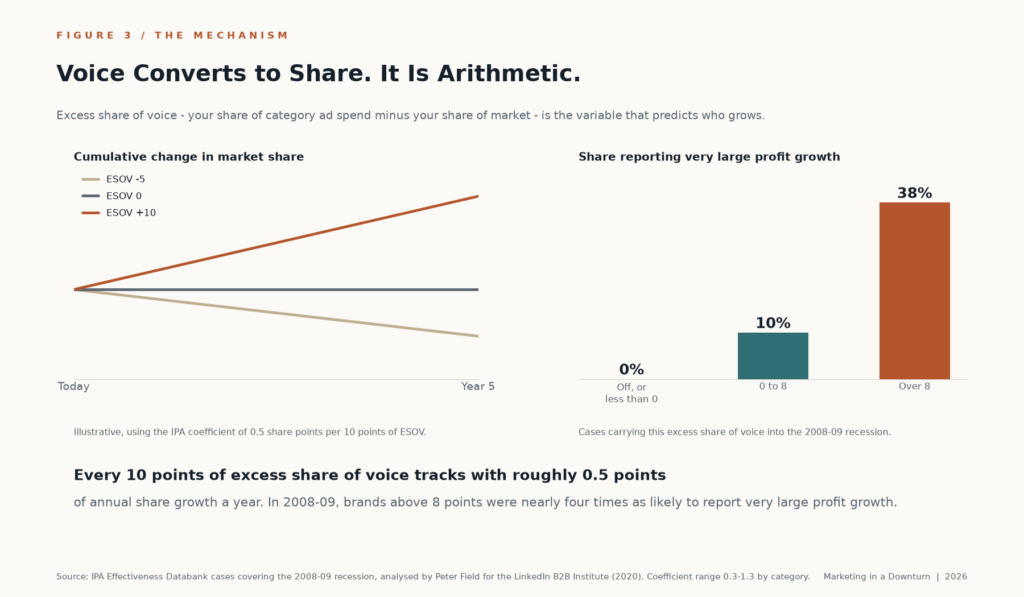
Peter Field’s analysis of IPA Effectiveness Databank cases covering the 2008–09 recession, done for the LinkedIn B2B Institute, sliced brands by the excess share of voice they carried into the crash — that is, their share of category ad spend minus their share of market. Among cases with an excess share of voice above 8 points, 38% reported very large profit growth. Among cases between 0 and 8 points, 10% did. Among cases at or below zero — the brands that went quiet — the figure was zero.
Zero. Not one case.
And the mechanism is not mysterious. Your share of voice is a leading indicator of your share of market, and the relationship has a rough coefficient attached to it: about half a point of annual share growth for every 10 points of excess share of voice. The range across categories is wide, 0.3 to 1.3, but the direction is not in dispute.
Which brings us to the thing most budget conversations skip entirely.
When a competitor cuts and you do not, your excess share of voice rises without you spending an extra dollar. That is the arbitrage. You are not buying more attention; attention is getting cheaper because the queue got shorter. Analytic Partners has estimated that if a similar-sized rival in your category doubles its marketing spend, the average brand loses about 15% of its business. Read that backwards: every rival who retreats is handing you a slice.
The Part Nobody Puts in the Deck
The reason marketing cuts survive contact with a board is that they don’t hurt immediately. Branded search keeps arriving. Retargeting pools keep converting. Your dashboards look fine for a quarter, sometimes two. Everyone concludes the cut was costless.
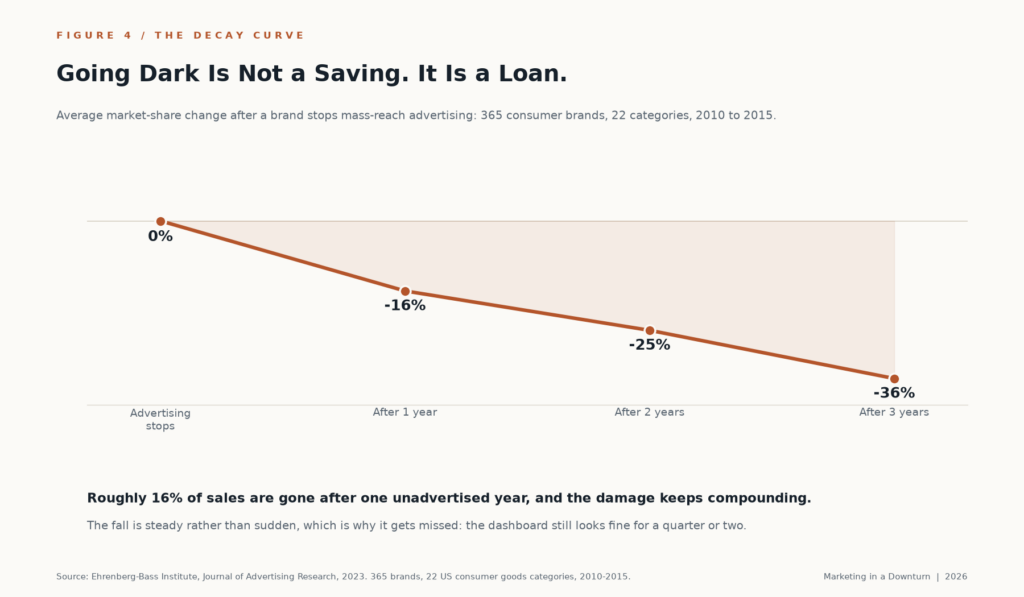
The Ehrenberg-Bass Institute put numbers on that lag, and the numbers are unforgiving. In their 2023 replication across 365 consumer brands in 22 categories, brands that stopped mass-reach advertising lost on average 16% of sales in the first unadvertised year. Twenty-five percent by year two. Thirty-six percent by year three.
Two details make this worse, not better.
First, the decline is roughly linear rather than accelerating. That sounds gentler, but it is worse for decision-making, because there is no dramatic moment that forces a review. The line just drifts down, quarter after quarter, and each individual quarter is explainable.
Second, large and stable brands weather a cessation better than small ones — for a year or two. That is the trap. If you are a strong brand, cutting works just well enough to prove you were right, right up until the bill comes due.
BCG has priced the bill. Cutting brand spend cost companies an average 0.8 percentage points of market share relative to those that kept investing. Regaining what was lost requires $1.85 of future investment for every $1 saved, a multiple BCG revised upward to $1.92 in its 2025 work. Three-quarters of marketers now say brand cuts do more damage than they did five years ago.
BCG’s phrase for this is the one to steal: brand marketing behaves like capital. Sustained, it compounds. Underfunded, it depreciates fast and demands disproportionate reinvestment.
What to Cut, Specifically
Enough with the argument. You have a budget to rebuild, and a defensive posture to defend.
Cut these, without sentiment:
The bottom fifth of your media. Not the bottom fifth of spend — the bottom fifth of return. Every mature account has campaigns that exist because they were renewed, not because they worked. A squeeze is the only socially acceptable moment to kill them. Do it while the political cover lasts.
Unproven experiments. In a growth market, funding three speculative bets is reasonable. In a flat one, you can afford one. Not zero — you still need a learning pipeline — but one, with a kill date written down before it starts.
The parts of your stack you cannot explain. Forrester found only 28% of B2B marketing leaders expect agency budgets to rise, down from 41% a year earlier, with 19% expecting cuts. The contraction is concentrated exactly where AI has made in-house work viable: digital marketing expectations down 20 percentage points, content creation down 15, brand strategy down 17. If your agency roster includes work your team could now do with a good prompt and a hard edit, that is your funding source.
Vanity spend with no strategic owner. Sponsorships nobody can tie to a goal. The annual report photoshoot. The conference booth you take because you have always taken it. If you removed it and nothing in the pipeline moved, it was never doing anything.
The principle is simple even if the application is not: cut fat, protect muscle. Fat is spend that produces no measurable or strategic return. Muscle is what generates demand and builds memory. Most cuts miss that distinction because they are made at the category level — “reduce marketing by 15%” — which guarantees you lose muscle and keep fat.
What to Protect, and How to Defend It
Protect these four, and go into the room with the reasoning already written down.
Demand generation that actually converts. The channels with a defensible cost per qualified opportunity. You would not shut a factory line that still ships. Same logic.
Retention and existing-customer marketing. Harvard Business Review, citing Bain, puts the cost of acquiring a customer at five to 25 times the cost of retaining one. In a squeeze, that ratio is not an argument for abandoning acquisition — it is an argument for not starving the cheaper half of the machine. Loyalty is won or lost in exactly the quarters when customers are reassessing everything.
Brand reach, the share-grab lever. This is the counterintuitive one, and the one that gets cut first. Reach is what keeps you mentally available to the 95% of buyers who are not currently in market. The Ehrenberg-Bass and B2B Institute work on the 95-5 rule is the cleanest statement of why: most of your future buyers are not shopping yet, and the only thing that makes them think of you when they start is memory. You cannot switch memory back on like a light.
Your proven performance channels. The ones where the marginal dollar still returns more than it costs. Protect them precisely because they are the easiest to over-trim when a percentage target lands on the whole function.
The Honest Caveats
This playbook is not universal, and pretending otherwise would be the same sin as the one I am arguing against.
It assumes a cyclical squeeze with a recovery. If your category is in structural collapse — not a cycle, but a permanent shift in how the thing is bought — then defending share in a market that is disappearing is just expensive nostalgia. Diagnose which one you are in before you act.
It assumes you have the cash. If survival is genuinely at stake, survival logic overrides growth logic, and no amount of ESOV research changes that. Protect demand generation obsessively, park the rest, and accept the rebuild cost.
It assumes you will protect effectiveness, not just spend. Keeping the budget while letting creative rot is not defence, it is a slower version of the same failure.
And it assumes leadership with patience. The payoff lands in four to eight quarters. If your CEO is measured on the next two, you will need to make the case in their language — cash flow, share of market, cost of regain — not in yours.
A Ninety-Day Version
If you need something actionable rather than agreeable, start here.
Weeks one to three: rank every line of spend by return, not by size or tradition. You are looking for the bottom fifth, and you already know roughly where it is.
Weeks three to six: build the cut list and the protect list in the same document, so nobody can take one without seeing the other. Name the recovery multiple on each brand cut — BCG’s 1.92 is a defensible starting number — and put it in the same table as the saving. Watch how fast the conversation changes.
Weeks six to twelve: reallocate, don’t just reduce. The goal is not a smaller budget. It is a sharper one, pointed at the channels where your excess share of voice is actually compounding.
The Takeaway
The most expensive marketing decision of 2026 is the one that feels safest: cutting first, because everyone is doing it and nobody will be blamed for it this quarter.
The market is not shrinking. It is redistributing. Ad spend is up 11.9%, your budget is flat to down, and the difference is being collected by brands that stayed in the room.
Cut the fat. Protect the muscle. And let your competitors’ fear hand you the market.