INSIGHT — The Proof Gap: Why Brand Loses Budgets It Should Win
The standard story is that finance kills brand investment because finance is short-termist. It is a satisfying story, it flatters marketers, and it is wrong.
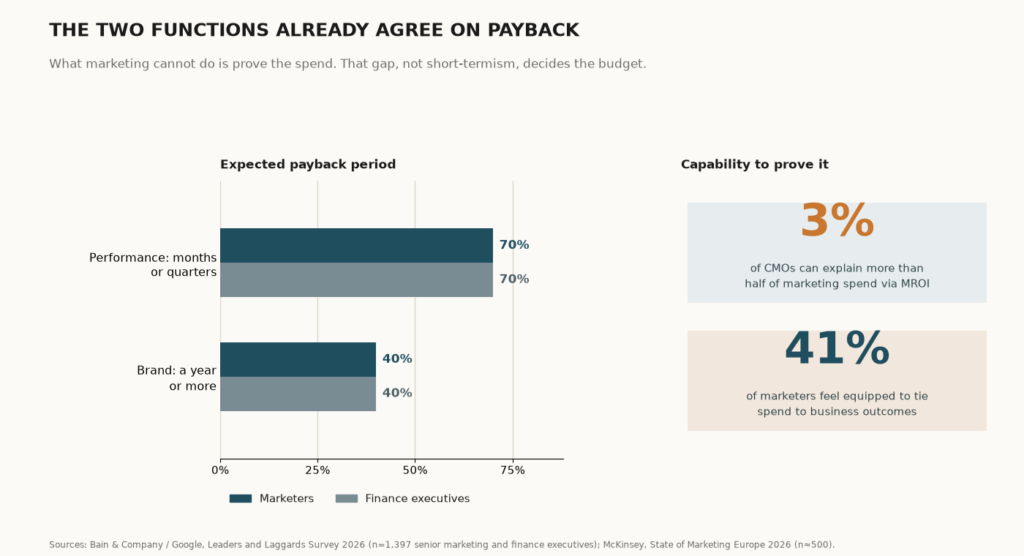
Bain & Company and Google asked almost 1,400 senior marketing and finance executives about expected payback periods. The results were almost identical: roughly 70% of each group expects performance spend to return within months or quarters, and about 40% of each accepts that brand investment needs a year or more. Both named the same top metrics, return on marketing investment and revenue impact.
Finance is not the adversary. Finance already agrees on the clock.
So what actually divides them?
Proof, not priorities. The same research found only 41% of marketers feel they have the data, tools and measurement to tie work to business outcomes. McKinsey’s State of Marketing Europe 2026, surveying roughly 500 senior marketers, is blunter still: 72% planned to raise budgets relative to sales, and 3% could account for more than half of their spend through measured return.
Read those together and the mechanism appears. It is not that brand is judged on a shorter clock. It is that brand arrives at the meeting without a number, and a request without a number cannot be ranked against a request that has one. Finance is not choosing performance over brand. It is choosing the demonstrable over the asserted, because that is the only comparison the process allows.
Why this is worse for brand than plain short-termism would be
A short-termist CFO can be argued with, because the disagreement is about values. A proof gap cannot. It is structural.
It also explains the pattern that confuses brand advocates: conviction is high and funding is falling. NIQ’s CMO Outlook has confidence in brand as a commercial asset at 83%, while belief that CEOs and CFOs back long-term brand investment dropped from 80% to 69% in a year. Belief did not evaporate. The evidence did not arrive.
And there is a harder edge. A CMO’s tenure at S&P 500 companies averages 4.1 years, and 3.5 years at consumer companies, per Spencer Stuart. Brand payback runs two to four years. The person who must approve the spend will often be judged before the spend reports back, which makes an unprovable line a personal risk, not just a budgetary one.
What this changes about the fix
It kills the most popular remedy. Publishing more effectiveness studies will not help, because the studies prove brand works in general, and the meeting asks whether this spend worked here. Generic evidence cannot close a specific proof gap.
The companies that have closed it do three unglamorous things. They lock the metric with finance before the campaign runs, rather than defending it afterwards. They name the expected payback horizon per line, so brand is not quietly held to a quarterly standard it was never meant to meet. And they make brand estimable inside the window, through brand-lift tracking, share of search or a quarterly mix model, accepting that these are estimates rather than measurements.
The uncomfortable implication for brand advocates is that the argument was never lost on its merits. It was lost on its evidence standard, and the fix is to meet that standard rather than to keep restating the merits.