The Economics Behind Podcasting’s One Percent
Every media channel’s revenue resolves to the same three numbers: how many hours of attention it can sell, how many ads it can pack into each hour, and what it can charge per impression. Multiply them and you get the total. Almost every argument about podcast advertising’s future is really an argument about which of those three can still move.
For podcasting, two of them have stopped.
Start with hours. Weekly listening now reaches 45% of Americans aged twelve and up — about 130 million people. That is a large base, and it is still widening at the edges, particularly among the over-fifty-fives. But hours are the slow lever. They compound at a rate set by human habit, which means single-digit annual growth and no mechanism for acceleration. You cannot buy your way to more listening hours the way you can buy your way to more impressions.
Then ad load. This is the lever the industry has been quietly leaning on for years, and it has stopped too. Ads occupy roughly 8.8% of episode time, a figure that has barely moved year over year even as the number of brands entering the channel climbed — 1,297 first-time advertisers in the second quarter of 2026 alone, at an average spend of about $31,400. Demand is rising. The supply of tolerance is not. 54.8% of U.S. podcast listeners already say there are too many ads, and only 8.6% would accept more to keep shows free. The tank has a bottom.
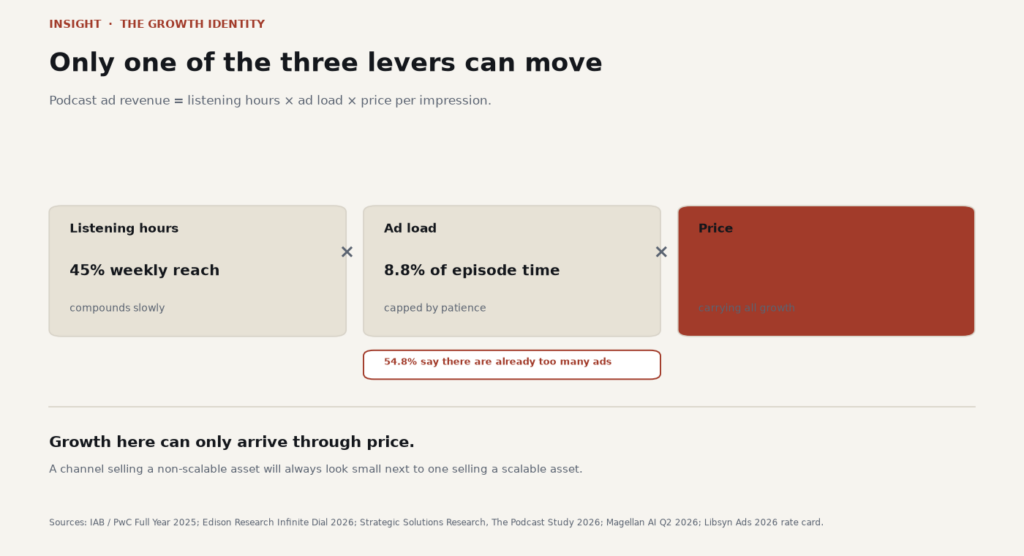
So growth can only come from the third lever: price. And price is where the interesting constraint lives.
A host-read impression sells for $24 to $26 per thousand. Programmatic network inventory sells for $12 to $15. That spread is not a measure of production value or creative quality. It is the market’s estimate of how much human trust is attached to the impression. And trust, unlike inventory, cannot be manufactured on demand. A network can add shows; it cannot add hosts who have spent four years earning a specific audience’s affection. The supply of credible endorsement is fixed by the number of people who have done that work, and it grows at roughly the speed of careers.
This is the part that rarely gets said plainly. Podcasting is not small because it is badly measured, or under-marketed, or misunderstood by media buyers. It is small because it sells a non-scalable asset into a market that structurally rewards scalable ones. Search and social can expand inventory by algorithm. Podcasting expands inventory by waiting for people to become trustworthy — which is not an operation a media plan can schedule.
That also explains the shape of the growth curve. A channel with two exhausted levers and a slow third produces exactly what podcasting has produced for a decade: steady, unspectacular, oddly dependable growth in the low double digits, with no bubble to correct and no breakout to celebrate. The ceiling is not a marketing failure. It is the arithmetic of the asset.
Which is, perversely, good news for the buyers who understand it. Non-scalable assets are usually underpriced, because most capital chases the scalable ones. You are not buying reach here. You are buying the one kind of attention that cannot be produced on demand — at a rate set by how scarce it genuinely is.