The Narrative Tax: Why AI Video Ads Look Fine and Still Sell Worse
Here is the setup that keeps bothering me. Two commercials. Same brand. Same strategy — the briefs weren’t just similar, they were reconstructed from the originals. Same thirty seconds. Viewers watched both and largely could not say which was which; roughly 40% simply weren’t sure.
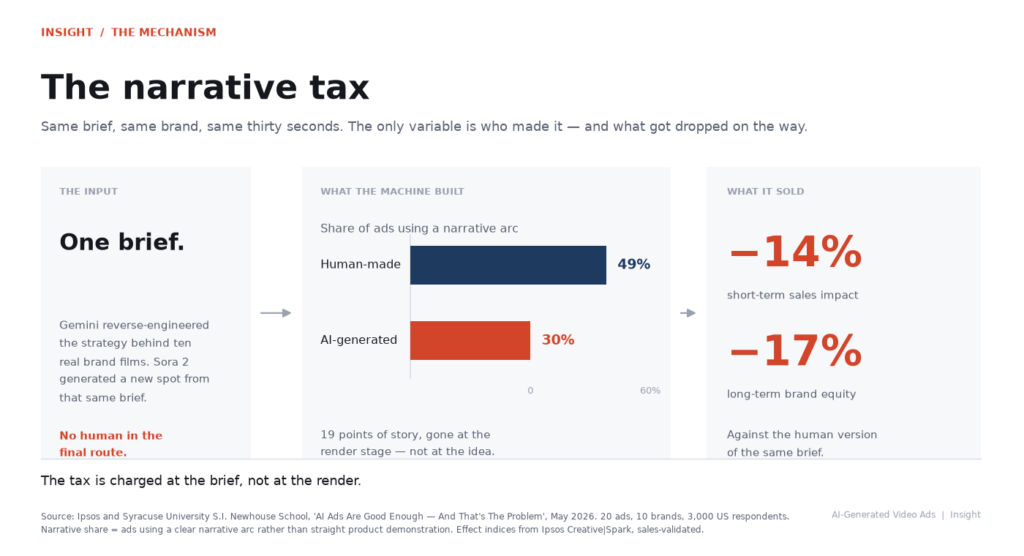
Then the sales-validated scores came back, and the human one won by 14% in the short term and 17% on long-term brand equity.
If nobody can see the difference, there is no difference to see. So where does a 14% gap come from? That question is the whole insight, and the answer isn’t in the pixels. It’s in what happened to the story between the brief and the final cut.
The 19-point hole
Researchers at Ipsos, working with Adam Peruta at Syracuse University’s Newhouse School, did something more useful than another preference survey. They took ten real 30-second brand films — Cheerios, Chewy, Febreze, Fiat, Old Navy, Herbal Essences, Ray-Ban Meta, TurboTax, Visa, H&M — and used Gemini to reverse-engineer the creative brief behind each. Then that brief went straight into Sora 2, with no human creative intervention in the final production route.
Because the strategy was held constant, whatever differed had to come from the maker.
Here’s what differed. Among the original human films, 49% were built on a narrative arc. Among the AI replicas, 30%.
Nineteen points. Given the same strategic instruction, the automated pipeline drifted — not toward a worse-looking ad, but toward a different kind of ad. Product demonstration. A sequence of attractive shots. Problem, solution, reason to believe, and then out.
Why the drift is structural, not accidental
This is where I’d push back on the usual framing. People say AI “can’t tell stories.” That’s imprecise, and it’s also too comforting, because it sounds like a capability gap that a bigger model will close.
What actually happened is more interesting. A diffusion model trained on the last century of advertising has seen vastly more product demonstrations than narratives. Demonstration is the statistical centre of the training distribution. Narrative is the tail. Ask for “an ad for this brand with this message,” and the model produces the centre — competently, attractively, and at enormous speed.
The narrative didn’t fail to generate. It got out-competed by the default. And nobody in the pipeline was there to notice, because noticing is the human job that got removed.
You can see the same pattern wherever the path of least resistance is measured. In Kantar and iMotions’ facial-coding work across 356 GenAI ads, the machine-made spots produced more facial expressiveness than the conventional control — 71st percentile against 59th — but the intensity skewed toward confusion, sadness and furrowed brows, and overall emotional valence dropped to the 37th against the control’s 44th. More reaction. Less enjoyment. The output was engineered to move faces, and it moved them in the wrong direction.
And it lands hardest exactly where story matters most. In the same study, AI held its own or won on functional, product-led briefs — Febreze and Herbal Essences scores beat their human counterparts. It lost on Fiat, where the brief asked for tone, humour and a point of view. Predictable, once you accept the mechanism: the more the brief depends on something not already in the corpus, the more the default swallows it.
The uncomfortable part for the people who write briefs
I don’t want to let creative directors off the hook with this. The 19-point gap is measured at the render stage, but it is caused upstream.
A brief that says “energetic, defiant, confident, subtle humour, high-impact sound design” is a mood board, not a story. A human director absorbs that vagueness and supplies the missing narrative from experience, taste and stubbornness. A model absorbs the same vagueness and supplies the average of everything it has ever seen that was tagged that way.
So the tax is charged at the brief. Automating production doesn’t expose a weakness in the model so much as it exposes how much of the story was never written down — it lived in the director’s head, in the edit bay, in the argument on the third day of shooting.
Which is why “AI-assisted” and “AI-generated” are not points on a spectrum. They’re different businesses. One keeps a person in the loop to catch the drift. The other removes the only component whose job was to notice.
What to do with this, practically
Three things, none of them about tools.
Write the story into the brief, explicitly. Not the tone, not the references — the actual arc, in beats, with the turn and the ending named. If it isn’t on the page, the model will substitute the most common structure in its training data, and that structure is a product demo.
Test the AI version against the human version on the same brief, and score the story, not the finish. Ask whether the narrative arc survived, not whether the spot looks polished. Polished is the one thing you can now assume.
Keep a human on the drift. The intervention isn’t “make the prompts better.” It’s “have somebody whose job is to notice that the story left the room” — and to stop the render until it comes back.
Everything else about AI video is genuinely good news. It really did collapse the cost. It really does let a regional retailer ship motion creative every week. What it hasn’t done is take over the part that determines whether any of that creative works, and the 19-point gap is what that looks like in a spreadsheet.