The Silence Behind the Data: Why More Listening Produced Less Understanding
Every listening team has felt the same thing, and most have been reluctant to say it out loud. The dashboards got better. The data got bigger. The confidence did not.
That is the paradox worth sitting with. In ten years, the industry moved from quarterly survey waves to real-time sentiment streams covering millions of mentions, and on nearly every slide the number went up. Coverage up. Volume up. Mentions captured up. And yet the same analysts who built those dashboards will tell you, quietly, that they trust them less than the survey sample they replaced.
The mechanism is not technical
Here is the sequence, and none of it required a bad decision by anybody.
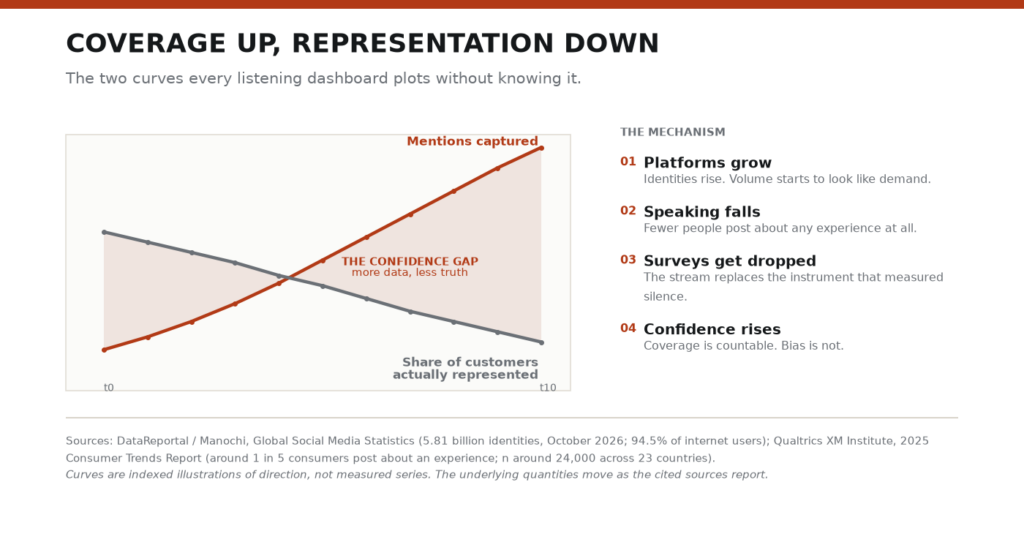
Social platforms grew. Global social identities reached 5.81 billion in October 2026, with 94.5 percent of the world’s internet users on social every month. For a listening team, that looks like an enormous gift: the whole market, instrumented.
At the same time, the share of people willing to say anything at all was falling. Qualtrics XM Institute research covering around 24,000 consumers across 23 countries found that only about one in five post about an experience, good or bad. Most tell nobody. And that proportion has declined consistently year after year.
So the two curves parted. The pipeline kept widening while the population it represented kept narrowing. Volume rose because the platforms grew, not because more customers started speaking — and those are entirely different causes wearing identical charts.
Why teams trusted it anyway
Because coverage is countable and bias is not.
Nobody can put a number on who is missing. You can count 4 million mentions. You cannot count the 40 million customers who said nothing, because by definition they left no record. Silence is invisible in a system built to read text, so the dashboard reports what it received and implies that what it received is what exists.
That is the incentive at work, and it is not cynicism so much as convenience. A stream is always on, always fresh, always available for Monday’s meeting. A survey costs money, takes six weeks, and arrives with a sampling error attached — a property that makes it honest and makes it harder to present.
What replaced what
The most consequential change was not that streams got better. It was that streams began to displace the instrument that had been measuring the very thing streams cannot see.
A properly drawn survey sample includes the people who never post. It reaches the customer who quietly stopped buying and would never think to mention it. The stream cannot reach them at all, and when the survey is retired as expensive or slow, the organisation loses its only view of the silent majority — while gaining the impression that its visibility improved.
The honest resolution
None of this argues for going back to surveys alone. It argues for knowing which instrument measures which population, and refusing to let one impersonate the other.
Streams tell you what the vocal minority is saying right now, in their own words, at a resolution a survey never could. Surveys tell you what the whole population thinks, including the people who never speak. Behavioural data — churn, repurchase, returns — tells you what people did regardless of what anyone said.
The failure is never choosing the wrong instrument. It is forgetting that you chose one.
Three questions worth asking of your own dashboard this quarter: what share of my customers could plausibly appear in this feed? Which decisions am I now making on it alone? And if the silent majority disagrees with what I am reading, how would I ever find out?
Read the room. Then check who is not in it.