Estée Lauder Couldn’t Use OpenAI in China. So It Bet on Qwen.
At the import expo on November 6, the beauty giant signed an AI deal that wouldn’t make sense in any other country — and that’s the point.
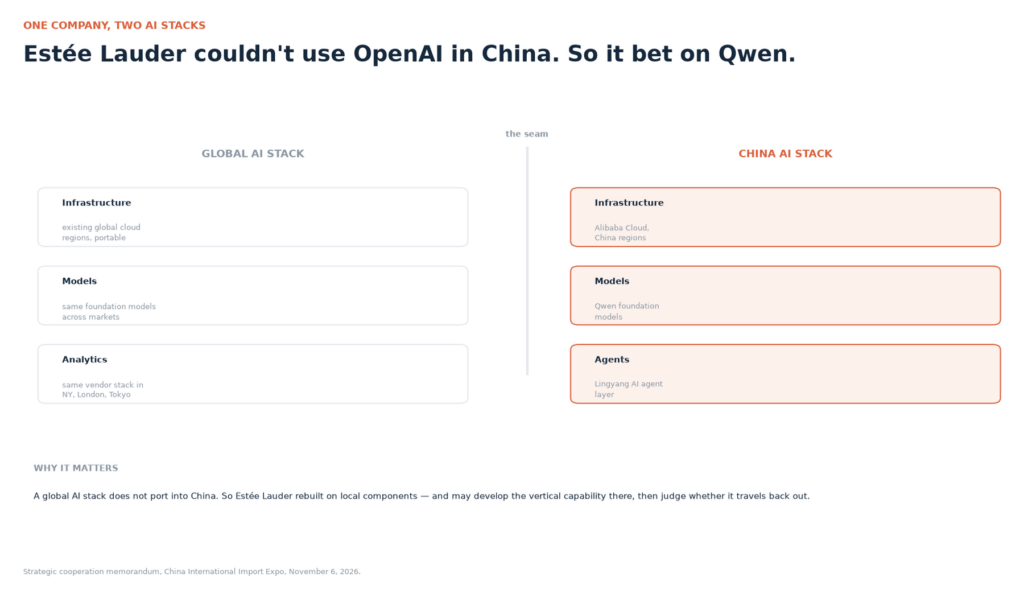
On November 6 at the China International Import Expo, Estée Lauder Companies signed a strategic cooperation memorandum with Alibaba Cloud. The four work streams named in the release are, on their own, unremarkable: AI infrastructure and model foundation, a unified data platform with AI decisioning, consumer insight and full-funnel marketing intelligence, and a “beauty AI” joint innovation track built on Alibaba’s Qwen models and its Lingyang AI agents.
What makes the deal worth reading is what it reveals about the seam that splits global AI from the Chinese market.
A multinational brand’s AI stack, elsewhere in the world, is largely portable: the same cloud regions, the same foundation models, the same analytics vendors across New York, London and Tokyo. In China, that portability stops. Data residency rules, the absence of familiar Western tooling, and a consumer data ecosystem that runs on domestic platforms mean an international brand cannot simply extend its global AI stack into its China business. It has to rebuild it, locally, on local rails.
Estée Lauder just spent a public event doing exactly that, and it named the pieces specifically: Alibaba Cloud for infrastructure, Qwen for foundation models, Lingyang for the agent layer. The stack is not “Alibaba’s AI.” It is an American beauty company’s China AI stack, assembled from Chinese components.
The four tracks, read for what they actually say
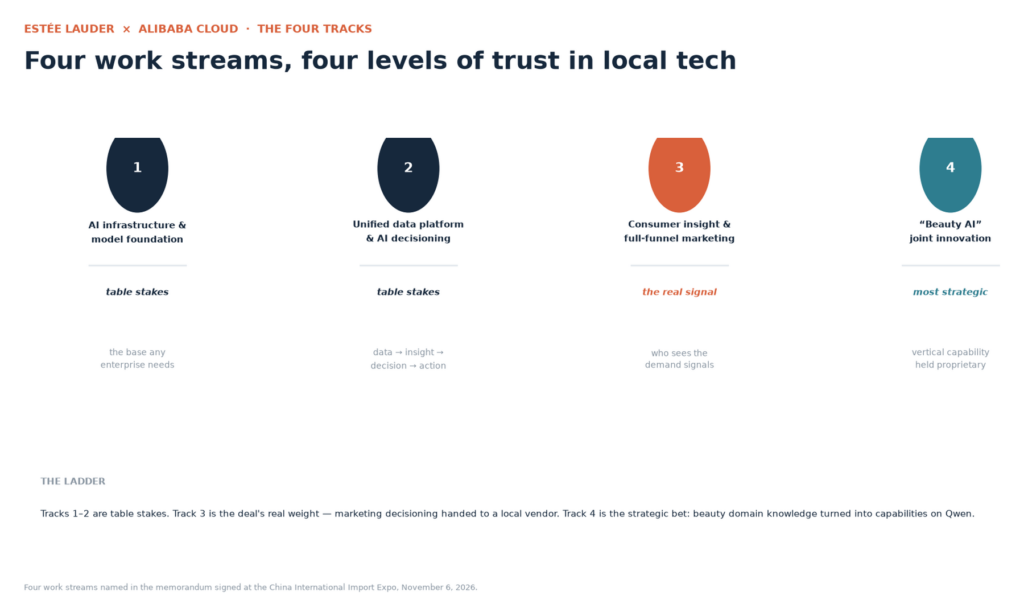
The release language is careful, but the four areas map to an escalating ladder of trust in local technology.
The first two are table stakes. Infrastructure and a unified data platform are what any large enterprise needs before it does anything intelligent; “connecting and activating consumer, product, marketing and operational data into a closed loop from data to insight to decision to action” is the standard enterprise-data pitch, translated.
The third is where the real signal sits. “Consumer insight and full-funnel marketing intelligence” is not a slogan about generating product images or writing copy. It is the decision layer of marketing — where campaign money is allocated, where a trend is detected early enough to influence product development, where a channel’s return on investment is measured. Handing that to a local cloud vendor with deep integration into China’s e-commerce and content platforms is a meaningful statement about who gets to see the company’s demand signals in its most important growth market.
The fourth is the most strategic, and the least concrete. A “beauty AI” joint track means the two companies intend to turn Estée Lauder’s decades of cosmetics domain knowledge into capabilities on top of Qwen — in the release’s phrase, a “differentiated, competitive beauty-specific AI IP.” That is the shape of every industry-model pitch: the model learns the vertical, the vertical stays proprietary, and the eventual value is whatever new product or experience the combination can produce that a general assistant cannot.
Brian Franz, the group’s chief technology and transformation officer, framed it the way a C-suite does when the deal is real rather than decorative: bring “the deep heritage and consumer insight of a prestige beauty group together with leading technology, so AI genuinely serves the consumer.” Alibaba Cloud vice president Xie Hang answered with the vendor’s symmetrical line about moving AI “from technical capability to business value.” Both are commitments to architecture, not to a feature launch date.
Why the stack matters more than the use cases
There is a temptation to read this as another “brand uses AI for marketing” story and file it next to every press release about a chatbot on a website. That would miss the structural point.
A prestige brand selling in China sits on a demand-signal problem. Its global systems see sales, not the live conversations and discovery behavior that precede them. The Chinese platforms — e-commerce giants, Xiaohongshu, Douyin — hold that signal, and hold it in forms an international brand cannot easily export. Partnering with Alibaba’s cloud and model layer is, in effect, renting a view of that signal while staying compliant with data residency.
The joint innovation track matters because it flips the usual dependency. Global brands are accustomed to exporting a headquarters-built model and localizing the edges. In beauty AI, the deal suggests the opposite direction: the vertical capability may be developed in China, on Chinese models, and then judged on whether it can travel back out. If a beauty-specific layer on Qwen proves it can predict demand or personalize better than a general model, that is a capability built outside the Western AI stack — and a precedent for other categories.
For Alibaba, the value is equally specific. You cannot buy a more valuable enterprise reference than a group whose chief technology officer stands on a stage in Shanghai and names your models as the foundation of a “beauty AI” vertical. Every cloud vendor is chasing vertical LLM proof. Estée Lauder hands Alibaba one in the highest-margin consumer category there is.
The scale point deserves care, because the numbers move fast. Alibaba’s cloud business grew 40 percent in the September 2026 quarter, and Qwen’s API call volume was up 16 times in the first half of the fiscal year. A beauty group is not Alibaba’s largest cloud customer by any measure. It is one of its most legible.
The honest limit of a memorandum
A strategic memorandum is an intention, not a contract with committed spend, and this one names no figures, no timeline, and no exclusive rights. The four tracks could mature into real shared infrastructure, or four of them could settle into co-marketing. The release does not specify whether consumer data co-mingles with Alibaba’s broader model training, what governance applies to the “beauty AI” IP, or how much of the stack replaces existing vendors rather than layers on top.
That ambiguity is not a flaw; it is how cross-border enterprise AI deals get structured. But it means the two questions that decide whether this matters will be answered later, not at signing: first, whether the full-funnel marketing intelligence actually shifts Estée Lauder’s media allocation in China in a measurable way; second, whether the joint “beauty AI” produces something that could not have been bought off a vendor’s shelf.
Until those are answered, read the deal as evidence of a broader fact rather than a product announcement. The global AI stack and the Chinese market have separated, and the world’s largest beauty companies have begun building two parallel AI operations rather than pretending one reaches both. Estée Lauder is simply the one that said so in public.