Where Import Brands Learn What Chinese Buyers Actually Want
Xiaohongshu built China’s most valuable search asset out of questions that don’t look like searches at all. The catch: for the first time, its users are spending less time inside it.
At the China International Import Expo in Shanghai on November 5, the national pavilion hosted an interactive screen with a single input box and no product catalog. A visitor typed a sentence that no retail data warehouse would recognize as a query: “Where should I take my parents for a weekend in Shanghai?”
What came back was not a curated guide. It was the accumulated, real-world testimony of ordinary users — which walking routes suit an older person’s stamina, which local Shanghainese restaurant cooks light flavor, which hour the Bund is least crowded.
The installation is called AI Wensou, roughly “AI ask-and-search,” and it is Xiaohongshu’s demonstration of how the platform intends to read Chinese consumption. Three self-reported figures carry the pitch: more than 800 million searches a day; about 39 million users a day who express a clear intent to buy something; and roughly 140 million daily purchase-consideration behaviors.
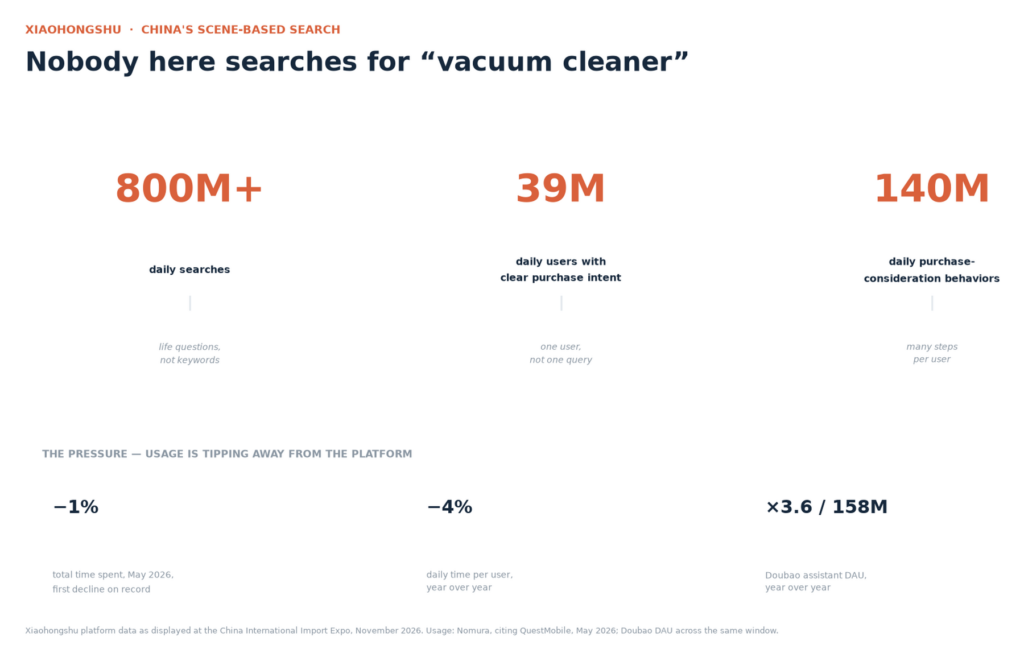
The interesting number is the first one, not the last two. Eight hundred million daily searches on a platform where the queries do not look like keywords.
Search that starts before the product
The platform’s taxonomy is three elements: people, scenes, and trends. A user does not search “stroller.” She searches “what to bring for a newborn in winter,” or “new-Chinese-style wedding prep.” The platform groups these common threads into an audience, attaches a consumption scene, and maps a trend. Queries like “a weekend trip with elderly parents” and “fall-winter commute outfit” and “new-Chinese wedding checklist” look like content topics. They are, in fact, the front edge of purchases that have not yet named a product.
This is the structural difference from a search engine. A keyword engine catches demand after it has been formed into a noun. Xiaohongshu catches it while it is still a sentence, when the buyer has not decided what to buy, only what problem the purchase is supposed to solve.
The Norwegian furniture group Flokk’s chair brand HÅG is the platform’s preferred case study, and it is a clean one. The HÅG chair’s core feature is dynamic sitting support. When it entered China it defaulted to being seen as a children’s study chair, and mothers were the buyers — a positioning error that persisted for an extended period. In early 2024, Flokk made Xiaohongshu its core operating base in China, and did something import brands rarely do: it stopped translating and distributing its headquarters’ unified materials, and instead rebuilt the product’s narrative around local consumption scenes, focused on back pain from prolonged sitting. Livestreams moved from product display to recreating a study-and-office scene. Content cadence moved from weekly to daily.
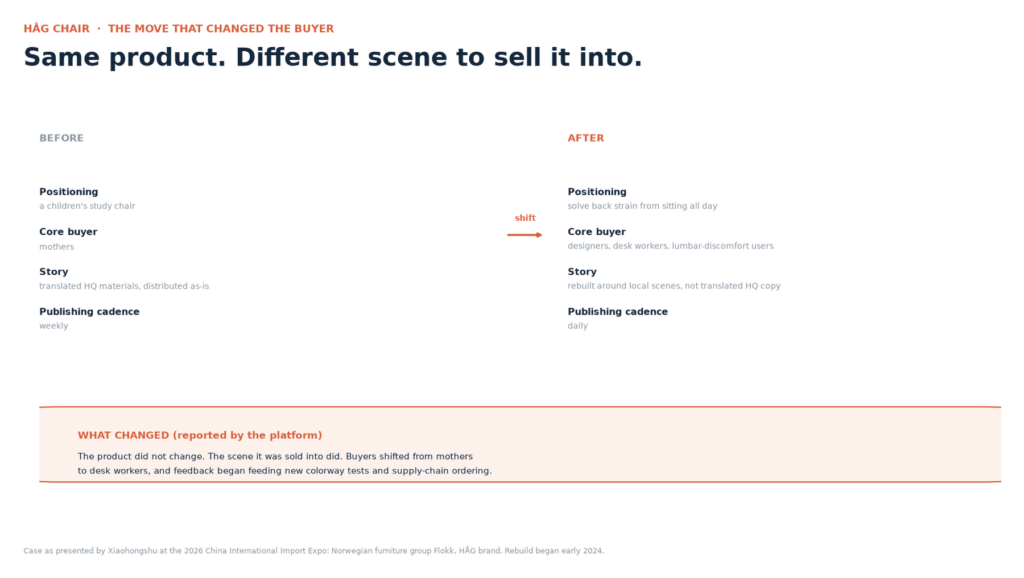
The reported result is that designers, long-hours desk workers and people with lumbar discomfort became the core users, and their feedback was used to test new colorways and adjust supply-chain ordering. The product never changed. The scene it was sold into did.
The part the press release leaves out
The reason this matters now, rather than three years ago, is that the platform is being pushed from two sides at once.
Externally, its users are drifting. Nomura data, citing QuestMobile, shows Xiaohongshu’s total time spent fell 1 percent year over year in May 2026 — the first decline since Nomura began tracking — with daily time per user down 4 percent. Over the same period, Doubao, the ByteDance assistant, grew its daily active users roughly 3.6-fold to 158 million. A coherent new habit has formed: ask an outside AI for a shortlist, then come back to Xiaohongshu to verify it.
Xiaohongshu’s response has been to make its in-app search converge with conversation. It folded its Q&A assistant “Wenyiwen” into its AI search brand “Diandian,” so that a search now also becomes a chat record, and every question feeds the model. In a product demonstration, a search for “recommend Bluetooth earbuds” returns an AI-compiled list of products first, with the double-column of user notes below it; the answer cites “thousands of real experiences,” and products carry a “percentage of people who recommend” figure. Users can jump from the AI answer to a purchase page without opening a single note.
That is the bet: convert the platform’s unique asset — an ocean of first-person experience — into an answer engine, before an outside assistant does it with the platform’s own content scraped secondhand.
The internal cost is real, and it is the part worth watching if you sell through Xiaohongshu. The platform’s revenue is unusually ad-heavy for a social product: roughly 76 percent of its 2025 revenue, about 32 billion yuan of a 42 billion yuan total, came from advertising. An AI answer that recommends products based on community discussion will not, by default, rank an advertiser first. The platform’s own commercialization team has wanted AI search to stop generating shopping recommendations automatically, per a report from 36Kr in May — but the feature stayed. The tension is fundamental: the more objective the answer, the longer users stay and the more searches compound; the more the answer bends toward ads, the faster the flight to outside assistants.
You cannot serve an honest search result and a sponsored one in the same sentence without admitting which is which, and the note-based format makes that admission harder than on a results page with a colored “Ad” label.
What this means if you market in China
Three things, each a change to the default import playbook.
Stop optimizing for the noun. If the platform’s engine groups queries by scene and trend, the unit of competition is not the product keyword but the life question it answers. The HÅG case did not win on “chair” — it won on “what happens to your back when you sit eight hours.” Audit your content against the questions, not the products.
Treat the recommendation percentage as a new, unregulated metric. In demos, product names carry figures like “70 percent recommend.” There is no stated denominator, no disclosed time window, and no treatment of sponsored content. Those percentages are not market share or satisfaction, and you should not let them be cited as either. Track what your own category’s answers cite, and which notes get pulled in — that is your real ranking signal now.
Watch the traffic you are about to lose to the assistant, not the one you already have. The first concrete danger is not the AI answer itself. It is that a buyer who has already shortlisted elsewhere arrives at your page later, with less patience and a formed opinion. The brand content that used to shape first impression is being displaced upstream, exactly as it is with external AI search — except here it is happening inside the platform that used to own the browse.
Xiaohongshu is doing something no Western platform has credibly built at scale: a recommendation surface where the query is a life situation and the answer is first-person testimony. The weakness is that the same AI logic that makes that testimony searchable is now being built, faster, by the assistants outside its walls. Whether the platform wins depends on a question it has not answered publicly: whose search result does the user see first — its own note, or the outside answer’s digested version of it?