AI Local SEO in 2026: What Actually Decides Whether a Small Business Gets Found
There is a number in the newest local search research that should have every plumber, dentist, and bookstore owner in the country slightly sick to their stomach, and almost nobody is quoting it.
When researchers tested 540 real local queries across three American cities, Google’s AI Overview appeared on 68% of them. The traditional three-business map pack, the thing local businesses have spent a decade optimising for, showed up on 39%.
Sit with that for a second. For roughly two out of every three local searches, the answer was written by a machine before the map even loaded.
And yet the entire conversation about AI search is being conducted by people selling enterprise software to enterprise clients. The agency case studies, the conference keynotes, the LinkedIn threads about “AEO strategy” all assume you have a content team, a technical SEO lead, and a budget line for schema implementation.
You don’t. You have a shop, a phone that rings, and maybe a nephew who set up your website in 2019.
So let me write the version of this story that’s actually about you.
The search that never reaches your website
Here’s the mechanism, stripped of jargon. Someone opens their phone and types “emergency dentist open late near me.” A year ago, that person got a map with three pins on it and tapped the one closest to them. Today, a large share of the time, they get a paragraph. The paragraph names one or two practices, mentions that emergency visits typically cost a certain amount, notes that you should ask about sedation options, and offers three blue links most people never touch.
Pew Research Center tracked the actual browsing behaviour of 900 American adults through March 2025 and put numbers on what everyone suspected. When an AI summary appeared, users clicked a traditional search result 8% of the time. Without one, they clicked 15%. Nearly double. And the links inside the AI summary itself? One percent.
So no, the traffic didn’t vanish. It got rerouted through a door most local businesses don’t know exists.
Two machines, one storefront
The single most useful thing I can tell you is that Google is now running two different ranking systems on the same query, and they reward completely different things.
The map pack rewards proximity, profile completeness, and category accuracy. It always has. The AI layer rewards being described consistently and cited across the open web, which is a very different skill, and one that a small business can actually get good at without hiring anybody.
Whitespark’s research team found essentially no correlation between how prominently a business appeared in the map pack and whether it appeared in the AI Overview above it. That’s the sentence to underline. Ranking third in Maps does not buy you a mention in the answer that now sits on top of Maps.
What the data actually says about intent
Now the nuance, because the 68% headline hides a very lopsided reality and the lopsidedness is the useful part.
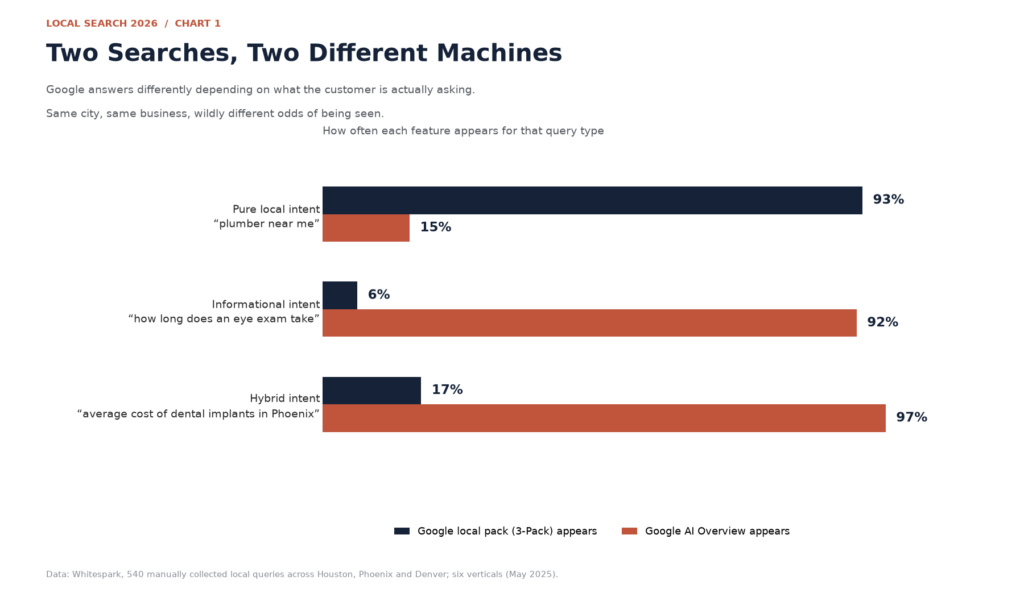
When the query was purely transactional and location-anchored, something like “plumber near me,” the map pack appeared 93% of the time and the AI Overview only 15%. The transaction is still intact. Google knows you want a plumber, not an essay about plumbing.
When the query was informational, the balance flipped hard. “How long does an eye exam take?” triggered an AI Overview 92% of the time. When it was hybrid, meaning the customer wanted a decision plus a number, like “average cost of dental implants in Phoenix,” AI Overviews appeared 97% of the time.
Read that as a funnel and it stops being abstract. The customer researches in the AI layer and transacts in the map layer. If you are invisible in the first stage, you are not losing the click. You are failing to make the shortlist that the click comes from.
The part everyone gets backwards: proximity still matters, rank does not
Here’s a widely repeated claim I want to kill: that AI search has made physical location irrelevant.
It hasn’t. Local Falcon ran 60,000 simulated searches across 4,423 businesses in 20 countries and found that a business close to the searcher appeared in AI Overviews 72% of the time, versus 68.5% for one slightly farther away. Proximity is a gate. It gets you into the pool.
What it no longer does is decide the order. Once you’re in the pool, what determines whether you get named is whether the machine can find clear, consistent, corroborated facts about you. That’s why a well-documented shop across town can beat a sloppy one two miles away, and why the phrase “I’m the closest, I should win” has quietly become the most expensive assumption in local marketing.
Why your website is still the document AI quotes
If you have absorbed the “websites are dead” narrative, this next finding will feel like a reprieve.
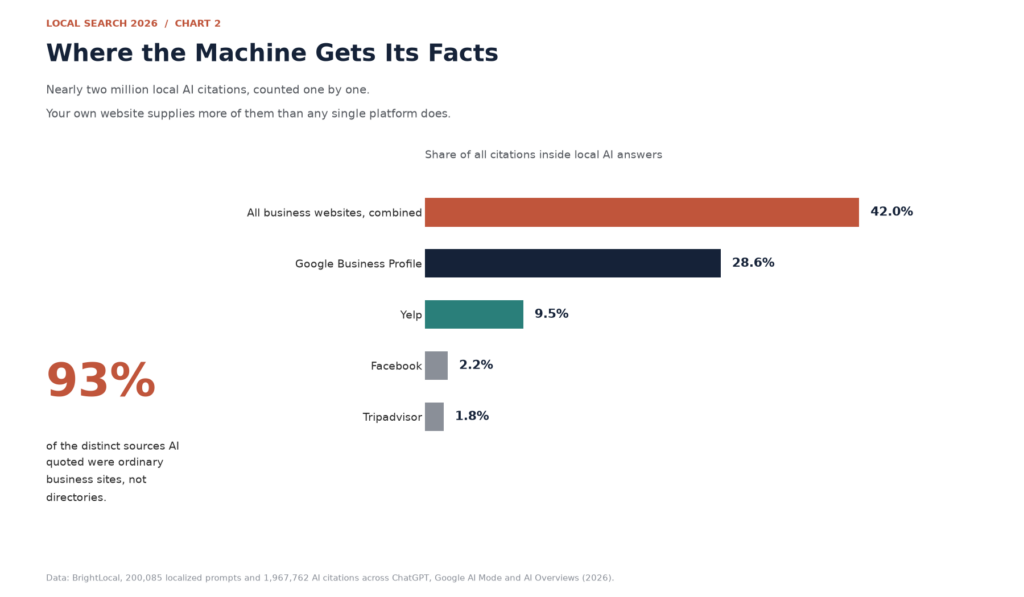
BrightLocal analysed 200,085 localised prompts and nearly two million AI citations across ChatGPT, Google AI Mode, and AI Overviews. Of the 116,000 distinct domains used as sources, 108,000 were ordinary business websites. Those business sites accounted for 42% of all citations.
The single biggest source was still Google Business Profile at 28.6%. Yelp followed at 9.5%, Facebook at 2.2%. But when you look at the variety of sources rather than the volume, the picture inverts. Ninety-three percent of the distinct websites the machines quoted were just businesses. Not directories. Not platforms. Businesses.
Your site is not being bypassed. It’s being read, and then summarised. Which means the question is no longer “does my website rank” but “does my website say anything specific enough to be worth quoting.”
The recommendation gap is brutal and mostly invisible
Now the bad news, and it’s worse than most people realise.
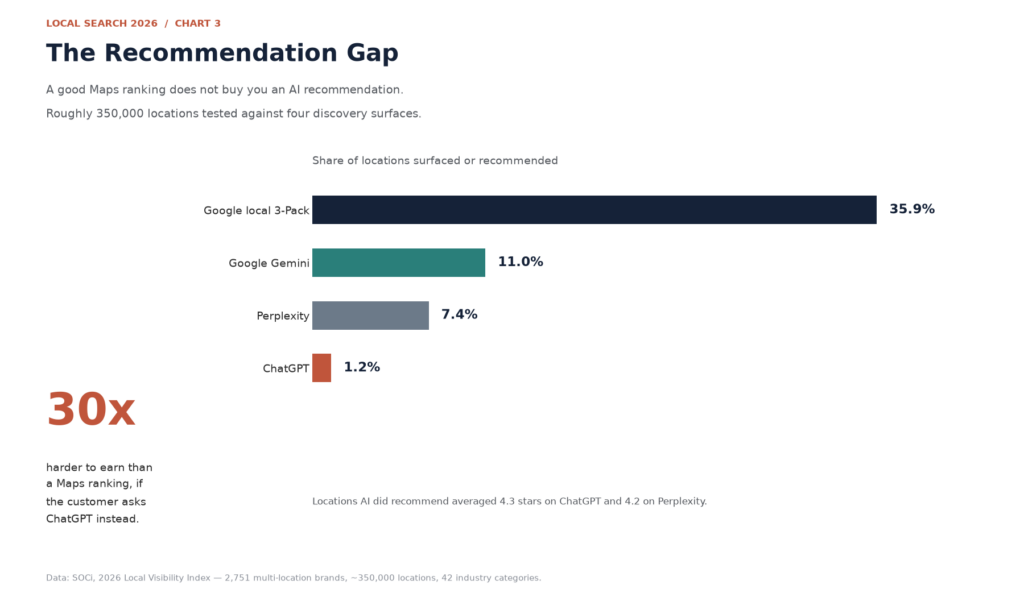
SOCi tested roughly 350,000 locations across 2,751 multi-location brands against four discovery surfaces. Google’s local 3-Pack surfaced 35.9% of them. Gemini recommended 11%. Perplexity recommended 7.4%. ChatGPT recommended 1.2%.
One point two percent.
Before you panic: that’s a coverage rate inside a specific query set, not a claim that ChatGPT can only ever name 1.2% of the world’s plumbers. Different studies, different prompts, different samples. But the direction is consistent everywhere, and the practical implication is uncomfortable. Getting named by an AI is meaningfully harder than ranking well on Maps, and the businesses that do get named look different from the ones that rank well.
They average 4.3 stars. They have complete, accurate profile data. And when researchers checked whether AI systems had their hours and addresses right, ChatGPT and Perplexity were correct only about 68% of the time, while Gemini, which draws from Google’s own graph, was accurate essentially always. Which tells you something important: if your data is inconsistent anywhere, the machine doesn’t guess. It moves on.
The customer moved first
Everything above is supply-side. Here’s the demand-side shock.
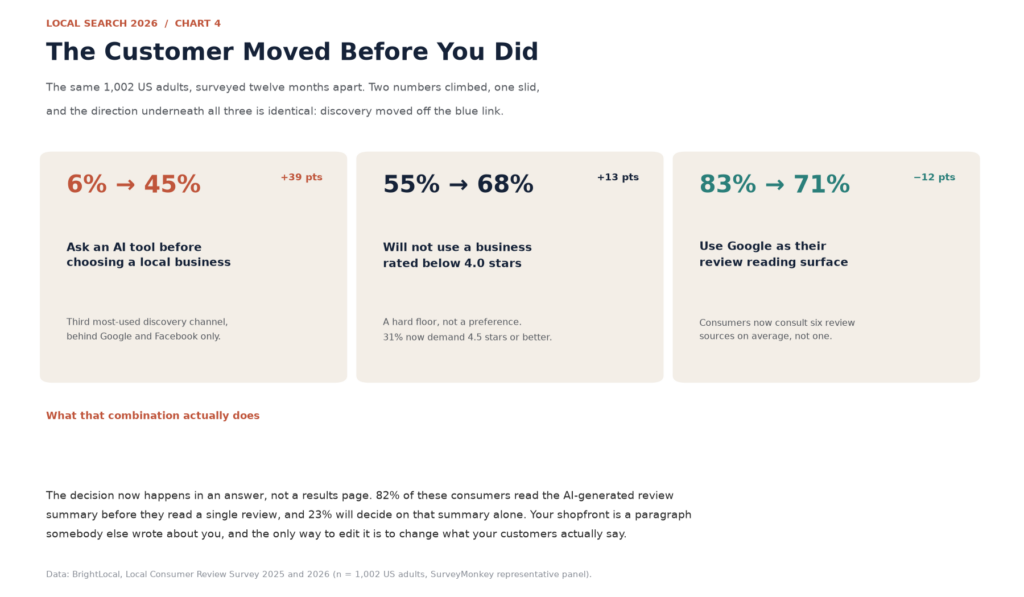
BrightLocal’s 2026 survey of 1,002 American adults found that 45% had used an AI tool to get a local business recommendation in the past year. ChatGPT alone reached 31%.
That figure is now the third most-cited statistic in local marketing, and it deserves a caveat most people quoting it skip: the 2025 edition of the same survey asked a narrower question and produced 6%. The jump from 6% to 45% is partly a real behavioural shift and partly a change in how the question was worded and which tools were offered as answers. Treat 45% as a solid 2026 snapshot. Don’t treat the 39-point jump as a clean year-over-year curve, because it isn’t one.
The rest of the same survey is harder to argue with. The share of consumers who say they will not use a business rated below four stars rose from 55% to 68% in a single year. The share demanding 4.5 stars or better went from 17% to 31%. Meanwhile, Google’s position as the place people read reviews slipped from 83% to 71%, and the average consumer now consults six different review sources.
Reviews stopped being a ranking signal and became a gate
This is the part I’d tattoo on the inside of every small business owner’s eyelid if I could.
In traditional local search, a 3.9-star business with strong everything else could still rank and still get calls. In the AI layer, a 3.9-star business frequently doesn’t get considered at all. SOCi’s data shows the gap in the averages: locations ChatGPT recommended averaged 4.3 stars, and the lowest-rated brands in the study appeared in AI answers zero times.
So the old advice, “get more reviews,” is now the wrong advice. Sixty-eight percent of consumers won’t book below four stars, and 74% only care about reviews from the last three months. Thirty reviews dumped in one fortnight followed by ten weeks of silence reads as a dead business, because recency has become the signal that matters more than volume.
Whitespark’s 2026 ranking factor survey, compiled from 47 practising local search experts scoring 187 factors, caught this shift in the bluntest possible way: “recency of reviews” jumped from 93rd place in 2023 to 11th. That is not a trend. That is a rewrite.
And you cannot shortcut it. The FTC’s 2024 rule on consumer reviews and testimonials now carries civil penalties for buying sentiment-conditioned reviews, for creating fake ones including AI-generated ones, and for suppressing negative ones. The cheap version of this tactic is legally radioactive. The honest version, asking every customer every week, is free.
The uncomfortable truth about “best of” lists
Here is the finding that surprised me most, and it is genuinely bad news for anyone who was hoping to win this on their own website alone.
When Whitespark added an AI visibility column to their expert survey for the first time, the number one factor wasn’t a profile field or a schema tag. It was inclusion in expert-curated “best of” lists. Three of the top five AI visibility factors were citation-related. The report’s own summary line was blunt: in AI SEO, mentions are the new link.
Ahrefs reached the same place from a different direction. Across 75,000 brands, branded web mentions correlated with AI Overview visibility at 0.664. Backlink count correlated at 0.218. Mentions were roughly three times the stronger signal. Brands in the top quartile for mentions recorded 169 AI Overview mentions; the next quartile recorded 14. And 26% of the brands studied, all of which had decent domain authority, had zero.
Which means the unpaid, unglamorous work is the work that counts now. Get into the city magazine’s annual roundup. Get onto the local chamber’s directory. Get quoted in the neighbourhood paper. Ask the regional trade association to list you. None of that is scalable, none of it is fun, and all of it is exactly what the machines are reading.
The playbook, in the order that actually works
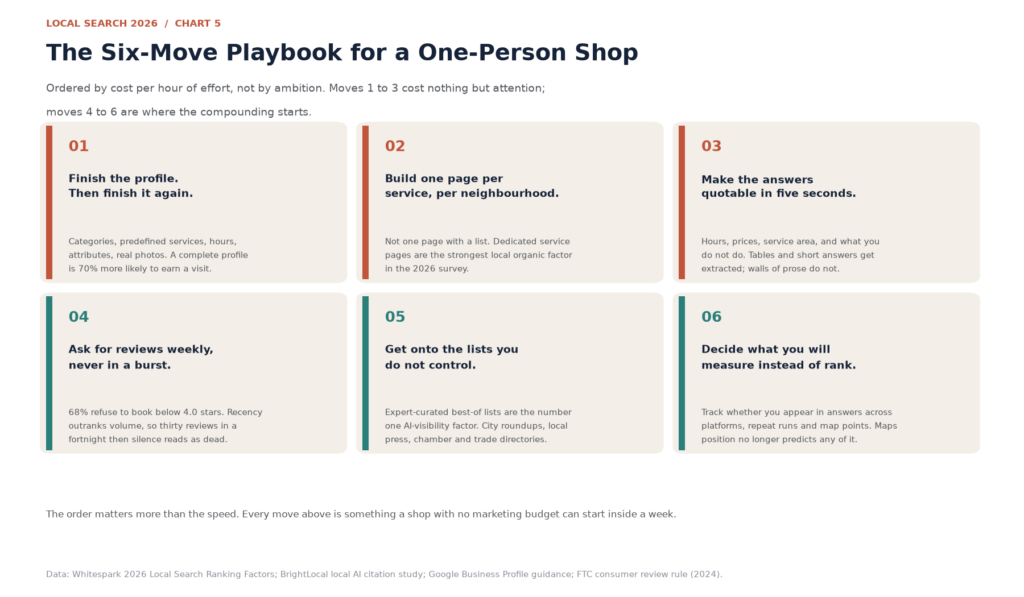
I’ve ordered this by effort-to-impact ratio rather than by ambition, because you don’t have a quarter to spend on a strategy deck.
Finish the profile. Then finish it again. Categories, predefined services, hours, attributes, real photographs. Google’s own guidance says a complete profile makes customers 70% more likely to visit and 50% more likely to consider buying. In the 2026 survey, “presence of GBP predefined services” landed at 22nd, up from being dismissed as a myth three years earlier. “Business is open at time of search” entered the top five. Fill in the boring fields.
Build one page per service, per neighbourhood. Not one page called “Services” with a bulleted list. The 2026 survey ranked dedicated service pages as the strongest local organic factor, and separately noted that sheer volume of prose on service pages lost 40 places. Short, specific, and quotable beats long, generic, and impressive.
Make your answers extractable in five seconds. Hours. Prices. Service area. What you don’t do. Which insurance you take. Put it in a table or a two-sentence block. The machines pull facts, not atmosphere.
Ask for reviews weekly, forever. One ask per customer, the same week, every week, with no incentive conditioned on sentiment. Then reply to them, because 89% of consumers expect a reply and half say a templated reply puts them off.
Get onto lists you don’t control. This is the highest-leverage item on the page and the one you’ll want to skip. Don’t.
Change what you measure. More on that below.
What to stop doing
Stop treating your map pack position as your scoreboard. It still predicts phone calls from people standing on the pavement. It no longer predicts whether you exist for the customer who is deciding which three businesses to call.
Stop buying links and calling it local SEO. The correlation data is fairly unambiguous now. Mentions move the needle; link counts mostly don’t.
Stop believing the most-quoted number in the industry. The famous claim that 46% of Google searches have local intent traces back to a remark a Google representative made at a conference in 2018. There is no published methodology behind it, and Google has never released one. The real figure could plausibly be 30% or 60%. Local search is undeniably enormous, but that specific statistic is folklore wearing a lab coat. If you need a number for your own market, pull it from your Search Console and filter for city names and “near me.”
The small-business advantage nobody writes about
I promised you an angle nobody covers, so here it is, and it isn’t a tactic.
The businesses best positioned to win the AI layer are not the ones with the biggest content budgets. They’re the ones with the tightest, most specific, most verifiable facts about a small geographic area, and that is structurally a small business advantage. A chain has to describe forty locations in generic language. You can describe one street corner with total precision.
The machine is trying to answer “who should I trust near me.” It needs evidence. Evidence, in this context, is an address that matches everywhere, a rating above four, a handful of recent reviews that mention specific services, and a mention in the local paper that you didn’t pay for. Every single one of those is something a shop owner can produce and an enterprise marketing department cannot fake.
The threat and the opportunity are the same event, seen from two angles. The AI layer is eating the click that used to bring people to your site. It is also the first distribution channel in twenty years where being small, local, and specific is an advantage rather than a handicap.
What to measure on Monday
Not rankings. Rankings no longer describe the thing you care about.
Measure whether you appear in answers. Pick ten prompts a real customer would type, things like “emergency plumber open Sunday in [your town]” and “how much does a crown cost without insurance in [your town].” Run them on ChatGPT, on Google’s AI Mode, and in plain Google search. Log which businesses get named. Run the same set four times, because consistency is low: BrightLocal found that a business named once reappears in only about half of subsequent attempts, and ChatGPT averaged 4.1 businesses per answer while AI Overviews averaged just 2.5.
Then move your pin around the map and run them again, because results shift with the searcher’s position even inside one town. Twenty-five percent of AI Overview results were “always present” across map points. For ChatGPT it was 3.5%.
That’s your new dashboard. It takes an afternoon to build in a spreadsheet, it costs nothing, and it tells you the truth that your rank tracker is now hiding.
The takeaway
The local search revolution isn’t coming for your website. It already came for the moment before your website, the moment when a customer decides which three businesses are worth a phone call. You can either be one of the three, or you can be the fourth business in a town of twelve thousand people, wondering why the phone got quieter.
The businesses that win won’t be the ones with the cleverest AI tools. They’ll be the ones who did the tedious, unglamorous, entirely free work of being findable, consistent and quotable, and who then asked every single customer for a review, every single week, for two years straight.
There’s no shortcut. There’s just the work, done in the right order.