Fluency Is Not Truth: What AI Hallucination Actually Costs a Brand
The capability marketers paid for — a machine that writes confident, on-brand prose at volume — is the same capability that manufactures evidence which never existed. That is not a bug in the tooling. It is the architecture. These models are optimised to produce language that sounds supported, not language that is supported.
The cost now shows up in two currencies. Legally, “the AI wrote it” has never once worked as a defence — not at the FTC, not in a Canadian tribunal, not in the Sixth Circuit. Reputationally, every major consumer study run between mid-2025 and late 2026 points the same way: visible AI production is a trust discount, not a trust premium.
The uncomfortable conclusion is also the simple one. Hallucination risk is not solved by waiting for better models. It is solved by refusing to let a model be the origin of a factual claim — and by building the verification gate that decision implies.
1. What hallucination actually is, in marketing terms
Strip away the vocabulary and hallucination is a specific, almost boring failure. The model produces a statement that is fluent, confident, well formatted, plausibly sourced — and untrue. Not wrong in a way you can spot. Wrong in a way that reads exactly like the correct version.
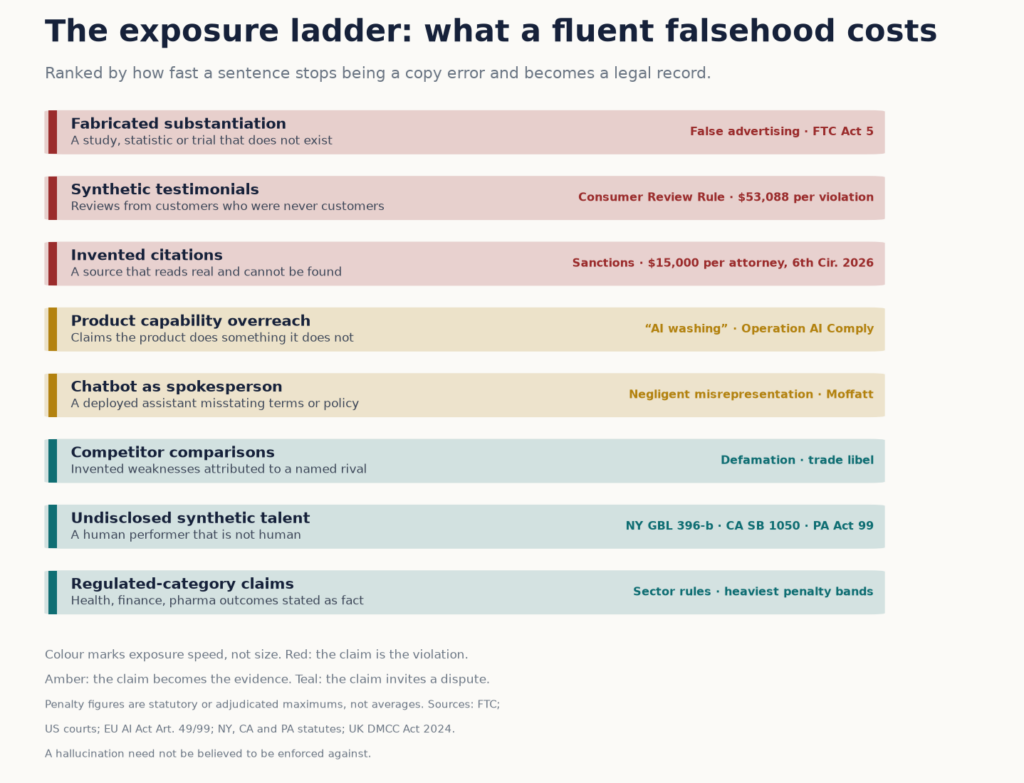
In marketing copy, that failure takes a small number of recurring shapes. An invented statistic. A study that does not exist, cited with a real-sounding journal name. A testimonial from a customer who was never a customer. A product capability the roadmap has not shipped. A competitor weakness nobody ever documented.
Then there is the version that should worry brand teams most, because it is not hypothetical. In its complaint against DoNotPay, the FTC described a quotation displayed prominently on the company’s site, attributed to the Los Angeles Times, praising the product’s legal reasoning. The quote was real. Its source was a high-school student’s opinion piece on a blog the newspaper hosts for young writers. Nobody at the company sat down to invent an endorsement. A pipeline did it, and the output looked like an award citation.
What separates this from ordinary copy error is asymmetry of detection. A typo announces itself. A hallucination does not. The person who prompted it cannot tell, because the model writes fabrications and facts in the same register.
NP Digital’s 2026 study — 600 prompts across six major models, plus a survey of 565 US marketers — puts numbers on the operational reality. Nearly half (47.1%) hit AI inaccuracies several times a week. More than a third (36.5%) said hallucinated content had already gone live publicly. And 23% said they were comfortable publishing model output with no human review at all. That last figure is the whole problem in one line.
2. The measurement problem: two benchmarks that do not agree
Here is where most treatment of this topic goes wrong, and precision matters, because the number you quote determines how alarmed you get.
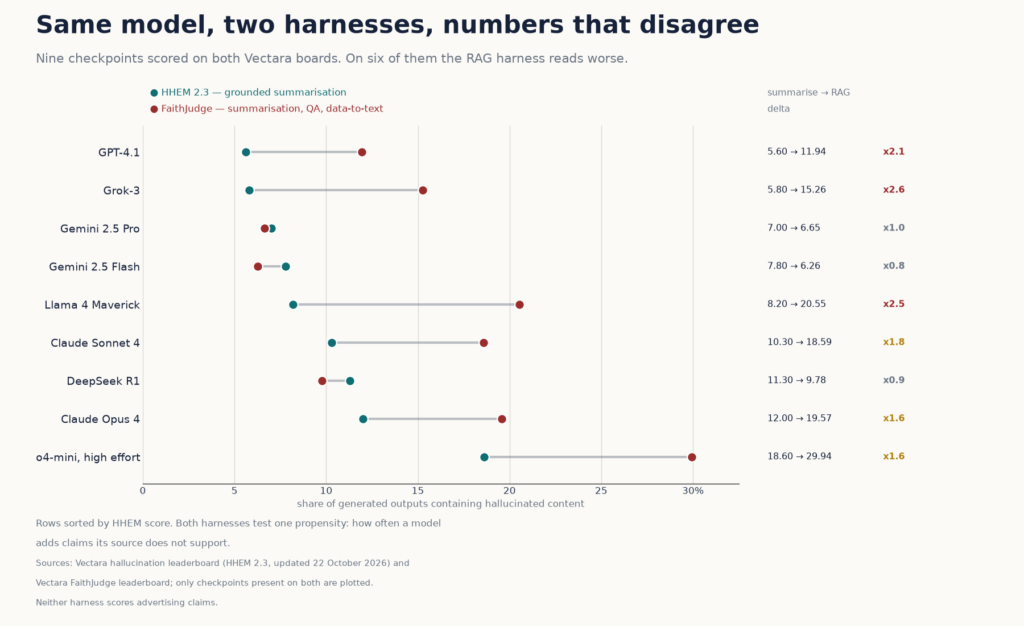
Vectara maintains two leaderboards, and they now tell visibly different stories about the same models. On HHEM 2.3 — does a model add unsupported content when summarising a document it was handed — the current figures, updated on 22 October 2026, are reassuring. GPT-4.1 sits at 5.6%. Grok-3 at 5.8%. Gemini 2.5 Pro at 7.0%. Only the weakest entries on the board climb past 18%.
On FaithJudge, which tests faithfulness across summarisation, question answering and data-to-text generation, six of those same nine checkpoints come out worse. GPT-4.1 goes from 5.6% to 11.94%. Claude Sonnet 4 from 10.3% to 18.59%. Claude Opus 4 from 12.0% to 19.57%. Llama 4 Maverick from 8.2% to 20.55%. o4-mini at high effort reaches 29.94%. The widest gap is a factor of 2.63.
Both numbers are real. They are not contradictory. They measure different tasks, and the divergence is the finding. Ask a model to restate a document you gave it, and it behaves like a careful clerk. Ask it to do anything else, and its error rate multiplies. Marketing rarely asks a model to restate a document. It asks a model to write the claim.
Three qualifications belong here, because this is exactly the area where tidy numbers become misleading.
The rankings are not stable across harnesses. Grok-3 looks safer than Claude Opus 4 on one board and worse on the other. Gemini 2.5 Flash is the single best performer on FaithJudge at 6.26% and mid-table on HHEM. A vendor slide quoting one benchmark is quoting a number chosen from a spread.
Comparing a HHEM figure to a FaithJudge figure is not a like-for-like comparison of the models. HHEM 2.3 runs on a refreshed evaluation set; FaithJudge draws on three separate RAG task families. When the two boards disagree, the honest reading is that the measurement instrument differs, not that one vendor lied.
And neither board evaluates advertising claims. That gap in the public evidence is real, and I would rather name it than paper over it. What both measure is the underlying propensity: how often a model adds what it was not given. A system that invents while summarising will invent while copywriting. That inference is the honest one available.
3. The legal position: AI is not a defence, and never has been
One sentence recurs, in different words, across every action and ruling in this field: the advertiser is responsible for the advertisement. The technology used to produce it is not a mitigating factor. It is barely relevant.
3.1 False advertising does not care who typed the words
The FTC launched Operation AI Comply in September 2024 with five simultaneous actions. The detail people underestimated was its durability — it continued through the change of administration, and by late 2025 trade press was describing it as an enduring enforcement focus rather than a departing one.
Two patterns matter for anyone writing marketing copy.
First, substantiation is the whole ballgame. DoNotPay paid $193,000 and had to notify past subscribers, after claiming its product was “the world’s first robot lawyer” while never testing whether its output matched a lawyer’s, and never retaining a lawyer to check. The Commission’s framing was blunt: there is no AI exemption from the laws on the books.
Second, this reaches business-to-business claims. If you sell a marketing platform to enterprises rather than consumers, the same deception standard applies to your pitch deck.
The UK route differs in mechanism and outweighs in ceiling. The Digital Markets, Competition and Consumers Act has been in force since 6 April 2025 and lets the Competition and Markets Authority fine up to 10% of worldwide turnover — or £300,000, whichever is higher — without going to court first. By October 2026 the CMA had issued more than £5.8 million in fines and secured £1.95 million in consumer refunds under the new powers.
And the UK’s Advertising Standards Authority has already ruled on an AI-mediated claim. In its 2025 decision on BCCR Ltd, trading as Belief Coding, the advertiser’s agency had used AI to summarise a published scientific paper. The model attributed an 83% efficacy figure to that paper. It was not there. Both issues were upheld. Nobody set out to mislead; the summariser did it for them.
In China the statute is blunter still. Article 55 of the Advertising Law fines false advertising at three to five times the advertising spend; where spend cannot be calculated, RMB 200,000 to 1,000,000. Three or more violations within two years, or other serious circumstances, raise that to five to ten times spend, or RMB 1,000,000 to 2,000,000, with licence revocation available. There is no AI carve-out anywhere in the text.
3.2 Testimonials have become a strict-liability problem
The FTC’s Rule on the Use of Consumer Reviews and Testimonials took full effect on 21 October 2024. It prohibits creating, buying, selling or disseminating reviews and testimonials that misrepresent whether the reviewer exists or used the product. Generative tools are not named in the operative text, but the Commission’s basis-and-purpose statement is explicit that AI-generated reviews are covered, because the marginal cost of polluting a review ecosystem has collapsed.
The teeth are the point. Breaching a rule — rather than the older Endorsement Guides — opens the door to civil penalties, which the FTC has cited at up to $53,088 per violation. On 22 December 2025 the Commission sent warning letters to ten companies, requiring a named compliance owner and a remediation plan within five business days. That is a clock, not a consultation.
3.3 Invented citations have already ended careers
The cleanest evidence that verification is a duty rather than a nicety comes from courts sanctioning their own officers.
In Mata v. Avianca (S.D.N.Y., June 2023), two attorneys and their firm were sanctioned $5,000 after filing a brief citing six fabricated cases, then defending the fabrications when opposing counsel could not find them.
In March 2026 the Sixth Circuit went considerably further. In Whiting v. City of Athens, counsel filed briefs across three consolidated appeals containing more than two dozen fake citations and misrepresentations of the record. Sanctions: $15,000 per attorney, full reimbursement of the appellee’s appellate fees, double costs, and a disciplinary referral. The panel’s logic is the transferable part — the duty is discharged at the point of signing and filing, and it cannot be delegated to whatever produced the draft.
Then Nebraska made it a career event. In April 2026 the state’s Supreme Court suspended an attorney indefinitely after a brief in which 57 of 63 references were defective, twenty of them outright fabrications. He initially told the justices he had not used AI; he later admitted otherwise, and the failure of candour became a separate finding. The court noted the errors could have been caught with ordinary legal research.
Marketing is not litigation. But the principle transfers without friction: whoever signs off owns the claim. And notice what attracted the harshest penalties in every one of those matters. Not the error. The failure to correct it once challenged.
3.4 Your chatbot is your spokesperson, legally
Moffatt v. Air Canada is the case every brand team should read once. A bereavement-fare chatbot told a customer he could claim a retroactive refund within 90 days. The airline’s actual policy said the opposite. When he claimed, Air Canada refused — and argued, in substance, that the chatbot was a separate legal entity answerable for its own statements.
The British Columbia Civil Resolution Tribunal called that submission remarkable. The chatbot, it held, was part of Air Canada’s website, and the airline was responsible for everything on its website, whether a static page or an interactive component. The damages were trivial — a few hundred dollars. The holding is not: a consumer cannot be expected to cross-check one part of your site against another for accuracy.
If your brand runs an assistant that answers questions about pricing, warranty or returns, you have a spokesperson generating unreviewed claims at machine speed.
4. Disclosure is arriving whether you plan for it or not
The regulatory direction through 2026 was consistent: transparency moved from principle to date-certain deadlines, and the deadlines have passed.
The EU AI Act’s Article 50 obligations became applicable on 2 August 2026. Providers of generative systems must mark synthetic outputs in a machine-readable, detectable format. Deployers must disclose deepfakes, and must label AI-generated text published to inform the public on matters of public interest — unless the content has undergone human review and a person holds editorial responsibility for it. Breaching Article 50 sits in the middle penalty tier of Article 99: up to €15 million or 3% of total worldwide annual turnover, whichever is higher. Note that the percentage runs against global turnover, not EU revenue.
China moved earlier and built a longer chain. The Measures for Labelling AI-Generated Synthetic Content took effect on 1 September 2025, issued jointly by four ministries and paired with a mandatory national standard. The regime requires both explicit user-visible labels and implicit metadata embedded in the file, and it reaches distribution platforms and app stores, not only model providers.
The US is going the other way: state by state, with incompatible triggers. New York’s synthetic-performer disclosure law took effect on 9 June 2026, covering any advertisement featuring an AI-generated human likeness, with civil penalties of $1,000 for a first violation and $5,000 thereafter, and no private right of action. California’s SB 1050, signed in September 2026, applies from 1 January 2027 — but only where a synthetic performer appears prominently, and it prescribes near-mandatory wording and covers AI-generated voices. Crucially, violations route through the state’s False Advertising and Unfair Competition laws, which leaves the door open to private litigation with no fixed penalty ceiling. Pennsylvania enacted its own Artificial Intelligence Deceptive Advertising Act at the end of October 2026.
Three states, three triggers, three exposure profiles. For a national campaign, that is a compliance puzzle — and the reason some brands are simply adopting the strictest standard everywhere.
One caveat, from the regulators themselves. At a 2026 industry panel the ASA’s chief executive warned that an AI label is not a get-out-of-jail-free card. Disclosure does not cure a misleading claim. It only removes the separate offence of concealment. New Zealand’s ASA guidance says the same thing in almost identical language: disclosure is a transparency measure, not a remedy.
5. The brand cost, which is larger and harder to reverse
If legal exposure is the visible cost, reputational damage is the compounding one, and the survey evidence converged with unusual speed.
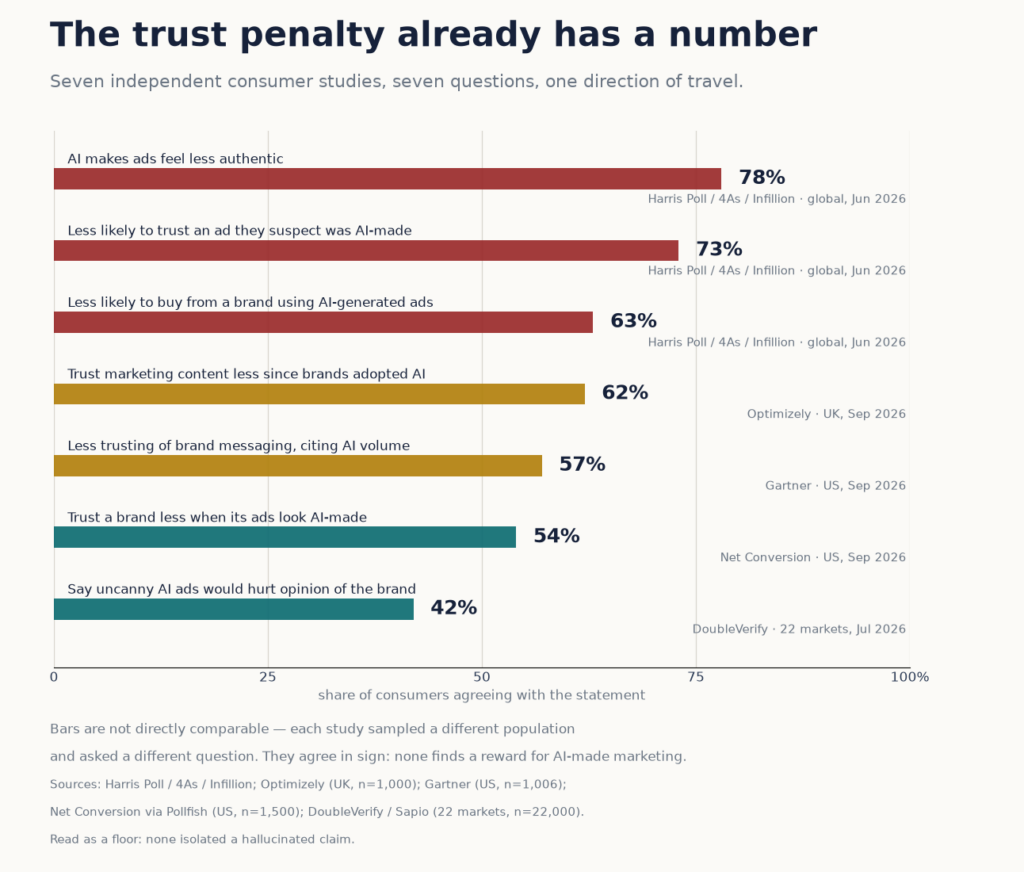
Harris Poll, working with the 4As and Infillion, found 78% of global consumers say AI makes ads feel less authentic — and the same share find brands cringey when they over-use it. 73% are less likely to trust an ad they suspect was AI-made. 63% are less likely to buy from a brand that uses AI-generated ads.
Gartner’s survey of 1,006 US consumers found 65% believe brands produce too much AI content, and 57% say that has made them trust brand messaging less. The more interesting number is adjacent: 35% now rely on influencers less because of AI content volume, while 43% lean more on real people.
Optimizely’s UK work put the trust decline at 62%, with 66% saying brands prioritise volume over quality and 59% saying content quality has fallen. Net Conversion, surveying 1,500 US adults, found 54% trust a brand less when its ads look AI-made — and 38% of 18-to-29s strongly agree, which is the opposite of the demographic most agencies assume. DoubleVerify, across 22,000 consumers in 22 markets, found 42% say uncanny AI advertising would damage their opinion of a brand. Encouragingly, 40% view polished, professional AI ads positively.
That last pair is the nuance that matters. Consumers are not rejecting AI. They are rejecting visible, cheap AI. Which is a different problem from hallucination — but an adjacent one, and it interacts badly. A hallucinated claim that ships is, by definition, an unreviewed claim, and unreviewed claims cluster with unreviewed craft.
And note the asymmetry. Gartner’s finding is that trust erodes on volume, not only on error. You do not have to publish a falsehood to lose ground. You only have to look like you might have.
6. Where the risk is highest — and where it genuinely is not
Not all AI-assisted marketing carries equal exposure, and pretending otherwise produces governance nobody follows.
The high-exposure band is narrow and identifiable. Anything carrying a verifiable factual assertion: statistics, survey results, clinical or efficacy language, awards, certifications, specifications, comparative claims against named competitors, any quote attributed to a real person or publication. Add testimonials and reviews, which now carry a rule-based penalty. Add regulated categories — health, beauty, supplements, financial products, alcohol, anything marketed to children. Add deployed conversational agents answering questions about terms. Add undisclosed synthetic performers, now a statutory offence in at least three US states.
The low-exposure band is equally real. Conceptual and aspirational copy. Clearly stylised creative making no factual claim. Internal ideation. First-draft structures a human will fill with verified substance. Summarising your own verbatim customer dataset.
The distinction that organises all of it is not AI versus human. It is fact-bearing versus non-fact-bearing. A brand can run a fully AI-generated visual campaign with modest legal exposure, and a fully human-written landing page with severe exposure, because the landing page makes claims. Risk lives in the claim, not in the pixel.
7. The playbook: five gates, in order
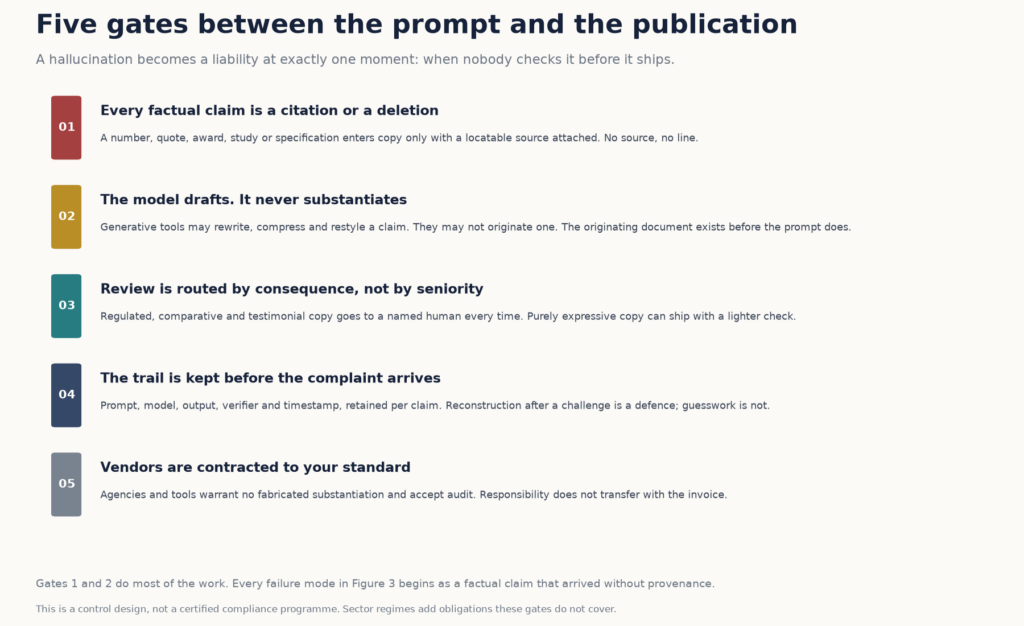
Gate one: every factual claim carries provenance or it gets deleted. A statistic, quote, award, study or specification enters copy only with a locatable source attached. No source, no sentence. This single rule removes most of the failure modes in Figure 2, because a hallucination is precisely a claim with no origin behind it.
Gate two: the model drafts; it never substantiates. Generative tools may rewrite, compress, restyle and translate a claim that already exists in a verified document. They may not originate one. This inverts the common workflow. Most teams prompt first and hunt for support second, which is exactly backwards — the model will cheerfully manufacture the support. Source first, prompt second.
Gate three: review is routed by consequence, not by seniority. Regulated, comparative and testimonial copy goes to a named human every time, with no volume threshold and no deadline exception. Purely expressive copy ships on a lighter check. This is how a review layer survives contact with a launch date.
Gate four: the trail is built before the complaint arrives. Retain prompt, model and version, raw output, verifier identity and timestamp, per claim. In every sanctions matter cited above, the aggravating factor was not the fabrication. It was the inability to show a verification process, or an attempt to defend the fabrication once challenged. Reconstruction after a challenge is a defence. Improvisation is not.
Gate five: vendors are contracted to your standard. Agencies and AI tools should warrant that no fabricated substantiation will be supplied, and should accept audit. A vendor’s failure does not transfer your responsibility with the invoice.
One organisational note from the data. Ahrefs’ 2026 survey of 301 content marketers found 93% using AI to create or assist with content, and 89% manually reviewing its output. Yet only 2.7% trust AI content with no human review, and only 22% disclose AI use at all. The gap between we check and we disclose is where most of the coming regulatory exposure sits.
8. What changes next
Three shifts are already visible, and each one raises the price of getting this wrong.
Detection is getting harder, not easier. DoubleVerify found 56% of consumers cannot consistently identify AI-generated content. As models improve, hallucination does not disappear; it becomes subtler, better formatted, more confidently sourced. The verification burden rises even as the headline error rate falls.
Disclosure is becoming mandatory rather than optional. With the EU regime live, China’s labelling in force since 2025, and three US states legislating within twelve months, the question has moved from whether to disclose to how — at what granularity, across which media, with which wording.
And the trust discount is now a documented market condition rather than a vibe. When 57% of consumers tell Gartner they trust brand messaging less because of AI volume, “we used AI carefully” stops functioning as a defence and starts being a positioning problem — one that has to be demonstrated, not asserted.
Conclusion
The brands that will get hurt by AI hallucination are not the ones using generative tools. They are the ones that let a generator become the source of a fact, and then published it because the sentence read well.
The fix is unglamorous and cheap relative to the alternative: make provenance a precondition for every factual claim, treat the model as a stylist rather than a witness, route the dangerous copy to a named human, and keep the record. None of that requires a better model. All of it requires a decision that the model is not allowed to be right by accident.