Brand Voice Was Never a Document. It Was Always a Decision.
There is a meeting that now happens in almost every marketing department. A draft goes up on screen. It is grammatical. It is on message. It uses the right words in the right order. And then the person who has spent nine years protecting this brand says, quietly: that is not us.
Nobody in the room can explain why. Nobody can say who wrote it either, beyond a name on a Slack thread and a tool that no one remembers approving. That is the governance problem in a single sentence. Not that AI writes badly. That AI writes plausibly, at volume, from everywhere, and no one is holding the line.
The scale problem arrived before the control problem
For most of marketing history, brand voice had a physical location. It lived in a creative director, a style guide on a shared drive, and a review queue. Control was centralised because production was centralised. That is no longer true.
In Ahrefs’ 2026 survey of 301 marketing and SEO professionals, 93% said they use AI to create or help create content, up from 87% a year earlier. Sixty-nine percent said the share of AI content they publish grew over the past year. Seven percent said more than three-quarters of what they publish is machine output with no editing at all. Two years ago that figure was four percent.
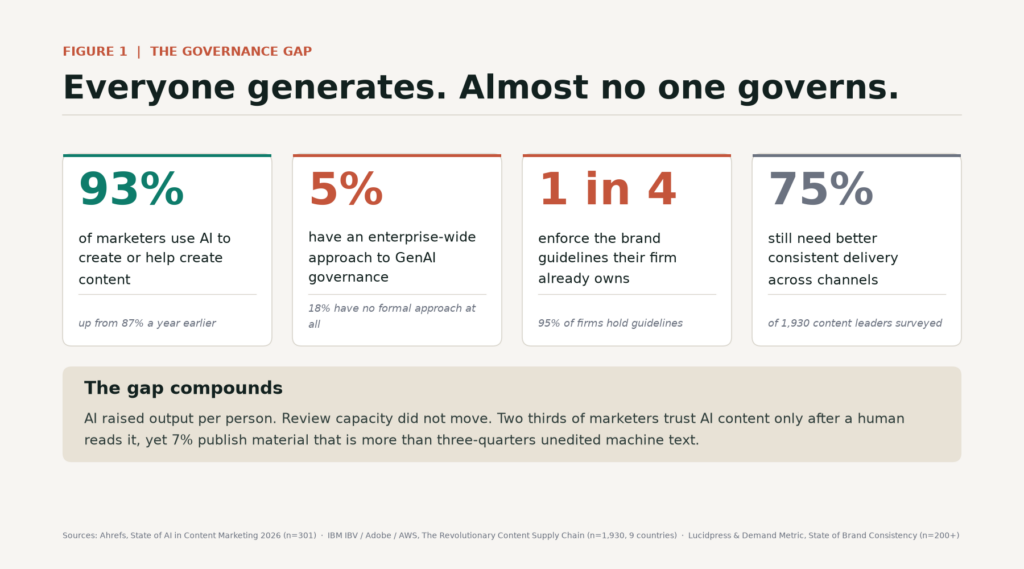
Now hold that next to a different number. In a joint IBM Institute for Business Value, Adobe and AWS study of 1,930 executives and content professionals across nine countries, only 5% said they had an organisation-wide approach to generative AI best practices and governance. Half were still drafting one. Eighteen percent had no formal approach at all, which means employees were simply using whatever they liked.
The gap between those two facts, near-universal production and near-absent governance, is where brand voice goes to die. And it is not only a sanctioned-tool problem. Survey after survey puts shadow AI somewhere between 45% and 66% of employees using tools their employer never approved. People are not being reckless. They are being fast, and the approved route was slower than the personal subscription they already pay for.
So the honest starting point is this: you do not have one content operation. You have a hundred small ones, each with its own prompt habits.
Brand voice is not a style guide. It is a pattern people recognise
Here is where a lot of governance programmes go wrong from day one. They treat voice as a document problem. It is not. A style guide is a description of voice. Voice itself is the accumulated, repeating pattern that lets a reader know who is talking before they check the logo.
It lives in specifics. Which words you use and which you refuse. Sentence length. Whether you use contractions. How much you joke, and about what. Where the tone shifts between a support page and a launch email. What you never say, even when it would convert.
And it is worth money. Research by Lucidpress and Demand Metric, surveying more than 200 organisations, found that brands presenting consistently were associated with an average revenue increase of 23%, self-reported by respondents with consistency problems. The same work found 71% citing market confusion as the biggest harm of inconsistency, and roughly 95% of firms holding guidelines while only about a quarter enforced them consistently.
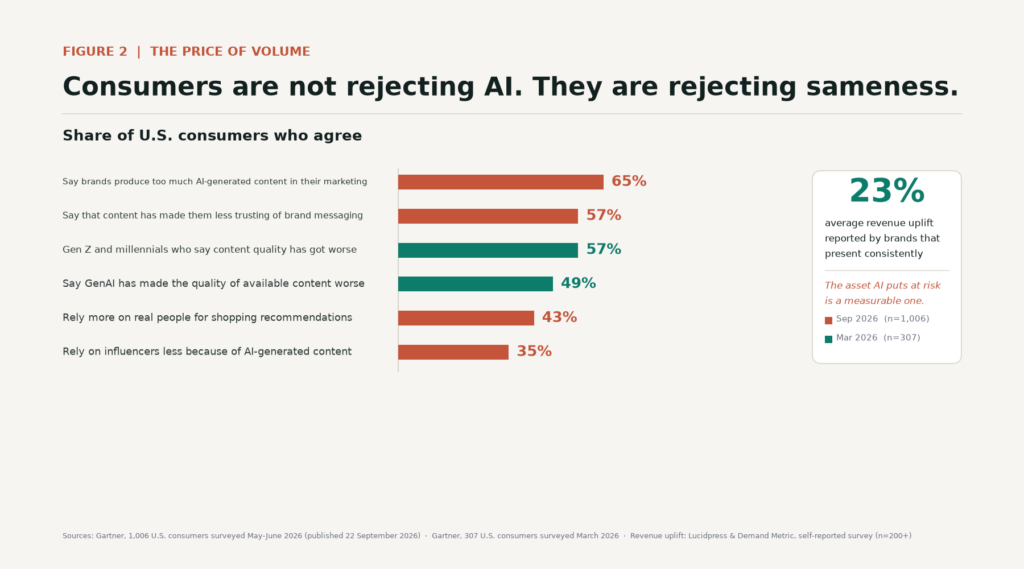
Then add the newer, harder number. A Gartner survey of 1,006 US consumers fielded in May and June 2026 found that 65% believe brands are producing too much AI-generated content, and 57% say that content has made them less trusting of brand messaging overall. Thirty-five percent now rely on influencers less because of it. Forty-three percent lean more on real people.
Read that again, because it reframes the whole argument. Consumers are not rejecting AI. They are rejecting sameness. Which means the thing governance protects is not a stylistic preference. It is the last remaining signal that a human was involved.
Three ways AI quietly dissolves a voice
It helps to name the mechanisms, because they need different defences.
Homogenisation. This one is documented, not speculated. In a controlled experiment published in Science Advances, Oliver Hauser and Anil Doshi found that access to generative AI ideas made individual writers more creative, with stories rated better written and more enjoyable, especially among less creative writers. But the AI-assisted stories were measurably more similar to each other than stories written by humans alone. Individual gain, collective loss. A separate 36-participant study by Doshi and Hauser at CHI 2024 found the same pattern: users produced more detailed ideas but felt less responsible for them.
Drift. Drift is homogenisation with a delay. Each individual output looks fine. But an organisation produces thousands of fine outputs from different prompts, and the average creeps away from the voice without any single decision to change it. This is the mechanism that turns a good week into a bad year.
Erasure. The slowest and most expensive. When machine volume dwarfs the human-crafted work that defined the brand, the crafted work stops setting the reference point. The average becomes the voice, because the average is what everyone reads.
There is a deeper reason to take homogenisation seriously rather than as a metaphor. In Nature, Ilia Shumailov and colleagues demonstrated that training generative models recursively on their own output produces model collapse, a degenerative process in which the tails of the original distribution disappear and the model converges toward a low-variance point estimate. Their conclusion is blunt: the value of genuine human-produced data will keep rising precisely because machine output is flooding the corpus.
Brand voice is a tail. It is the low-probability, high-information part of the distribution. And tails are the first thing collapse eats.
The accountability vacuum, and why AI can never fill it
Ask a simple question in a post-mortem: an off-voice, slightly wrong claim shipped on a landing page. Who is responsible?
The tool vendor will point at the prompt. The prompter will point at the model. The model, asked directly, will produce a fluent paragraph apologising for the inconvenience. Everyone is adjacent to the decision and no one owns it. That is not a technology failure. It is an organisational design failure, and it appeared the moment generation became free and approval stayed manual.
Two distinct ownerships need separating, and most companies blur them.
Voice ownership is a creative and editorial function. It defines what the brand sounds like, adjudicates edge cases, and holds final sign-off on decisions that change the voice.
Accuracy and compliance ownership is a separate function. It owns facts, claims, substantiation and regulatory exposure. A compliance reviewer should not be deciding whether a sentence sounds like the brand, and a brand editor should not be signing off a medical claim.
And above both sits a principle worth writing into the policy document: the model is never the accountable party. Accountability is a human property. If you cannot name the person, you do not have governance. You have a queue.
This is also where regulation is starting to push in the same direction. Under Article 50 of the EU AI Act, applicable from 2 August 2026, deployers of generative systems must disclose AI-generated or manipulated text published to inform the public on matters of public interest, with penalties reaching 15 million euros or 3% of worldwide annual turnover. But the obligation carries an exemption where the text has undergone human review or editorial control by a person holding editorial responsibility. In other words, the law draws a line at exactly the same place good governance does: named human editorial judgement. Companies that never assigned that responsibility now have both a brand problem and a compliance one.
The governance stack: five layers between a prompt and a published sentence
Frameworks get abstract fast, so here is the version that survives contact with a Tuesday.
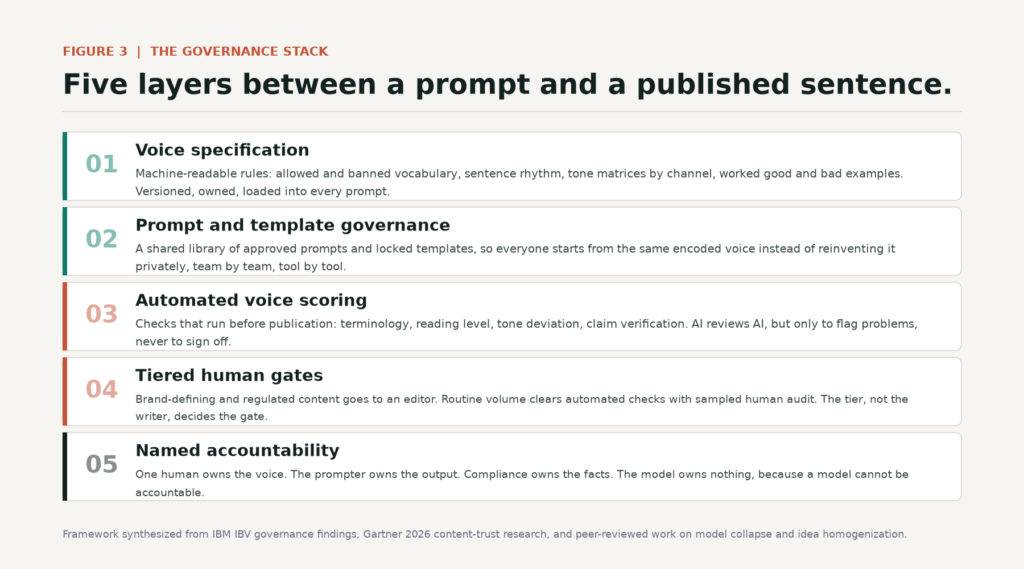
Layer one: a voice specification machines can actually use
Not a PDF of adjectives. A specification with rules. Permitted and prohibited vocabulary. Sentence-length bands. Tone matrices per channel, because a voice that works on a pricing page will be unbearable in a crisis email. Worked examples, and here is the counter-intuitive part: the bad examples are more useful than the good ones. A model trained on what you approve learns the shape. A model shown what you reject learns the boundary.
Layer two: prompt and template governance
If everyone writes their own prompt, you have no voice specification, only a suggestion. Approved prompt libraries and locked templates are how the spec reaches the work without a training session. The test is simple: can a new hire produce on-voice copy on their first afternoon without asking anyone? If not, the layer is missing.
Layer three: automated scoring before publication
Terminology checks, reading level, tone deviation, claim verification. The point is not to replace judgement. It is to stop spending human attention on the mechanical failures so it can be spent on the ones that matter. Ahrefs found 29% of AI users now ask AI to check AI output, double the prior year. That is a healthy trend and a dangerous one at the same time. A model flagging problems is useful. A model granting approval is how quality quietly degrades while the dashboard stays green.
Layer four: tiered human gates
This is the layer that determines whether governance helps or strangles you. Not all content deserves the same scrutiny. Brand-defining work, regulated claims, crisis comms and anything a customer will screenshot get a human editor. Routine volume clears automated checks with sampled human audit. The tier decides the gate, not the seniority of whoever wrote it.
Layer five: named accountability
One human owns the voice. The prompter owns the output. Compliance owns the facts. Write the names down. Put them in the workflow tool. Review them annually.
The review layer is thinner than the publishing layer
Here is the uncomfortable part of the data. Among marketers who use AI, 2.7% trust AI content with no human review at all. Two thirds, 66%, trust it only after a human reads it. That sounds reassuring until you set it beside the 7% who publish output that is more than three-quarters unedited. The stated belief and the actual behaviour do not match, and the gap is where brand damage accumulates.
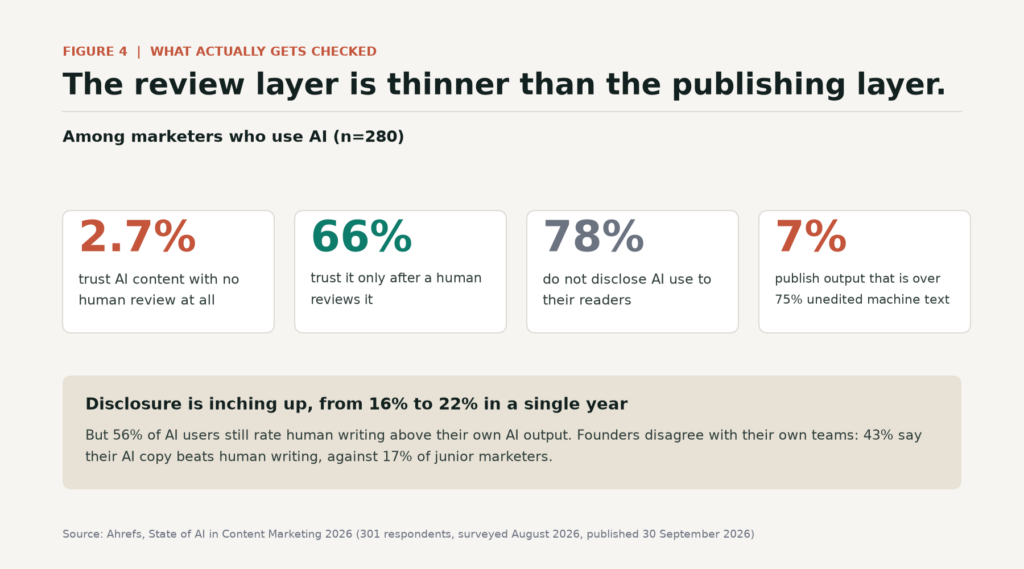
There is a second, quieter finding worth more attention than it got. Fifty-six percent of AI users say human-written content is better than their own AI output, with 23% calling it way better. But 43% of founders and business owners say their AI copy beats human writing, against 17% of junior and mid-level marketers. The people with the least time to review are the most confident in the output. That is not a coincidence. It is exactly the Dunning-Kruger shape you would predict, and it tells you where to put the gate.
While you are looking at the numbers, note that 78% do not disclose AI use to readers, and only 22% do, up from 16%. Disclosure is moving, slowly, and mostly in the direction regulation is already pushing.
The honest caveats, because governance has a cost too
I would not sell you a stack without telling you where it breaks.
Over-governance kills the thing you were buying. If every asset needs three approvals, you have rebuilt the bottleneck AI removed, and your teams will route around it. You will not notice. You will just find, six months later, that the best writers are using a personal account for the work that actually matters.
Rigid specs produce flat content. A spec tight enough to guarantee consistency is tight enough to remove the surprise that makes writing worth reading. Build in deliberate slack: places where a human is expected to break the rule on purpose.
Compliance and voice pull in opposite directions. Legal review flattens personality because flattening is safer. That is rational. Governance has to hold the tension explicitly, rather than letting the safest voice win by default. Decide in advance which content types are allowed to be dull.
Market-level convergence is outside your control. Even with a perfect spec, if every brand runs similar models against similar specifications, the market converges. Your differentiation then depends on the human inputs a model cannot invent: proprietary data, real customers, actual point of view.
And one structural note. Gartner’s 2026 research found 84% of companies stuck in what it calls a brand doom loop, underinvesting in brand measurement, distrusting the numbers, then attracting less funding next cycle, while predicting that by 2028 more than 80% of companies will make significant changes to identity, mission and culture to keep pace with AI. Governance without measurement is just opinion. If you cannot show that voice consistency moves a number, the programme will lose its budget to something that can.
What I would do in the next ninety days
Weeks one to three. Collect fifty pieces of content, twenty-five you consider on-voice and twenty-five that make you wince. That corpus is your actual specification, and it will be more honest than the one in the deck.
Weeks four to six. Turn it into rules. Vocabulary lists, sentence bands, tone per channel, five worked before-and-after examples. Version it. Name the owner.
Weeks seven to nine. Build three approved prompts and three locked templates covering the highest-volume content types. Turn on terminology and tone checks for those types only. Measure false positives; tune before expanding.
Weeks ten to twelve. Define your tiers, then audit a sample of tier-two content by hand. Publish the policy, including the disclosure stance. Record who is accountable for voice, and who is accountable for facts.
The order matters. Specification before tooling, tooling before gates, gates before policy. Most programmes run it backwards, buy a platform, then discover they have nothing to put in it.
The answer to the question in the title
When AI writes, the brand voice is owned by a named human being, equipped with a specification precise enough for a machine to follow, checks fast enough to run before publication, and gates placed by consequence rather than by seniority.
That is the whole answer, and it is deliberately unglamorous. AI did not create the need for editorial judgement. It removed the scarcity that used to enforce it. When writing was slow, quality control was a by-product of effort. When writing is nearly free, quality control has to be designed, staffed, and defended.
Governance is not the brake on AI. It is the reason you can press the accelerator without dissolving the one asset that made anyone care in the first place.