Why More Machine Translation Made Global Campaigns Worse Without Getting Worse
There is a sentence in the vendor deck that tells you how the whole problem happened, and it is not the sentence you would expect. It is the one about how many words the system translates.
A large language services group announced in its 2025 annual report that its technology had translated more than a trillion words in twelve months. Reported without alarm, because at the time it looked like progress. And it is progress, if your model of translation is “move words from one language to another.” It stops looking like progress the moment you ask the question that decides whether a campaign works: who read any of it?
Here is the arithmetic nobody puts on a slide.
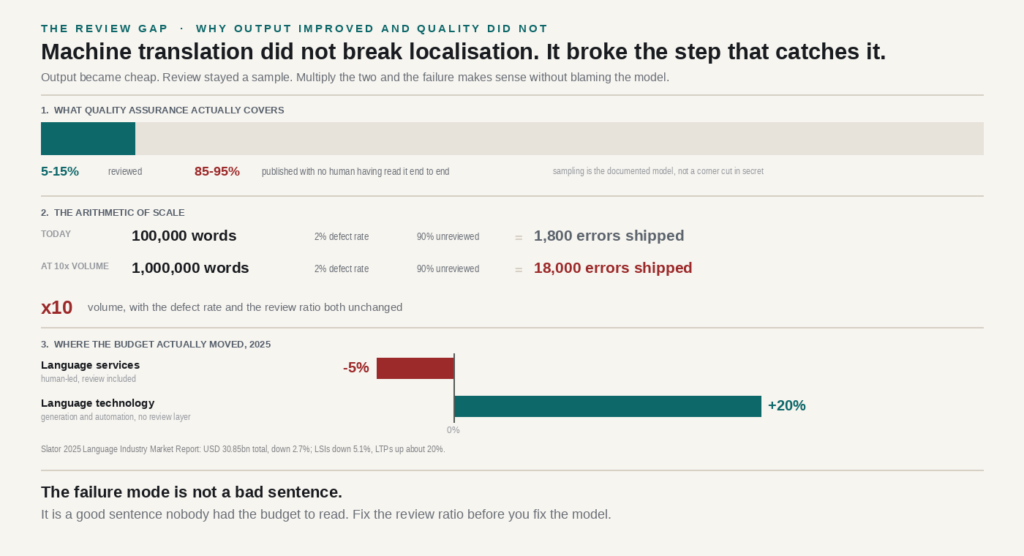
Linguistic quality assurance in this industry is built on sampling. A supplier reviews a representative slice of the translation — commonly somewhere between 5% and 15% of the volume for standard-risk content — scores the errors it finds, and draws conclusions about the whole. This is not a shortcut taken in secret. It is the documented quality assurance model, distinct from the 100% review that quality control implies, and it is defensible when volume is stable and the supplier’s measured accuracy is known.
Now do the sum. Take a defect rate that would be entirely acceptable — say 2% of segments carrying some error of consequence. Take a review ratio at the top of the normal range, 10%. Multiply by a hundred thousand words and 1,800 defective segments ship unreviewed. Nobody made a mistake. The model held. That is the point: the model held.
Then output volume rises tenfold, because generating a first draft in twelve languages just became trivially cheap. The defect rate does not move. The review ratio does not move. And 18,000 defective segments ship instead.
Nothing in that chain required anyone to be careless. It required only that one variable scale and the other stay fixed, and that is exactly what happened. Slator’s 2025 market data shows the split cleanly: language services revenue, where the humans and the review layer live, fell 5.1%, while language technology platforms, where generation and automation live, grew about 20%. The budget moved to the part of the workflow that produces. The part that catches stayed where it was.
Which reframes the entire conversation about AI translation quality. The interesting question is not whether the newest model writes better prose than the one before it. It is whether your review coverage survived the volume increase. For most teams shipping multilingual campaigns in 2025 and 2026, it did not, and nobody decided that. Output grew in one dimension and the safeguard grew in none, because a safeguard is a headcount and output is a token count.
The practical consequence is that your defect profile changed shape, not just size. When volume was low and review was thorough, the failures that reached market were the ones sampling could not catch — rare, structural, expensive. Now the failures reaching market are ordinary quality drift: the same term rendered three ways, a tone that sits slightly wrong in one market, a legal qualifier dropped from a disclaimer nobody checked. Ninety percent of multilingual consumers have noticed at least one localisation fault on a live site. That is not a coincidence of taste. It is what sampling arithmetic looks like from the outside.
Two things follow, and neither is “use better models.”
Measure your own coverage ratio before you measure your model’s BLEU score. It is the number that actually governs what your customers read, and almost no marketing team tracks it — because it lives in the localisation budget, not the campaign budget.
And when you approve a tenfold increase in output, approve the review capacity to match, or explicitly accept the exposure. The second option is legitimate. It just has to be a decision rather than an arithmetic side effect.