When Every Quality Signal Says Yes: Ad Fraud, AI Slop, and the Metrics That Stopped Working
Somewhere in your media plan this quarter, there’s a line item you’ll never see. It doesn’t appear in the DSP, it doesn’t show up in the agency report, and nobody will ever send you an invoice for it. It’s the portion of your budget that gets paid out to something that was never a person.
We’ve spent years getting very good at buying attention at scale and remarkably bad at confirming that the attention existed. That’s the whole story of ad fraud in one sentence, and everything below is the detail.
The number everyone quotes is not the number you think
Start with the headline. Juniper Research put global ad fraud losses at roughly $84 billion in 2023, about 22% of the online ad spend in its dataset, and projected that figure would pass $172 billion by 2028. Those numbers get repeated everywhere, usually without the asterisk.
Here’s the asterisk. That $172 billion is a forecast built from a model, not a measured invoice trail. Juniper’s research was produced in partnership with Fraud Blocker, a commercial fraud-blocking vendor, and the published materials don’t give you enough to reproduce the projection yourself. The direction is almost certainly right. The decimal places are not something you should stake a board presentation on.
So treat the headline as a scale signal, not an accounting entry. The more useful question is a smaller, harder one: of the dollars that actually left your account last quarter, how many bought an impression that a human being could have seen? That number you can measure. And it’s worse than most marketers expect.
What ad fraud actually is, in five shapes
“Ad fraud” gets used as a catch-all, which makes it feel abstract. It isn’t. It’s five fairly specific business models, and they fail in different ways.
Bots and invalid traffic. The biggest category by volume. Software pretending to be a person, loading pages, triggering ad calls, occasionally clicking. The industry splits this into general invalid traffic, which is detectable through routine list-based checks (crawlers, declared bots, prefetch traffic), and sophisticated invalid traffic, which needs behavioral analysis and human review to catch. Both get removed from your billable numbers under the standards. Both still distort everything downstream before they’re removed.
Click fraud. Clicks generated to burn a rival’s budget, or to inflate a publisher’s payout. Crude, old, and still effective on pay-per-click campaigns that never look past the click.
Domain spoofing. A low-value page dresses up as a premium one and gets sold at a premium price. The buyer thinks they bought a financial news site. They bought a template.
Ad stacking and pixel stuffing. Several ads layered into a single slot so only the top one renders, or a whole creative squeezed into a one-pixel frame. The impression registers. Nobody sees anything.
Click farms and incentivized traffic. Real humans, paid to click, with no intent to buy anything. This one is worth pausing on, because it breaks the intuitive assumption that “human traffic” equals “valid traffic.” It doesn’t. Paid-to-click traffic is human and worthless at the same time.
The money doesn’t vanish. It gets absorbed.
When people say ad dollars are “wasted,” the image is money disappearing. That’s not what happens. The money goes somewhere specific, to someone specific, and that’s exactly why it’s so hard to reclaim.
The Association of National Advertisers has been running the most rigorous public accounting of this. Its 2023 study of the open web programmatic chain found that only about 36 cents of every dollar entering a demand-side platform reached a consumer as a viewable impression on quality inventory. It identified roughly $22 billion in annual efficiency opportunity across an $88 billion market, and it found made-for-advertising sites taking 21% of impressions while collecting 15% of spend.
Then the follow-ups got interesting. By Q1 2025 the ANA’s TrueAdSpend index had climbed to 41%. By Q3 2025 it reached 47.1%, with the ANA estimating $13.6 billion in recovered media value and MFA exposure down to 0.39% of spend. And in Q4 2025 the gap between disciplined and undisciplined buyers became the real story: advertisers actively governing quality converted 56.7% of spend into benchmark-qualified impressions, while the laggards sat at 37.5%.
Note on how to read these: the ANA figures come from log-level data submitted by participating advertisers, coordinated with TAG TrustNet and Fiducia. It’s a benchmark panel, not a census. The dollar figures attached to it are modeled optimization value, not cash waiting in an escrow account.
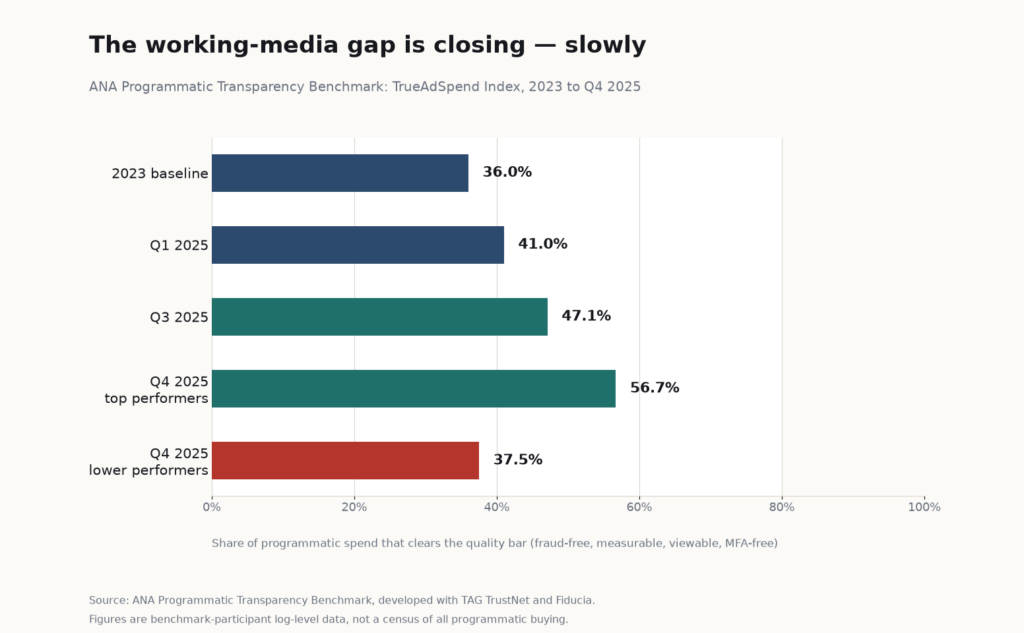
Look at that chart again. The industry average moved about eleven points in two years. That’s genuinely slow. But the top performers didn’t wait for the average to catch up, and the bottom group got worse in relative terms. Which tells you something important: this is not a tide that lifts all boats. It’s a discipline that some teams install and others don’t.
Fraud lives where the inventory is hardest to see
Here’s where the textbook story and the current data start to disagree. The instinct is that fraud is a low-quality-web problem, something that lives in the grubby corners of the open exchange. The measurements say otherwise.
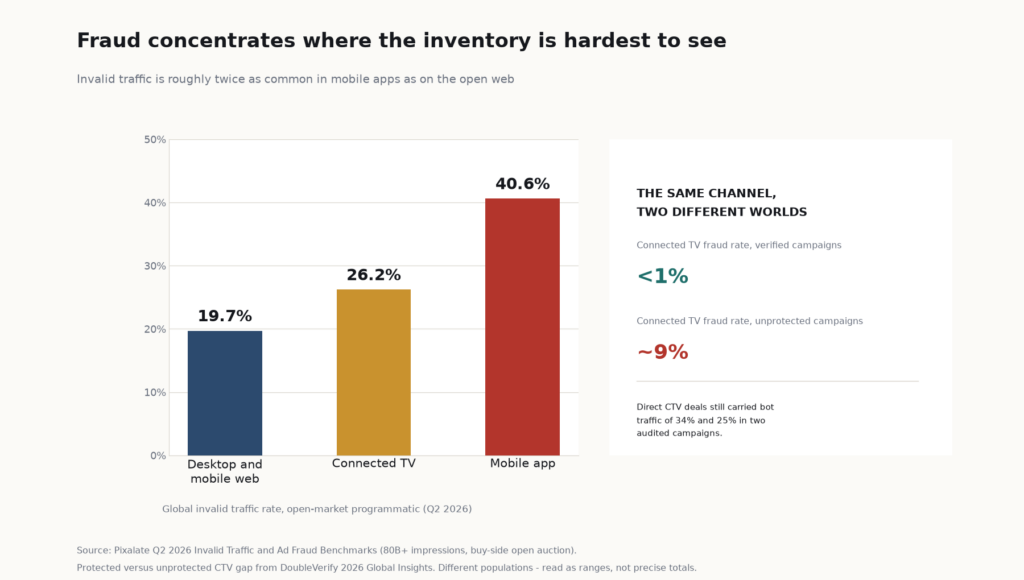
Pixalate’s Q2 2026 benchmarks, drawn from more than 80 billion open-market programmatic impressions, put global invalid traffic at 19.7% for desktop and mobile web, 26.2% for connected TV, and 40.6% for mobile apps. Read that last number again. In mobile app inventory, roughly two in five impressions failed the validity test in that dataset. Mobile app is not the corner of the market people brag about buying.
Then there’s the finding that should genuinely change how you buy CTV. DoubleVerify’s 2026 streaming report found fraud rates below 1% in campaigns running verification controls, against nearly 9% in unprotected ones. And the comfortable assumption that direct deals and private marketplaces are inherently clean? DV found 34% of impressions in one consumer healthcare campaign going to bots, and 25% in a major CPG campaign. Both were direct buys.
“Fraud always finds a way,” as DoubleVerify’s fraud lab VP put it. Direct just means fewer intermediaries between you and the problem. It doesn’t mean fewer problems.
One more data point from that report, and it’s the quiet one that matters most: only 21% of advertisers use invalid traffic or fraud detection as a CTV performance KPI. So the channel that’s growing fastest is the one where almost nobody has a fraud tripwire wired into their reporting.
Why it persists when everyone agrees it’s bad
If fraud is detectable and universally condemned, why is it still here? Because detection isn’t the binding constraint. Incentives are.
The incentives point the wrong way. In a per-impression supply chain, an intermediary gets paid more when more impressions flow. Filtering fraud reduces the number they report and the revenue they book. You’re asking a party to voluntarily shrink its own top line. Some do. Not all do, and the ones who don’t have a structural advantage over the ones who do.
Opacity is a business model, not an accident. The ISBA study published by PwC in the UK is the clearest evidence we have. In 2020, 15% of advertiser spend simply could not be attributed to anyone in the chain, and PwC could only match 12% of impressions end to end. Twelve percent. When the follow-up data was collected in 2022, the unknown delta had fallen to about 3% and match rates rose to 58%, with publisher revenue moving from 57% to 65% on a restated baseline. That’s real progress, produced by a task force that forced shared data standards. It also took two years and a lot of arm-twisting, and it only covered participating premium players.
Your metrics are paying for the fraud. This is the part that stings. If you optimize for impressions, clicks, and traffic, you have created a purchase order for anything that can generate impressions, clicks, and traffic at a low price. Fraud is a supplier that meets your spec exactly. You didn’t ask for it, but you did specify it.
The arms race never ends. AI-powered crawlers drove an 86% jump in general invalid traffic in the second half of 2024, and 16% of that known-bot volume traced to AI scrapers like GPTBot, ClaudeBot and AppleBot. On the criminal side, the numbers are wilder: CTV fraud schemes detected in Q1 2026 were up 140% year over year, and DoubleVerify identified ten times more fraudulent CTV apps in 2025 than in 2024. The detection gets better. So does the fraud. Anyone promising you a permanent solution is selling something.
The real cost is the corrupted feedback loop
Wasted spend is the visible injury. The invisible one does more damage over time.
Fraudulent traffic doesn’t just take money. It contaminates the data your systems learn from. Your bidding algorithm sees cheap clicks converting poorly and adjusts. Your audience model absorbs fake devices. Your attribution report credits channels that were partly imaginary. You then make budget decisions on that output, shifting money toward whatever looks efficient, which may just be whatever is best at generating synthetic signals.
So the fraud compounds. You lose the dollar once, and then you lose again every time a decision is shaped by a metric the fraud inflated. That’s why the fix isn’t “buy a fraud tool.” A tool cleans the pipe. It doesn’t rebuild the measurement.
The playbook, in six moves
Verify independently. Platform self-reporting is not verification. Use measurement that is audited to industry standards, and check the audit scope rather than the marketing claim. The Media Rating Council accredits specific products for specific environments, and those distinctions matter.
Audit the supply path. Pull the log-level data. Count your resellers. The ANA found the median advertiser working with 19 supply partners and reaching 53,799 domains and apps, with 90.3% of impressions concentrated in the top 3,000. If your long tail is that long, you cannot possibly be governing it.
Refuse what you can’t verify. Inclusion lists, direct paths, curated private marketplaces. The Q4 2025 ANA data showed private marketplaces accounting for over 92% of median spend. That’s the market voting with its feet.
Move from vanity metrics to outcomes. The single highest-leverage change, and the one most teams resist because it makes the dashboard look worse before it looks better. Cost per acquisition and revenue per thousand are harder to inflate than impressions. Audit your own KPI set: is there a metric in there that a bot can satisfy? Then it will be satisfied by a bot.
Monitor continuously. Fraud is not a quarterly audit item. Set anomaly alerts on traffic spikes, impossible click-through rates, and traffic that converts at a fraction of baseline. The pattern is usually visible within days.
Contract for clawbacks. Put detection thresholds, make-goods and refund terms into the paperwork. Note also that certification schemes are wobbling: in 2026 both Google and The Trade Desk let their TAG seals lapse, arguing that MRC accreditation now covers the same ground. Which means you should verify specific claims about specific integrations rather than trusting a logo.
The uncomfortable new front: content that passes the test
Now the part that should genuinely unsettle you.
AI-generated content built to harvest ad revenue — “AI slop” — is not a big share of spend yet. TAG, working with the ANA and Fiducia, sized it at 1.3% to 2.4% of open web programmatic spend in Q1 2026, against an MFA level of 1.1%. Small.
But look at how it scores on your quality checks. Invalid traffic rate of 0.05%, versus 0.32% for clean supply. Viewability of 77.2%, versus 74.9%. Graded premium more than 70% of the time. It commanded a higher TrueCPM than legitimate inventory: $7.08 against $6.15.
Every signal you use to judge quality said yes. The content has no demonstrable human authorship, and 88% of it also classified as MFA. This is the fraud problem arriving in a new costume: not fake humans this time, but real screens, real impressions, and content that exists only to arbitrage the auction.
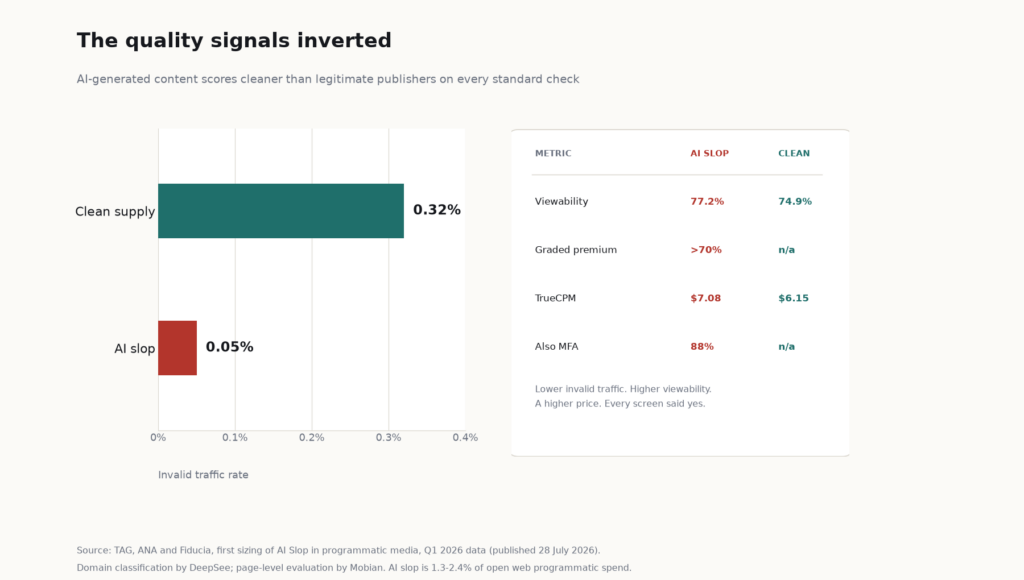
The uncomfortable conclusion: viewability and invalid traffic rate are no longer sufficient proxies for whether inventory deserves your money. They were good proxies for a decade. They aren’t anymore, and the market is still pricing as if they are.
Standards are tightening while enforcement is fraying
Two things are happening at once, and they pull in opposite directions.
The rulebook got sharper. In October 2025 the MRC ruled that domain-level, keyword-based verification could no longer be marketed as “brand safety” without measuring the actual images, video and audio in the content, with a transition period running to roughly April 2026. That’s a real tightening, and it forces a useful conversation: does your vendor see the page, or just the URL?
At the same time, participation is thinning. TAG’s own financial analysis estimated that industry anti-fraud efforts saved US advertisers about $10.8 billion in 2023, with invalid traffic staying below 1% in fully certified channels. But the caveat is load-bearing: a certified channel requires three or more certified parties along the path, and certification covers a legal entity, not a product. The seal tells you a company passed a process review. It doesn’t tell you this particular integration is clean.
The honest summary is that the standards are better than they’ve ever been, adoption is uneven, and the burden of proof keeps landing on the buyer.
What to actually do this quarter
You don’t need a transformation program. You need four things, in this order.
Pull the log-level data and find out what share of your spend clears a quality bar you defined yourself. Then take your three worst-performing long-tail domains and look at what they actually are. Then change one KPI to an outcome measure and watch what happens to the traffic mix. Then write fraud terms into your next insertion order.
That’s a quarter of work. Most teams can do it. The reason it doesn’t happen is that it’s nobody’s full-time job, and the waste doesn’t announce itself.
The takeaway
Ad fraud isn’t a technology problem that a better tool will solve. It’s a governance problem. The money leaks because the incentives reward leaking it, the supply chain is built to obscure where things came from, and the metrics we optimize against are the exact metrics fraud is best at producing.
None of that is unfixable. But it only gets fixed by buyers who insist on seeing the data, prune the path, pay for outcomes instead of volume, and keep checking. The brands that stop paying the invisible tax usually discover something mildly insulting: they had a bigger budget the whole time.