Why Marketing Salaries Went Flat While Specialists Got Expensive
Here is a number that should not exist. In 2026, average pay growth for US marketing and creative roles is projected at 1.5%. Two years ago it was 4.7%. Last year, 3.4%.
Read that against everything you have heard about a talent shortage. Workers with AI skills command a 56% wage premium, more than double the prior year. Seventy-eight percent of marketing and creative leaders say they will pay above the band for specialised expertise. And yet the average is barely above inflation.
Both facts are true, and the space between them explains the freelance marketing economy better than any survey of team structures. The average did not fall because talent got cheap. It fell because the market split in two — and an average of two diverging groups is a number that describes neither of them.
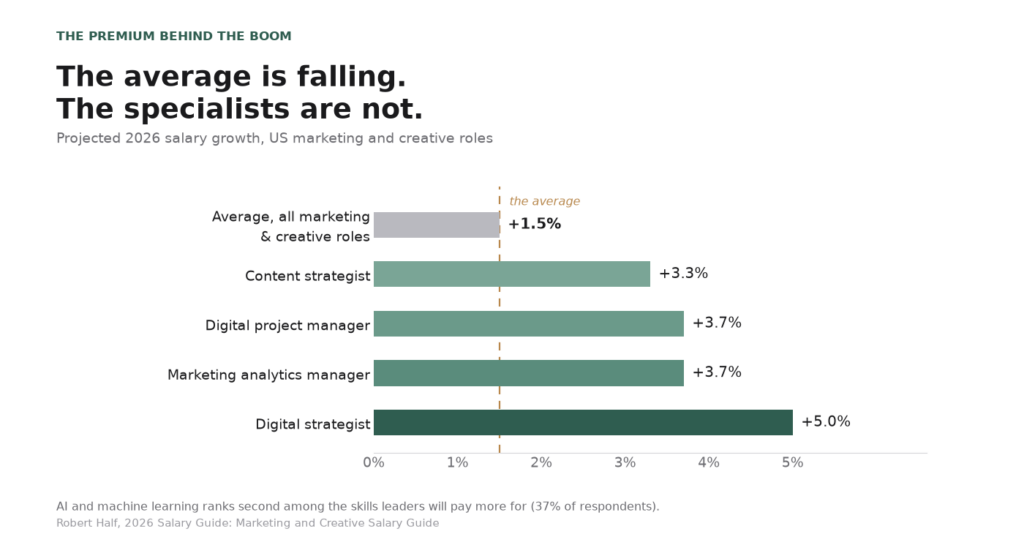
Inside that 1.5%, the distribution is doing something else entirely. Digital strategists are projected near +5.0%. Marketing analytics managers and digital project managers near +3.7%. Content strategists near +3.3%. The roles where work is more routine are not merely flat — they are negative in real terms once inflation is subtracted.
So a CMO faces a specific arithmetic problem. The budget is locked at roughly 7.7–7.8% of company revenue. The specialist she needs now costs 4% more than last year, and can be fully utilised for perhaps a fifth of it. Employing that person means paying a rising premium for unused capacity. Renting them means paying a higher rate for exactly the hours required.
The rational answer is the second one, and that is the entire mechanism. Freelancing is not spreading because companies prefer flexibility, or because workers crave autonomy, though both are true. It is spreading because a widening pay distribution inside a fixed budget makes ownership irrational. When the premium for specialisation grows faster than the budget that would have to absorb it, employment stops being the efficient way to access expertise.
The supply side confirms the same logic from the opposite direction. Americans earning more than $100,000 as full-time independents went from 3.0 million in 2020 to 5.6 million in 2025. Senior people did not leave employment because they could not find jobs. They left because the premium for seniority now flows to whoever sells it by the unit rather than by the year.
This also reframes the contested statistics. Assemble’s 30-to-70% contractor share and The CMO Survey’s 77.9% full-time hiring intent are not in conflict. They describe a team that held its employee count roughly steady and added a layer it could never have afforded to employ — because that layer costs more per hour and less per year.
The uncomfortable conclusion: the freelance marketing economy is not a cheaper model. It is a model that trades rate for utilisation. Per hour, the specialist is more expensive than the employee they replace. The saving appears only when utilisation is genuinely low, which is why the model struggles with steady, continuous work and works beautifully for needs that arrive in bursts.
The boom is real. The discount usually is not.