Insight — The Denominator Problem: Why Nobody Can Agree What a Community Member Is Worth
Position note: this runs as a standalone Insight piece under the “community-led growth” cluster, or slots directly after Section 3 (the flywheel) in the main feature — the argument there claims community amplifies every funnel stage; this explains why that claim keeps failing the budget review.
Ask three people on the same community team what a member is worth and you’ll get three answers so far apart they sound like different companies.
Ask the person who reports to the CMO and you’ll hear about engagement. Ask the person who owns the renewal list and you’ll hear about a specific dozen accounts. Ask whoever built the community and they’ll tell you about a hundred people answering questions at two in the morning, holding the whole thing up.
All three are correct. That’s the problem.
The numerator was never in dispute
Here’s what I’ve come to believe after watching these programmes get cut in budget reviews: the fight was never about how much value the community generates. It’s about what you divide that value by.
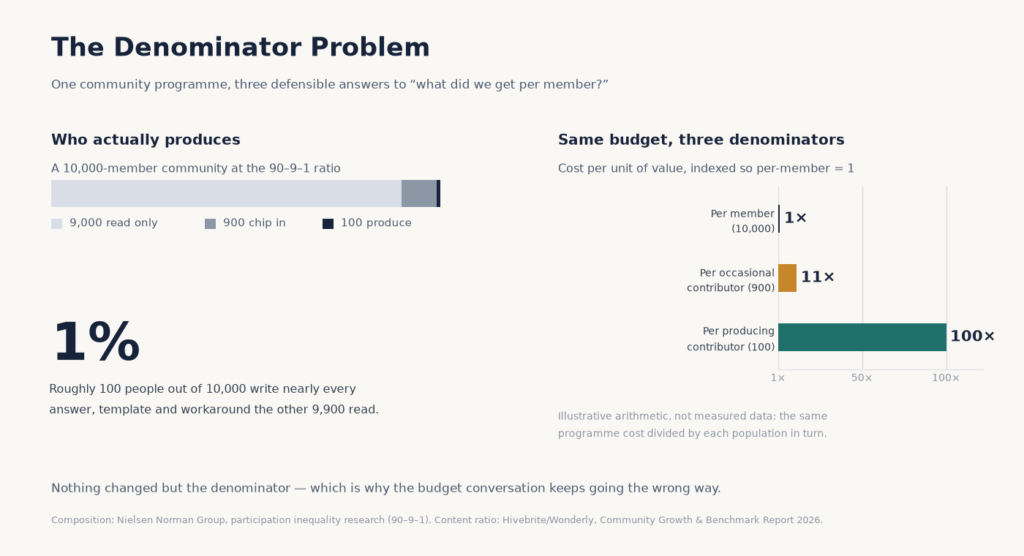
Pick your population. A 10,000-member community with 100 real producers looks like a rounding error per member — a few dollars of attributed pipeline, a fraction of a percent of retention lift. Divide the same programme cost by those 100 producers and you’re looking at a figure that makes community the cheapest acquisition channel in the building.
Same money. Same outcomes. Same month. Only the bottom of the fraction moved, and it moved the answer by two orders of magnitude.
Why the wrong denominator keeps winning
Because the wrong one is free.
Seat count arrives from your platform without anyone asking. Active members is a filter in a dashboard. The count of producing contributors is something you have to go find — by hand, by name, by reading threads. The CFO asks on Thursday; the defensible answer needs three weeks nobody scoped.
So the team reaches for member count. It’s honest. It’s just not the population that does anything.
Then something worse happens. Once you commit to a per-member denominator, every internal decision inherits that logic. You optimise for sign-ups because sign-ups are the number. You run campaigns to fatten the top of the funnel you’re dividing by. You celebrate a 40% membership increase that adds people who will never post, answer, or refer — and your cost per unit of real value climbs while the chart goes right.
I watched a team hit its membership target in six months and then lose its two most active moderators to burnout inside the same quarter. The dashboard was green. The programme was dying.
What the producers actually charge you
There’s a second inversion underneath, and it’s the one I find most useful.
The people who produce do it for free, but not for nothing. They’re paid in status, access, and belonging — and the bill arrives in ways that never touch a budget line. They want early access before the roadmap locks. They want a reason when a decision gets reversed. They want their name on the thing they wrote. Mostly they want the community manager to answer at 11pm once, so they believe someone is home.
That’s the true cost of the 1%: not software, but attention and candour, delivered consistently by a human with authority to say yes to a small request without filing a ticket.
Programmes that fund the tooling and skip the attention end up with 10,000 members, 900 occasional chippers, and a rotating cast of 100 producers who quit every eighteen months. The per-member number stays comfortably small. Nothing else does.
The one change that ends the argument
Stop reporting per member. Report per producing contributor, alongside member count — not instead of it.
Two numbers, side by side, plus one sentence saying they measure different things: reach and depth. The first tells you whether the room is filling. The second tells you whether it’s alive. Nobody who sees both can pretend they’re the same metric, and nobody can quietly swap one for the other in a budget deck.
That’s the whole insight. Community wasn’t undervalued. It was divided by the wrong number, by people who had no time to find the right one.