The Economics Behind China’s Fragmentation Dividend
Every few months, someone on a Western marketing team proposes waiting. Wait for the platform landscape to settle. Wait for the regulation to clarify. Wait until there is a playbook worth copying. It sounds like prudence. In China it functions as a subscription fee — paid quarterly, so that someone else can collect the dividend.
Strip away the mystique and the mechanism is fairly plain. Fragmentation does not simply mean many platforms. It means many new surfaces, each arriving with attention that has not been priced yet. A creator nobody has signed. A format nobody has budgeted for. A tab inside an app that suddenly holds forty minutes of somebody’s evening. For a short window, the cost of reaching people there sits far below where it will land once everyone notices.
Then the repricing happens, and it happens quickly. QuestMobile’s autumn 2026 report gives a clear view of the receipts: in September, short drama and short video together accounted for 111.5% of all net growth in time spent online. The figure exceeds 100% because everything else shrank. Short drama alone added 13.3 billion monthly hours year on year, while online video lost 1.4 billion and search lost close to a billion. That is not growth. It is a transfer, completed inside twelve months, away from the surfaces most brands had already written into their plans.
Speed is what turns that transfer into margin. Reallocate in days and you buy the underpriced attention. Reallocate at the next planning cycle and you buy the repriced version — if any of it is still available.
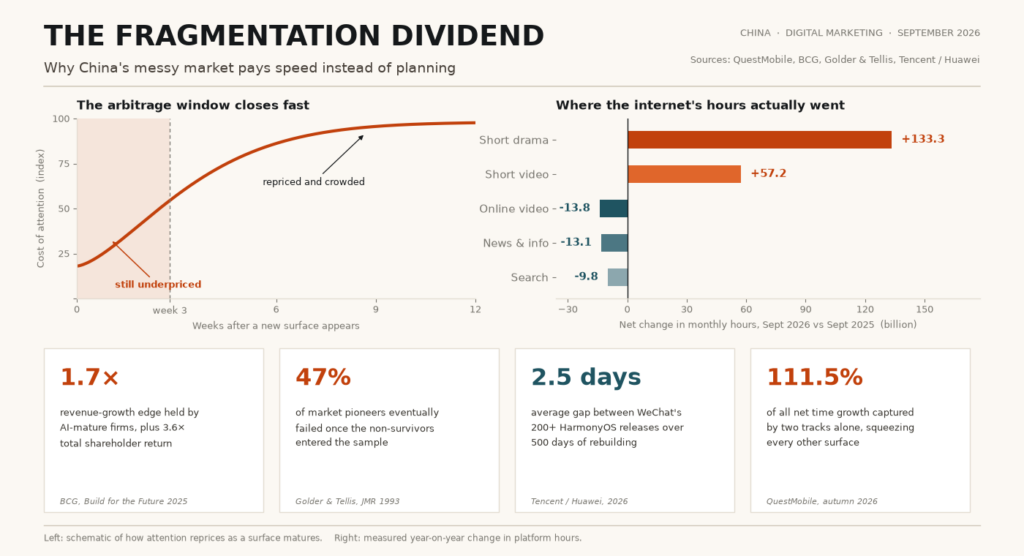
The uncomfortable part is that speed and first-mover advantage are not the same thing, and the research has been saying so for three decades. Golder and Tellis, working through roughly 500 brands across 50 categories, found that almost half of market pioneers eventually failed once the failures were counted instead of quietly dropped. The early leaders who did endure typically entered about 13 years after the pioneer. Being early is not the edge. Being fast repeatedly is — the difference between a single bet and a cadence.
Which is why the disciplined version of this looks deeply unglamorous. Small budgets. Two-week tests. Killing on Tuesday what launched on Monday. The platforms model it themselves: WeChat’s HarmonyOS rebuild shipped more than 200 versions across 500 days, roughly one every two and a half days, with an 800-person team behind it. Nobody calls that reckless. It is simply what staying in the market costs.
The price of the other approach is measurable. BCG’s 2025 study of AI maturity found its top 5% of firms pulling 1.7 times the revenue growth and 3.6 times the shareholder return of the laggards — compounding gaps, not one-off wins. Waiting does not hold you in place. It moves you onto the slower curve.
China’s mess is chronic, not transitional. Regulation keeps arriving on its own schedule — an anthropomorphic AI services rule in July 2026, a revised governance framework in September — and each arrival reprices something. You will never be handed the settled landscape. What you can build is a shorter loop than your competitor’s. That loop, not the plan, is the asset.