The Cost Mirage: Why Cheap AI Ads Cost More Than They Save
The pitch was simple enough to put on a slide: AI makes ads cheaper. Two years in, the invoices tell a different story.
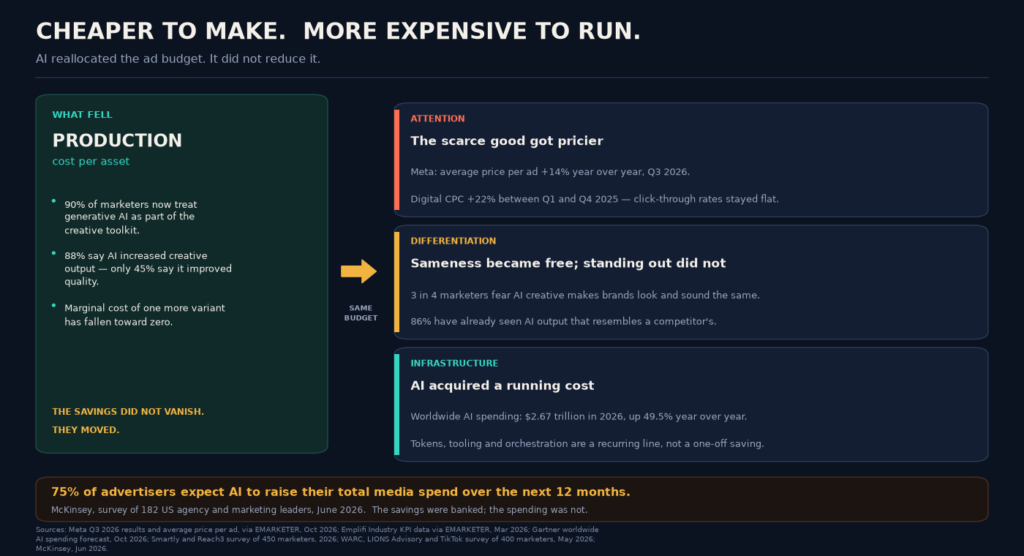
Meta’s average price per ad rose 14% year over year in the third quarter of 2026 — in a period when the company guided to as much as $145 billion in capital spending, much of it for the AI that was supposed to make those ads more efficient. Across major digital channels, cost per click climbed 22% between the first and fourth quarters of 2025 while click-through rates sat flat. Cheaper to make, more expensive to run, both true in the same quarter.
That is not a contradiction. It is a receipt.
Production really did collapse
Give the promise its due. Nine in ten marketers now treat generative AI as part of the creative toolkit, and 88% say it raised their creative output. The marginal cost of one more variant — another headline, another cutdown, another market’s version — has fallen toward zero. Cost efficiency is the benefit ad executives cite most often. So the line item called “make the ad” genuinely got smaller.
And cheap supply made attention the scarce good
Here is the step the spreadsheet skipped. When the supply of ads rises and the supply of attention does not, the price of attention rises. Emplifi’s cross-platform benchmark data shows the mechanism cleanly: automation intensifies auction competition, and clearing prices climb without any matching gain in user response. The production savings were not deleted. They were transferred into the auction, where nobody was looking.
Then comes the tax on looking like everyone else
Three in four marketers now worry that AI-generated creative makes brands look and sound the same, and 86% say they have already seen output that resembles a competitor’s. When sameness costs nothing, distinctiveness becomes a premium input: more testing, more human craft, more media weight behind the work that actually breaks through.
And AI arrived with its own meter
Gartner expects worldwide AI spending to reach $2.67 trillion in 2026, up 49.5% from $1.79 trillion a year earlier. Tokens, tooling and orchestration — the stack that makes generation possible — are a recurring charge, and the “AI is free” story never itemized them.
Why the mirage survives
Because the savings and the new costs sit in different columns. Production falls under studio or agency fees. Attention arrives as CPM. Differentiation hides inside testing budgets. Infrastructure lands in the martech or IT line. No single owner sees the whole trade, so the CFO reads “cheaper creative” and concludes the budget should shrink — while McKinsey’s survey of 182 agency and marketing leaders finds nearly three-quarters expect AI to increase total media spend over the next twelve months.
Budget the whole picture
Stop measuring cost per asset and start measuring cost per outcome. Reinvest the production savings into the thing that just became expensive — distinctiveness — instead of banking them as profit. Price the infrastructure honestly. And when someone asks whether AI made advertising cheaper, answer the question underneath it: cheaper for whom, and on which line?
The money did not disappear. It changed address, and nobody forwarded the mail.