INSIGHT — The Inspectability Rule: Why the Dupe Takes Makeup but Not Sunscreen
The most useful thing about the 2026 dupe data is not that 58 percent of US shoppers bought one. It is where the dupes failed to land.
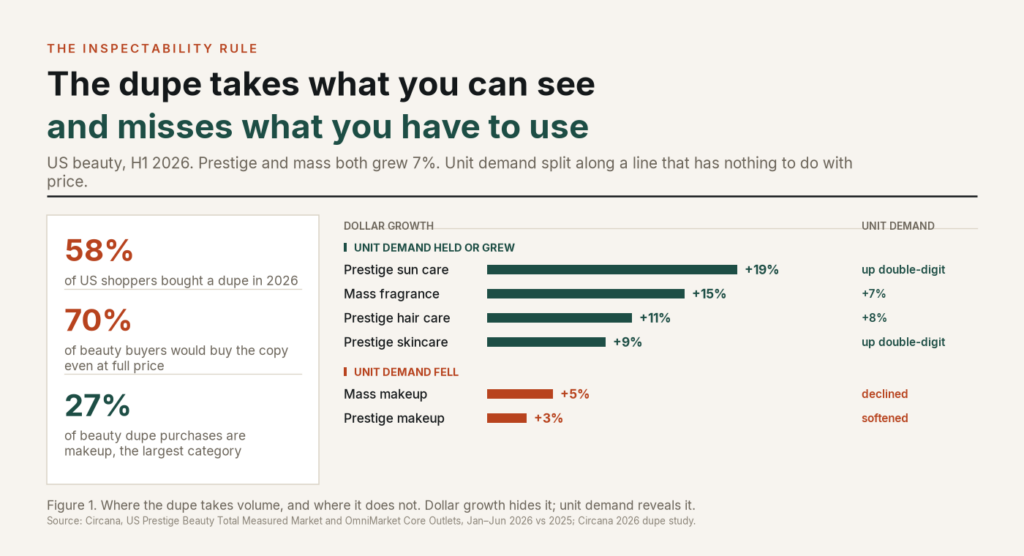
Look past the dollar growth. Circana’s first-half 2026 US beauty numbers show prestige and mass both up 7 percent — 17.1 billion dollars and 39.2 billion dollars respectively — which reads like a stable market. The unit demand underneath tells a different story, and it splits along a line that has nothing to do with price.
Sun care: prestige sales up 19 percent, with unit demand up double digits. Mass fragrance: up 15 percent on dollars, 7 percent on units. Prestige hair care: 11 percent on dollars, 8 percent on units. Prestige skincare: 9 percent, units climbing double digits.
Makeup: prestige up 3 percent with units softening. Mass up 5 percent with units declining.
Makeup is the most dupe-saturated category in beauty — 27 percent of beauty dupe purchases are makeup, the single largest slice. It is also, right now, the only major category where units are going backwards in both channels. Those two facts are not a coincidence, and explaining the link is the whole point of this piece.
The rule: you can inspect looks, you cannot inspect feels
A dupe can copy anything a shopper can evaluate before paying. A lip liner’s shade match is visible in a photo. A bronzer’s pigment load is demonstrable in a fifteen-second clip. Packaging, finish, even the click of a compact — all inspectable, all copyable, all postable. This is why makeup became dupe culture’s native habitat: it is the beauty category with the shortest distance between a claim and its proof.
Sun care runs the other way. Whether an SPF actually delivers its rating depends on formulation, stability and application — none of which a shopper can verify in a store, and none of which survives a screenshot. You are not buying a look. You are buying a reassurance you cannot audit, which is exactly the condition under which a brand’s accumulated credibility becomes the product.
The same logic explains hair serums, up nearly 60 percent in prestige in the same period. Nobody can tell from a photo whether a serum will work on their hair in four weeks. The purchase requires trust, and trust is the one input a dupe supply chain cannot warehouse.
Why dollar growth concealed it
Here is the part worth internalising. If you had tracked only revenue, makeup would have looked healthy — plus 3 and plus 5 percent, still growing. The dupe’s signature was invisible in the metric most decks lead with, because it was being masked by price.
Prestige fragrance is the clean illustration: dollar sales up 6 percent while units stayed flat and average prices rose 5 percent. All the growth came from trading up, not from more people buying. Strip out price and the underlying demand is stationary.
Which means margin and volume can diverge for two years before anyone in the room notices. Dollar growth is a lagging, price-contaminated signal. Unit demand is what tells you whether the customer still chose you or merely paid more.
What this changes about positioning
The conventional read is that commoditization attacks across the board. The inspectability rule says it attacks selectively — and predicts in advance where.
Ask one question about every claim you make: can a stranger verify it before paying, from a photo or a short video? If yes, that claim is dupe-eligible and will be priced to its marginal cost within a product cycle. If no, that claim is where a premium can survive.
That reframes what positioning work actually is. Not finding a better adjective for the same attribute, but deliberately migrating the brand’s promise toward the claims that resist inspection — the ones that only resolve after use. Efficacy over appearance. Outcome over finish. Evidence over aesthetic.
The uncomfortable corollary: categories that live entirely in the inspectable zone have no positioning problem to solve. They have a business model problem. Makeup is not losing to dupes because its brands marketed badly. It is losing because it is the one beauty category where the copy can be verified as equal — and a shopper who can verify equality will not pay 691 yuan for a difference she cannot see.
That is the why. The dupe did not beat brands. It audited them, category by category, and where the audit came back clean, the price collapsed.