Connected Social Commerce: The West’s Slow Catch-Up to China
TikTok Shop will sell well over $100 billion of goods this year. That sounds like the West has arrived. It hasn’t — and the data shows exactly where the gap still lives.
Something strange happens when you put China’s social commerce numbers next to America’s. You don’t get a gap. You get a category error.
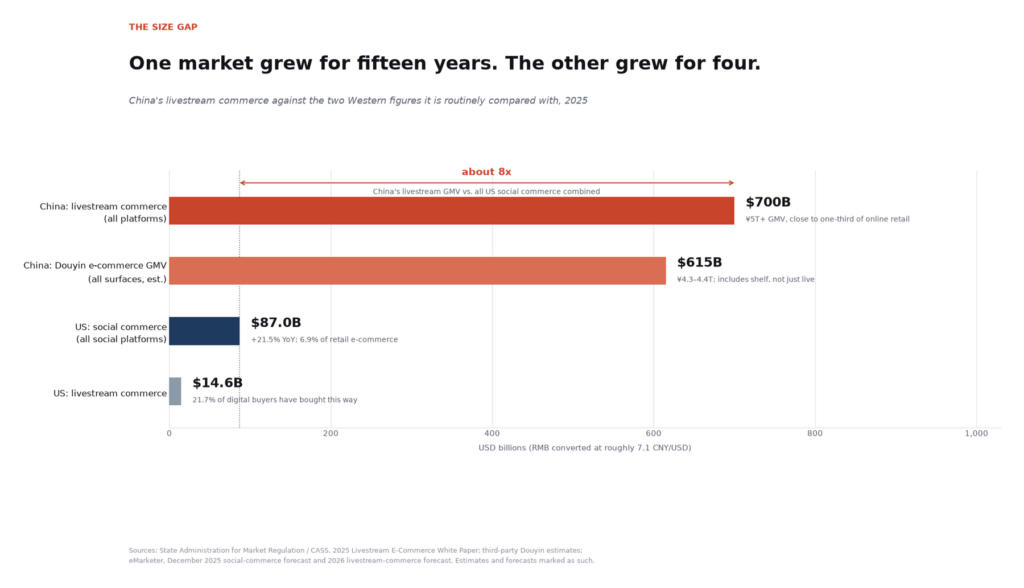
China’s livestream commerce generated more than ¥5 trillion in gross merchandise value in 2025 — close to one-third of the country’s online retail, according to the State Administration for Market Regulation’s research arm and the Chinese Academy of Social Sciences. All of US social commerce, across every platform, every format, every creator, came to $87 billion.
Convert the yuan at market rates and you’re comparing roughly $700 billion to $87 billion. Eight to one. And that’s the flattering version of the comparison, because the American figure includes secondhand sofas sold through a marketplace tab while the Chinese figure covers a single format.
So the lazy conclusion writes itself: the West is years behind, TikTok Shop is a pale copy of Douyin, and nothing else needs saying.
Except the interesting story isn’t the size gap. It’s what the size gap is made of — and how that composition is changing in ways that mostly get reported wrong.
The China benchmark is more fragile than the legend
Here’s the standard telling. Douyin fuses short video, livestream, in-app payment, and logistics into one continuous motion: you see, you want, you buy, it arrives tomorrow. WeChat turns conversation into a storefront through mini-programs. Xiaohongshu seeds desire so efficiently that 种草 — literally “planting grass,” the act of making someone want something — became a marketing verb in a language that already had plenty of words for persuasion.
That’s accurate as far as it goes. What it leaves out is that the legend rests on an integration China paid for over fifteen years, in a closed loop most Western markets can’t replicate even if they wanted to.
Two payment apps reached near-universal penetration and made QR codes the default way to settle a transaction. Worldpay’s 2026 Global Payments Report puts digital wallets at 89% of China’s e-commerce transaction value and 87% of point-of-sale value. Cards used outside a wallet account for roughly 7%. Read that again: the card rail didn’t lose market share. It was functionally bypassed.
Then logistics. Same-day and next-day delivery across hundreds of cities, priced low enough that it disappears inside the impulse. Then creator economics, where a Douyin creator earns a commission on the sale rather than a slice of ad revenue — which aligns the content with the transaction instead of with the view count.
Now the part the legend usually skips. Reporting on the 2025 livestream white paper shows merchant-run streams (店播) account for over half of platform livestream GMV, while the share driven by top-tier influencers fell to 10.66%. The commanding voice in Chinese live commerce is no longer the celebrity host. It’s the brand’s own studio, running shifts like a store.
And now the genuinely uncomfortable number
If China’s social commerce is seamless, why does Xiaohongshu — the most sophisticated demand-generation engine on earth — close less than 2% of what it seeds?
Its 2025 e-commerce GMV reached roughly ¥850 billion against 350 million monthly users. Impressive until you place it beside Douyin’s ¥4.3 trillion or Tmall’s ¥9.5 trillion. More telling is the in-app order conversion rate: 0.7% to 1.2%, the lowest among major Chinese platforms.
Users get inspired, screenshot the post, open Taobao, and buy there. Sound familiar? That’s the exact behaviour Western analysts describe as the “Western consumer lag” — research on social, purchase elsewhere. It turns out the behaviour isn’t Western. It’s human, and China routed around it with payment friction so low that switching apps felt like more effort than staying.
Xiaohongshu’s response is instructive. In 2025 it stopped insisting on the closed loop and opened direct purchase links to Tmall, JD, and Meituan. It chose advertising margin over transaction ownership, because the transaction was never really its to own. Even in the most integrated commerce market in the world, the discovery layer and the checkout layer are often different companies.
What the West actually built
Now the other side of the ledger, which is less empty than the discourse suggests.
TikTok Shop is the only Western platform that has genuinely rebuilt the Douyin loop: discovery, in-stream purchase, livestream selling, affiliate creator commissions, and now its own logistics network. It crossed $15.8 billion in US sales in 2025, up 108% on a base that had already grown 407%. eMarketer’s later 2026 update put the US figure at $23.4 billion.
YouTube Shopping has quietly become the most underrated piece of the puzzle. More than 1.3 million creators are enrolled in the affiliate program, GMV grew 13-fold over two years, and shopping tags generate more than double the clicks of links buried in descriptions. Amazon joined as a partner in August 2026 and AliExpress in October; the program is slated to reach 35 markets by year-end, up from 15 in early August. Bloomberg reported the Amazon deal as Alphabet’s “next strategic swing,” which is a fair description of how seriously Google is now treating commerce inside video.
Instagram went the other direction — and that’s the story almost nobody tells correctly. Meta didn’t lose a race; it walked away from one. Native checkout inside the app is gone. Live shopping ended in March 2023. Since September 2025, Facebook and Instagram Shops complete purchases on the merchant’s own website. Meta looked at the unit economics of processing payments, absorbing chargebacks, and handling returns for millions of small merchants, and decided it would rather sell the attention than own the transaction.
That’s not a failure of ambition. It’s a different bet: discovery is defensible, payments are a low-margin operations business, and competition regulators on two continents were watching.
The bellwether is outrunning its own forecasts
Which brings us to the number that should reframe the whole conversation.
In the first half of 2026, TikTok Shop moved $50.3 billion of goods globally, up 92% year on year, according to Momentum Works and Tabcut. The United States alone accounted for $11.8 billion — up 103%, overtaking Indonesia to become the platform’s largest single market for the first time. The firms forecast $123.5 billion for the full year.
Look at the shape of that curve. $4.4 billion in 2022. $16.3 billion in 2023. $33.2 billion in 2024. $64.3 billion in 2025. Then roughly double again.
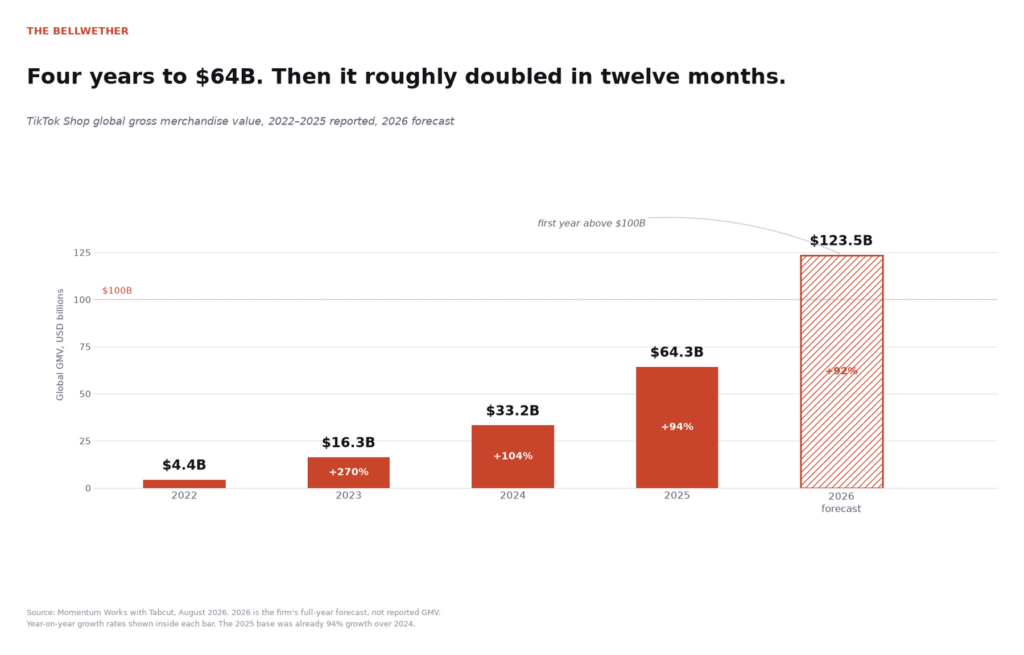
A platform that was a novelty three years ago is on pace to join the $100 billion GMV club in its fifth year of operation. Amazon took considerably longer to get there.
But look at how Americans are buying
Here is the finding that quietly demolishes the standard narrative. It comes from Momentum Works’ breakdown of TikTok Shop’s US GMV by surface in the first half of 2026.
Livestream: 8.2%.
Short video: 40.4%.
Storefront — plain, unglamorous, shelf-based e-commerce: 51.4%.
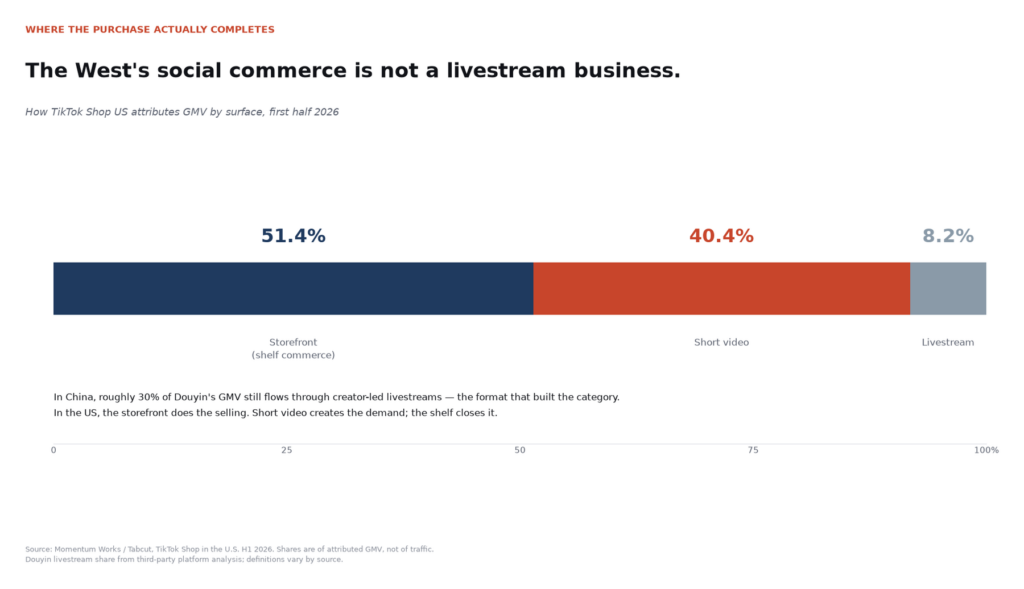
The most successful Western attempt at replicating Douyin is, in the United States, mostly a shop with an extremely effective content funnel bolted to the front. Livestream isn’t the engine. It’s a feature.
And that tracks with everything else we know. eMarketer measured US livestream commerce at $14.6 billion in 2025 and expects roughly $19.8 billion in 2026 — growing fast, still small. Only 21.7% of US digital buyers had bought anything via livestream. Forty-three percent of American adults say they’ve never tried it and don’t want to.
Meanwhile TikTok itself said its US livestream sales more than doubled in the first half of 2026. Both things are true. A category can grow at 100% and remain a minority behaviour. That’s exactly what’s happening — and it means the headline growth rate is telling you far less than the base it’s growing from.
The five locks that keep the gap open
So why isn’t the mechanical gap closing faster, if the tools now exist on both sides? Five reasons, and only one of them is about technology.
Payment rails. China skipped a generation of card infrastructure and went straight to wallet-native commerce. The US and Europe didn’t skip it; they perfected it, then layered wallets, buy-now-pay-later, and platform checkouts on top. Every added rail is another handoff, another authentication, another place to abandon. You can’t retrofit a QR-code monoculture onto a market that already has twelve ways to pay.
Logistics depth. Fulfilled by TikTok handles storage, pick, pack, and ship, and its seller documentation promises three-day delivery on more than 80% of eligible US orders, with 98% shipping within one calendar day. Genuinely impressive for a network built in about twenty months. It’s also roughly 15 US fulfillment centres against Amazon’s 150 to 200 large fulfillment centres inside a 600-site US network. Impulse commerce dies in the gap between “buy now” and “arrives Thursday.”
There’s a detail here that surprises people: TikTok tried to make its logistics mandatory, announcing that seller-fulfilled shipping would end on 25 February 2026 and be fully phased out by 31 March. It reversed the policy on 17 February after seller backlash, leaving all four fulfilment options in place. The ambition is real; the enforcement isn’t there yet. That’s a fair summary of the entire Western catch-up.
Creator economics. On Douyin, a creator’s income scales with units sold. On YouTube and Instagram, historically, it scaled with views and brand deals. YouTube Shopping is closing that gap faster than anyone expected — 1.3 million creators, 13× GMV in two years — but affiliate commission as a primary creator income stream is still a newer idea in the West than in China, where it’s been the default for years.
Behaviour — the real lock. ESW’s Signals 2026 study interviewed 23,000 shoppers across 18 markets in the first quarter of the year. In the US: 45% discover products on social media, rising to 76% among Gen Z. Only 37% prefer to buy on a brand or retailer site. Just 27% trust social-commerce checkout. And 7% prefer to buy mainly on social platforms.
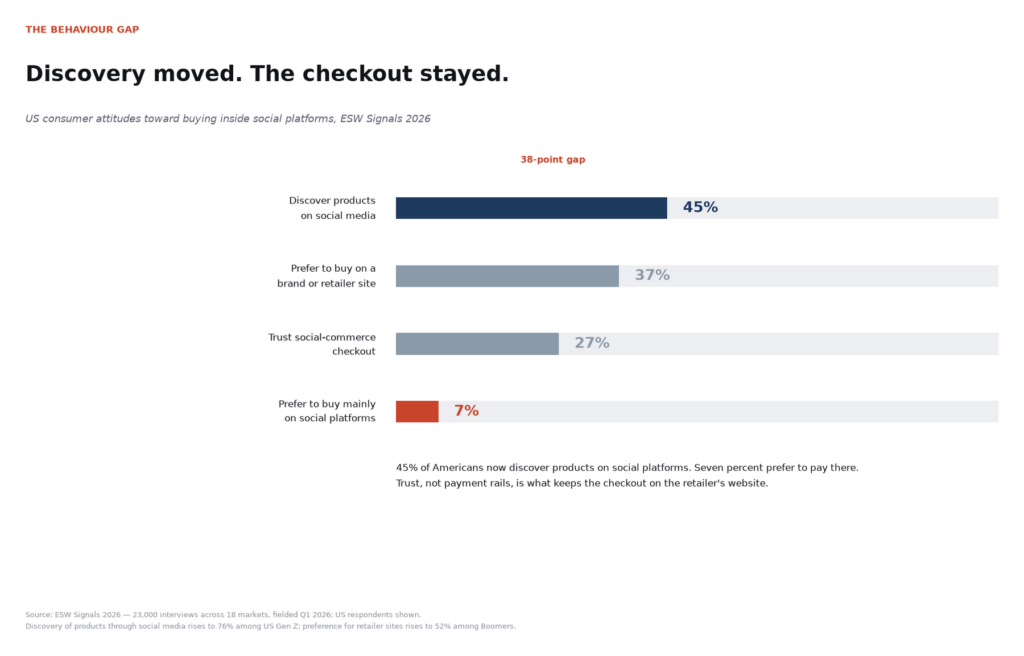
Seven percent. Discovery has migrated. The checkout hasn’t. That’s not an infrastructure problem you can solve with a better API — it’s a trust and habit problem that gets solved one unremarkable transaction at a time.
The cost stack. Western social commerce carries fees Chinese platforms largely don’t, and the headline number hides them. A US TikTok Shop seller pays a 6% referral fee on most categories — since April 2024 — and that fee already bundles payment processing, which is more generous than it sounds. But on top of it sits a creator commission the seller sets itself, typically 10% to 20% and sometimes higher in competitive categories, plus weight-tiered fulfilment, plus a return reserve that matters enormously at a 19.3% online return rate.
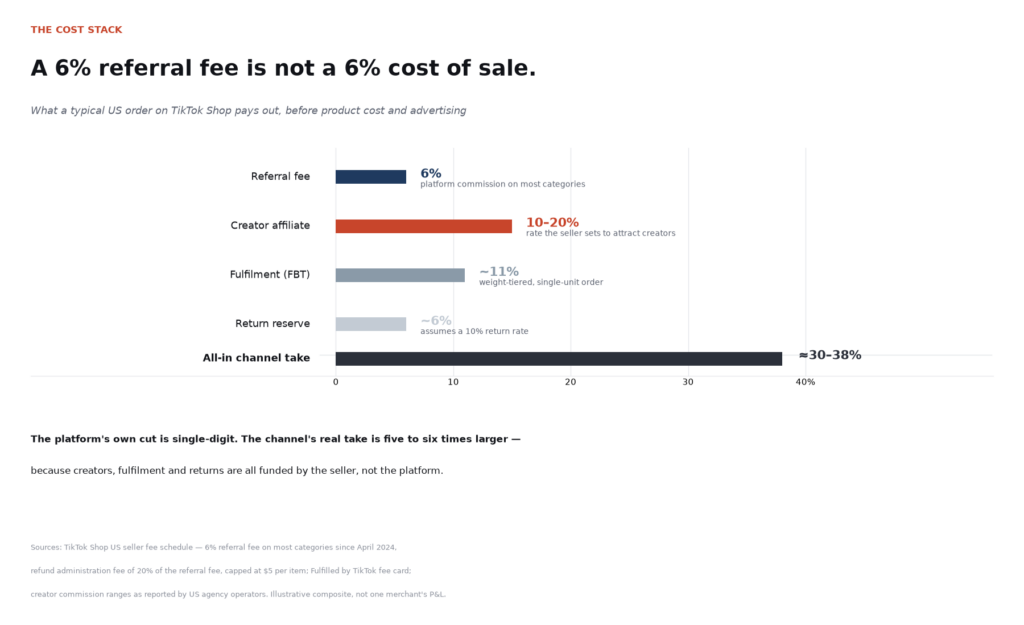
Stack those and the all-in take rate lands near where Amazon’s has always been. The difference isn’t the total — it’s the split between the platform and the people doing the selling. On TikTok Shop, more of that money goes to creators, which is either the model’s genius or its fragility, depending on your margin.
Give the West its due
It would be dishonest to frame this as pure catch-up. In several respects the West is building something China didn’t have to.
Its returns infrastructure is genuinely superior. NRF data puts US retail returns at $849.9 billion in 2025 — 15.8% of sales, and 19.3% for online. Brutal economics, but also a consumer-protection machine: free returns, chargebacks, statutory cooling-off periods. Chinese social commerce grew up without that safety net, which is part of why its conversion rates are higher and its early trust problems were worse.
Privacy norms cut the other way. The data-driven targeting that makes Chinese social commerce so efficient runs into consent requirements, app-tracking restrictions, and GDPR in the West. This slows the buildout and, arguably, makes the resulting commerce more durable.
And Western brand-safety and measurement standards are more developed. Premium brands will integrate with a TikTok Shop that can prove incrementality faster than they integrated with a Douyin that couldn’t.
A short detour on numbers you should distrust
You will read that US livestream commerce is either a $20 billion market or a $68 billion market in 2026. Both figures are real, published, and attributable. The $67.8 billion comes from a Coresight Research and Bambuser forecast issued back in 2023; the ~$20 billion comes from eMarketer’s more recent, narrower definition. They differ by more than threefold on the same year.
That’s not a scandal. It’s what happens when an analyst defines “livestream commerce” to include or exclude live-auction resale, or counts GMV instead of net revenue. If you’re building a budget on these numbers, know which definition you’re buying. The directional story — fast growth from a small base — is robust. The absolute level is not.
The same caution applies to China’s side of the ledger. Douyin’s ¥4.3–4.4 trillion GMV figure is a third-party estimate, not an audited platform disclosure, and payment-basis GMV differs materially from post-refund settlement value. Treat it as the right order of magnitude, not a precise measurement.
The ownership question nobody in marketing is asking
One more structural detail worth understanding, because it shapes everything that follows.
In January 2026, TikTok’s US operations were restructured into a US-controlled joint venture. Oracle, Silver Lake, and MGX each hold 15%; ByteDance retained 19.9%; the board is majority American; the algorithm is licensed rather than owned.
Which means US e-commerce decisions on the platform that is defining Western social commerce are no longer made by a single company in Beijing. They run through a structure with American investors, American data governance, and American political exposure.
Then, in November 2026, TikTok launched a standalone TikTok Shop app in Singapore, Malaysia, Thailand, and the Philippines — a dedicated shopping surface, spun out of the entertainment app entirely.
Put those two facts together and the trajectory is clear: TikTok Shop is being rebuilt as a retail platform first and a content feature second. That is Douyin’s endpoint, reached from the opposite direction.
Convergence on mechanics, divergence on culture
My read: the mechanical gap closes within three years. The behavioural gap does not.
Payment friction will keep falling — embedded checkout, one-tap wallets, agentic purchasing. Logistics will deepen; the FBT network will grow because TikTok has no choice if it wants to compete on delivery promise. Creator commissions will keep expanding; YouTube’s 35-market affiliate rollout is the template.
But Western social commerce will not become Douyin. It will be more trust-dependent, more returns-tolerant, more brand-safe, and — this is the one people get wrong — more shelf-led. The West’s livestream experiment is growing at roughly 35% a year while remaining a minority behaviour, and the format winning the volume is short video plus storefront. That’s not a lesser version of China’s model. It’s a different model with the same inputs.
The tell is already visible in the channel mix. 51.4% storefront, 40.4% short video, 8.2% livestream. Nobody predicted that ratio. The market produced it.
What brands should do about it now
Three moves, in order of urgency.
Build the shelf, not the studio. Most brands responding to the social-commerce wave over-invest in livestream capability and under-invest in the product feed, catalog hygiene, and review content that actually closes sales inside a social storefront. Your TikTok Shop storefront is a store. Stock it, price it, merchandise it.
Separate the discovery budget from the conversion budget. These are different problems with different vendors, different metrics, and different time horizons. Discovery is a content and creator problem. Conversion is a feed, pricing, and logistics problem. Blending them into one line item hides which half is broken.
Stop treating returns as the enemy. In a market where 19.3% of online purchases come back, generous returns are the mechanism that makes impulse buying rational. The brands winning Western social commerce are the ones whose return experience doesn’t feel like a punishment. That’s not a cost centre. It’s the trust rail the entire category rides on.
The short version
China built the playbook over fifteen years, on rails the West doesn’t have and can’t retrofit: wallet-native payment, dense low-cost logistics, commission-driven creators, and a purchasing habit formed young.
The West copied the mechanics and is now discovering the mechanics weren’t the hard part. TikTok Shop will pass $100 billion in global GMV this year and still derive 8.2% of US sales from livestream. Instagram handed checkout back to merchants. YouTube built the quietest commerce network in the industry. And 7% of American consumers actually want to pay inside a social app.
That’s not a failure to copy China. That’s a market finding its own shape. The brands that build shelf-level, trust-level, and returns-level capability now will own the model when it finishes forming — which is sooner than the headlines suggest, and stranger.