8.1% From Screens That Targeted No One
The store has spent a decade collecting signals it cannot act on in time. Edge AI is what happens when the decision moves to where the shopper already is.
1. The Five-Second Shelf
A shopper pushes a cart down an aisle. The screen above the shelf lights up as she approaches, holds her for five to fifteen seconds — that is the exposure window the cooperating retailer reported to the researchers behind the largest field experiment on in-store screens to date — and then she is gone, already thinking about the dairy case.
Five to fifteen seconds. That is the entire opportunity, and it is shorter than most personalization stacks take to decide.
If the content on that screen depends on a round trip to a regional data centre — signal out, inference in the cloud, content back — you have spent somewhere between a tenth and a third of a second before a single pixel changes. Add queueing at peak hour, add a model that has to be routed to a bigger instance because the small one cannot rank the offer, and the response lands after she has moved on. The screen did not fail. It answered a question nobody was still asking.
The argument of this piece in one line: personalization at the shelf is not a modelling problem, it is a timing problem, and the cloud sits on the wrong side of the timing.
Edge AI — inference running on the device, the kiosk, the camera, the shelf controller itself — is the architectural answer. Not because it is fashionable, and not because it is cheaper in every case, but because it removes the part of the system that is not allowed to be slow.
A word on what follows. There is a great deal of confident vendor arithmetic circulating in this category, including several figures that sound authoritative and turn out, on inspection, to have no primary source. I went looking for them. Some existed. Several did not. What survived is here, with the sample sizes and the interests attached.
2. The Latency Budget Nobody Wrote Down
The most useful numbers in interaction design are also the oldest. Jakob Nielsen set them in 1993 and nothing has displaced them: one hundred milliseconds feels instantaneous; one second keeps a person’s flow of thought intact but is felt as a delay; ten seconds is about as long as attention holds.
Those thresholds were written about screens people touch. They matter more at a shelf, because a shelf screen is not being operated — it is being walked past. The shopper is not waiting for it. She is in motion, and the question is whether the content changes in a way that feels like part of the environment rather than a machine deciding to respond.
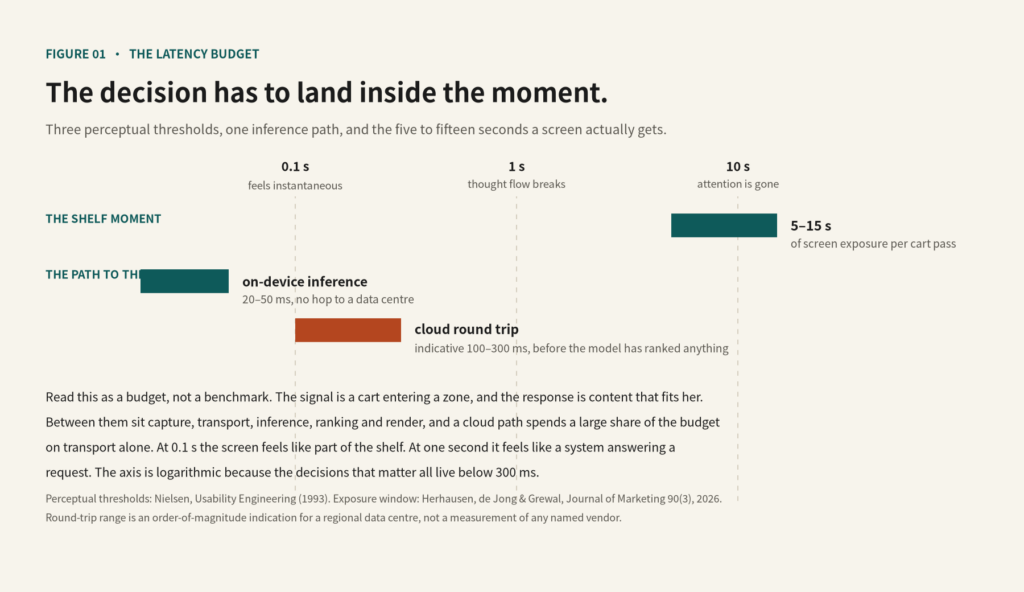
The practical translation: your latency budget is the gap between the signal — a cart enters the zone — and the response — content that fits her. Everything inside that gap is a cost: feature extraction, transport, inference, ranking, rendering, and the return trip. A cloud-only path spends a meaningful share of the budget on transport alone, before any model has thought about anything.
What the hundred-millisecond rule actually means
It does not mean every screen must refresh in a hundred milliseconds. It means that the moment a shopper can perceive as belonging to her — the glance, the pause, the hand reaching — has to be met at that speed or it belongs to the previous shopper.
Which is why the same technology behaves so differently across formats. A push notification has seconds to spare. An app homepage has hundreds of milliseconds. A screen beside a shelf has almost none, because it is competing with the shelf itself, and the shelf always wins the next second of attention.
Real-time is not a property of the model. It is a property of the whole path. And the path is where the money hides.
3. The Store Became a Media Channel Before It Became a Computer
Here is why this matters commercially rather than architecturally.
The physical store is no longer only a place where inventory waits. In the UK, retail media grew 18% to £3.8bn in 2025, within a digital ad market that grew 10% to £40.5bn, according to the IAB’s Digital Adspend study with Oliver Wyman. Retail media was the second-fastest growing segment after video, and the IAB’s own reading of the year was that in-store capability is becoming the advantage pure-digital retailers cannot copy.
That changes the question. You are not deciding whether to experiment with screens. Screens already exist, in fleets of thousands, with a P&L line attached. You are deciding what the marginal screen decision is worth, and whether your architecture can afford to make it at the moment it counts.
Retail media grew because it offered two things the open web had run out of: first-party purchase data and closed-loop measurement. Put plainly, the store finally has a feedback loop. What most estates do not have is a decision loop fast enough to use it.
4. What Edge AI Actually Changes: Three Taxes
Strip away the marketing and edge computing is a re-placement of three costs. Each is a real invoice, and each is paid by someone.
Tax one: the round trip
Cloud architecture charges you in milliseconds, and milliseconds are the one currency a shelf cannot borrow. IDC’s analysis of why AI agents need an edge inference strategy is blunt: relying solely on cloud infrastructure introduces latency that is unacceptable for anything interacting with the physical world, and shipping raw streams such as high-definition video to the cloud can be prohibitively expensive or bandwidth-constrained.
The survey evidence points the same way. In IDC research published in 2025, 77.9% of companies named faster on-site processing as a key driver of edge deployment, and 64.7% cited the ability to make quicker operational decisions locally. Read those two together and it stops looking like a technology in search of a use case. It looks like operators telling you where their decisions currently stall.
Tax two: the pipe
This one is arithmetic, and you can check it yourself. A single 1080p camera at thirty frames per second generates roughly 670 gigabytes per hour in raw form. Compress it sensibly and you are still moving two to three gigabytes per hour, per camera. Multiply by a store’s camera count, then by the store count, then by twelve hours of trading.
That is the invoice you pay in order to have a model in another building look at a shelf. The alternative is not exotic. It is a small model on a box in the back office that answers the question locally and ships a few kilobytes of outcome upstream. Once the answer is a score rather than a video, the pipe stops being the constraint.
Tax three: the data you did not want to hold
Raw footage of identifiable shoppers is not a neutral asset. It is a liability with a compliance schedule attached: retention limits, lawful basis, transfer assessments, and increasingly specific rules about what you may do with biometric data once you hold it.
Which is where edge architecture earns its keep, because the cheapest way to secure data is to never move it. If the frame is scored on the device and discarded, the transfer never happens, the copy never exists, and the breach surface shrinks from one bucket holding a continent’s worth of shoppers to one box in one store.
That is not a moral argument. It is a risk-transfer argument, and it is the one that survives contact with a legal team.
5. The Evidence Is Real — and Narrower Than the Decks Say
Now the part most vendor decks skip: what has actually been measured.
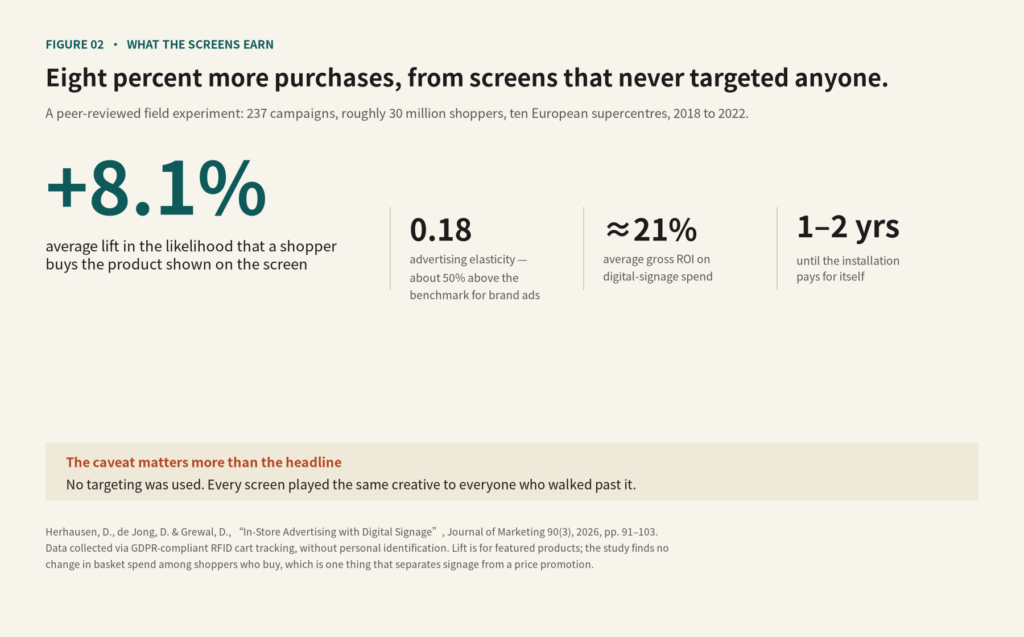
The strongest evidence on in-store screens is not a case study. It is a peer-reviewed field experiment in the Journal of Marketing — Dennis Herhausen, David de Jong and Dhruv Grewal, published 2026 — covering 237 advertising campaigns, roughly 30 million shopper journeys, ten European supercentres, and data from 2018 to 2022. Exposure was randomised, outcomes were read at the basket, at checkout.
The headline: exposure to in-store digital signage raised the likelihood of buying the featured product by 8.1%. Advertising elasticity came out at 0.18, roughly 50% above the benchmark for brand advertising. Average gross ROI on signage spend was about 21%, and the installation paid for itself in one to two years. The authors estimate roughly 88% of the additional revenue is attributable to the signage exposure itself rather than to extra basket spend.
The 8.1% that came with no targeting at all
Here is the detail that should change how you read every other number in this category. During the study period, the signage system used no targeting whatsoever. Every screen played the same creative to everyone who walked past it. The authors say so plainly, and they treat it as a limitation — the causal estimate is clean precisely because nothing was personalised.
Two conclusions follow, and they pull in opposite directions.
The encouraging one: untargeted screens, in a randomised field test, moved purchase likelihood by eight percent and paid back inside two years. That is a floor rather than a ceiling, and it is already bankable.
The sobering one: nobody has published an equally clean causal estimate for targeted shelf personalization. The incremental lift everyone is promising from edge-driven, moment-level targeting is a hypothesis with excellent priors — not a result. If someone sells you 8.1% as the forecast for your edge roadmap, they are quoting a study that deliberately switched targeting off.
6. The Cautionary Tale: Just Walk Out
If you want to know how edge retail fails, the most instructive case is not a startup. It is Amazon.
Just Walk Out was the demo everyone pointed at: cameras and shelf sensors, computer vision in the store, no queue, no scan. In April 2024, The Information reported that more than a thousand people, largely in India, were reviewing transactions, and that in 2022 roughly 700 of every 1,000 sales required human review against an internal target of about 50. Customers waited hours for receipts. That same month Amazon pulled Just Walk Out from its Fresh grocery stores and replaced it with smart carts that scan as you shop.
Amazon disputes the framing. Its position is that the team mostly trained models and validated only a small minority of visits, after the fact, and that shoppers were never watched live. Take the dispute seriously — the reporting rests on a single source and the company pushed back hard.
But notice what is not in dispute: people were in the loop, at scale, and the economics did not hold at the accuracy the system actually delivered. That is the pattern to internalise. The demo is the model. The system is the exception queue. Edge AI’s real cost is not the chip and it is not the camera. It is the humans standing behind the model for the cases the model gets wrong — and how many of those cases there are at three in the afternoon on a Saturday.
Most edge retail budgets never contain a line for that. Then the pilot ends and nobody can explain why.
7. Where Edge Wins First
Not every shelf decision deserves an on-premise brain. The useful filter has two dimensions: how tight is the latency tolerance, and how much personal data does the decision touch? Rank the use cases and the order becomes obvious.
Shelf-adjacent screens come first. Latency tolerance is brutal, personal data can stay close to zero if you avoid facial recognition, and the evidence base is the strongest in the category.
Queue and flow analytics come second. Seconds matter, the output is aggregate, and exposure is low because you are counting people rather than identifying them.
Frictionless checkout comes third. Throughput is the product, but this is where exception handling eats the margin, and the Just Walk Out lesson applies directly.
Loss prevention comes fourth, and it is the trap. Latency needs are real, but the data is the most sensitive in the store, so legal exposure is highest and the temptation to run face-based models is strongest. If you deploy here, deploy carefully, on the box, with a written answer to what happens when the model is wrong about a customer.
On-device app personalization is the quiet fifth. Your customer’s phone is an edge device with a neural engine and a privacy story you did not have to build. Anything you can decide on the handset rather than in a data centre is a decision you get nearly free.
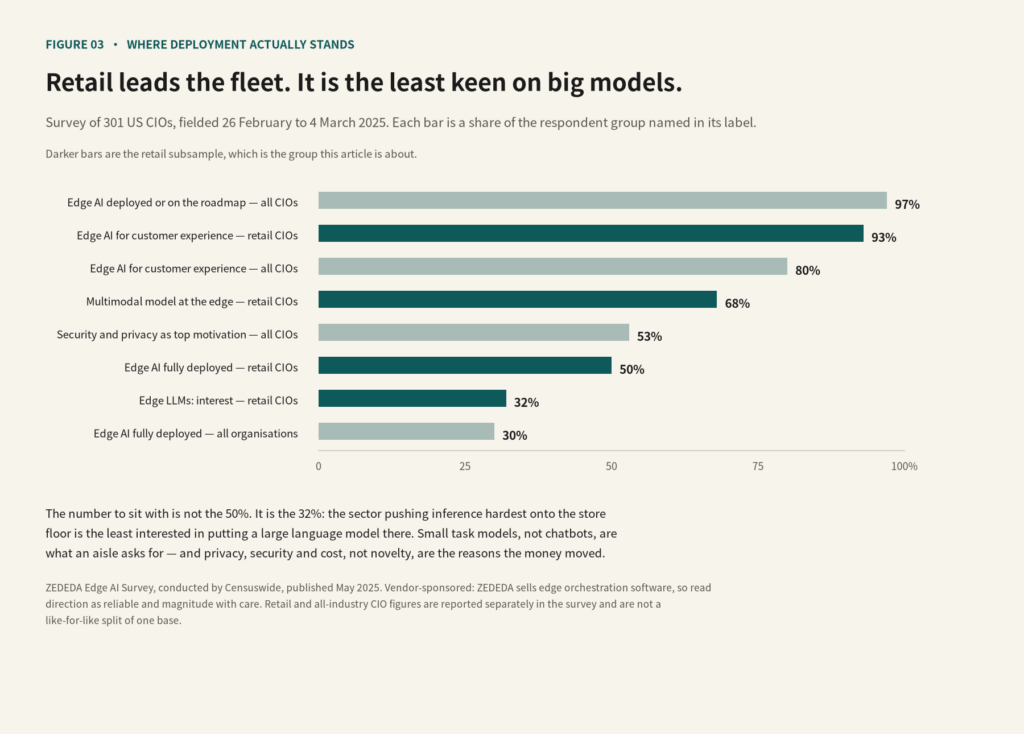
The market is moving faster than the sceptics allow. ZEDEDA’s survey of 301 US CIOs, fielded in early 2025, found 50% of retail CIOs with edge AI fully deployed — the highest of any sector — and 93% deploying it for customer experience. Handle the magnitude with care: the survey was sponsored by a company that sells edge orchestration. The direction is corroborated elsewhere, including IDC’s forecast that 30% of retailers will take 10% of store IT cost out by 2028 using distributed edge computing with onboard AI chips.
8. The Architecture: Train in the Cloud, Decide at the Shelf
The pattern that works is not a replacement. It is a split.
What goes on the box
Small, narrow, quantised models doing one job well: rank three candidate creatives against a shopper’s zone and dwell; classify a shelf gap; score a queue. Not a general model that writes copy. The model that writes copy belongs in the cloud, where it can be large, slow, and shared across every store at once.
The rule of thumb we use: if the decision must be made before the shopper moves two metres, it belongs on the box. If it can be made tonight, it belongs in the cloud.
What never leaves it
Raw frames. Faces. Basket-level identity. What travels is the smallest possible description of what happened — a score, a count, an anonymised intent signal. The store keeps the pixels; the cloud gets the meaning.
Then the loop closes the other way. Models are trained centrally, quantised, packaged as containers, pushed to a fleet, validated locally against a reference set, and rolled back automatically when validation fails. This is boring infrastructure, and it is the whole difference between a pilot in four stores and a thousand nodes you can account for.
9. Governance: A Thousand Local Brains Need One Conscience
The governance problem arrives later than the technology problem and hurts more.
Two developments are worth knowing. First, the connector problem is being standardised: in December 2025, Anthropic donated the Model Context Protocol to the Agentic AI Foundation, a directed fund under the Linux Foundation co-founded with Block and OpenAI. It arrived with more than 10,000 public servers and roughly 97 million monthly SDK downloads. For retail, the practical consequence is that wiring an edge node to a product catalogue, a CRM or a pricing engine stops being bespoke work per vendor.
Second, a warning from the other direction. Gartner expects 40% of enterprise applications to carry task-specific AI agents by the end of 2026, up from under 5% — and at the same time expects more than 40% of agentic AI projects to be cancelled by the end of 2027 on cost, unclear value and weak risk controls. A thousand local agents is a thousand places for that failure mode to happen quietly, one store at a time.
So govern the fleet like a fleet: a version registry, a validation gate no model skips, a rollback path, and a named owner for the exception queue. The central conscience is not a committee. It is a pipeline.
10. Privacy Is Architecture, Not Exemption
This is the caveat that gets lost in the enthusiasm, and it is the one most likely to decide whether a programme survives year two.
Processing data locally reduces exposure. It does not create a lawful basis. Consent duties, notice duties, retention limits and impact assessments travel with you whether the inference happens in a rack or on a shelf controller.
Regulators are already drawing that line precisely. Maryland’s Online Data Privacy Act, in force since October 2025, is among the strictest state regimes in the United States, and its treatment of biometrics is instructive: data collected for security purposes — loss prevention, for instance — cannot then be repurposed for advertising. The collection context binds the use.
That is exactly the boundary an edge deployment is most tempted to blur, because the camera and the screen sit on the same aisle and it is one API call to connect them. The design rule that keeps you out of trouble is unglamorous and works: collect the least you can, keep it for the shortest period that is defensible, send the smallest description that still supports the decision. If your architecture cannot answer the question of what minimum you need to choose this creative, a legal review will answer it for you later, on worse terms.
11. How to Measure It Without Fooling Yourself
The measurement gap here is not a rumour. It is surveyed.
Comviva’s global study of more than 200 senior marketing and IT leaders across retail, e-commerce and telecom found that 90% increased AI marketing budgets over two years while only 12% could clearly demonstrate returns. Sixty-seven percent could not determine total AI costs; 55% reported a disconnect between improved customer experience and revenue. Comviva sells customer engagement software, so discount the framing — but the shape of the problem matches everything else in the field.
Two habits fix most of it.
First, borrow the matched-market method instead of inventing one. Albertsons Media Collective launched store-level incrementality measurement in January 2026, matching test stores to control stores on nearly 60 variables to estimate the counterfactual. Its first reported campaign — Mondelēz, 116 stores, in-store screens combined with onsite and offsite media — produced a 14% in-store sales lift, a 1.5% conversion rate and a $2.41 matched-market iROAS. That is a retailer measuring its own inventory, so read it as a credible vendor claim rather than an independent finding. The method, though, is the right one, and it is the same logic as the randomised exposure in the Journal of Marketing study.
Second, put the four numbers that justify the edge on the dashboard: p50 and p95 decision latency, exposure-to-purchase lift against control stores, bytes of identifiable data leaving the store, and cost per thousand decisions on-box versus in-cloud. If you cannot produce those four, you are not running an edge programme. You are running a pilot with good slides.
12. The Ninety-Day Sequence
If you want this operational rather than philosophical, here is a sequence that fits inside a quarter.
Instrument one aisle in two stores plus one control store, and get the exposure-to-purchase link working before you touch a single creative. If you cannot measure lift, do not build the model.
Move exactly one decision onto the box. Pick the narrowest one you have — which of three creatives to serve, not which offer to invent.
Set a latency service level and measure p95, not the average. Averages hide the peak-hour tail that ruins the moment.
Count the exception rate. If humans are reviewing more than a small fraction of events, you have built a Just Walk Out, and the economics will find you eventually.
Write the data boundary down before procurement, not after. What leaves the store, in what form, kept for how long.
Only then scale to the fleet — with a validation gate, a rollback path, and someone accountable for the queue.
Conclusion: The Last Unmeasured Moment
Put the pieces together and the shape is clear.
The moment is short: five to fifteen seconds of exposure, against a hundred-millisecond threshold for a response that feels like the environment rather than a machine. The money is already there: retail media at £3.8bn in the UK alone, growing 18%, with in-store named as the advantage digital cannot copy. The evidence that screens work is unusually strong for this category — 8.1% more purchases, about 21% gross ROI, payback inside two years — and it was earned by screens that targeted nobody. The scale is arriving: one syndicated estimate puts edge AI in retail at $21.8bn in 2025 rising to $81.7bn by 2030, around 30% a year, while IDC expects a tenth of store IT cost to come out of the estate via edge by 2028.
Against that, the failures are equally legible. Amazon’s frictionless checkout ran on a thousand human reviewers and a 700-per-1,000 exception rate, and it was withdrawn from the format that mattered. Nearly nine in ten organisations cannot prove what their AI marketing spend returned. And a camera feeding a screen is one integration away from doing something with biometric data that a regulator will not like.
Edge AI is not a category you buy. It is a placement decision you make, one workload at a time: train in the cloud, decide at the shelf, keep the pixels in the store, and measure the lift against a control group that never saw the screen.
Think at the shelf, not in the data centre. The moment you are trying to win is shorter than your network round trip.