8.4 Billion Assistants, One Missing Strategy: The Ambient Marketing Gap
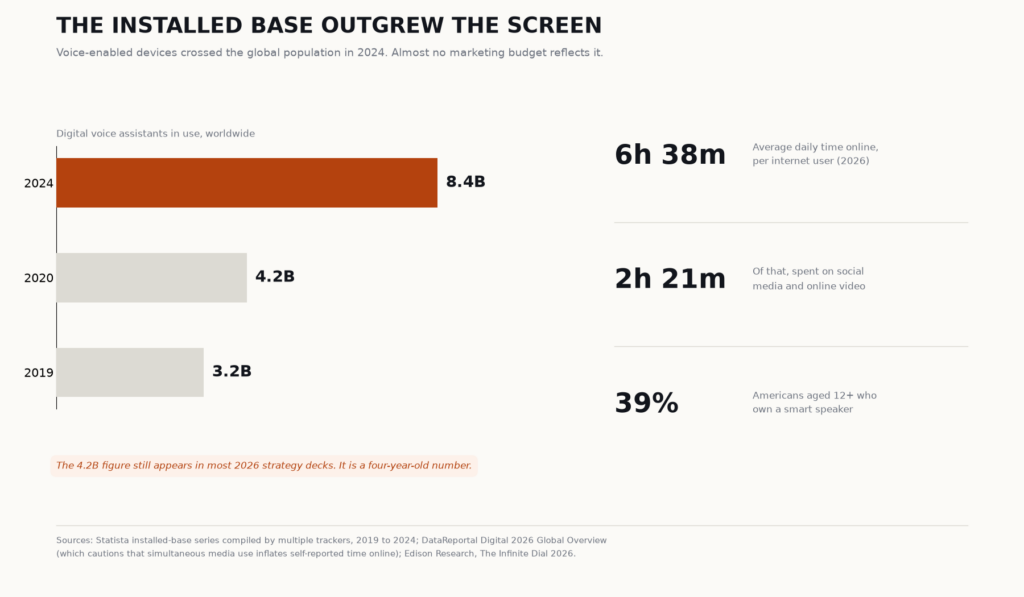
Six hours and thirty-eight minutes. That is how long the average internet user spends online each day, according to DataReportal’s Digital 2026 overview — and roughly two hours and twenty-one minutes of it goes to social media and video.
Now ask a question that sounds almost too obvious to bother with. Of those six hours, how many involved a screen you were looking at, and how many involved a screen that was merely nearby?
That gap is where this story lives. Because the second number is growing, and most marketing budgets are still built entirely around the first.
The Screen Was Never the Destination
For twenty years, marketing had exactly one canvas. The banner. The feed. The pre-roll. The interstitial you try to close and miss. Everything we learned about targeting, creative testing, attribution and conversion optimisation was learned on glass.
Ambient computing dissolves the glass. It is the shift from “open the app and do the thing” to “the environment notices and responds” — sensors, voice, wearables, connected products, all of it running quietly in the background. Computing becomes everywhere, which is another way of saying it becomes invisible.
You have already lived through the first half of this. Your phone stopped being a device you operated and became a thing that taps you on the shoulder. Your watch knows your heart rate before your doctor does. Your car has opinions about your route. None of that required you to open anything.
The screen was a phase. It was never the destination. And the brands that treat the interface’s disappearance as a distribution problem to be solved are going to spend the next three years solving the wrong problem.
What CES 2026 Said Out Loud
Every January, the industry gathers in Las Vegas and quietly tells you what it is about to do. Most years the message is buried under hardware. In 2026, it was unusually blunt.
Omnicom Advertising’s global head of strategy and innovation, Matt Moran, came back from CES and named the first two shifts on his list with almost unsettling clarity. The first he called ambient interfaces — “where technology disappears,” where sensors, AI and IoT anticipate needs and respond “without constant taps, swipes or screens.” The second he called the screen-free generation: a reprieve, as he put it, from the attention wars.
His closing line is the one worth taping to a monitor. The future isn’t louder. It’s quieter, stranger and far more intentional.
That is not a technology forecast. It is a media plan written in the negative. If the future is quieter, then the loudest available channel is, by definition, the one losing.
The Number Everyone Quotes Is Four Years Old
Here is a small piece of evidence that ambient marketing is being under-imagined rather than over-hyped.
Open almost any 2026 strategy deck that touches voice, and you will find the same figure: 4.2 billion voice assistants in use worldwide. It is a good number. It is also a 2020 number.
By 2024, the global installed base of digital voice assistants had reached roughly 8.4 billion — more assistants in the world than people. The trajectory matters more than the total: 3.25 billion in 2019, 4.2 billion in 2020, 8.4 billion in 2024. That is not a channel maturing. That is a channel becoming infrastructure.
And yet the 4.2 billion figure keeps circulating, because it is the number that was true when someone first wrote the slide. Strategy decks have a way of fossilising. So does strategy.
Attention Was Rented. Intention Is Owned.
Let me put the strategic shift as plainly as I can.
Attention is a rented asset. You buy it impression by impression, you rent it again next quarter, and the price goes up every year because everyone is bidding for the same finite resource. There is a hard ceiling on attention: a day has only so many hours, and the average user is already spending six and a half of them online.
Intention is different. If a system knows that you are out of dishwasher tablets, or that your flight lands at 11pm, or that your resting heart rate has drifted upward for nine days — it does not need to interrupt you. It can simply be useful at the moment usefulness is possible.
That is the trade ambient marketing offers, and it is genuinely a trade, not a euphemism. You give up the guaranteed impression. You get the well-timed act. Whether that is a good deal depends entirely on whether you can be trusted with the context you are being handed.
Surface One: The Assistant Became a Storefront
Voice is the most mature ambient surface, and the most misunderstood.
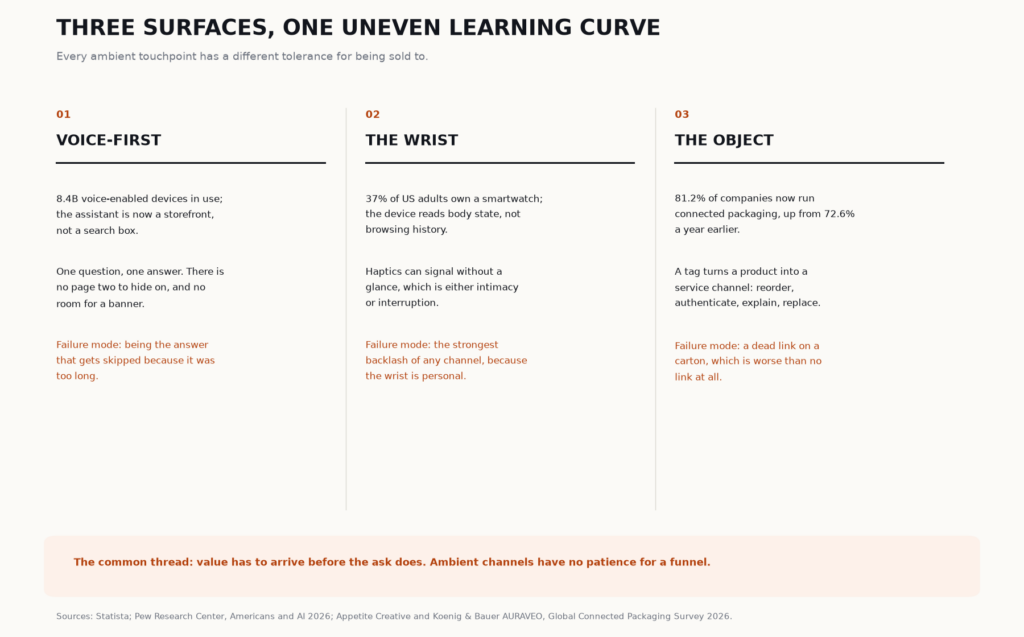
The misunderstanding is that voice is a search box you talk into. It is not. It is a queue with one position. There is no page two. There is no sidebar. There is no banner, no carousel, no “you may also like.” When someone asks their speaker or their assistant a commercial question, the answer is the storefront — and if you are not the answer, you were not in the room.
This is why the 8.4 billion device figure should worry you more than it excites you. Voice assistants are not a new placement to buy. They are a filter that removes placements entirely.
Surface Two: The Wrist Is Sacred Real Estate
Wearables are the opposite problem: too much intimacy, too little patience.
Roughly 37 percent of US adults now own a smartwatch, according to Pew Research Center’s Americans and AI 2026 survey of 5,119 adults. That is a device worn against skin, reading body state rather than browsing history — heart rate, sleep, movement, stress. It is the most personal data surface marketing has ever been offered, and it is the one with the shortest tolerance for being sold to.
Haptics make this sharper. A vibration can deliver a signal with no glance, no unlock, no sound. Which is precisely why misuse is so costly: a notification on a phone is an annoyance, but a notification on a wrist is an intrusion into the body’s own channel. There is no scroll-past. There is only “why is my watch buzzing at me.”
The wrist rewards restraint more than any other surface. A brand that sends three things a year and gets all three right will outperform a brand that sends thirty.
Surface Three: The Object Became the Channel
The third surface is the one most marketers still treat as packaging.
Connected packaging has crossed from pilot to practice. In the fifth annual Global Connected Packaging Survey, published by Appetite Creative with Koenig & Bauer AURAVEO, 81.2 percent of companies reported currently using connected packaging, up from 72.6 percent a year earlier. Some 92.3 percent said it will grow in importance over the next twelve months. QR codes and NFC tags used together are now the most common configuration, at 47.1 percent of adopters.
Why does that matter for screenless marketing? Because a tag converts a physical object into a persistent service relationship. A carton can authenticate a product, explain how to use it, reorder it when it runs out, or tell you whether the batch you are holding is the one being recalled. None of that requires a screen you own. It requires the screen you already have in your hand, pointed at the thing you already bought.
The Sound-On Correction
For a decade, the received wisdom was to design for sound off. Captions, bold text overlays, visual-first storytelling — because nobody has their audio on in public.
That advice was wrong, or at least it was wrong about which way the tide was running.
Spotify’s Sound-On Era research — five thousand consumers across five countries, 105 advertisers across twelve markets, thirty expert interviews — found that 86 percent of its users mute video on other platforms specifically so they can listen to music, podcasts or audiobooks instead. Read that sentence again. People are actively turning other media’s sound off in order to turn sound on somewhere else.
You should hold that number with one hand and hold its provenance with the other. This is Spotify’s own research about the value of audio, published by a company that sells audio advertising. It is not neutral. But the behavioural claim is specific, the methodology is disclosed, and it is corroborated by independent data on time spent.
The same research reports that 90 percent of consumers want a verbal response from an AI assistant, and that 70 percent say they would use a voice command to engage with an ad even with the screen off. On market size, Spotify cited a projection of roughly $50 billion for voice agents by 2034; the underlying Market.us estimate puts voice AI agents at $47.5 billion by 2034, up from $2.4 billion in 2024. Treat the direction as reliable and the decimal places as decoration.
If sound is the ambient backbone, then sonic identity stops being a brand nicety. In a screenless moment, the voice is the logo.
Five Rules for Interfaces You Cannot See
I want to give you something usable rather than something admirable, so here is the operating framework in five moves.
Context is the new click. The trigger is no longer a tap. It is location, time of day, motion, biometric state, ambient noise, purchase history. You are no longer optimising a landing page; you are deciding which moment deserves an intervention, and most moments do not.
Anticipatory, not presumptuous. The distinction is everything. Anticipatory means you surface value before the ask — restock before the cupboard is bare. Presumptuous means you decide on someone’s behalf without being invited. The line between them is whether the user would describe what happened as helpful or as creepy, and users are not shy about telling you which.
Progressive disclosure. Whisper first. A headline, a single spoken sentence, a haptic pulse. Elaborate only when interest is signalled. Ambient interfaces fail loud, not quiet — nobody complains that an assistant said too little.
Multimodal consistency. A person may start on a watch, continue on a speaker, finish on a phone. If the identity, the offer and the tone do not survive that journey, you have built three brands and will be remembered as none of them.
Design for error tolerance. Sensors misread. Context engines get it wrong. A brand that apologises gracefully and stops immediately survives; a brand that repeats the mistake at volume becomes the reason someone mutes a device permanently.
The Consent Problem Nobody Wants to Own
Here is where ambient marketing stops being a creative challenge and becomes a legal one.
Pew’s 2026 data is a cold shower. About seven in ten US adults expect AI to make their personal information less secure. Sixty-three percent say the technology is advancing too quickly. Only about a third own a smart speaker at all, and 35 percent of non-owners cite microphone privacy fears as a reason.
Now layer the regulation on top. The EU AI Act’s Article 50 transparency obligations became applicable on 2 August 2026. They require that people interacting with an AI system — chatbots, assistants, voice agents, and explicitly AI agents acting on someone’s behalf — be told they are talking to a machine, unless that is obvious from context, and the European Commission has said that “obvious” should be read narrowly. Disclosure is supposed to arrive at the start of the first interaction, not buried in a terms page. Non-compliance carries exposure up to 15 million euros or 3 percent of worldwide turnover.
Under GDPR, voice is not automatically special-category data — but the moment a recording is processed to identify a speaker, it is biometric data and needs explicit consent on its own track, separate from whatever consent covers ordinary call recording.
So the ambient marketer’s real constraint is not creative. It is evidentiary. Can you show, on demand, that a person understood what the system was doing, agreed to it, and could stop it as easily as they started it?
What the Readiness Data Actually Says
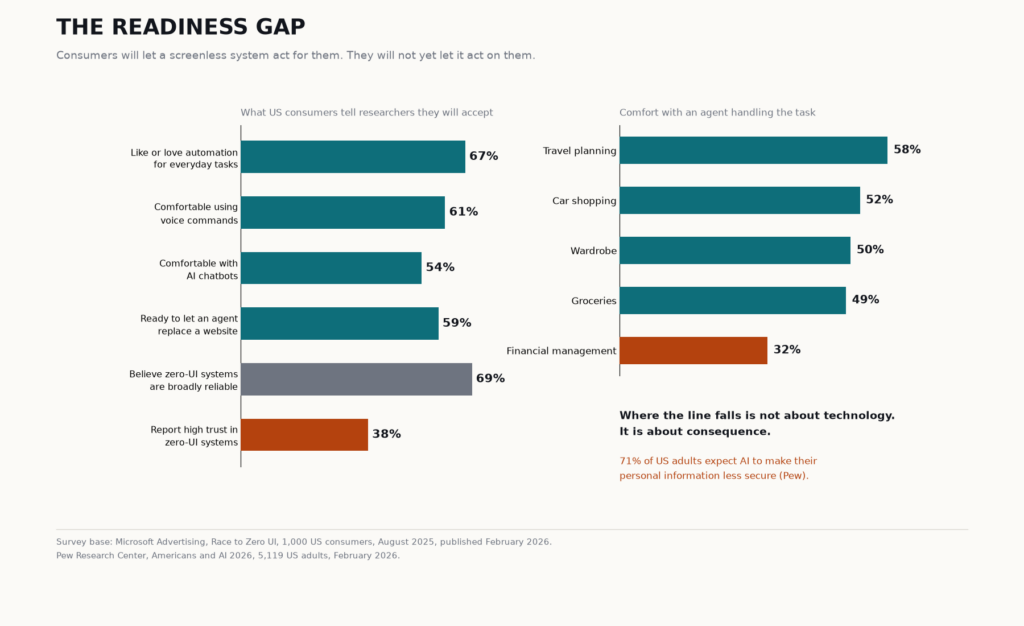
Microsoft Advertising surveyed a thousand US consumers for its Race to Zero UI study, and the results are more interesting than a single headline number.
Comfort with the machinery is high. Sixty-seven percent like or love using automation to make life easier. Sixty-one percent are comfortable with voice commands. Fifty-four percent are comfortable with AI chatbots. Fifty-nine percent say they are ready to let an AI agent replace a website for some tasks.
Trust in the outcome is not. Only 38 percent report high trust in zero-UI systems. And when you move from category comfort to specific scenarios, the numbers fall away in a very telling order: 58 percent comfortable letting an agent handle travel planning, around half for car shopping, wardrobe and groceries — and just 32 percent for financial management.
That gradient is not about technological readiness. It is about consequence. People will delegate the reversible. They will not delegate the irrevocable.
The Category Is Real. The Category Size Is Fiction.
You will be asked to budget for this, so you should know that nobody agrees on what it is.
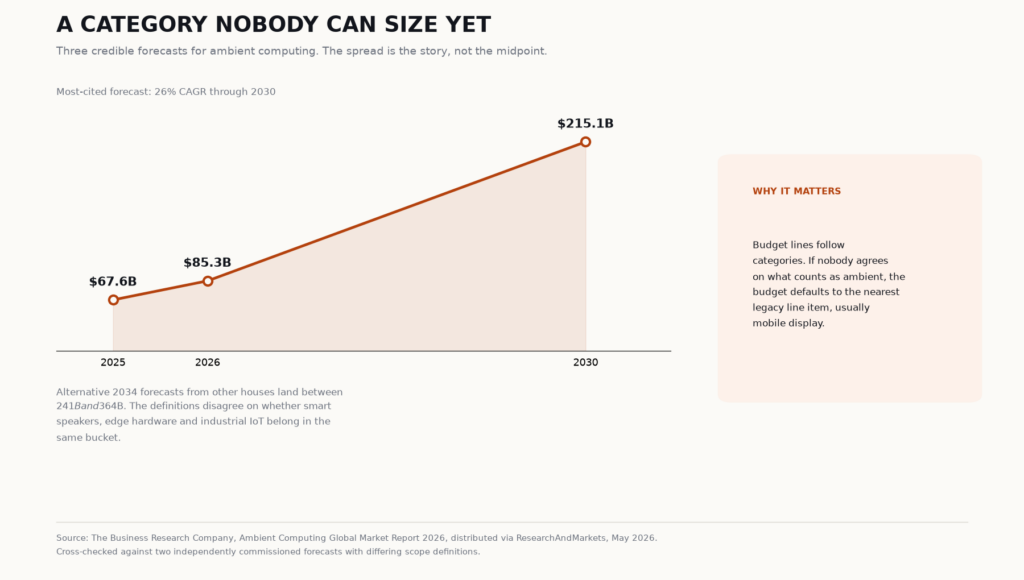
The Business Research Company’s 2026 report sizes ambient computing at $67.59 billion in 2025, $85.35 billion in 2026, and $215.05 billion by 2030 — a 26 percent compound annual growth rate. Other houses, working from different definitions, put the 2034 figure anywhere between roughly $241 billion and $364 billion.
The spread is not a scandal. It is a definition problem. Does a smart speaker count? Does industrial IoT? Does edge silicon? Depending on where you draw the line, the same market is a quarter-trillion dollars or a rounding error in the device industry.
Practically, this means the budget will not arrive under an “ambient” line item. It will arrive as a reallocation from mobile display, from CRM, from the retail media test you were going to run anyway. If you wait for the clean category, you will wait past the moment.
What to Do on Monday
Five things, in the order I would do them.
Audit your zero-click exposure. Take your ten highest-intent queries and ask what your answer sounds like when it is read aloud by an assistant. If it is a headline and a paragraph of brand throat-clearing, rewrite it.
Build one sonic asset you actually own. Not a jingle. A voice, a cadence, a three-second audio signature that survives being played through a laptop speaker at low volume. Test it with your eyes closed.
Pick one anticipatory use case and instrument it honestly. Restock, renewal, replenishment, service reminder — something where being early is unambiguously better than being loud. Measure whether people keep it on. Retention of the ambient touchpoint is the only metric that matters in year one.
Rewrite consent as a feature, not a footer. Make opting out a single gesture that works as fast as opting in. If your opt-out takes four screens and your opt-in takes one tap, you have not built consent. You have built a maze.
Stop buying impressions in the channel where the decision is made. If the assistant answers, the assistant is the placement. Optimise for being the correct, quotable, structured answer rather than for the click that never happens.
The Quiet Part
Ambient computing does not shrink the brand opportunity. It relocates it — from attention to intention, from interruption to presence, from the impression you bought to the moment you earned.
The uncomfortable implication is that most of the skills that made digital marketing legible over the last fifteen years are the skills of the screen. Landing page optimisation. Scroll depth. Viewability. Click-through rate. All of it assumes someone is looking. Ambient assumes someone is living, and occasionally listening.
Which brings us back to that six hours and thirty-eight minutes. The average person is not going to spend more time online. There is no more time. The only variable left is how much of that time feels like being handled versus being helped.
Brands that help people put the phone down and still stay present in their lives will earn something that attention never bought: permission to be there next time.
The future isn’t louder. It is quieter, stranger, and far more intentional. The question is whether your marketing is built for the volume it used to need, or the silence it now has to earn.