Why the Entry-Level Marketing Job Disappeared Before AI Arrived
Here is the question that the skills-gap debate keeps failing to ask. If everybody agrees that marketing graduates arrive underprepared, who was supposed to have prepared them?
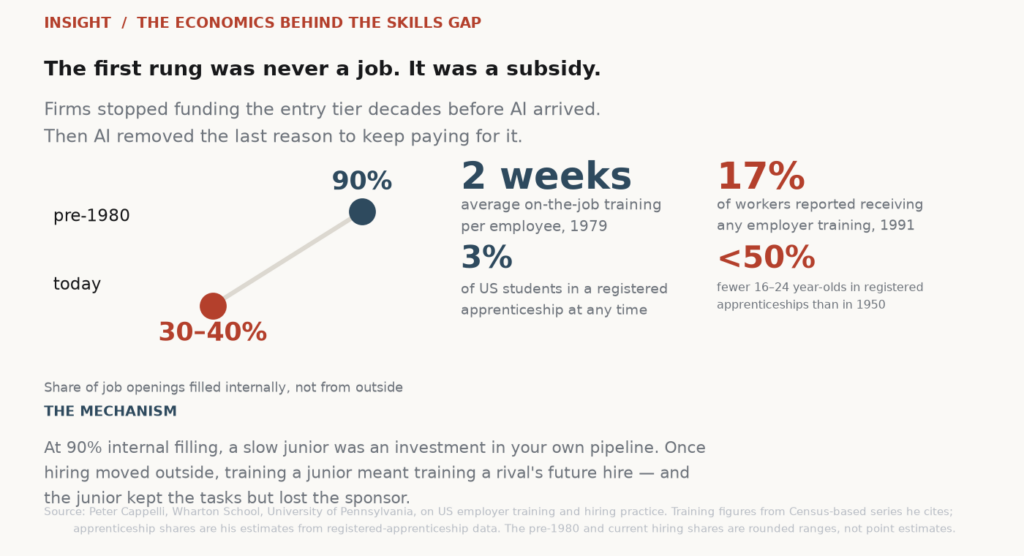
For most of the twentieth century, the answer was: the first employer. A junior marketer was slow, expensive and about 40% productive for eighteen months. Nobody pretended otherwise. The reason firms tolerated it is that the arithmetic worked. In the decades before 1980, roughly 90% of job openings in US firms were filled from inside, through promotion, transfer and lateral moves; only about one in ten came from the external market. When you train a junior under those conditions, you are funding your own pipeline. The return arrives in year four, from someone who is still yours.
That ratio has essentially inverted. Cappelli’s account of US hiring practice puts internal filling at some 30–40% today, with most roles now recruited from outside. Which changes the economics of the same act completely. Train a junior in a 60%-external market and you are, with decent probability, funding the pipeline of a competitor who will pay them 20% more in three years.
The externality nobody priced
This is a textbook collective action problem, and economists have named it: the poaching externality. When firms can hire trained workers away from each other, each firm under-invests in training relative to what the group needs, because the group captures less of the return than the payer does.
Cappelli’s training series shows the retreat in plain numbers. In 1979 the average employee received about two weeks of on-the-job training. By 1991, only 17% of Census respondents reported receiving any employer training at all, and the decline continued into the 2000s. Apprenticeships tell the same story: fewer than half as many 16-to-24-year-olds are in registered programmes today as in 1950, and just 3% of US students are in one at any given time.
The entry-level job was never primarily a productivity device. It was a training subsidy, paid by the employer, priced into the cost of a junior’s slow year. That subsidy has been quietly withdrawn for four decades.
What AI actually changed
AI did not invent this. It removed the last defence.
The one argument that survived all the cost-cutting was that juniors do the low-value work so seniors can do the high-value work. Administrative coordination, first-draft copy, competitor scans, reporting pulls, deck assembly. That was the junior’s contribution to the ledger, and it justified the loss.
AI now does that work at near-zero marginal cost. So the junior’s measurable output collapses, while the unmeasurable output, the slowly-accruing judgment, hasn’t arrived yet. The subsidy loses its alibi. Firms are not automating entry-level marketing because they want to destroy the talent pipeline. They are doing it because the maths, which was already bad, has become indefensible.
The 10-to-20% decline in young-worker employment in AI-exposed occupations, and the roughly 19% gap against their less-exposed peers, is not primarily a story about machines replacing people. It is a story about a bargain expiring.
The uncomfortable implication
If the entry tier was a subsidy, then every prescription in the skills-gap conversation is misaddressed.
Telling graduates to “build a portfolio” is asking them to self-fund a training cost that used to sit on a corporate P&L. It can work, and for some people it will. But it is not a fix; it is a transfer of cost onto eighteen-year-olds and their parents.
The honest framing is that somebody has to pay for the learning curve, and we have spent forty years pretending nobody does. Firms have offloaded it onto universities, who offloaded it onto unpaid internships, who offloaded it onto students. The invoice has simply moved down the chain until it reached the person with the least ability to pay it.
Which means the interesting question for 2027 isn’t whether AI will destroy junior marketing jobs. It is who is willing to buy the subsidy back, and on what terms. A firm that reinstates a structured junior programme is not being generous. It is buying access to a pipeline it will otherwise have to rent from its competitors at market rate.