The Layer Behind the Lens: How China’s Live-Commerce Agencies Actually Run the Room
Watch a Chinese livestream for ninety seconds and you will draw the wrong conclusion, and you will draw it confidently.
A host holds a jar of cream. She flips it, reads a comment aloud, calls out a number, and a counter on the screen spins. Her voice is fast and slightly hoarse. There is a countdown, a pinned link, a promise that the price holds only for the next hundred units. It looks, from the outside, like a person selling into a phone.
That is the part you can see. And because it is the only part most foreign brands ever study, it becomes the whole mental model: an energetic presenter plus a product plus a discount. Add a camera. Press go.
The trouble is that the thing on your screen is the top of a seven-layer operation, and the other six layers are staffed by people you have never met, do not employ, and have not budgeted for. In China, you do not “do a livestream.” You hire a layer that runs one.
The Part of the Stream You Can’t See
Here is the gap in perception, stated plainly. To a Western marketer, livestream commerce is a creative format. To a Chinese operator, it is an operated asset — closer to running a shop floor than to shooting a campaign.
That single difference in framing explains most of the failures.
Why the surface looks so copyable
The surface is designed to look easy. That is the craft of it. A good host makes improvisation look effortless: the joke lands, the objection gets handled, the stock counter clicks over at exactly the moment the room leans in. Nobody films the spreadsheet behind that timing.
And unlike a television ad, a livestream produces a number in real time. You can watch the number. You can compare it to your forecast. Which means the format invites a very seductive thought — if it is this simple, we can run it ourselves — right up until the room sits at eleven viewers for forty minutes.
The uncomfortable arithmetic of Chinese live commerce is that the visible layer is roughly the cheapest thing in the building. Hosts are the cheapest labour line in the operation, the camera is a phone, and the set is a corner of an office park in Hangzhou. What costs money is everything you cannot photograph.
The five businesses standing behind one host
Here is the stack, and it is worth memorising, because each line on it is a separate vendor with its own contract, its own failure mode, and its own invoice.
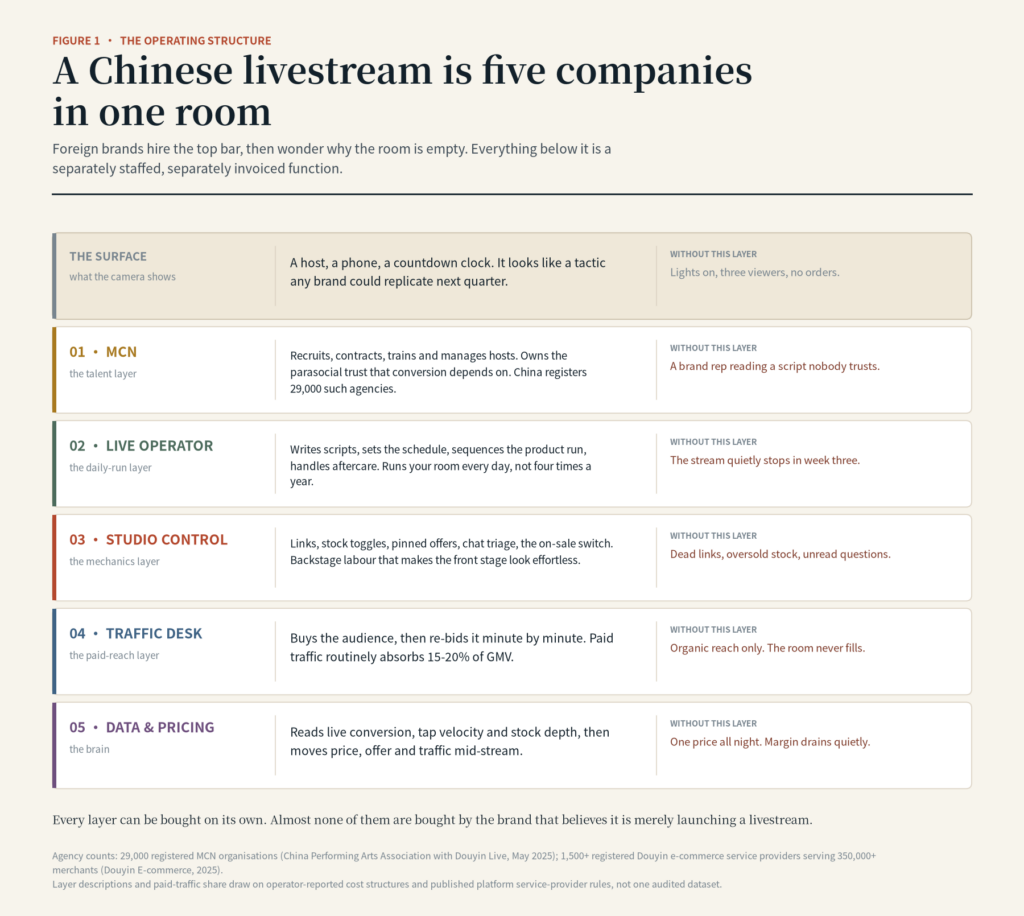
The talent layer recruits and manages hosts. The operator writes the scripts and runs the daily schedule. The control room manages links, stock and chat. The traffic desk buys the audience. The data seat reads the room and moves price and offer mid-stream.
Skip one and nothing visibly breaks. The stream still runs, the host still talks, the replay still exists. It simply stops converting, and nobody in the room can tell you why.
The Anatomy: Who Actually Does What
The easiest way to feel the weight of this layer is to walk it, layer by layer, and notice how much of the work is administrative rather than creative.
The MCN: the trust supply chain
An MCN is a talent business, not a marketing agency, and the distinction matters when you are contracting. It recruits creators, signs them, trains them, books them, and takes a cut of what they sell.
By the count published by the China Performing Arts Association together with Douyin Live in mid-2025, there were about 29,000 registered MCN organisations in China, up from 160 a decade earlier. The same industry survey put the MCN market at RMB 63.6 billion in 2024, tracking toward roughly RMB 70 billion in 2025. Those are agency-side numbers, collected by an industry association with a platform partner, so read them as a scale signal rather than an audited statistic.
What the MCN actually sells you is not a person. It sells you a relationship that already exists between that person and an audience — the accumulated familiarity that lets a host say “trust me on this one” and be believed. You cannot manufacture that in a quarter, and you certainly cannot manufacture it with a brand employee reading a script.
The association’s survey also quietly explains why this layer is expensive to replicate: among e-commerce MCNs, the average online support team for a top-tier merchant client runs to 16.5 people. For a mid-tier merchant, five. That is the staffing reality behind the phrase “just put someone on camera.”
The live operator: the daily grind
The second layer is the one foreign brands most often mistake for the whole job, and it is the least glamorous.
A brand’s own broadcast in Chinese, dianbo — is a shop that opens every day. Not a launch. Every day. Scripts get written for six-hour shifts, not for a keynote. Product sequences get rebuilt around inventory that changed overnight. Comments get triaged by someone whose actual job title is closer to customer service than to presenter. And after the stream ends, there is aftercare: the questions that arrived at minute 200, the orders that need confirming, the complaints that need absorbing before they become a public comment.
This is why the operator layer exists as a business rather than as a job description. It is a full-time operational post that most brands cannot staff at the volume the channel requires. The trade press in China has documented the resulting market for years: agencies running daily rooms on behalf of brands, priced on a retainer plus a share of sales, with the retainer under constant downward pressure as supply outgrows demand.
The control room: the mechanics nobody films
If the host is the performance, the control room is the staging, and it fails in ways viewers never see but always feel.
Someone has to toggle the on-sale switch at the right second. Someone has to swap the pinned product when the first one sells out, without dead air. Someone has to catch the comment asking whether the serum is safe for sensitive skin and route it to the host before the questioner leaves. Someone has to notice that the link is broken and fix it in under a minute, because a broken link in a live room is not a bug, it is lost revenue with a timestamp.
These are the mechanics that make an operated stream feel casual. It is the same trick as a restaurant kitchen: the calm dining room is purchased with a loud back room.
The traffic desk: buying the room minute by minute
Chinese live commerce does not wait for an audience to arrive. It buys one.
Paid traffic is a live trading desk. The buyer watches cost per click, conversion and return on spend in real time, and reallocates between audience segments while the stream is still running. When a room’s conversion dips, the desk does not console itself with brand love; it changes the bid, the creative, or the audience, and it does so inside the same hour.
Operators commonly report that paid traffic absorbs somewhere between 15 and 20 percent of gross merchandise value. That figure is a working range from agency cost structures rather than an audited series, but the direction is not seriously disputed: the reach is rented, and the rent is not small.
This is the layer a foreign brand almost never has. Which is why the self-run experiment so often produces a beautiful, well-lit room with a couple of hundred viewers, all of them employees.
The data and pricing seat: the brain of the operation
The last layer is the one that separates a stream from an operation, and it is the one that gets cut first when a budget tightens.
In a mature room, price is not a decision made last Tuesday. It is a live variable. The data seat watches conversion rate, tap velocity, cart abandonment and stock depth, and moves the offer accordingly — a deeper discount on the slow mover, a bundle on the fast one, a hold on the item that is about to sell out with margin intact.
You can see the same instinct in China’s broader promotional machinery, where discounting has become algorithmic rather than calendar-driven. The point for a foreign brand is simpler than the technology: a static stream running one price for six hours is not competing with an operated stream. It is competing with a less informed version of itself.
The Shift That Changed the Job
Something structural happened while Western marketers were still debating whether livestreaming was a fad, and it inverted the economics of the whole layer.
Why store broadcast won
The short version: brands got tired of renting attention they could not keep.
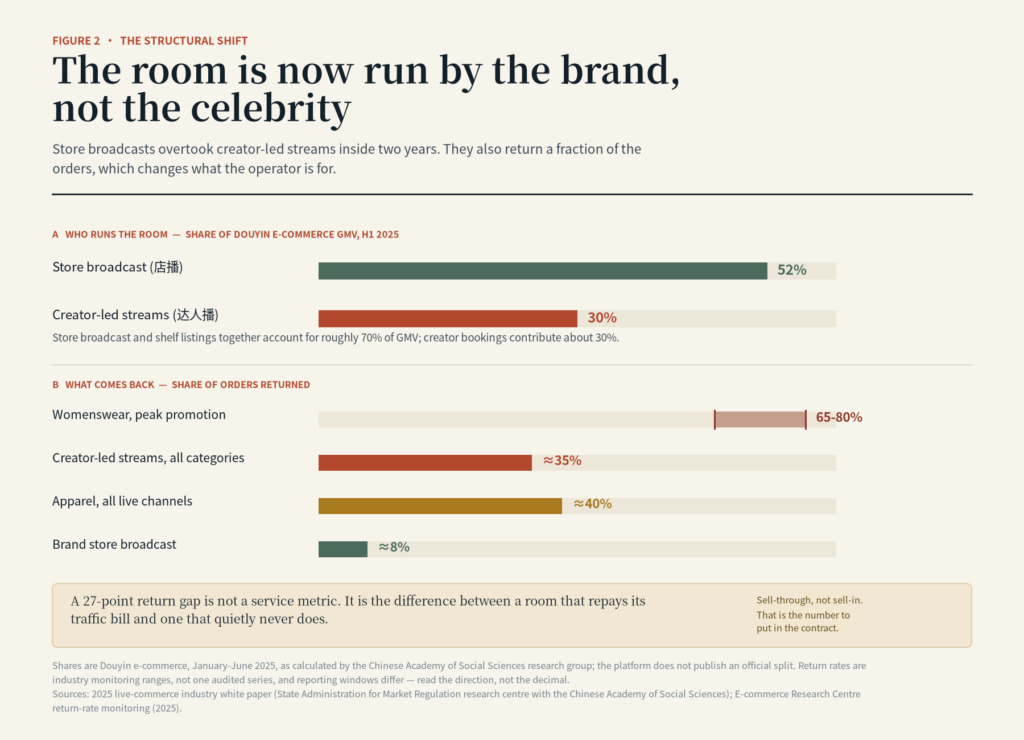
The Chinese Academy of Social Sciences researcher Li Yongjian, presenting platform-derived figures in 2025, calculated that store broadcast contributed about 52 percent of national live-commerce sales in the January-to-November 2024 window — a period in which national live-commerce sales reached RMB 4.3 trillion on a net basis, meaning after unpaid orders and returns were stripped out. For Douyin specifically, in the first half of 2025, creator-led selling accounted for roughly 30 percent of GMV, while brand self-broadcast and shelf listings together made up about 70 percent.
Those are researcher calculations on platform data, not an official platform disclosure, and the split moves month to month. But the direction is unmistakable, and it has a commercial logic that has nothing to do with fashion. When a brand runs its own room, it keeps the pricing power, the customer record and the content. When it books a star, it rents all three for one night and hands back the audience at midnight.
What the return gap really says
Then there is the number that decides whether any of this made money, and it is the number most decks leave out.
Industry monitoring consistently puts return rates for brand-run broadcasts in the high single digits — commonly cited around 8 percent — against roughly 35 percent for creator-led streams. In womenswear during peak promotion, the range climbs to 65–80 percent, and some operators report higher. These are survey-based industry ranges compiled by monitoring firms rather than an official statistical series, and the reporting windows differ, so treat the direction as solid and the decimal as soft.
Still, a 27-point gap is not a service-quality metric. It is the difference between a channel that pays for its traffic and one that quietly never does. Creator-led streams are built on urgency: the limited window, the countdown, the emotional close. Some of those orders are decisions; some are reflexes. Store broadcast attracts people who already know the brand, which is why its returns look like ordinary e-commerce.
For the agency layer, this shift is existential. The work moved from booking talent to operating a room, and operating a room is a staffing business with a thin margin. Which brings us to the money.
Why Foreign Brands Keep Losing the Layer
Now the diagnosis. If the layer is this visible once you look for it, why do capable marketing teams keep walking past it?
The “we’ll just do a livestream” assumption
Because the format looks like content, it attracts content people. A brand flies in a regional marketing lead, books a studio, writes a script in the global brand voice, and puts a product manager on camera for ninety minutes. The product manager is knowledgeable, sincere, and completely unable to hold a room.
This is not a talent failure. It is a category error. You have brought a film crew to a job that needed a market stall.
Your social agency cannot just add livestreaming
The second assumption is that the incumbent agency can absorb the new channel as a line item. It usually cannot, and the reason is mechanical rather than political.
A generalist social agency has planners, creatives and media buyers. It does not have a stable of contracted hosts, a control-room team who can work a six-hour shift, a traffic desk optimised for intraday re-bidding inside a live room, or the platform accreditation that China now requires for this work. Douyin’s own service-provider rules draw the line explicitly: a store operator enters by invitation, needs at least 20 staff with 12 dedicated to the platform, an office of 100 square metres or more, and a deposit, and must ship a minimum quarterly sales volume through the stores it serves.
That is a different company from the one that runs your Instagram.
The host is not a role, it’s a relationship
Third, and most expensive to fix: brands treat the host as a headcount problem when it is actually a trust problem.
The conversion engine in a Chinese live room is parasocial familiarity. Viewers buy because they have watched this person for two years, because she remembers regulars, because she has been right before. A brand employee can be trained to say the same words. She cannot be given the same history. The MCN layer exists precisely because that history is the asset, and history cannot be procured on a three-month contract.
Chinese regulators have now made this relationship formally legible, which is worth knowing before you sign anything. Under the live-commerce supervision rules that took effect in February 2026, the host’s agency is named as an independent responsible party alongside the platform, the room operator and the presenter — responsible for vetting hosts, vetting products, training, and keeping records for at least three years. In September 2026, a second regulation extended the same logic to the wider content-agency industry, requiring business registration that explicitly covers multi-channel content distribution and a 30-day filing update for existing firms.
Translation: the layer is no longer informal. If your partner is not properly registered, that is not a paperwork detail, it is your exposure.
Static stream versus operated stream
Put the four failures together and you get the same outcome every time. A static stream — one price, one script, one host, no traffic desk, no data seat — competes against an operated stream that changes its price four times an hour and re-bids its audience twice.
The static one loses. Not because the brand is worse, but because it brought a tactic to an operations fight.
The Money: Why the Layer Is Thinner Than It Looks
Here is the part that surprises brands who assume the agency must be getting rich.
Commission on a number that keeps shrinking
An operator is typically paid a retainer plus a percentage of sales. The percentage sounds generous until you notice what it is charged on.
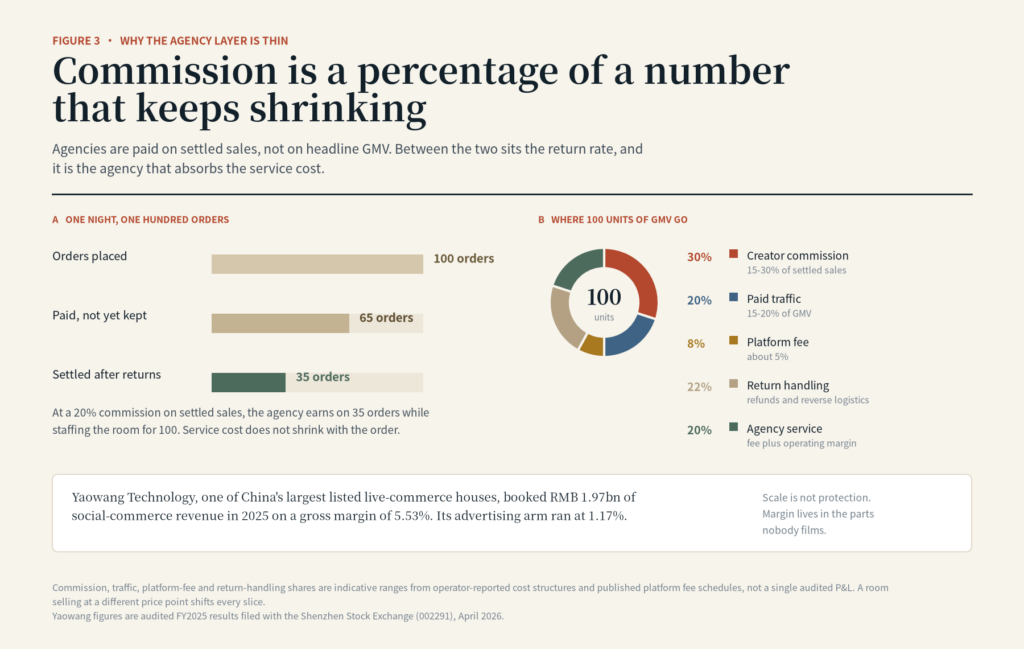
If a hundred orders are placed and 35 percent come back, the agency is paid on 65, and in womenswear it may be paid on 25. Meanwhile it staffed the room for all hundred: the same six-hour shifts, the same control-room headcount, the same aftercare queue. The service cost does not shrink when the order does. That asymmetry is why return handling is the quiet destroyer of agency margin, and why the good operators now negotiate on sell-through rather than on gross merchandise value.
The publicly listed numbers make the point without any need for advocacy. Yaowang Technology, one of the largest listed live-commerce houses in China, reported 2025 revenue of RMB 3.303 billion, down about 31 percent, with a net loss of RMB 649 million. Its social-commerce segment — the livestream business itself — booked RMB 1.968 billion of revenue at a gross margin of 5.53 percent. Its new-media advertising arm ran at 1.17 percent. These are audited results filed with the Shenzhen Stock Exchange, which is what makes them so instructive: this is what the business looks like at scale, with明星 talent and national reach.
What the listed margins tell you
Two conclusions follow, and both should shape how you negotiate.
First, the layer is not extracting fat from your budget. Most of the money in a live room leaves through commission, traffic and returns before the agency sees anything. Any partner quoting you a spectacular margin structure is either subsidising the deal or planning to make it back somewhere you have not looked.
Second, and more useful: agencies that survive are the ones that solved the cost problem structurally — by reusing one studio across several brands, by pushing paid traffic down in favour of content that earns reach, by moving to digital hosts in dead hours. When you evaluate a partner, you are really evaluating which of those three they have actually done.
There is one more number worth carrying into the conversation. Frost & Sullivan’s estimate, as reported in secondary industry research, puts China’s Douyin service-provider market on a 19 percent compound growth path toward roughly RMB 300 billion by 2027 — while the largest single provider holds about 4.6 percent and the top five together hold 17.2 percent. A market that big and that fragmented is a market of specialists, not a market of one-stop shops. Plan accordingly.
How to Actually Buy This Layer
If you accept the framing, the buying decision changes shape. You are not procuring a campaign. You are appointing an operating partner, and the diligence looks different.
Four things to insist on, in writing
Insist on who owns the account. The shop, the follower base, the replay archive and the ad history should sit in your corporate entity’s name. This is the single most common source of expensive regret, and it is trivially easy to fix before signature.
Insist on the sell-through definition. A contract that pays on gross merchandise value rewards volume. A contract that pays on settled sales, net of returns, rewards the behaviour you actually want. Put the return assumption in the document and review it monthly, because it will move.
Insist on seeing the traffic desk. Ask who decides bids inside the room, how often they re-bid, and what share of GMV paid traffic consumed last quarter. If the answer is vague, the capability is probably thin, and you are about to fund someone’s learning curve.
Insist on registration proof. Given the 2026 rule changes, ask for the agency’s business registration scope and platform accreditation tier. A partner who cannot show it is a partner whose compliance failure becomes your legal problem.
One practical caution on pricing, since it is where most of the negotiating energy goes. Widely circulated industry figures put brand self-broadcast teams at roughly RMB 80,000 to 150,000 a month in labour, against agency retainers of RMB 30,000 to 80,000 plus 5 to 15 percent of GMV. Those numbers come from agency-side commentary and should be treated as a negotiating reference, not a benchmark — the sources have an obvious interest in making self-operation look expensive. Get three quotes and compare the scope, not the fee.
The Risks Nobody Puts in the Deck
A layer this large, growing this fast, has a soft middle, and you should price that in.
Thin shells dressed as full-stack
China’s live-commerce service layer is uneven. At the top are genuine full-stack operators with control rooms, traffic desks and data teams. Below them sits a long tail of firms that own a host, a phone and a link, and describe themselves using the same vocabulary as the top.
The filtering mechanism is accreditation and audited results. Douyin’s tiered provider system exists largely because brands could not tell the difference, and the tiers are a crude but useful proxy. Ask for the tier, then ask for a client list you can actually call.
The commission that sells your margin
Commission alignment is real, and it is also a trap, because the fastest route to volume is a deeper discount. An operator paid on sales has a legitimate interest in selling, and the cheapest way to sell is to cut price. That is your margin being spent to hit someone else’s number.
The mitigations are unglamorous: a floor price clause, a margin review at fixed intervals, and a monthly conversation about contribution rather than revenue.
Renting your own moat
The strategic risk is the one that does not show up in a quarterly review. Outsource the whole operational layer and you rent the capability that makes the channel work. The day the relationship ends, the room goes dark and the audience goes with it. That is acceptable if you treat the agency as infrastructure and keep the assets — data, account, content library — on your side of the line. It is fatal if you treat it as a vendor and let it hold the relationship.
Where This Goes Next
Three trajectories seem well-supported by what is already visible.
Consolidation into full-stack operators
A fragmented market with a 4.6 percent leader and thin margins is a market that consolidates. Expect the service layer to look more like martech than like a talent agency within a few years: fewer, larger operators offering an integrated stack, and a long tail of specialists serving individual categories. For a foreign brand, that is mostly good news — a turnkey operator is easier to buy and easier to compare.
AI absorbs the mechanics, not the trust
The parts of the layer that are procedural will automate fastest: control-room toggles, chat triage, overnight shifts, the first pass of data reading. Digital hosts already cover dead hours for several large brands in China, and the economics are straightforward — the marginal cost of a night shift falls toward zero.
What does not automate is the reason people buy. The judgment about which objection to answer, the instinct for when a room is about to turn, the accumulated familiarity with an audience — those remain human for now, and they are what you are really paying the MCN for.
Category fluency beats generalist scale
The last trajectory is specialisation. Beauty, fashion, food and home each have their own room rhythm, their own return profile, their own regulatory exposure. A category-fluent operator beats a generalist of twice the size, because the expensive mistakes in live commerce are category mistakes, not production mistakes.
What travels and what doesn’t
And here is the honest limit of this entire article. The concept — that content channels are operations, and that operations are hireable — travels anywhere. The specific layer does not. It exists at this density because China has 660 million people buying through live streams and a market measured in trillions of renminbi. You will not find a 29,000-agency ecosystem in a market where live commerce is a rounding error, and you should not try to buy one.
What you can do is apply the diagnosis. Ask, for any channel where you are about to press go: which layers am I staffing, and which am I assuming someone will handle? The answer is usually more instructive than the campaign brief.
The Takeaway
The foreign brand watching a Chinese livestream sees a host, a phone and a countdown, and concludes it is looking at a marketing tactic it could copy next quarter. What it is actually looking at is the top of an operated asset: a talent supply chain that manufactures trust, a daily-run team that treats a stream like a shop floor, a control room that keeps the mechanics invisible, a traffic desk that rents the audience by the minute, and a data seat that moves price while the room is live.
Live commerce in China is not a format you adopt. It is an operation you hire, and the hiring is where most foreign brands quietly fail — not at the camera, at the contract.
The brands that get this right do three unglamorous things. They partner an operator with a real control room and a real traffic desk. They source the host through the layer that owns the relationship, rather than through a job posting. And they negotiate on settled sales instead of headline volume, because that is the only number that survives the returns.
Everything else is staging. Beautiful staging, but staging.