Why AI Didn’t Fire the Junior Marketer — It Stopped Buying the Option on Them
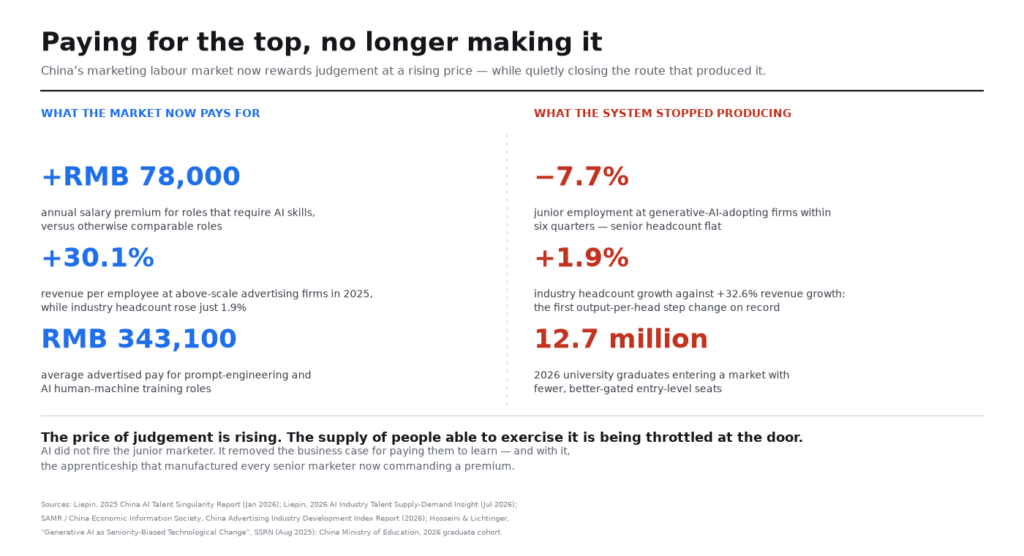
There is a line in China’s 2025 advertising data that reads like a magic trick. Industry revenue: up 32.6%. Revenue per employee at above-scale firms: up 30.1%. Headcount: up 1.9%.
Nearly all the new money was produced by roughly the same number of people. Everyone nods at this. Almost nobody asks the obvious follow-up — where did the extra productivity come from, and who paid for it?
The answer explains something the aggregate numbers hide. It isn’t that Chinese marketers suddenly became twice as skilled. It’s that a chunk of the work disappeared, and the work that disappeared was, disproportionately, the work that junior people used to do.
The old junior role was an option, not a cost
Here’s the mechanism, and it’s cleaner than most AI-and-jobs commentary allows.
A junior copywriter’s salary was never really a payment for output. Forty product descriptions a week had a market value, but it was small — close to what the firm would have paid a freelancer. The rest of that salary was a purchase of optionality: the firm was buying the right, but not the obligation, to find out whether this person would, in three years, become someone who could judge a campaign.
That’s an options contract. You pay a premium now against an uncertain future payoff. It’s expensive, it’s inefficient, and it’s how every senior marketer in the industry was actually made.
Then generative AI arrived and collapsed the value of the underlying output to near zero. Which sounds like bad news for the junior. It’s worse than that — it’s bad news for the structure. Once the day-one output is worthless, the entire salary has to be justified by the option. And options on unproven people are exactly the kind of line item a finance team cuts first in a cautious market.
So firms didn’t fire juniors. They stopped buying options on them. Harvard’s 285,000-firm study found junior employment down 7.7% within six quarters of AI adoption, with senior headcount flat — and the decline came almost entirely from fewer hires. That’s not a layoff pattern. That’s a purchasing decision.
The part everyone gets backwards
The intuitive reading is that AI devalued junior people. Wrong target. AI devalued junior output, and the junior salary was mostly not output.
Which is why the same market simultaneously pays prompt engineers RMB 343,100 and refuses to hire a graduate at RMB 6,000 a month. Both are rational. One is priced on demonstrated judgement, the other on an option nobody wants to underwrite any more.
What this predicts
Two things follow, and they’re testable.
First, the entry-level job won’t come back in its old form. It will be redesigned as a supervised, higher-bar, fewer-seat role — closer to an apprenticeship than a production line, which means firms will have to invest in it deliberately rather than getting it free as a by-product of content volume.
Second, and more uncomfortably: the current premium on judgement is partly a scarcity rent produced by a broken pipeline. In five to seven years, the firms that kept hiring and genuinely trained juniors will hold a talent advantage that no amount of tooling can buy back. The ones that optimised for this quarter’s output-per-head will find themselves bidding for the same thin pool of experienced people everyone else is bidding for.
The trend isn’t “AI replaces marketers”. It’s “AI repriced an apprenticeship as a cost centre” — and markets are very good at cutting cost centres, and very bad at noticing what they just sold.