Thirteen Percent of the Posts, Twenty Percent of the Money: Rewriting the KOL/KOC Budget Story
A note before we start. Two claims in the original outline did not survive verification, and correcting them made the argument sharper rather than weaker. The first was the idea that Chinese buyers distrust social media outright — McKinsey’s 2025 survey actually points the other way, and the correction reframes the whole mechanism. The second was a sequencing claim presented as a measured result when it is a conceptual model. Both are fixed below. What is left is what the evidence supports.
The claim, in one paragraph
Western campaigns usually run one direction. A big ad, a known face, broadcast outward. Chinese brands run two directions in a specific order: they seed a dense grass-roots layer of ordinary-user and micro-creator content first, then put the expensive amplifier on top of it. The order is not a stylistic preference. It determines whether your amplification lands on something a buyer can actually check, or lands in empty air. The same creator, bought before the floor exists versus after, produces different outcomes — and the mechanism behind that difference is searchable, inspectable, and now legally enforced.
The two directions, properly defined
Let us get the vocabulary straight, because the industry uses it loosely and the looseness hides the actual decision.
Top-down: what reach actually buys
A KOL — key opinion leader — is a professional creator with an audience, a niche, and a rate card. You are buying distribution plus borrowed standing. The reach is real and hard to substitute. If nobody in your category knows your name exists, no volume of small-creator testimony solves that, because nobody is searching for you yet.
The weakness is equally real. A large paid post announces itself. Chinese audiences have spent a decade learning to spot the production values, the scripted cadence, the undisclosed commercial relationship. The post still works as awareness. It works poorly as proof.
Grass-roots: what density actually buys
A KOC — key opinion consumer — is a buyer who posts. Small following, no media kit, frequently compensated in product rather than cash. You are not buying reach. You are buying the answer to a question a suspicious buyer will ask: is anyone who is not being paid to say this saying it?
One KOC note is worth very little. Forty of them, spread across different voices, different photographs, different vocabularies, different complaints — that is a different asset entirely. It reads as a crowd.
Why they are not substitutes
Here is the trap. Most budget conversations frame this as an either/or: one big KOL or twenty small ones. That framing produces both classic errors. Put seventy to eighty percent into a single top-tier name and you get one touchpoint with no reinforcement. Put everything into a hundred micro-posts and nobody ever discovers the product in order to read them.
Worse, treating them as interchangeable line items means comparing a distribution purchase against a credibility purchase. They are not the same product. Which is why the interesting question is never which tier, but which tier first.
What the money already does
Before arguing about sequencing, look at where Chinese advertiser budgets actually sit. The answer changes the argument.
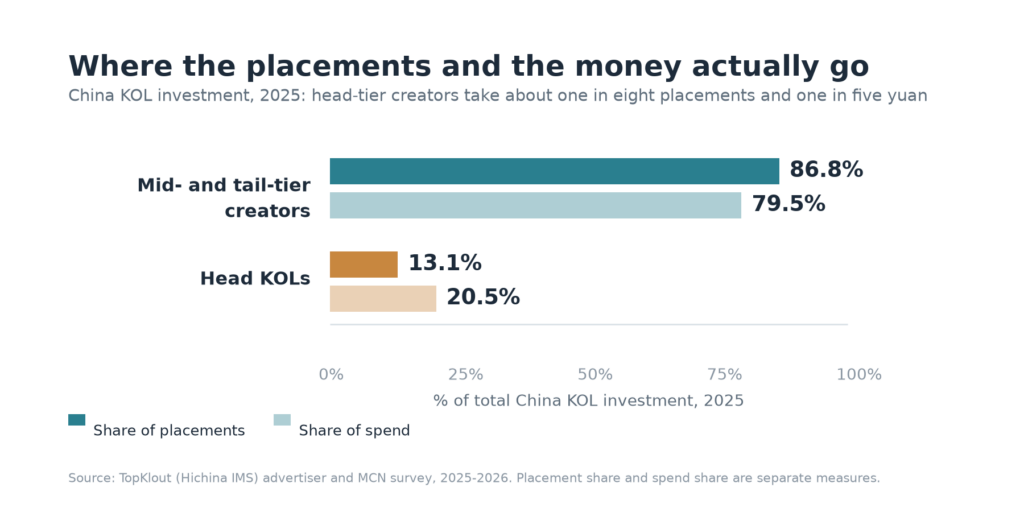
The tier split: 13.1 percent of placements, 20.5 percent of spend
TopKlout’s 2025–2026 advertiser and MCN survey, drawing on the WEIQ platform and a panel of brands and agencies, puts head-tier creators at 13.1 percent of KOL placements and 20.5 percent of KOL spend. Mid- and tail-tier creators take 86.8 percent of placements and roughly 79.5 percent of the money. Placements and spend are separate measures, and mixing them is one of the most common errors in English-language write-ups of this data.
The direction of travel matters more than the level. Head-tier share has fallen year over year while mid and tail climb. On Douyin, tail-tier creators now take 72.7 percent of placements. On Kuaishou, mid-tier spend share jumped four points in a single year. The market already decided that the money goes down-tier.
Two research houses, two scopes
Ebiquity sizes China’s social KOL marketing market — content plus the paid distribution and search coordination wrapped around it — at 930 billion yuan in 2025, roughly 58 percent of global KOL investment and around 17 percent of total China brand advertising. TopKlout, measuring only pure content commissions and excluding livestream slot fees, paid feeds and search, puts it at 840 billion yuan, down about 4 percent from 873 billion in 2024 and well below the 2023 peak of 900 billion.
These are not competing numbers; they are different scopes. The flat top line is the more interesting figure. Same money, different allocation: TopKlout finds 49 percent of advertisers planning to increase spend on seeding-type KOLs in 2026, 43 percent on commerce-type KOLs, and 49 percent on AI conversational search, while brand advertising climbs back to 53 percent of the mix against 47 percent performance.
What this means
If the money is already flowing down-tier, then spend more on KOC is last year’s advice. The remaining differentiator is not allocation. It is order. Plenty of brands now run large KOC programmes and still get nothing, because they run them after the launch spike, as a tidy-up exercise, once the buyer has already formed a verdict.
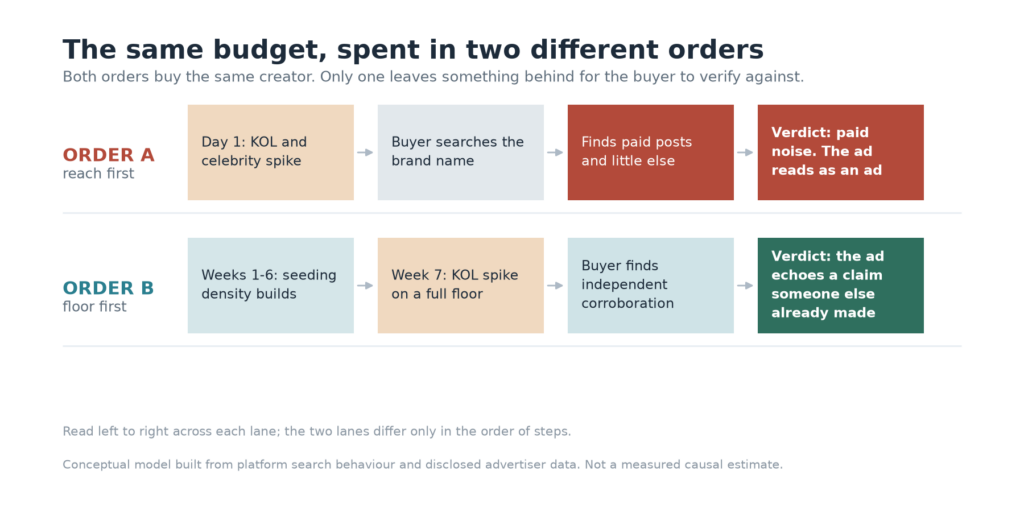
The verification reflex, corrected
This is where the outline needed the biggest fix, and the correction is the most useful part of the piece.
McKinsey’s State of the Consumer 2025 — a ConsumerWise survey of more than 25,000 respondents across 18 markets, plus a deeper four-country sample of 2,838 including 600 in China — found that consumers in Europe and the United States rank social media as their least influential source for brand and product recommendations, with friends and family ranking first. The widely circulated Western summary stops there and concludes that Chinese consumers must feel the same way.
McKinsey’s own text does not support that. In China, consumers also put family and friends first, but they cite several other sources — social media and online reviews among them — as influential. That is a materially different buyer.
iiMedia’s 2025 seeding-economy survey gives the texture of it: 61.20 percent of consumers describe themselves as rational about seeding content, and the channels they credit are spread across KOL review videos at 55.14 percent, KOL commerce content at 48.29 percent, ordinary-user sharing at 45.95 percent, and friends and family at 35.36 percent. No single channel dominates. The same survey puts KOL recommendations as the preferred input for 52.12 percent of Xiaohongshu users and KOC recommendations at 22.66 percent — a spread, not a hierarchy.
So the Western framing — Chinese consumers don’t trust social media — is both wrong and strategically misleading. What the data shows is a buyer who consults more sources, not fewer. Which reframes the strategy entirely. You are not defeating a trust deficit. You are making sure that when a buyer triangulates, every leg of the triangle agrees with the others.
McKinsey’s own advice to marketers follows the same logic: own your messaging across multiple sources rather than concentrating it in one.
The floor: what a buyer finds when they search
Xiaohongshu reports that close to 70 percent of its monthly active users search inside the app, and the platform’s commercial positioning has shifted decisively toward search. The practical consequence: after any stimulus — an ad, a KOL post, a friend’s mention — a meaningful share of buyers go type the product name into a search box.
What they find there is your floor. Forty independent notes with different photos, different gripes, different use cases. Or six glossy posts from the same brief, published in the same week, all praising the same three features.
The second floor does not read as an absence of evidence. It reads as evidence of a campaign. That distinction is the whole game.
The echo
Once the floor exists, the expensive post changes meaning. It stops being a paid person says this is good and becomes a known person is talking about the thing that keeps coming up. The claim is corroborated rather than asserted. Both layers get stronger.
This is the most defensible part of the model, and it is why the sequencing logic survives even after the trust-deficit premise was corrected. The mechanism was never really about distrust. It is about corroboration.
The asymmetry
Run the expensive post first and the buyer’s search returns a floor of one voice repeated. Run it second and the search returns a crowd. Same creator. Same fee. Same creative brief. Opposite result. The variable is not the asset — it is the state of the ground it lands on.
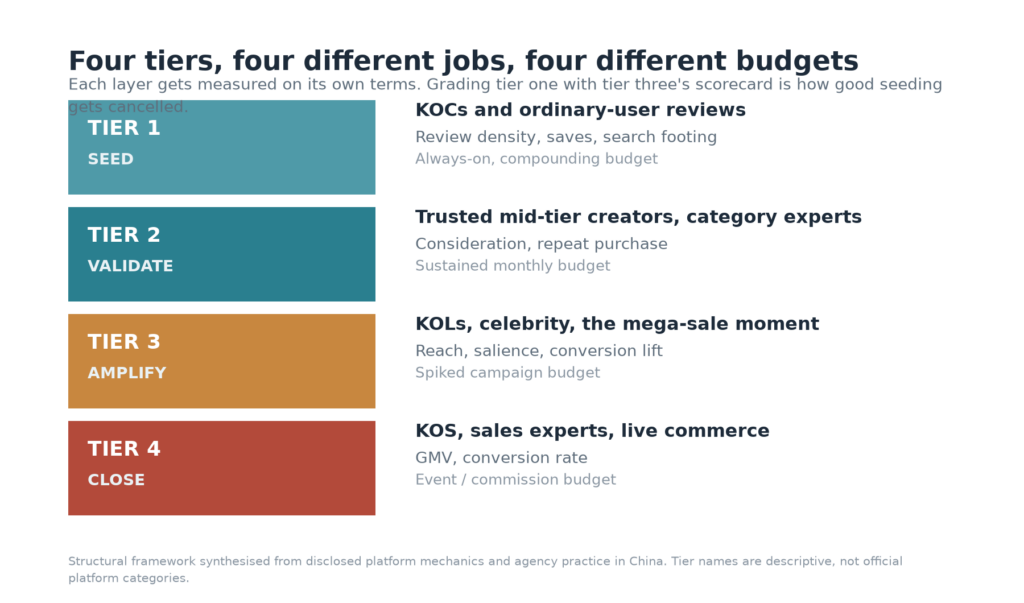
Tier one — seed
Ordinary-user and micro-creator content, produced before any amplification. The objective is not reach; it is the density and variety of independent testimony. Real usage time before posting is the single biggest determinant of whether this works. Creators briefed into advertising language produce advertising, and platform ranking behaviour punishes it.
Measure this tier on review density, save rates, comment substance, and whether branded search starts to move.
Tier two — validate
Trusted mid-tier creators and category specialists who can speak with authority the grass roots cannot manufacture. A dermatologist, a working chef, a coach with a specific credential. This tier converts people like me say it works into someone who knows says it works.
Measure it on consideration signals and repeat purchase, not impressions.
Tier three — amplify
Now the reach. KOLs, celebrity, the mega-sale moment. This tier’s job is salience and scale, and it should be doing that job against a floor that already exists.
Measure it on reach, share of voice, and lift — and expect the lift to be partly unmeasurable, which is the next problem.
Tier four — close
Sales-side experts, live commerce hosts, commission-based closing. This is where trust becomes a transaction, on entirely different economics: base fee plus commission, sometimes fifteen to thirty percent of GMV.
Measure it on GMV and conversion rate.
When to lead top-down instead
Grass-roots first is the default, not a law.
Established brands with an existing floor
If you already have years of organic chatter, a loyal base, and a searchable archive of real reviews, the floor exists. You are not building it, you are spending against it. Amplification is the right lead.
Pure salience moments
A mega-sale window where the objective is genuinely a spike — awareness, category entry, a price moment — is a reach problem. Density does not solve a two-day window.
The hybrid rhythm
The mature pattern is not one sequence run once. It is always-on seeding as a standing budget line, punctuated by amplification spikes. The floor compounds quietly; the spikes harvest it. Split the budget accordingly: consistent money to the trust layer, event money to the reach layer.
The mechanics underneath
Search is the compounding surface
A Xiaohongshu note keeps getting found for months. A short-video hit spikes and fades. This asymmetry is structural, and it is why grass-roots content behaves like an asset rather than a rental. You are not buying impressions that expire; you are buying inventory that sits in a search index.
That is also why saves matter more than likes. A save is a stated intention to return, usually at the moment of purchase.
The engagement weighting
Platform operators and agency handbooks consistently describe Xiaohongshu’s internal engagement scoring along these lines: likes worth one, saves worth one, comments worth four, shares worth four, follows worth eight, weighted toward longer comments and deeper reading. That structure is not officially published and should be treated as an operator reconstruction rather than a disclosed formula — but the direction is unambiguous. Conversation and return visits outrank passive approval.
Which is a problem for the buy-a-hundred-posts school of seeding. Posts that generate no conversation score badly, get less distribution, and produce a floor nobody ever sees. Volume without response is not density.
Five ways this breaks
The fake floor
Everything above rests on the grass-roots layer being genuine. Bought micro-accounts with emoji-only comment sections are detectable, and the detection is becoming public. When the floor is fraud, the amplifier amplifies fraud. This is the load-bearing assumption and it has no substitute.
The briefing that kills the content
Send a script and you get a script read aloud. The creator’s value was their voice; a brief that overwrites the voice removes the only reason to pay them. Give the key message, the brand codes, the mandatory disclosures, and let the rest belong to the creator.
The metric mismatch
Two tiers, two lenses. Grading seeding by reach, or amplification by persuasion, produces exactly the wrong conclusion twice — and gets someone fired for the wrong reason.
Regulatory exposure
This is now operational risk, not a footnote. China’s Internet Advertising Measures took effect on 1 May 2023. Article 9(3) requires content that promotes goods through knowledge-sharing, experience-sharing or product-review formats and attaches a purchase link to be clearly marked as advertising. The Advertising Law requires identifiability under Article 14, and Article 59(3) permits fines of up to 100,000 yuan where an ad is not identifiable.
Enforcement is not theoretical. A Yiwu procuratorate review of restaurant-review videos carrying unpriced commercial links led to 203 local creator accounts being rectified and 415 new commercial videos being properly labelled. Farther up the scale, Liangshan courts handled two linked cases in 2023 and 2024: nine defendants in the Zhao Ling’er and Qubu case received sentences of eight months to three years two months; eight defendants in the Mengyang and Aze case received nine months to one year two months plus fines of 20,000 to 100,000 yuan, with sales in the tens of millions of yuan.
For a brand running seeding at scale, this means disclosure, brief compliance and MCN diligence are part of the media plan, not the legal department’s problem afterwards.
Tier blur and KOC inflation
The tiers are not walls. A KOC note can go viral and become the amplification. And as KOC budgets grow, the price of genuine micro-creators rises with them. One KOC agency’s 2025 white paper — supplier research, and it should be read as such, since the author sells KOC services and derives its figures from its own platform data plus third-party reports — estimates the category passing 400 billion yuan with growth above 60 percent. Treat supplier estimates of a category the supplier sells into with matching scepticism.
Two cases, one lesson
Perfect Diary built a floor
Yatsen’s prospectus disclosed collaboration with close to 15,000 creators of varying scale, an unusually early and systematic use of KOL infrastructure for a Chinese beauty brand. The widely cited deployment pyramid — one celebrity, one top KOL, three head creators, forty-six mid-tier, one hundred junior, one hundred and fifty ordinary users — comes from third-party industry analysis rather than the prospectus, and should be labelled that way wherever it appears.
Either way, the sequencing is the point: the mass sat at the bottom, the amplification sat on top of it.
Florasis rented an audience
The counter-case is uncomfortable. Growth was built on deep dependence on a single super-host channel, with reports at the time putting that channel at close to 80 percent of flagship-store traffic and marketing spend above 20 percent of revenue. When the channel went quiet, the numbers moved. When a pricing controversy hit in 2023, eyebrow-category GMV on Taobao fell 44.8 percent year on year, and full-year online GMV dropped to about 2.39 billion yuan in 2024 — down over 21 percent — against a 2021 peak near 5 billion.
One brand built a floor. The other rented an audience. The lesson is not celebrity versus micro-influencer. It is about whether the trust survives the day you stop paying for it.
A working checklist
- Seed for at least four to six weeks before any amplification. Budget the time, not just the money.
- Give creators real usage time. A same-day post reads as a same-day post.
- Brief the message, the codes, the disclosures. Nothing else.
- Watch branded search during tier one. If it does not move, the content is not landing and more volume will not fix it.
- Grade tier one on saves and comment substance, not impressions.
- Hold twenty to thirty percent of the creator budget back for amplifying whatever organically worked.
- Audit disclosure on every commercial post before it publishes. The fine is trivial; the account suspension is not.
- Expect the lift to be partly unattributable, and say so out loud before your CFO does.
Conclusion
Chinese brands do not choose between grass-roots and top-down. They stack them, and the stack has an order: seed the floor, validate it, amplify it, close it. The order is the entire trick, because a buyer who triangulates across search, reviews and friends will check what is underneath your expensive post. If the answer is a crowd of independent voices, your amplification confirms something. If the answer is six posts from the same brief in the same week, your amplification confirms the campaign.
The market has already moved the money down-tier. What has not moved, in most Western teams, is the calendar. That is the gap worth closing.